
Every pitched roof has a ridge, and sooner or later the ridge needs attention. When it does, the roofer will ask which method you want: tiles bedded on mortar and pointed, or a dry-fix system of clips, battens and caps with no wet work at all. Online advice tends to pick a side. In reality each method has places where it is the better answer, and a few where it is the wrong one.
The question has become more pointed since BS 5534 was revised in 2014. These days a mortar bed is not regarded as enough alone to secure ridge and hip caps, so a traditional ridge today means mortar plus a mechanical fixing, and a dry ridge means a tested system. Below we compare the two on cost, looks, upkeep, ventilation and compliance, then say which we would put on which kind of roof. If you are still choosing between systems, our page on ventilated ridges is a useful companion.
What each method actually is
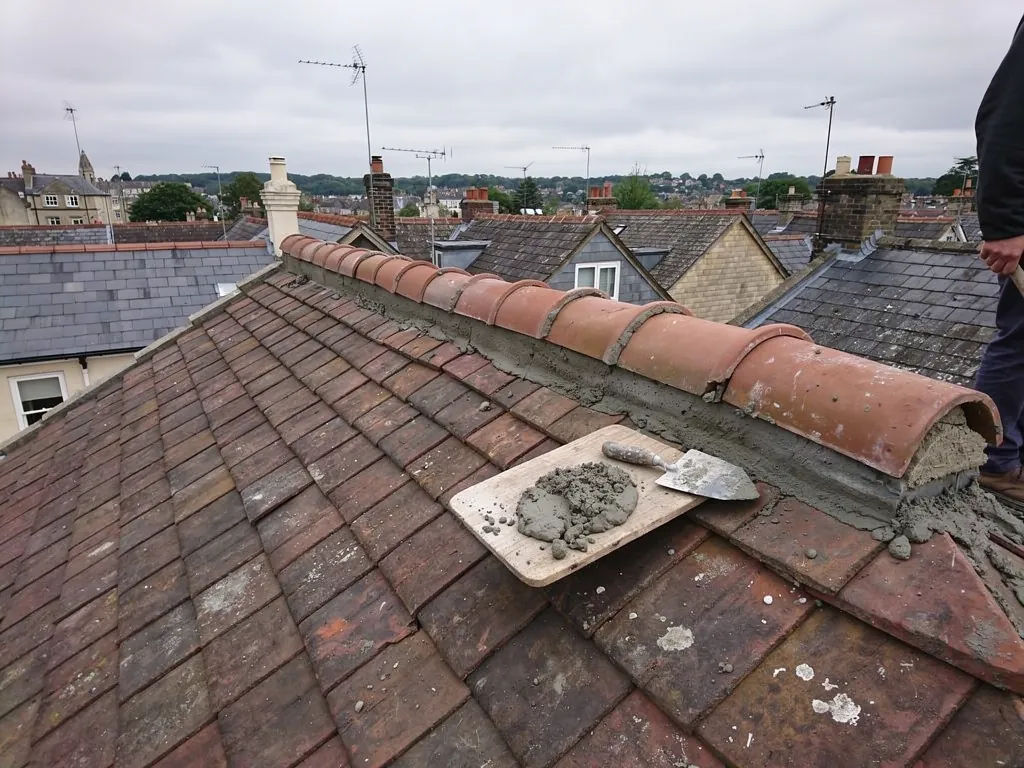
A mortar ridge is built in layers. The ridge tiles are laid along the top of the roof on a bed of mortar, with the joints between them filled and finished by hand. Done properly today, a fixing also goes through or around every tile into a support underneath, so the mortar provides the seal and the finish while the fixing does the holding. Colour pigments can be added to the mortar so it blends with the tiles.
A dry ridge replaces the mortar with a manufactured system. Typically a ridge batten is fixed along the roof, a flexible seal or a roll of vented material runs underneath, and the ridge tiles are clamped down by clips or bolts through the tile into a holding plate. The ends are finished with end caps. Nothing is wet, so the system can be laid in cold or damp weather, and it never has to cure.
Both can be used for hips and, with the right fittings, for verges. The principles are the same, though the parts differ, and our guide to verge repairs shows how the gable-end edge is handled.
Is a dry ridge only for new roofs?
No. Dry systems are routinely fitted to existing roofs when the old ridge is stripped. The only requirement is that the tile profile and the roof pitch suit the manufacturer's parts, and that the batten has something sound to fix to.
Cost compared
Neither method has a fixed price, and the numbers below are national guides, not quotes from us. MyBuilder, in a guide updated on 21 August 2026, lists £200 to £400 to repoint ridge or hip tiles, and £300 to £600 to lift and renew ridge tiles. For dry ridge it quotes £40 to £60 per linear metre, and says a typical job lands between £500 and £1,000. Checkatrade, in its roof repair guide updated in June 2026, lists dry ridge at £50 to £70 a metre and dry hip at £70 to £100 a metre, before VAT.
On those figures a mortar repair is cheaper for a short ridge or a limited fix, while a dry system starts to make sense on cost when a whole ridge needs stripping and relaying, because it avoids the time spent mixing and finishing mortar joint by joint. Cost per metre rises with hips, with awkward junctions, and with any need for scaffold. Whichever method you favour, check whether any quote includes VAT and the scaffold, since either can change the comparison.
| Item | Typical guide figure |
|---|---|
| Re-bed or replace ridge tiles | £300 to £600 |
| Repoint ridge or hip tiles | £200 to £400 |
| Dry ridge, per metre | £40 to £60 (MyBuilder), £50 to £70 before VAT (Checkatrade) |
| Dry hip, per metre | £70 to £100 before VAT |
For a closer look at one side of this comparison, see our guide to rebedding ridge tiles.
Appearance and the look of the roof line
Mortar gives the traditional look: a continuous ridge line with pointed joints, which weathers alongside the roof. On a clay-tiled cottage, or a house inside a conservation area, that look is often part of why the roof appeals. Dry systems leave visible caps and fixing points, and the ridge can read as flatter or more regular, particularly where the tile is a plain concrete profile.
The gap is smaller than it was. Manufacturers offer caps that match common tile colours, and on a modern estate house in concrete tile the two are hard to tell apart from the pavement. On a period building, it can stand out. Listed buildings raise a separate question, because the council may not accept a visible dry cap over a traditional ridge. Our guide to heritage ridges covers when a traditional finish is expected and how it is fixed.
Shape matters here as well. A half-round ridge has a different silhouette from an angled one, and a dry system has to be chosen for the profile you already have. Colour is a practical point too. Mortar can be tinted, but it tends to weather paler than the tiles around it, whereas dry-fix caps are made in fixed colours. Ask for a sample against your own tile in daylight before ordering, and look at it from the pavement rather than from a few feet away, since that is how the roof is seen by everyone else.
Upkeep and how each method ages
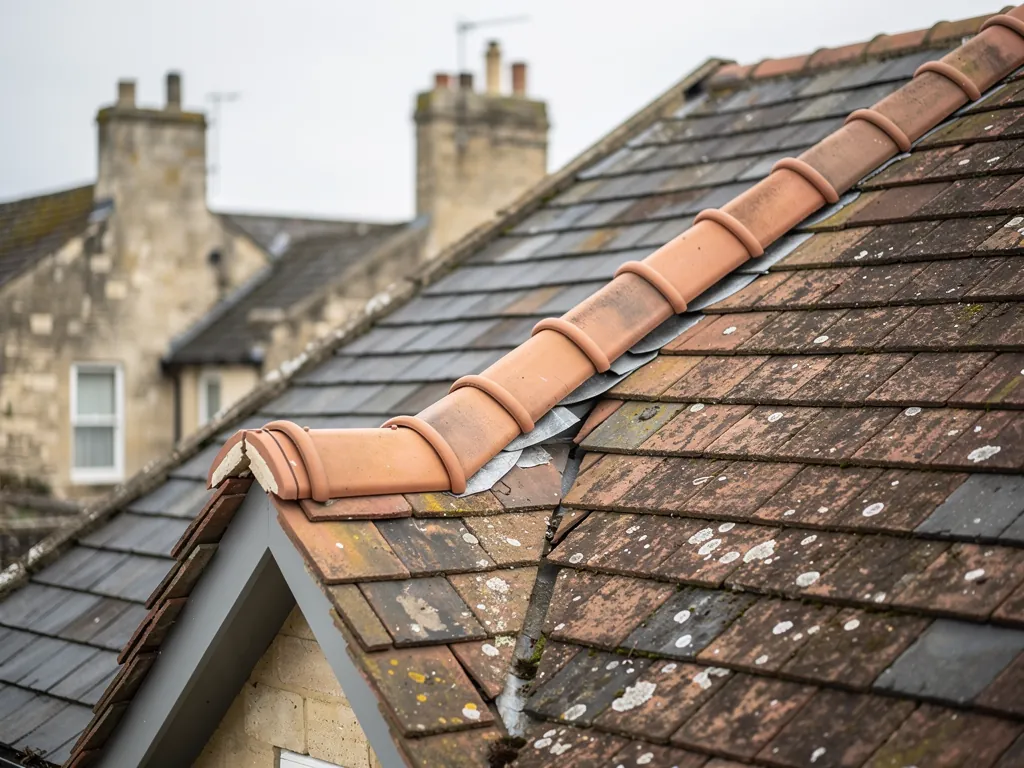
Mortar ages by cracking. Shrinkage, frost, wind-driven rain and movement in the roof gradually open hairline cracks, and eventually small pieces fall away. Repointing is a normal maintenance task, and doing it before the bed has loosened is far cheaper than relaying a whole ridge. Because mortar absorbs water, moss and lichen collect along joints, and a ridge that is left may need cleaning too.
A dry ridge has no mortar to crack, so the usual repointing cycle does not apply. What it needs is a check: the clips, caps and seals should be seated and undamaged, and nothing should be loose after a storm. A glance up from the lawn once or twice a year, plus a check after any severe weather, catches most problems while they are still small. Plastic and rubber parts perish eventually, and a cap that has blown off must be replaced with the right part. Our guide to DIY ridge tiles explains why this is work for a roofer on a ladder and a scaffold, not for a weekend.
Which needs the least looking after?
On a typical modern roof, a dry system usually needs fewer interventions, because there is nothing to repoint. On a historic roof the mortar belongs to the way the building looks, and keeping it pointed comes with owning the house.
Does damp or cold stop the work?
Wet mortar should not be laid in frost, and rain can wash it out before it sets. Dry fixing avoids that restriction, though high winds still stop any work on the ridge.
Standards, ventilation and compliance
BS 5534:2014 is the standard that changed the picture. Marley's reading is that mortar's own tensile strength could not safely be trusted to hold ridge or hip tiles down, so every bedded fitting needs a mechanical fixing alongside it. That applies to both methods in different ways. A mortar ridge needs a fixing added. A dry system is the fixing.
Dry-fix systems are specified in BS 8612:2018, which BSI publishes as the specification for dry-fix systems on ridges, hips and verges under slate or tile. Marley adds that a product has to have passed the tests before it can show compliance, so the product you choose should come with test evidence and the right parts for your tile.
Ventilation is a separate matter. Some dry ridge products incorporate a vent, and some roofs need extra airflow at the ridge, depending on the construction and underlay. Whether yours does is a question for the survey, not for the ridge method. The general rule is that a ridge should never be sealed in a way that closes ventilation the roof relies upon.
Mortar is not banned and dry-fix is not automatically compliant. Compliance comes from the fixing and, for dry systems, from the tested product.
Wind, weather and what goes wrong in each method
Both methods fail in recognisable ways, and knowing them helps you judge a quote. A mortar ridge goes wrong when the bed cracks, when the mix was too strong or too weak for the tile, or when the fixing was left out and the tiles rock in a gale. The signs are open joints, tiles that move under a hand, and pale crumbs on the roof below.
A dry ridge goes wrong when the wrong parts were used for the tile, when a clip or bolt was under-tightened, or when a cap has worked loose. Because the system is mechanical, a failure tends to show as a cap that has blown off or a ridge that rattles, not as a slow crumble. A tested product used as the manufacturer intended copes well with wind, but a mismatched or home-made substitute does not.
Workmanship matters more than the label on the method. A well-bedded mortar ridge with a hidden fixing will outlast a badly fitted dry system, and the reverse is equally true. When you read quotes, look for what is being fixed to what, which fixings are used and what the finish will look like, rather than the headline word.
Is one method safer in high winds?
Neither can be called safer without knowing the roof. The exposure of the site, the pitch, the tile and the quality of the fixing all matter, and we do not make claims about wind performance that the product's own test data does not support. Ask for the data sheet and read it.
How we advise on a Swindon roof
We look at the roof before we look at the method. For a railway terrace or Victorian house in clay or slate with a ridge that is basically sound, we usually propose a lime-rich or pigmented mortar bed with the mechanical fixing hidden underneath, because it keeps the look and the roof's character. For a 1980s or newer estate house in concrete tile, with a ridge that has failed along its length, a dry system is often the better value and the lower maintenance choice.
Mixed answers are common. A house may have a mortar-bedded front hip and a dry rear ridge, or a mortar ridge with dry verges. The test is always whether the method suits that part of the roof and whether the result will be sound after the next hard winter.
What will your ridge quote actually say?
Once we have been up and looked, the quote arrives on paper, with photographs taken of your own ridge, and a plain account of why we lean towards one method. If you ask for the other method, we price that too where it is suitable. Where repointing will cure the fault, the quote is for repointing and not a new ridge.
Ten years of workmanship cover is issued in a document you keep, and we leave the site swept with our rubbish gone. To book a survey, ring 01793 626096 or use WhatsApp or the contact form, and for the wider set of options go back to the ridge, verge and dry-fix page.