
Pricing a dry ridge is mostly arithmetic. The work is charged by the length of ridge, so two figures decide the outcome: the rate per metre, and how many metres your roof has. Everything else, from scaffold to hips to the state of the timber under the old mortar, nudges the total up or down from there.
The rates below come from published UK cost guides and are national typical figures. They are not Skyline prices and they are not an offer. Each is dated, because costs shift, and each is labelled with whether VAT is included. Once we have surveyed the roof, the written quote gives one total price for it. If you are weighing a new dry system against a repair, our page on what ridge repairs cost puts them next to each other, and the wider ridge, verge and dry-fix service page shows the full range of work.
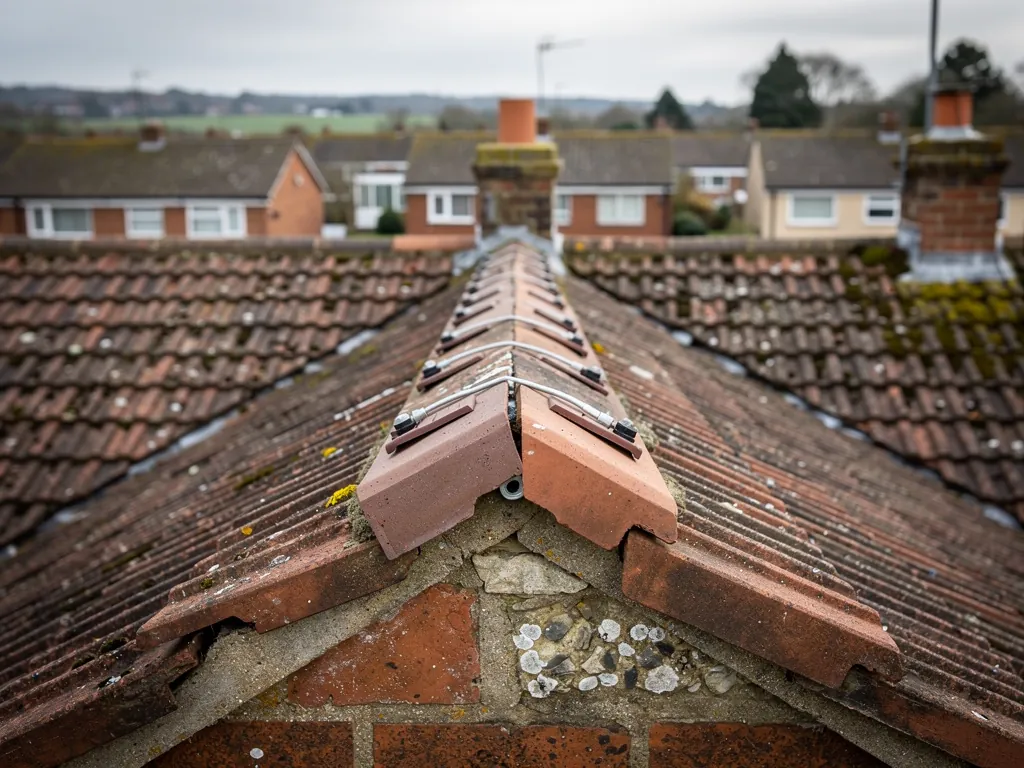
The per-metre rates from published guides
Two national guides give a rate for dry ridge, and they overlap rather than agree exactly, which is normal for cost guides that survey different contractors.
| Source and date | Work | Published figure |
|---|---|---|
| MyBuilder dry ridge guide, updated 21 August 2026 | Dry ridge system | £40 to £60 per linear metre |
| Checkatrade roof repair guide, updated October 2026 (excluding VAT) | Dry ridge | £50 to £70 per metre |
| Checkatrade roof repair guide, updated October 2026 (excluding VAT) | Dry hip | £70 to £100 per metre |
Read together, a sensible planning band for dry ridge is about £40 to £70 per metre, with hips costing more per metre than the ridge itself. The reason hips cost more is that each one has an angled run, a different cut at every tile, and usually a hip iron or end fitting to deal with at the bottom.
Linear metre means a metre along the length of the ridge, not a metre of roof area. That distinction trips people up when they compare a ridge rate with a rate for a flat roof, which is charged per square metre of surface.
Check whether a figure includes VAT. The Checkatrade rates above are quoted without it, while a published total for your own job should say clearly either way.
Prices in these guides also assume a roof in reasonable shape. A ridge that sits on a sound timber line is quick to fit. A ridge that needs the old bed chipped out in heavy lumps, or a batten line re-levelled, takes longer, and the rate moves accordingly.
What a typical whole job comes to
MyBuilder's dry ridge guide says a typical job sits between £500 and £1,000. That is the number most people want, because it takes the per-metre rate and lets it settle against a real roof.
You can test it with simple multiplication. A ridge 8 metres long at £40 to £60 per metre comes to £320 to £480. A ridge 12 metres long at the same rates comes to £480 to £720. Add a pair of hips and an extra day on site and the total moves into the range the guide describes. The sums are only an illustration of how the maths works, because your own ridge length is the first thing we measure.
Why is my bill higher than the rate suggests?
Because the per-metre rate covers the ridge system itself, and a job often includes more than that. Hips, a long run across a double-fronted house, a ridge on an extension or garage, and repairs to the tiles on either side all add to the total. Terraces can also surprise people: a ridge that runs across several houses is long, and each household may be asked to share the cost of the stretch above their roof.
Is a short ridge cheaper in proportion?
Not always. There is a minimum cost to get a crew, a ladder or scaffold and the materials to your door, so a very short ridge can cost more per metre than a long one. The length-based rates work best for typical full-width roofs.
Detached houses with long, uninterrupted ridges tend to give the lowest cost per metre, because the crew settles into a rhythm and the system goes down in one pass. Roofs with steps, dormers or a cross-wing add joints and cuts, so the same length can price higher. This is why a guide figure is a starting point for your thinking and not a number to hold a quote against.
Dry ridge against re-bedding: what the guides say
People often ask whether the dry system is dearer than simply re-bedding the old ridge on fresh mortar. The same guides give figures for the traditional job. In its guide to slate roofs, MyBuilder gives £300 to £600 when ridge tiles are re-bedded or replaced and £200 to £400 for repointing ridge or hip tiles.
Laid out side by side, those headline numbers sit close together, which is why the lowest figure is not always the best value. Repointing is the lightest touch and suits a ridge with sound tiles and joints that have opened. Re-bedding takes the tiles off and relays them. Fitting a dry system replaces the whole arrangement with a batten, fixings and seals, and removes the cement that tends to crack in the first place.
The 2014 revision of BS 5534 also means a modern re-bed should carry mechanical fixings, not just new mortar. We explain that in our guide to BS 5534 and ridge fixing. Once fixings are in, the gap between a re-bed and a dry system narrows, and the deciding factors become the condition of the tiles and the look you want from the ground.
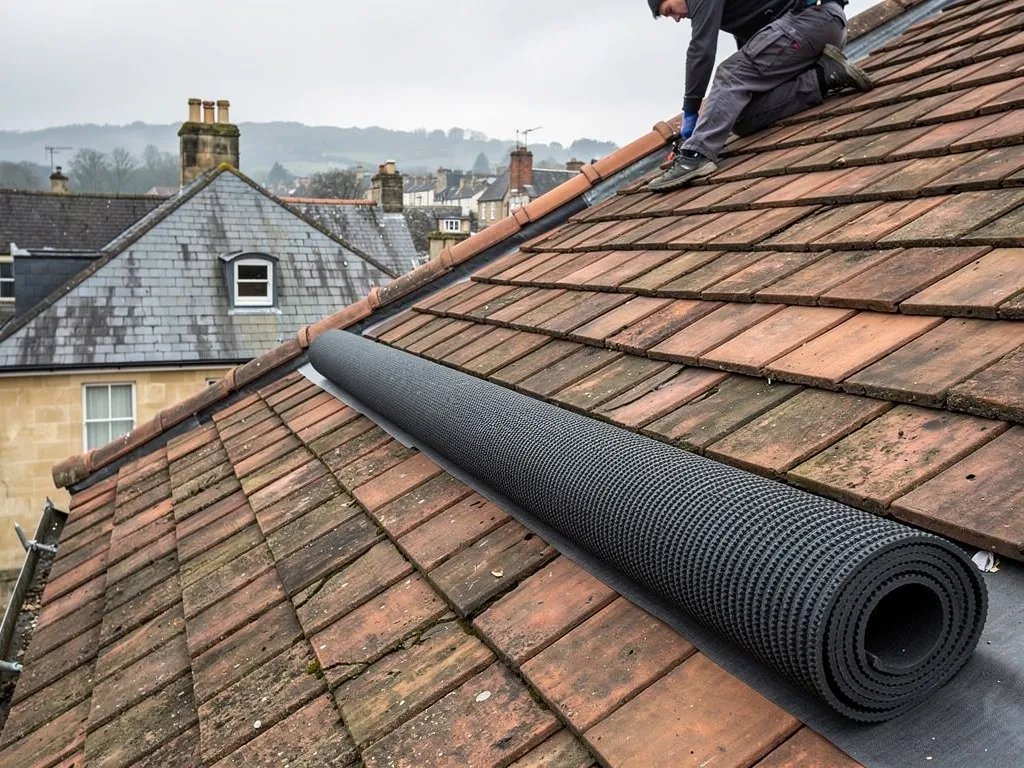
Scaffolding, access and the other extras
The ridge is the highest point on the house, so reaching it safely is part of the price. For a short, simple repair a ladder or a tower may be enough. For a full ridge on a two-storey house, scaffold along the eaves is common, and it can rival the cost of the ridge work itself.
| Item | Published figure | Source |
|---|---|---|
| Standard two-storey scaffold | Around £850 to £1,200 | MyBuilder, updated 21 August 2026 |
| Scaffold for a roof replacement | £700 to £1,300 | Checkatrade, updated October 2026 |
| Chimney scaffold at high level | £400 to £900 | MyBuilder, updated 21 August 2026 |
If scaffold goes up for the ridge, it makes sense to look at what else can be done while it is there: a failing verge, loose hip tiles, a chimney flashing or a run of damaged fascia. Sharing one scaffold across several jobs spreads the cost.
Other things that change a ridge price include the removal and disposal of old mortar and tiles, repairs to the ridge board or timber underneath, replacement ridge tiles where the old ones have cracked, and the type of tile. Ridge tiles for some plain-tile and heritage roofs are made to order and cost more than a standard concrete ridge.
Hips, verges and ends: where a ridge job grows
A ridge rarely stands alone. On a hipped roof it meets the hips at a three-way junction, and every one of those junctions needs its own cut tiles or purpose-made fitting. Gable roofs end instead in a verge, the angled edge above the gable wall, where the ridge finishes against an end cap. Both details cost labour that the plain per-metre rate does not capture.
It is therefore worth asking on the survey what happens at each end of the ridge. A hipped roof with four hips can take much longer than a gabled roof of the same ridge length, and that difference is why the Checkatrade hip rate sits above its ridge rate. If the verges are also loose or the mortar is failing there, doing both together shares the access cost, and our guide to types of dry verge shows what the edge work involves.
Do end caps cost extra?
They are usually part of the system and are included in the quoted system, but ask. Some kits supply them, while others need separate purchases for each gable or hip end. A tile in a colour that does not exactly match the old roof can also mean ordering from a different range.
What changes the price on your own roof
When we survey a ridge, the same handful of questions shape the quote. We note them here so you can see where a quote comes from and why two roofs of the same length can price differently.
- Length and hips: total metres of ridge, plus the number and length of hips.
- Access: whether a ladder is enough, whether the house is detached with room for scaffold, or terraced with a shared ridge.
- Tile type: concrete, clay or slate roofs take different ridge tiles and different fixing details.
- Condition underneath: a sound batten line costs less than one with rotten timbers to cut out.
- Extras alongside: verges, flashings and pointing done in the same visit.
None of these is a surprise charge. Each is something we look at in the survey and photograph, and the quote that follows the survey is a single total for the job as described, with a clear note on whether VAT and scaffold are inside it.
Should I wait for a cold snap to pass before booking?
Ridge repairs in winter are possible, though some tasks depend on dry conditions for the best result. Our guide to ridge repairs in winter covers what can and cannot wait.
Getting a fair comparison between quotes
Two quotes for a dry ridge can differ by a few hundred pounds without either being out of line, so it pays to compare like with like. Start with the basics: is it the same system, and is it a tested product? BS 8612 is the specification that dry-fix systems are tested against, and you can ask for the manufacturer's name and data sheet.
Then check what is in each total. Is VAT in the figure? Is scaffold or a tower? Does it cover the hips as well as the ridge, and removal of the old tiles and mortar? Is the work guaranteed in writing, and for how long? Our own workmanship is covered by a 10-year guarantee on paper.
What should I do with a very low quote?
Ask what has been left out. A ridge that is priced well under the published rates may leave out the hips, or assume that the old timber is fine, or use a system that is not what you were shown.
What if the ridge is leaking?
Then we look at the cause before we price the cure. A damp patch under the ridge can come from a failed bed, a cracked tile or a gap at the end of a hip, and the repair should match. Our page on why ridges leak explains the usual causes. For the parts and the way they fit, see how dry ridge systems work.
One last practical point: ask when the price was given and how long it stands. Tile and fixing costs move, and a figure from the spring may not hold in the autumn.