
The morning after a bad night of wind, the instinct is to get up and look. That instinct is sound, but the safest way to look is from the ground and from inside. Roofs are slippery, wet slates behave like glass, and a surprising number of storm injuries happen to people checking the damage rather than to people sheltering from it.
This guide sets out a sensible order: the garden and the pavement first, then the gutters and the lines of the roof, then the loft, then your phone. It also covers what you can safely write down for your records and the point at which the right move is to stop looking and ring someone. If water is already coming through a ceiling, start with our guide on what to do when a roof leaks (part of our emergency roof repairs section), then come back here.
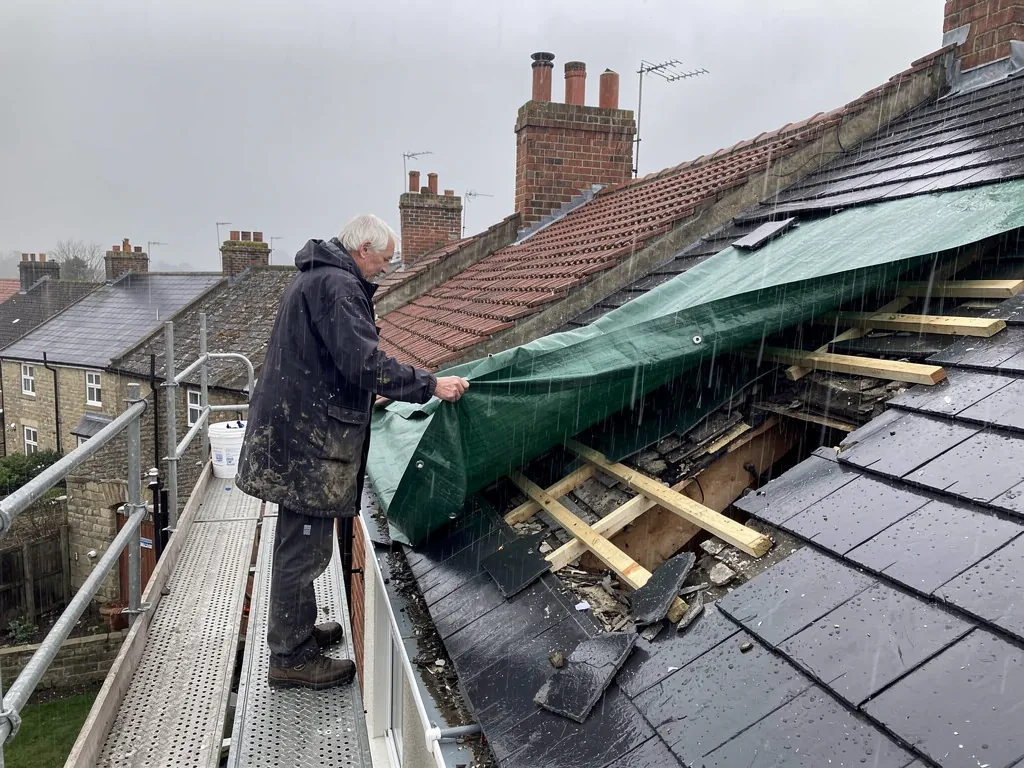
Start on the ground, and stay there
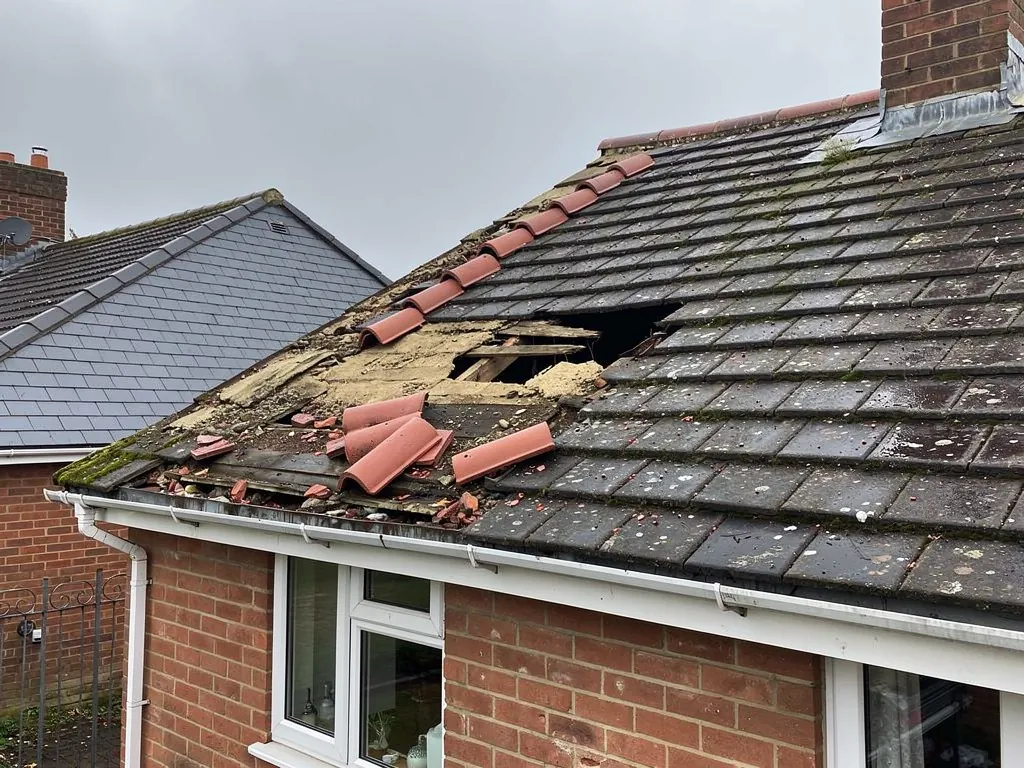
Walk the full outline of the house, side passage and back garden included. You are looking for things that have come off the building and things that have landed on it. Broken pieces of clay or concrete tile, slate fragments, lengths of lead, plastic guttering, ridge sections and chunks of mortar all end up on paths, in flower beds and on the lawn. Each piece tells you roughly where on the roof to look. A scatter of grey slate under the front bedroom window points at the front slope; a pile of red mortar crumbs under a gable end points at the verge.
Check cars, sheds and conservatories as well, and keep children and dogs away from broken glass until it is swept up.
Which direction did the wind come from?
A storm usually arrives from one quarter. Damage tends to cluster at corners, at the ends of the roof and along the top row, because air speeds up there. Start on the side that faced the wind, then do the other.
What should I do about loose items still overhead?
If a tile is hanging by its nibs or a gutter is dangling above the front door, do not stand underneath it to take a photograph. Mark the spot, step back to a safe distance and use your camera zoom. A loose element can drop in the next gust, and a roofer will want to make it safe before anyone uses that door again.
Reading the roof from the pavement
Stand across the road, or at the far end of the garden, and look at the roof as a pattern. A healthy roof covering reads as an even set of lines, with each row of tiles or slates sitting parallel to the one below. Storm damage breaks that pattern. Look for a dark rectangle where a slate has gone and the underlay is showing, a tile that sits proud of its neighbours, a row that has shifted sideways, or a line of lifted edges along a verge.
Binoculars are the best tool most households already own. With them you can check the ridge for gaps between the caps, the hips for displaced pieces, and the chimney stack for missing pots or a cracked cement cap, which roofers call flaunching. The flashing around the stack, the lead strip dressed into the brickwork above the slope, should lie flat against the masonry. If it has lifted at a corner, that is a path for rain even if nothing else looks wrong.
Notice the shape of the roofline, not only the covering. A dip in the ridge, a bowed verge or a wavy slope suggests something has moved underneath, and that is a structural question for a roofer.
Gutters, downpipes and the roofline
The edge of the roof takes a beating in high wind, and it is easy to check. Look at the fascia boards, which run along the bottom of the slope and carry the gutter, and at the soffits, the boards under the overhang. Fascias that have pulled away from the rafters leave a gap at the eaves where rain and birds can get in. Gutters knocked out of line stop draining and spill water down the wall below.
Gutter brackets are fixed to the fascia, and in older houses those fixings may have been tired already. A section of gutter that sags in the middle, or has dropped at one end, is often a sign that a bracket has let go. Look at the joints between sections and at the corners, where plastic is under most strain.
Down at the base of each downpipe, look at the gully for tile fragments and moss. A choked outlet will back water up the pipe and out through the joints, which can look like a roof leak from the inside of a wall. If the water marks on your wall run in a straight vertical line below a joint, the cause is probably the gutter, not the roof. Our guide on the kinds of storm damage a roof can suffer describes how the different failures present themselves, and lets you compare what you can see with what a roofer would expect.
Going into the loft with a torch
The loft tells you what the outside cannot. Go up with a bright torch, and switch the lights off if you can do so safely, so that any chink of daylight shows. Stand on the boarded area or on the joists, never on the plasterboard between them, and take your time. If the loft is not boarded and you cannot see where you are putting your feet, leave it for a roofer.
Chinks of light between the tiles or slates are the first thing to look for. Under a sound covering, with an intact underlay, you should see none or very little. Light showing through at a slope usually means a slate or tile has gone. Then check the underlay and timbers for damp patches. Fresh water looks dark and glistens, and it often drips from the lowest point of a stain. Older marks are dull, pale or ringed like a tide line.
Is the insulation wet?
Squeeze a handful of insulation and check whether it is cold and heavy. Sodden insulation loses its value and holds water against the ceiling below, so it is worth recording even if the ceiling looks fine. Our guide to drying out after a leak covers what to do once you find it.
Have I got daylight where the chimney passes through?
The area around a chimney breast is a regular trouble spot. Look for staining on the brickwork inside the loft and for light at the junction between the stack and the roof timbers. A gap here points back to the flashing you looked at from outside.
If you can see water near light fittings, wiring or the consumer unit, do not touch anything. Read our guide to a leak near electrics before going any further.
Photographs and notes for your records
Photographs cost nothing, and they are useful whatever happens next. A set of clear pictures lets a roofer give a better idea of the job when you phone, and they are a record of the condition of the property on the day, which matters if you later talk to an insurer. Take them before anything is moved, swept up or patched, and keep the originals on your phone with their date stamps intact.
Work from wide to close. Begin with the whole front of the house, then each elevation, then the damaged area, then a close-up. Put a familiar object in the frame, such as a glove or a tape measure, to give a sense of scale. Photograph fallen debris where it landed before you clear it, and photograph the wet patches in the loft with the torch on, from a few feet away. A short video that pans slowly along the roofline and into the loft is easy to share on WhatsApp.
What should I write down?
Note the date and the approximate time the storm peaked, which way the wind was blowing, when you first noticed the damage and where. Write down anything you did, such as placing a bucket or moving furniture. Keep receipts for any emergency costs. ABI advice issued for Storm Eunice in 2022 was to ring your insurer early, to arrange temporary repairs only where they stop the damage getting worse, and to speak to the insurer before doing so. It also said to keep receipts.
What not to do while you are checking
Do not climb on the roof. Do not lean a ladder against the gutter, which is not designed to take your weight, and do not lean out of a dormer window to reach slates. A wet roof after a storm is at its most dangerous, and a fall from even a single-storey extension can cause serious injury. Binoculars and a camera zoom are enough for a homeowner.
Do not push displaced tiles back into place. They may be cracked, and the underlay beneath may be torn. Pushing them back hides the evidence and can trap water.
Do not seal a suspect area with silicone or builders' foam from a tube. It looks like a repair, but it sticks poorly to dust and damp, fails within weeks, and a roofer then has to scrape it away before the real repair. If water is coming in and you need to slow it down, our page on temporary roof repairs explains what a temporary cover involves and why a roofer fits it from safe access.
Is it safe to use a room with a wet ceiling?
Keep out of a room where the ceiling is bulging, sagging or dripping heavily, and turn off the lights in it at the switch if you can reach the switch without standing under the wet patch. Plaster full of water is heavy, and a ceiling in that state can drop with no warning.
When to call a roofer, and what to tell them
Some findings do not need a hurry, and some do. A single missing ridge cap on a dry, calm day is a job for the next available survey slot. Water coming through a ceiling, a sagging roof line, a chimney that has moved, slates sliding in a sheet or a tree resting on the roof are different, and call for a prompt phone call. Where a tree has come down, read our guide to a fallen tree on a roof first, because there is an order to follow.
When you ring Skyline on 01793 626096, or send a message on WhatsApp, have your pictures ready. Mention how old the house is, what the covering is if you know it (slate, concrete tile, clay tile or a flat roof), which elevation seems to be affected, and whether water is entering. When a roof is letting water in, stopping that comes ahead of everything else on our list. Sometimes that means a temporary cover now and the lasting repair booked in afterwards.
You get the survey pictures and the written quote together. A storm that cost you three slates should lead to a three-slate repair, not a sales pitch for a new roof. The repair itself comes with a ten-year workmanship guarantee on paper, and the site is left tidy.
What if I am not sure the damage is from the storm?
Roofs wear out as well as break, and a storm often finds a weakness that was already there. A roofer can usually tell the difference by looking at the surfaces of a break and the state of the surrounding material. That distinction matters to insurers, and we describe it in a separate guide, so photograph everything and let the survey decide what is fresh and what is old.