
A leak rarely picks a convenient moment. It tends to show itself at night, in a storm, or just as you are about to go out. The first few minutes matter, but not because speed beats care. The order of your actions matters more, because the worst outcomes from a roof leak are an electric shock, a collapsed ceiling and a fall from a ladder, and every one of them is avoidable.
This guide is about immediate actions only. It does not try to find the leak or explain what caused it; for that, see our guide to checks to make after a storm. Here the aim is simpler: keep everyone safe, limit the damage inside the house, record what has happened, and get the right person to look at the roof. The sections follow the order in which you will need them.
First, make the room safe
Before you think about the roof, look at what the water is touching. Water and mains electricity are a dangerous pair, and a leak often drips onto or runs through light fittings, ceiling roses, extractor fans, smoke alarms wired into the mains and sockets in the wall below.
What if water is near lights or sockets?
Do not touch wet switches, sockets or fittings. If you can reach the consumer unit without walking through water, switch off the circuit for that room, or the whole supply if you are unsure which circuit is affected. If the consumer unit is in the wet area, or you cannot get to it safely, leave it and call an electrician or your electricity network operator for advice. Keep children and pets out of the room. Do not use that room's lights, and use a torch instead.
Once the power is off, leave the fittings alone until an electrician has checked them. A fitting that has been wet inside can look fine and still be live or faulty when switched back on. Our guide to a roof leak near electrics goes into this in more detail.
What about a ceiling that is bulging?
A ceiling that has swelled or sagged is holding a large amount of water, and plasterboard that is saturated can fall without warning. Stay out from underneath it and move furniture and people away. If it is bulging, many people are told to pierce it at the lowest point to let the water out in a controlled way: put a bucket underneath, stand to the side and make a small hole with a screwdriver or similar tool on a long handle. Do this only if you can do it without standing under the bulge, and not near any lights or wiring. If you are unsure, leave it and keep the room shut off.
Contain the water inside the house
With the room safe, your job is to stop the water spreading. A few minutes spent here can save a carpet, a bed or a ceiling in the room below.
Where should the buckets go?
Put a bucket, washing-up bowl or large tub under each drip. If the drip is fast, lay a towel or folded sheet in the base so it does not splash, and empty the container before it fills, because a full bucket is heavy and tips easily. If water is running down a wall rather than dripping, a plastic sheet taped along the skirting, with the lower edge in a bowl, will lead it away from the floor.
What should I move?
Lift furniture, rugs, electronics, books and clothing out of the affected area. If you cannot move something heavy, cover it with a plastic sheet. Roll back carpet near the wet patch if the underlay is soaking, so it can begin to dry from above and below. Do not use a wet and dry vacuum or any mains appliance on a wet floor until the circuit has been checked.
Is there anything in the loft I should do?
If you can reach the loft hatch safely and there is no active water near wiring, a look inside may show where the water is arriving and how far it has spread. Place a bucket on the joists beneath a drip, and spread a board or plank across the joists rather than stepping between them, since a ceiling will not support your weight. Do not stay in a dark loft with a fast drip. A torch is safer than a switch.
What not to do: climbing on the roof
The urge to get up and fix it yourself is natural, and it is the single most dangerous response to a leaking roof. A roof is slippery when wet, a ladder in wind and rain can slide, and tiles or slates that look fine can be cracked underneath and give way under your weight. Falls from ladders and roofs cause serious injury every year, and the damage to the house is not worth that risk.
What about sealant, tape or a sheet from a ladder?
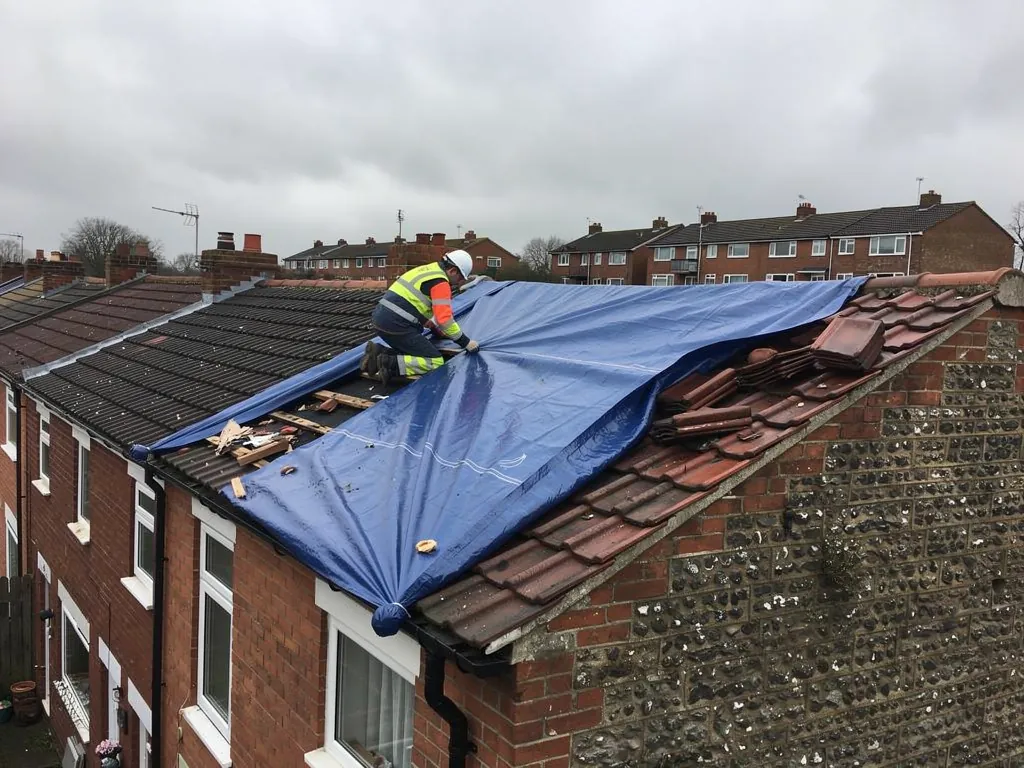
Resist the temptation to smear sealant or stick tape over where you think the hole is. In wet weather it will not bond, you cannot see the real fault from a ladder, and whatever you smear on has to be scraped away before a proper repair can start. A tarpaulin over a damaged slope is a job for someone with the equipment and the training to work at height, because it has to be fixed under the covering at the top and weighted or battened securely. Our guide to temporary roof repairs shows what a temporary cover involves.
Is it ever fine to look from the ground?
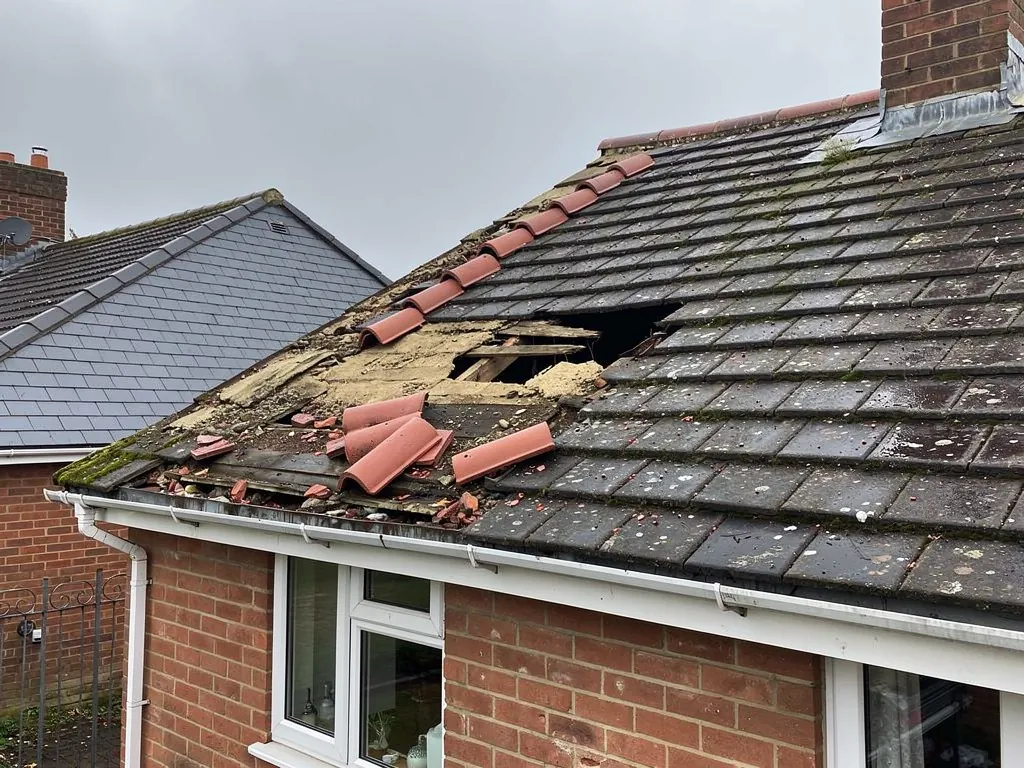
Yes. Standing back from the house on firm ground, perhaps with binoculars, you can often see a patch where tiles have slipped, a section of ridge that has shifted or a chimney flashing hanging loose. Photograph what you see. Do not climb onto an extension or garage roof to get a better angle, and do not lean a ladder against guttering, which is not built to carry your weight.
If you see tiles or slates sliding or hanging, keep people away from the area below, including the path and the front door, until they have been dealt with.
Record the damage before anything changes
Even if you do not plan to claim, a record is useful. It helps whoever visits understand the problem, and if you do claim, insurers want to see the damage as it was. Take photographs and short videos as soon as it is safe to do so, before you move things or mop up, and write a few notes while the details are fresh.
What should the photographs show?
Take a wide shot of each affected room, then close-ups of the stain, the drip and any damage to the ceiling, wall or floor. Photograph any items that have been ruined. From the outside and from the ground, photograph the roof, the gutters and any debris in the garden such as slipped tiles. Most phones record the date automatically.
What should I write down?
- The date and time you first noticed the leak.
- The conditions outside, and whether the leak came and went with the rain or ran continuously.
- Which rooms are affected and how the water is moving.
- What you did to stop it, with the time.
- The names of anyone you phoned, such as an electrician, and what they advised.
If you think the cause is a storm, tell your insurer early and ask what it needs from you. We cover the paperwork in our guide to storm damage and insurance claims. Keep any receipts for buckets, dehumidifier hire or emergency work, since an insurer may want to see them.
Who to call, and in what order
There are up to four phone calls to consider, and the order depends on what is happening in your house.
Which call comes first?
If anyone is hurt, or there is a smell of burning or visible sparking, call 999. If water is near the electrics and you cannot isolate the supply, call an electrician or your electricity network operator. If water is entering in quantity and a ceiling looks ready to fall, get everyone out of that room first and then call.
For the roof itself, call a roofer. The number to ring is 01793 626096, though a WhatsApp message or a note through the contact page also reaches us. Water getting in is a priority for us, and stopping it comes first. That holding job is separate from the permanent repair, which comes later.
What should I tell the roofer?
Describe where the water is showing, what kind of roof you have, and when it started. If you can say whether it is a flat roof, a pitched tiled roof or a slate roof, that helps. Send your photographs. Mention anything that hints at a cause, such as a tile in the garden, a fallen branch or an overflowing gutter.
Should I ring the insurer too?
If the damage looks significant, yes, and early. ABI advice from Storm Eunice in 2022 told policyholders to get in touch with the insurer early, check with it before booking temporary emergency repairs, and hold on to every receipt. Our guide to emergency roof repair costs explains what shapes the price of the work.
What the roofer will do when they arrive
Knowing what to expect makes the visit easier. A roofer called to a leak will first look at the damage inside, then at the roof from outside. The first aim is a dry house. The second is to work out what has failed and what the lasting repair is.
Will it be fixed that day?
Sometimes a quick job is all that is needed, such as replacing a slipped tile or refixing a loose section of flashing. Sometimes the right first step is a temporary cover, because the weather is too bad to work safely, or because the fault needs a repair that cannot be done in the rain. We say which it is and why. For missing or lifted coverings, see our page on tiles blown off in a storm.
What do I get on paper?
Afterwards a quote arrives in writing, backed by photographs of what we found on your roof. We would rather cure the fault than sell a bigger job, so a loose tile does not become a new roof. Our workmanship is guaranteed in writing for 10 years, and the site is left clear of waste.
If the leak turns out to be one of several signs of storm damage, the guide to types of storm damage to a roof shows what else to look for. For everything under this heading, visit our emergency roof repairs hub.
After the leak is stopped
When the water has stopped coming in, the house still needs attention. Wet plasterboard, insulation and timber do not dry on their own in a closed, cold house. Open windows when the weather allows, keep heating on low and steady, and use a dehumidifier if you have one. Remove saturated insulation from the loft floor only when it is safe to do so.
Watch for signs that the damage is continuing. Stains that spread after the rain has stopped, a musty smell, mould appearing in a corner or paint bubbling all mean there is still moisture in the structure. A small leak left damp can rot a rafter or the end of a joist over time, which turns a modest repair into a larger one.
Do not rush to redecorate. Paint over damp plaster blisters and fails. Wait until the area has dried fully and the repair has been tested through a spell of wet weather.
If you are reading this before a leak, know where your consumer unit and stopcock are, keep a torch and a few buckets together, and check the roof from the ground each season. Our guide to preparing a roof for storm season is a good place to start.