
Storm repairs are expensive mainly because they arrive at the wrong time: in the dark, in the wet, with water already coming through a ceiling. Most of that can be avoided by checking the parts of a roof that fail first, while the weather is still kind and nothing is urgent.
The list is short. The ridge and the verges, because they stand highest and take the wind. Flashings, because one lifted corner lets rain behind the metal. Trees close to the house, because limbs fail in gales. Gutters and downpipes, because an overflow can soak the wall beneath the roof edge. And the loft, where early warning signs show up long before a ceiling does. None of it needs you to climb a ladder. Most of it can be done from the ground, with binoculars and a phone camera, and the photographs are useful later if you ever have to explain what condition the roof was in. The wider emergency roof repairs page explains what happens if a storm gets there first.
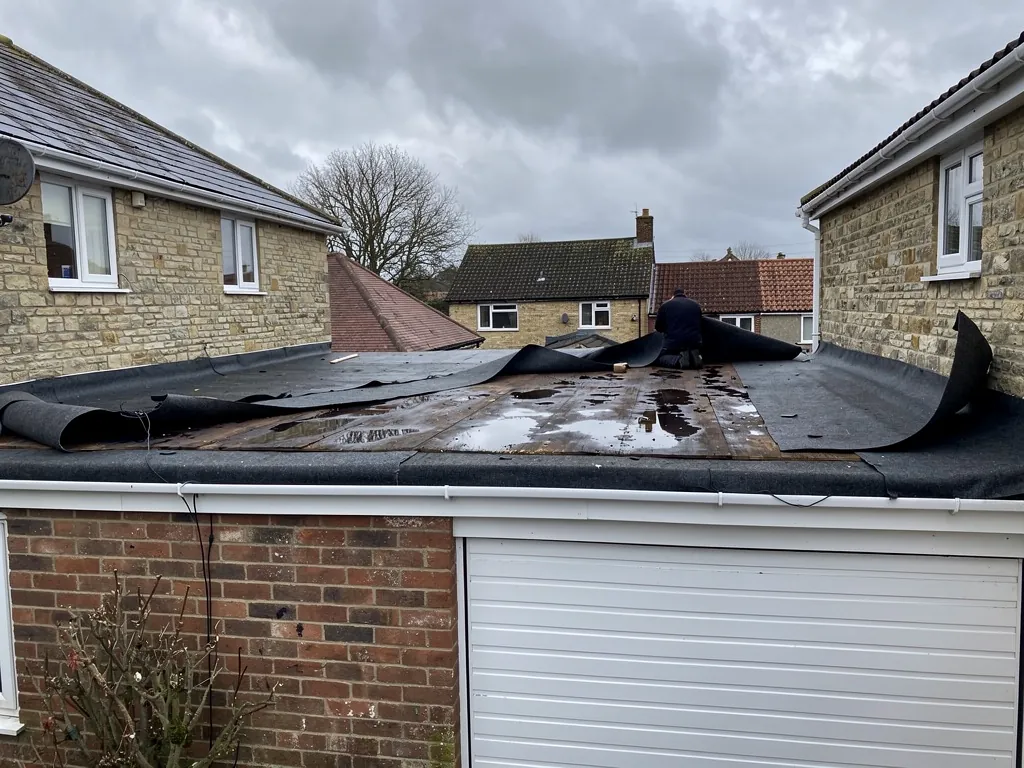
Start from the ground with binoculars
A slow walk round the house on a dry, bright morning tells you more than most people expect. Step back until a whole slope fits in view, then look for anything that breaks the pattern: a tile sitting proud of its neighbours, a slate that has slid a finger's width, a gap, a dark patch where a tile has gone. Binoculars bring the ridge and chimney into focus without leaving the lawn.
Check the ground too. Pieces of mortar, small shards of tile or moss in the borders and on paths often mean something above is breaking up. Look down the sides of the house where the gutters discharge, and glance at the soffit boards under the eaves for sagging, staining or gaps.
If you have a neighbour with a better view of the back of the house, ask them to glance up too. Roofs on terraces and semis are often easier to see from next door's garden or from the street behind, and a second pair of eyes spots a missing slate that you have stopped noticing.
What to photograph
Take dated photographs of each slope, the ridge line, the chimney and each gable end. They give you a baseline: if a storm damages the roof, you can show what it looked like in September, and a roofer can see what has changed. Keep them with the date in the file name.
Stay off the roof and off the ladder if the ground is soft or you are not confident. A roof inspection from the ground costs nothing and a fall costs a great deal.
Ridges, hips and verges: the first to go
Along the apex sits the ridge. Where a hipped roof slopes in at its corners, the hips run down them, and at each gable the verge finishes the slope. Their height makes them the roof's most exposed parts, and on many older houses they are held by mortar that went on long ago and has been weathering since. The 2014 revision of BS 5534 expects mechanical fixings as well as bedding, so a house older than that is the likeliest to have a ridge that depends on mortar alone.
From the ground, look for ridge tiles that are not in a straight line, cracked or missing mortar joints between them, and a pale line where bedding has fallen out. At a gable end, the verge tiles should sit evenly and the mortar beneath them should be continuous. Crumbling pointing there lets wind in under the tiles.
Re-bed or go dry?
Where the bedding has gone, you can lift and relay the tiles on fresh mortar with mechanical fixings added, or move to a dry-fix system built to BS 8612, which grips the tiles with clips and a flexible seal. Both work. A dry system suits roofs where the mortar has failed repeatedly, and re-bedding often suits traditional ridges that should keep their look. Our mortar against dry-fix comparison weighs them up.
Doing this in autumn, before the wind picks up, means the repair is planned rather than rushed. MyBuilder's slate roof guide (updated 21 August 2026) gives £300 to £600 as a national range for re-bedding ridge tiles; the price for your own roof follows the survey and arrives in the written quote.
Flashings and the joints around chimneys
Lead strips called flashings seal the places where a roof butts against a chimney, a wall or a dormer. They fail quietly. A small gap admits a little water, and the timbers below can absorb it all winter before a stain appears. Storm season is when a loose corner turns into a missing flashing.
Look at each chimney stack from the garden. The lead around its base should lie flat and tight with no gaps along the top edge, and the mortar line where it enters the brickwork should be intact. Staining on the chimney breast inside, particularly after rain, points to the same area. Cracks in the sloping mortar cap around the chimney pots, called flaunching, deserve attention too, since water that gets through them soaks the stack from the top.
What counts as worth acting on?
Lead that has lifted, split along a fold or pulled out of the wall joint should be refixed before a gale gets underneath it. Sealant smeared over a cracked flashing is not a repair. It sometimes buys a few weeks, and it also disguises the fault. More on the chimney end of this is in our chimney repairs pages.
Rooflights and roof windows have their own flashing kit, and the same rule applies: check that the frame sits tight and that nothing has lifted at the corners.
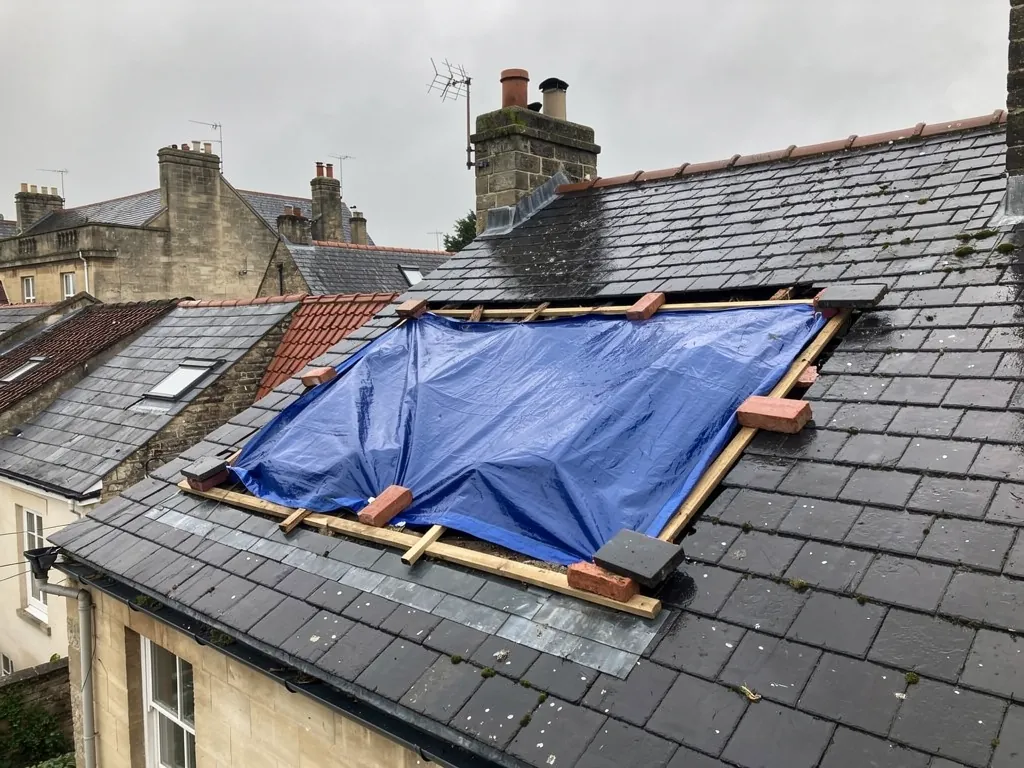
Trees, branches and what is overhead
Trees near a house cause two separate problems in a gale. The obvious one is a limb or the whole tree coming down. The less obvious one is constant contact: branches that brush a roof in every wind wear tiles and fill gutters with leaves, moss spores and twigs all year.
Walk round and look up. Dead wood in the crown, a branch that has already cracked, a tree that leans further than it did last year or a fresh gap in the soil at its base all warrant a tree surgeon's opinion before winter. If the tree is not yours, tell the owner in writing. If it is protected by a tree preservation order or stands in a conservation area, the council needs to be told before work starts, so ask the planning department at your own council first.
Clearing branches from the roof line
As a general rule, a gap of a metre or so between branches and the roof surface stops most abrasion and gives a branch room to flex in the wind. Overhanging limbs are best cut back by a professional who can lower them safely, and never by someone standing on the roof.
Other things that become missiles
Garden furniture, trampolines, sheds that are not fixed down and loose fence panels travel in strong wind, and they end up on conservatory roofs, lean-tos and pitched slopes alike. Moving or anchoring them takes ten minutes and may save a roof repair. If a tree does come down on the house, our guide to a fallen tree on a roof sets out what happens next.
Gutters, downpipes and the roofline
Gutters seem like a separate subject, but a blocked one makes a storm worse. Rain that cannot get away pours over the front edge or backs up behind it, where it soaks the fascia, the rafter ends and the top of the wall. In a heavy downpour, a gutter full of leaves is a more likely cause of a stain on an upstairs wall than a hole in the tiles, and the two are easy to confuse.
Clear gutters and hoppers once leaves have fallen, and check that each run falls gently towards its outlet. Makers of gutter systems suggest a gentle fall to the outlet, somewhere between 1:600 and 1:350 depending on the product. A gutter that holds standing water has dropped at a bracket or sagged between supports. Look for staining below the joints, a sign that a seal has failed, and for brackets that have pulled out of rotten fascia.
Fascias and soffits
Boards along the eaves hold the gutters up and shut the gap beneath the tiles. If they are soft, split or lifting, a gale will find them. They also keep birds and wasps out of the roof space. Whoever clears the gutters is the only person who gets near the fascia, so ask them to report on its condition.
If you cannot tell whether a wet patch is coming from the gutter or from the roof, our guide to a gutter or roof leak helps separate them.
A look in the loft
The loft is where a roof tells the truth. In daylight, with a torch in hand, look for pinpricks of light through the covering, brown tide marks on the underlay or boards, damp insulation, and drips on the timbers. Small signs found now are a slow job. The same signs found after a storm are an urgent one.
Pay attention to smell and to wood. A musty smell, white fungal threads or soft timber suggest moisture has been getting in for some time, and that is a conversation for a roofer before winter. Check the water tank and pipes while you are there. Loose or fallen insulation, which wind can drive in through gaps, is worth putting back so the ceilings below stay warm and dry.
Condensation or leak?
Damp patches in cold, dry weather often mean condensation from warm indoor air meeting a cold roof, not a leak. A roof that can breathe helps; blocked eaves ventilation does not. Do not stuff insulation tight into the eaves, since that stops air moving over the underlay.
If water has already come in
Dry the area quickly, because timbers and insulation that stay wet invite rot. Our page on drying out after a roof leak covers how.
Keeping records and knowing your policy
Prevention also helps if you ever need to claim. The Financial Ombudsman Service notes that policies commonly carve out gradual deterioration and wear. It is unlikely to side with a policyholder who let a worn roof go on deteriorating, or whose storm merely revealed a fault that was there anyway. Which? made the same point in November 2025: an ordinary policy may refuse a claim where rain came in through a badly maintained roof.
That is not a reason to worry; it is a reason to keep records. Dated photographs, receipts for maintenance and a note of when the roof was last checked all show that you looked after the building. Read your policy now, in the calm, and check what it says about storms, who to contact and whether you must tell the insurer before emergency repairs.
What our survey adds
A written survey with photographs of your roof gives you an independent record of its condition. We cannot promise how any insurer will respond to a claim, and we do not handle claims. Our pages on wear and tear in roof claims, loss adjusters and what to do if a claim is rejected explain how the process usually runs.