
A roof claim usually turns on one question: did something sudden happen, or was the roof already failing? Insurers pay for the first and commonly decline the second. A gale that tears a ridge off is damage. A slate that has slowly slipped for years because its nails rusted is deterioration. In real life the two blur, because a storm often finishes off something that was already weak.
That blur is where disputes begin. This guide explains how insurers usually apply the clauses that rule out ageing and slow decay, what the Financial Ombudsman Service looks at when a claim is refused, what Which? and Financial Conduct Authority figures show about storm claims, and how maintenance records can help you. Claims are the insurer's business, not ours, and nobody outside the insurer can say how a given claim will go. What we can do is explain how a roof ages, so you know what a surveyor is likely to see. If the weather has just done damage, read about emergency roof repairs first and come back to this once the roof is safe.
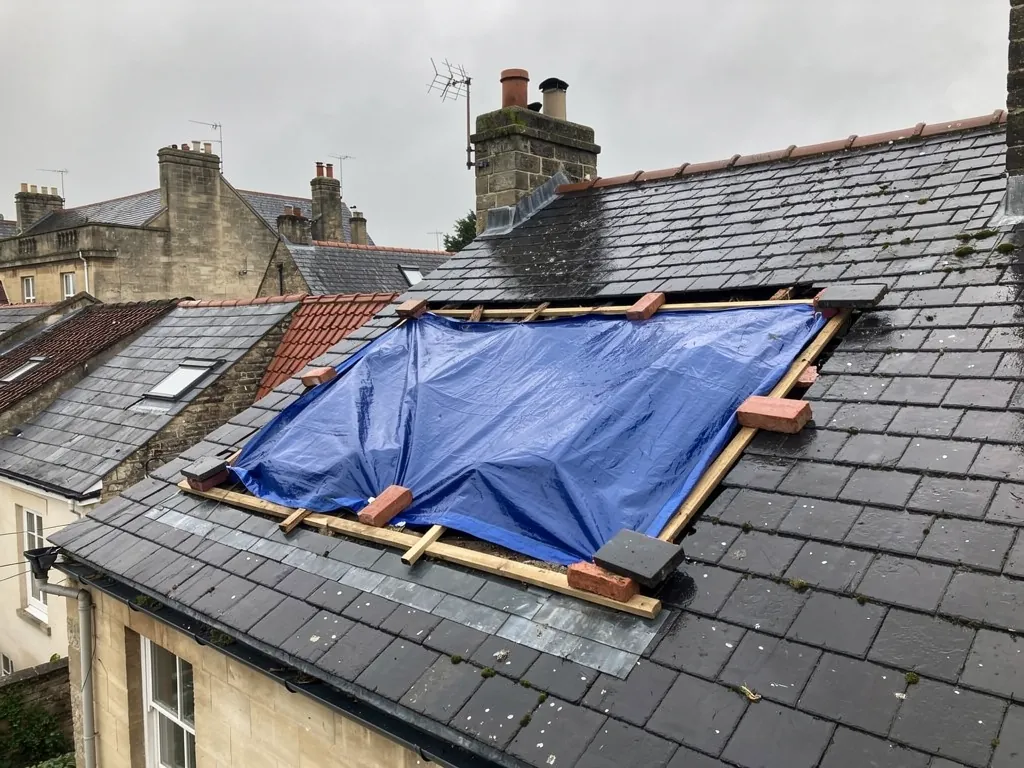
What the exclusions usually say
Policies differ, so the wording of yours matters more than any general summary. But most standard buildings policies share a pattern. They cover named perils, storm among them, and they carve out damage caused by wear and tear, gradual deterioration, lack of maintenance and faulty workmanship. The aim is to treat insurance as protection against events, not as a maintenance fund.
The Financial Ombudsman Service puts it plainly: exclusions for gradual damage and wear and tear are a common feature of these policies. Where an insurer relies on an exclusion, it is for the insurer to show that the exclusion applies. That is a useful principle to know, though it does not mean every refusal can be overturned.
What counts as gradual damage?
Anything that develops over a long period rather than at a moment. Nail sickness in a slate roof, mortar that has crumbled away from a ridge over many winters, lead that has fatigued and split, felt that has crazed and blistered in the sun, a gutter that has rusted through. Each of those might leak in a storm, and each may still be classed as deterioration.
What about a storm that exposes it?
That is the hard case. The Ombudsman has said a complaint is unlikely to succeed if the roof was in a bad way already and the owner knew it, or if the weather merely brought an old fault to light. A claim that rests on a storm having been the main cause stands a better chance than one where the roof would probably have failed anyway.
How the Ombudsman looks at a storm claim
If an insurer turns a claim down and you complain, you start with the insurer itself. If the insurer has not sent a final response after eight weeks, or its answer does not satisfy you, the complaint can go to the Ombudsman. Its published approach to storm damage asks three questions. Did a storm actually occur when the damage happened? Is the damage consistent with what we generally see as storm damage? And were storm conditions the main cause of the damage, or might it have happened anyway?
Each question is worth thinking about before a claim, because the evidence you can gather is different for each. The date and strength of the weather are public record. The pattern of damage is something a photograph and a survey can show. The question of the main cause is where the state of the roof comes in.
Why does the definition of a storm matter?
Which? reported in November 2025 that insurers often use the industry definition of a storm, one element of which is wind gusts of at least 55mph. A policy may therefore ask whether conditions met a threshold on the day. If you are unsure how your own policy defines it, the wording is usually in the definitions section, and our guide to how insurers define a storm goes through it.
None of this means a claim will or will not succeed. It means a claim stands or falls on facts, and facts are easier to show when you have them to hand.
What the Which? and FCA figures show
The same Which? article, published on 20 November 2025, carried figures from the FCA showing that only 32% of storm-related claims made in 2024 resulted in a payout. It also gave a typical example of a claim that standard policies may not cover: water entering a home through a poorly maintained roof.
Those figures need careful reading. They count claims, not roofs, and they do not say why each one was unsuccessful. Some were declined under an exclusion, some may have fallen below the excess, some may have been withdrawn, and some may have been for damage that was not storm damage at all. They do not tell you how your claim will fare. What they do show is that storm claims are by no means automatic, which is a good reason to understand the exclusions before you rely on cover.
What do you do with that information?
Use it as a prompt to act before winter. A roof that is in sound condition and has been looked after is in a stronger position than one with a known fault left alone. Our guide to preparing a roof for storm season lists the checks that reduce both the risk of damage and the risk of an argument about it.
Do not treat a refusal as the last word. Ask the insurer to put its reasons in writing, naming the exclusion it relies on.
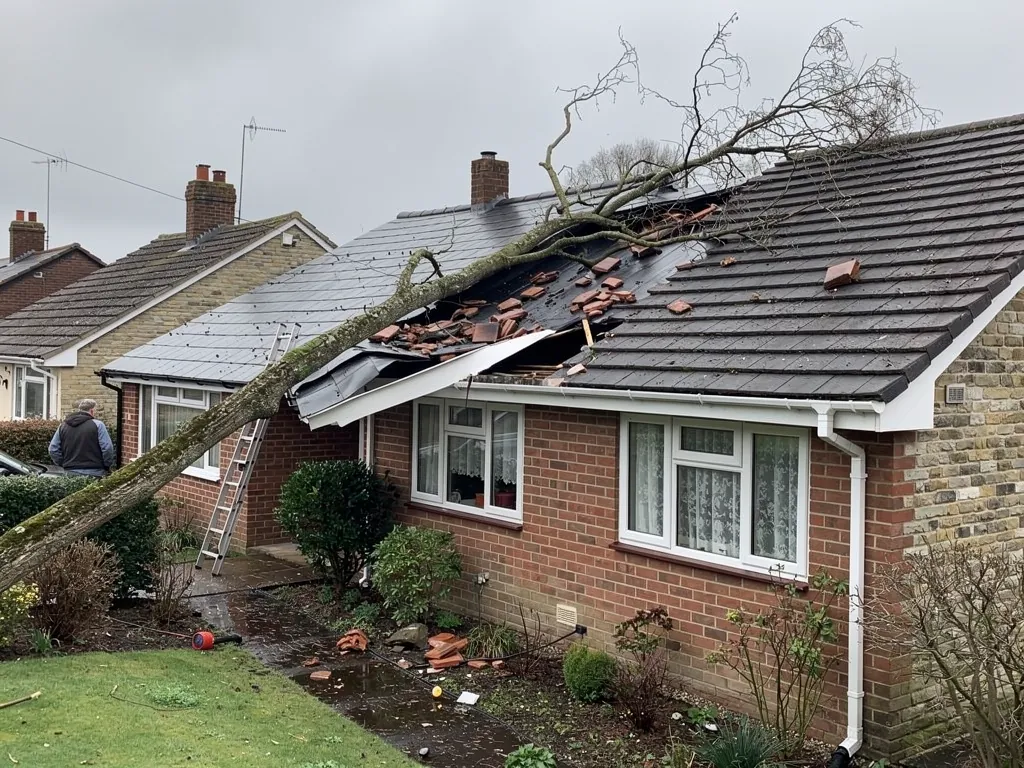
How a roof ages, and what a surveyor sees
Knowing what deterioration looks like helps you tell it apart from damage. Slate and tile roofs show their age in a few recognisable ways. Slate nails corrode and slates slide out in lines along a course. Moss builds up and holds moisture against the surface. Pointing around a chimney or along a verge crumbles. Lead turns stiff and splits at folds. On flat roofs, felt blisters and cracks, and the surface ponds where it was laid without enough fall.
Damage from a storm tends to look different. Tiles are displaced or broken in a pattern that follows the wind, often on one slope or near an edge. Ridge tiles are thrown clear with fresh clean bedding showing where they sat. An impact leaves a line of broken tiles under a fallen branch. Fresh edges on a break are bright where old ones are weathered and dark.
Can a roofer tell the difference?
Often, yes, because the evidence is physical: rust on a nail head, weathering on a broken edge, dust and cobwebs over a fracture, clean timber exposed where something has just been torn away. We can describe what we see and photograph it. We cannot decide a claim, and an insurer's own assessor may reach a different view.
Why a survey helps either way
A surveyor's written report with photographs pins down the roof's condition on a given date, whatever happens next. If you later claim, it shows how the roof stood before the weather arrived. If you do not, it tells you what needs attention.
Maintenance records that help
The strongest answer to an argument about neglect is a history of care. It need not be elaborate. A folder, physical or digital, with the following is plenty: dated photographs of each slope and the chimney, invoices for repairs and gutter clearance, notes on when the roof was last inspected and by whom, and any survey report.
A record also saves argument later, because nobody has to rely on memory about when the gutters were last cleared or which slope was patched. Store photographs somewhere that would survive a flood or fire at the house, such as an email account or cloud folder.
Records help in two ways. They show the insurer the roof was kept in reasonable order. And they give you a baseline against which sudden damage stands out. A photograph of an intact ridge in September, followed by a photograph of a missing ridge in October, tells its own story.
What should you record?
The whole roof, from several angles, in good light. The chimney and flashings. The gutters and the roofline. The loft, including the underside of the roof covering and the insulation. Date every file. Keep the receipts from any repair, however small.
What if the roof is old and untended?
Then act now. A survey tells you what is fair wear and what is a fault, and repairs done promptly show that the fault was dealt with once known. The point of the Ombudsman's remark about knowledge is that leaving a known problem is treated differently from not having known about it. Our guide on photos for a roof claim shows how to take pictures that help.
When damage arrives: what to do and in what order
If a storm has damaged the roof, the order of events matters. Make the building safe and stop further water getting in. Photograph everything before it is covered or moved. Contact your insurer promptly and read what they say about temporary repairs. Keep every receipt. Do not throw away broken tiles or other evidence until the insurer says you can.
Insurers' own trade body gave similar advice during Storm Eunice in 2022: ring the insurer early, speak to them before booking emergency repairs, and keep receipts, which count towards the claim. Insurers may send a loss adjuster, and our page on dealing with a loss adjuster sets out what they do.
What if a tree has come down?
A fallen tree can raise questions of its own in a claim: whose tree it was, whether it was diseased or known to be unsafe, and what damage it did to structure and contents. The practical steps are in our guide to a tree that has fallen on a roof.
What happens if the claim is refused?
You can ask for the decision in writing, add evidence, and complain through the insurer's process. Once eight weeks pass without an answer, or if the answer disappoints you, the Financial Ombudsman Service is the next step. Our page on a rejected roof claim describes the usual route.
What we do and do not do
Our part is the roof. We make a damaged roof safe, survey it, describe what we find with photographs, and give a written quote for the repair. Our advice is the smallest repair that settles the matter, and where a roof has several tired areas we separate the urgent ones from those that can wait.
We do not act as a claims handler, we do not negotiate with insurers, and we cannot promise a claim will be paid. Anyone who says otherwise on a roof they have not seen is guessing. What a survey can do is give you an independent, dated account of what the roof is like, which you are free to show to anyone you choose.
The work itself leaves the site clear, with waste removed, and carries a 10-year workmanship guarantee in writing. That guarantee is ours and is not backed by insurance.