
After a bad night of wind, people usually describe the damage in one of two ways: "there are tiles on the lawn" or "there is a stain on the bedroom ceiling". Both are real, but they are the end of a chain. Something on the roof gave way first, and what gave way tells a roofer a good deal about what to do next.
Storm damage falls into a handful of recognisable types. Wind lifts coverings and tears at the exposed edges. Ridges, hips and verges, the parts that stand proud at the top and sides, lose their fixings. Flashings, the metal seals at roof joints, get peeled back. Trees and flying debris cause impact damage that is often worse inside than out. This guide takes each in turn and explains how it is made safe and what the repair involves. If you have just had a storm, the checks in our guide to what to look at after a storm come first, and the wider emergency roof repairs page covers how we respond.
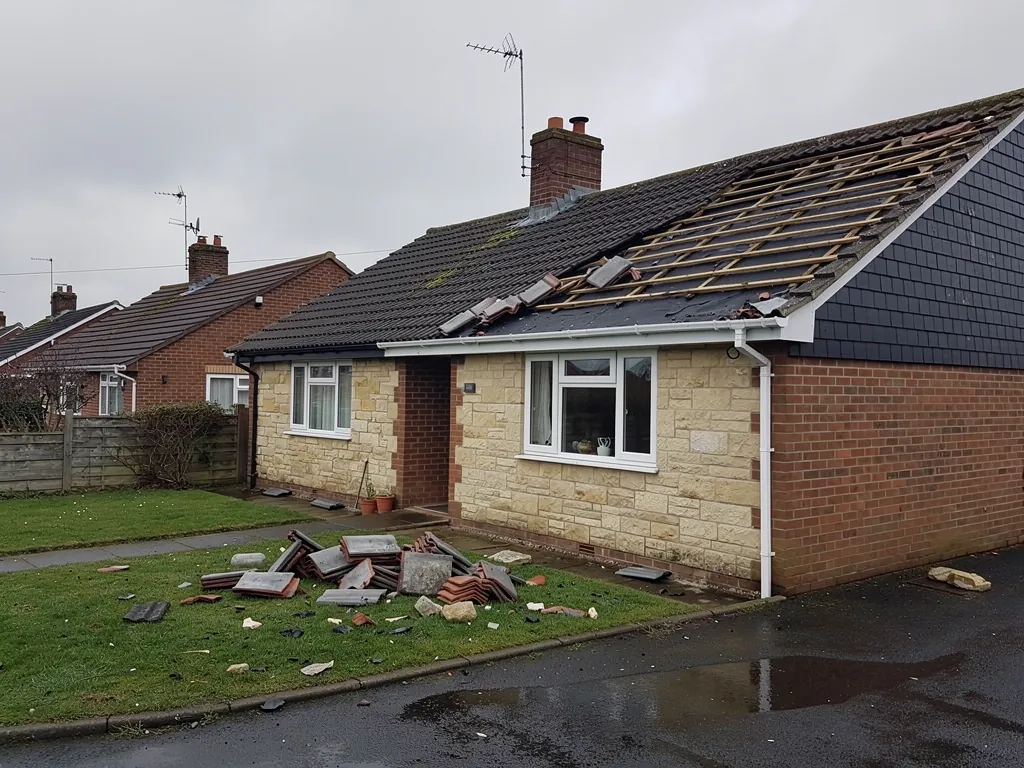
Wind uplift: tiles and slates lifted off the slope
Wind does not only push on a roof. As it passes over the ridge it creates suction on the leeward side and along the edges, and that suction tries to peel the covering upward. This is wind uplift. It is why tiles near the verge and the ridge go first, and why a house on open ground at the edge of an estate loses more than one tucked into the middle of a terrace.
What survives depends on how each tile or slate is held. Plain tiles hang on small nibs and rely on weight and a few nailed courses. Slates hang from fixings, and on tired roofs the original ones have often rusted thin, so a gust that a sound roof would shrug off pulls a line of slates out. Interlocking concrete tiles are heavier and usually clipped at the edges, though clips are missing on plenty of older work.
How tiles blown off are made safe
If the underlay is intact, a few missing tiles can be replaced with matching ones and the gap closed the same visit. Where the underlay is torn or the battens beneath are split, the area is first covered so water stops getting in, then reinstated properly once the timbers have been checked. Matching matters on older roofs: a hand-made clay tile or a Welsh slate rarely has an exact modern twin, so reclaimed stock is often the better answer.
When it is a sign of something bigger
One or two tiles lost from an otherwise tight roof is a repair. A whole run of loose or missing tiles across a slope, especially if the nails come out with the tile, suggests the fixings are tired across the roof and the next gale will do the same. The survey photographs show which of the two you have, and the written quote covers whichever job deals with it.
Ridge, hip and verge failure
Three parts of a roof stand proud and take the worst of it. The ridge caps the very top, where two slopes meet. Hips cap the angled corners of a hipped roof. The verge runs up the side of a gable, where the tiles stop at the wall. All three are exposed to uplift from every direction, and all three depend on mortar and fixings that age badly.
Plenty of houses built before 2014 have their ridge and hip tiles sitting in mortar and nothing else. Mortar shrinks, cracks and washes out over the years, and the tiles end up resting on little more than their own weight. A storm lifts them, slides them or drops them into the garden. Since the 2014 revision of BS 5534, builders no longer trust mortar by itself for these tiles and add mechanical fixings, and dry-fix systems tested to BS 8612 use clips and seals instead of bedding.
What does a failed verge look like?
Along a gable the tiles sit on an undercloak, a strip of tile or fibre cement laid under the edge. When the mortar cracks, the verge tiles lift and slip, and rain gets into the roof space beside the gable wall. Birds and insects find the gap before you do. From the garden, look for a ragged line along the edge, mortar crumbs on the ground or a tile sitting at an angle.
How it is put right
A loose ridge is often made safe by removing the tiles at risk and covering the exposed line. The lasting cure is new bedding with mechanical fixings added, or a switch to a dry system, depending on the roof beneath. Our pages on ridge re-bedding and verge repairs set out both routes.
Flashings torn back or lifted
Wherever a roof meets something else, whether a chimney, a party wall, a dormer cheek or a roof window, the joint is sealed with a flashing, usually lead. It is fixed along one edge and left free to move along the other. That copes well with ordinary weather but badly with a gale that gets under the free edge and folds it back like the page of a book.
Older flashings are more at risk. Lead that has fatigued stiffens and cracks along its bends. The mortar pointing that locks its top edge into the brickwork perishes. After that, one strong gust is enough to pull the metal loose. Lead is also stolen in some places, and a flashing that looks cut rather than torn is a matter for the police.
Why a flashing leak shows up late
A lifted flashing lets water in at the junction, but the water often runs along a timber or the underlay before it reaches a ceiling. The stain can appear a metre or more from the fault and days after the storm. That delay is why a roof that seemed fine on the morning after can show brown rings by the weekend.
Making it safe and mending it
A torn flashing is first dressed back into place or covered so the joint is shut while the weather stays bad. Permanent repair means new lead of the right weight, with soakers (small lead pieces laid between slate or tile courses) renewed where they have failed, and the top edge fixed and pointed into the wall properly. For a closer look, see our page on a flashing blown off in a storm.
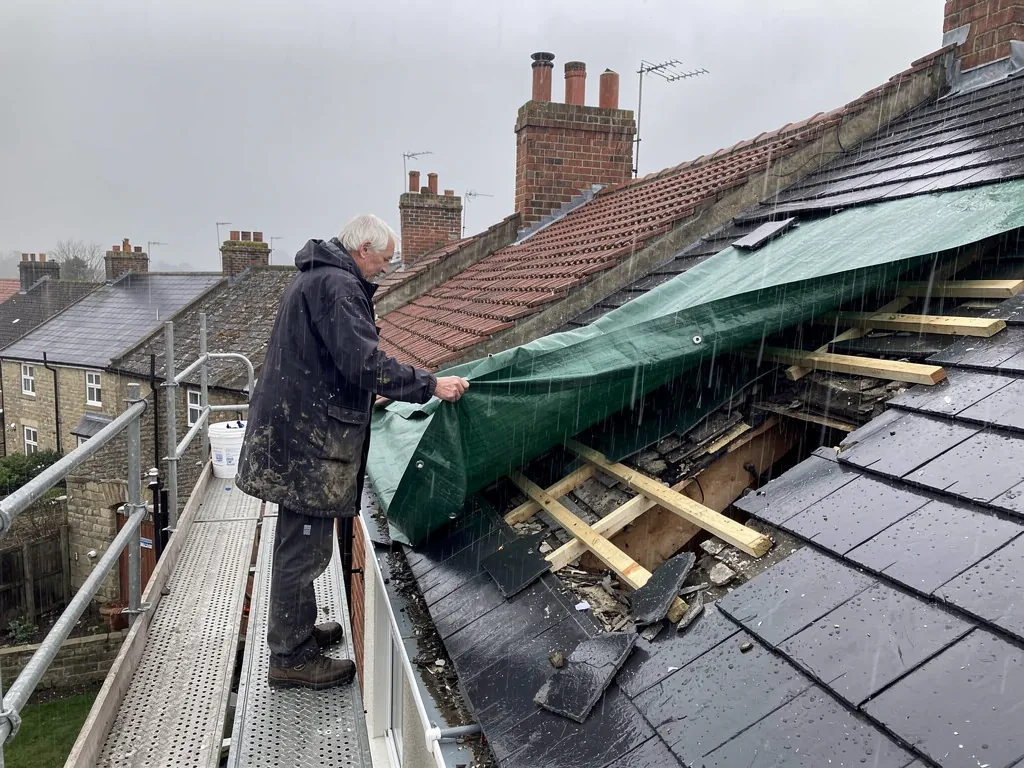
Fallen trees, branches and flying debris
A tree strike is the most dramatic type of storm damage and the one where the real extent is hardest to judge from outside. A large branch can punch through tiles, split rafters and bring the ceiling down in a single event. A smaller limb may only crack a few tiles but still dent the underlay and leave a slow leak that appears weeks later.
Debris from elsewhere does similar work on a smaller scale. Fence panels, trampolines, garden furniture and slates from a neighbour's roof all travel in strong wind, and they land on conservatories, flat roofs and rooflights as readily as on pitched slopes. Impact damage often shows as a line of cracked tiles, a dished flat roof covering or a split in a polycarbonate sheet.
Is the timber frame still sound?
The tiles are the cheap part. What matters is whether any rafter, purlin or wall plate is cracked or pushed out of line. A sagging line along the roof, a ceiling that has dropped, doors that suddenly stick: any of these suggests the structure has moved and needs inspecting before anyone goes inside or on top of it.
Who does what first
Do not go on the roof yourself, and keep people out of any room below a damaged section. If a tree is still on the roof, it usually needs removing in a controlled way by a tree surgeon before roof repair starts. Once it is clear, the area is covered and made watertight, the damage is photographed, and the permanent rebuild follows after a proper survey. Our guide to a tree that has fallen on a roof takes the steps in order.
Water often does the second round of damage. A covered roof with dry insulation beneath it is a smaller job than the same roof left open for a week.
Water inside: ceilings, lofts and the damage you cannot see
Many storm repairs begin with a call about the ceiling, not the roof. Water gets into the loft through a gap, soaks insulation, runs along timbers and gathers above the plasterboard. The ceiling then bulges, stains or drips, usually in a spot that has little to do with where the gap is.
A ceiling that is bulging with trapped water is a safety issue as well as a repair one. The plasterboard can fail without warning, and the water can reach light fittings and cabling. Our guide to a ceiling bulging with water covers what to do in the first minutes, including why a small controlled release can be safer than waiting.
What gets wet in the loft
Loft insulation holds water and passes it on slowly. Mineral wool that has been soaked loses much of its value until it dries, and may need replacing if it stays wet. Timbers can take a long time to dry, and persistent damp raises the risk of rot. That is why drying and checking the roof space is part of the storm job, not an extra.
Telling storm damage from an older fault
A roof can already be leaking slowly before a storm exposes it. A stain that is dark at the edges with a tide mark suggests water has been arriving for a while. A fresh, still-wet patch with no staining around it points to recent entry. We note which we see in the survey because it matters to how an insurer, and later the Financial Ombudsman Service if there is a dispute, treats the claim. See our page on wear and tear and roof claims for how that distinction works.
From make-safe to permanent repair
Storm repairs usually happen in two stages, and it helps to know which stage you are paying for. The first stage is making the roof safe and watertight: removing loose material, covering openings and stopping further water getting in. The second is the permanent repair, done once the weather allows and the extent of the damage is known.
Skipping straight to stage two is rarely sensible in the middle of a storm. Working at height in high wind is dangerous, and a repair carried out in the wet seldom lasts. Equally, a temporary cover is not a finish. Our page on temporary roof repairs explains how long they are meant to last.
What does the survey record?
It covers the damaged area, the roof space beneath and the neighbouring slopes, because wind that damaged one part often loosened another. Photographs of your roof arrive with the written quote. The brief is the minimum work that properly mends the fault: a handful of tiles if that is all it needs, a re-covered slope only if the surviving fixings would not hold through another winter.
What moves the cost?
Access first, since a high roof or a chimney stack may need scaffolding, then the size of the area, the covering and the state of the timbers. MyBuilder's roof repair guide, updated 21 August 2026, puts storm fixes at £500 to £1,500 nationally, a sense of scale and not a price for your roof. Whichever quote you compare, ask if VAT and scaffolding are in it.
Rubbish goes in our van when the job ends, and the repair is covered by a 10-year workmanship guarantee in writing.