Flat-roofed garages behind brick semi-detached houses

Roofers in Lechlade

Roof work for Lechlade houses and cottages by the Thames, from Georgian town houses near the market place to cottages down towards the river and the newer streets beyond the old railway line.

Lechlade's roofs, from St Lawrence to the riverside

Georgian town houses with steep tiled roofs
Georgian and older town houses

The county history says many Lechlade houses were rebuilt in the late seventeenth and eighteenth centuries, naming Church House, Sherborne House and Ryton House among the larger residences of those years. Houses of that age usually carry steep, broad roofs on timbers that have worked for three hundred years or more, and the coverings range from stone tiles to later clay and slate. Parapets, valleys and chimney stacks add lead and flashing work that needs real care. Before a quote is written we go up into the loft to look at the timbers, the bedding of the ridge and the condition of every valley, since a house of this age rewards patient diagnosis more than a quick patch.

A row of shops and cottages by a market place
Market place and river streets

Lechlade received its market charter in 1210 and the market place still anchors the old town, and the town grew at the point where the River Leach joins the Thames, the highest place on the river that boats can navigate. The Thames and Severn Canal reached the town in 1789 and the railway followed in 1873, so trade brought new materials as well as new customers, and roofers in later years could specify coverings that had once been too costly to haul in by cart. Cottages, shops and small terraces here have a variety of coverings, and gutters and flashings suffer where buildings stand close together and shade each slope. Moss gathers on shaded north-facing tiles, and we clean it away by hand where a pressure lance would damage soft or old clay. The usual jobs are renewing failed tiles, repairing valley gutters in lead and re-forming the joints around shared chimney stacks.

Brick bungalows under pitched tile
Newer homes beyond the old line

The railway closed in 1962 and its line is long gone, and the land around the old line and the edges of the town have since filled with later houses, bungalows and extensions. Their roofs are simpler: regular pitches, concrete or clay tile, plain verges and brick stacks. Time brings the usual ailments: crumbling verge pointing, lifting ridge tiles, tired felt below the covering, and garage or porch roofs that have outlived their membrane. The plain geometry of these roofs makes diagnosis quick, so a precise repair often does the job. We name the exact tiles and joints in the quote, and where a flat porch roof is involved we check its fall and edge trim as well, since standing water shortens its life.

From Swindon to the head of Thames navigation

Map showing Lechlade and central Swindon. 12 road miles north-north-east of central Swindon.

Distance
12 road miles north-north-east of central Swindon
Council
Cotswold District Council
Council
Cotswold District Council
Conservation area
Lechlade, designated 7 July 1971 and reviewed in 1986, 1990 and 1994
Setting
The edge of the Cotswolds, where the Leach meets the Thames

Lechlade roof questions

Does the 1971 conservation area cover my Lechlade roof?

Possibly. Check the boundary map from Cotswold District Council. Matching repairs seldom need permission; a new material or a listed house is a question for the council before work starts.

Can stone slates be repaired on a house near the river?

Yes. A slipped stone can be fixed back, and rotten pegs or soft battens renewed, with the stones laid again in diminishing courses. As much of the original stone stays as the roof allows, and we tell you before anything is replaced.

Who handles building control in Lechlade?

The district council keeps its own building control team, and a registered approver is the private alternative. We explain which applies when your work is notifiable.

Q1

What does a Lechlade conservation area change for roofers?

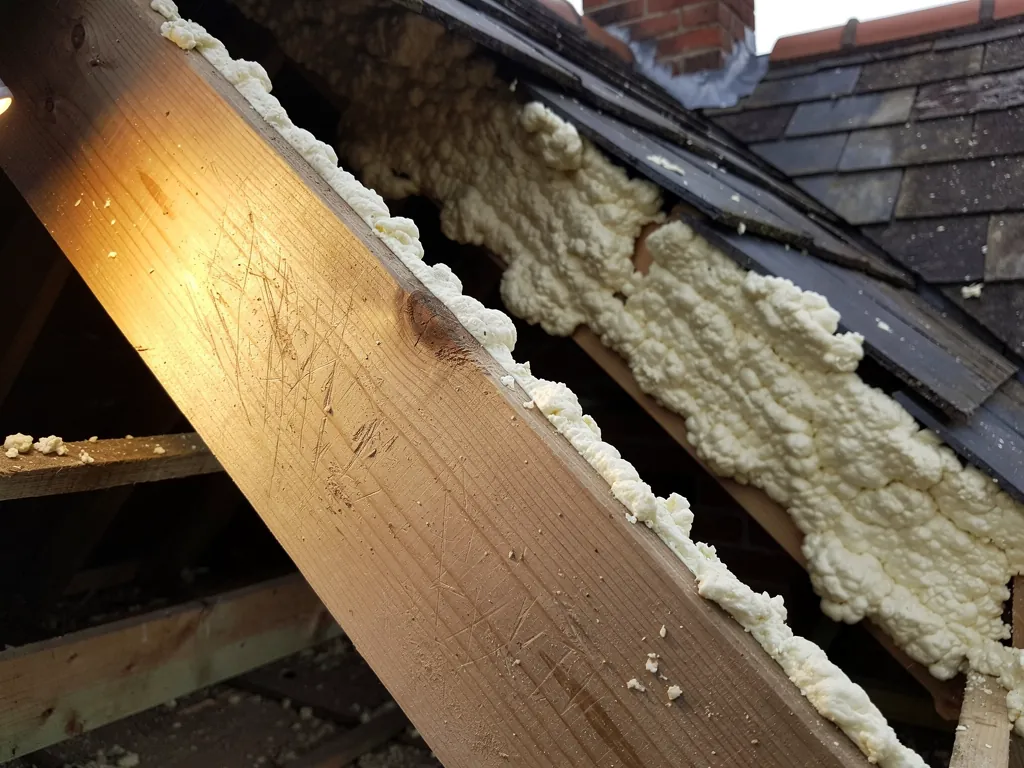
Scraped-back rafter beside thick spray foam under a slate roof
Lead-lined valley gutter between two slate roof slopes

The short answer

Lechlade Conservation Area was designated on 7 July 1971 and reviewed in 1986, 1990 and 1994. In practice, repairs in matching material seldom need an application, but a different covering or a listed building needs a conversation with Cotswold District Council before any roofer is booked.

The designation dates from 1971 and the council has looked at the boundary three times since. For a householder, the practical question is simple: will this job alter what passers-by see of the roof? When the look stays the same, you are dealing with maintenance. When it changes, ask first. The council's conservation team can usually say quickly which side of the line a job sits on.

Do matching repairs need permission?

Putting back slipped tiles, rebedding a ridge or renewing lead flashings in matching material leaves a building's appearance unchanged, so planning permission is not normally needed. Section 55 of the Town and Country Planning Act 1990 sets that out, and the same logic holds in a conservation area, subject to any Article 4 direction. Ask the council whether one applies to your street.

What if I want a different covering?

Swapping stone or clay for concrete, or adding new openings to a roof slope, does change the look. A roof window question has its own planning page on our site, roof window planning, because the rules are specific. We would rather you heard the council's view early than discovered it after the scaffold went up.

What about listed buildings and St Lawrence?

Changes touching a listed building's special character need listed building consent, and its roofing is part of that. The Church of St Lawrence is Grade I listed; while it is in Church of England use, it comes under the faculty system rather than the council's consent route.

If you cannot tell whether your house is within the boundary, Cotswold District Council publishes the conservation area map, and we are glad to read it with you before a quote is written.

Lechlade Conservation Area at a glance
DetailPosition
Designated7 July 1971
Reviewed1986, 1990 and 1994
Decided byCotswold District Council
Grade I buildingChurch of St Lawrence
Q2

Is Cotswold stone slate worth keeping on a Lechlade house?

The answer

Usually, yes. Cotswold District Council's traditional guidance says a maintained stone roof can easily last a century, and could last far longer. The stones often outlive the pegs and battens holding them, so new fixings and the same stones laid again in their courses is normally better than replacing the covering.

Cotswold stone slate is oolitic limestone, split into thin tiles and hung from battens on oak pegs. Cotswold District Council's technical guidance, published in 2000, observes that the southern half of the district says stone tile and the northern half says stone slate. The name varies; the behaviour does not.

Why do stone roofs leak?

The stone seldom fails first, which surprises many owners. Pegs rot, battens soften and the slope slowly opens. Water finds the gaps, usually at the valleys, the chimney and the lower courses. We often see slates that have slipped, not slates that have worn out, so the repair is to refix them.

Should the roof be repaired or re-laid?

A handful of moved stones can simply be fixed again. A failing slope calls for a careful strip: the stones are sorted by length, battens and fixings renewed, and the courses rebuilt from the large stones at the eaves up to small ones beneath the ridge. Breakages are made good from matching stock. Our Cotswold stone roofing page describes the method.

Does the weight or the source of the stone matter?

A stone slate roof is a heavy thing, about 1,000 kg for every 10 square metres according to the council's guide, so the structure gets a check before any change of covering. English Heritage policy, as reproduced in that guide, prefers new stone slates over second-hand ones, and reclaimed stone only from the building it came from. Concrete substitutes are not suitable for historic buildings.

That is a good rule for any old roof. Keep the original covering wherever it can be saved, and tell the owner exactly why a stone has to go.

Q3

What leaks on a Thames-side house in Lechlade?

Weathered brick chimney stack with eroded joints and cracked pot
Roofer repointing a stone chimney stack above lead flashing

The short answer

On older houses, leaks tend to start at the joints rather than across the open slope: valleys, chimney bases, parapet gutters and the lead where one roof meets another. A damp edge by a shared wall is more often a flashing than a tile, and tracing the real entry point comes before any quote.

Lechlade sits low beside the river, with the Leach joining the Thames close to St John's Bridge. Whatever the weather does, water on a roof follows the same rules. It runs down, finds the lowest or weakest joint and gets in. Our job is to follow its path.

Why do valleys and parapets leak?

Valleys are the internal angles where two slopes meet, and they gather a great deal of water. On older houses it is usually lined in lead, which can crack where it has been bent too tightly or lifted by repeated movement. Parapet gutters, where a wall rises above the roof edge, have the same weakness. Our lead roofing page explains how lead is worked and what its codes mean.

How do chimneys let water in?

Old stacks carry flaunching, the sloped mortar cap that seats the pots, plus lead flashings round the base. Cracks in either let water run down the flue and into the ceiling below, and a stain beside a chimney breast is often the first sign. Often the stack is sound and the lead has simply aged, which is welcome news because relining a joint costs far less than rebuilding brickwork. Replacing the lead, with a chimney lead code chosen for the job, costs far less than rebuilding the stack.

Can gutters cause a damp wall?

Cast iron and plastic gutters alike clog with leaves and moss. When gutters overflow, water soaks the wall top and the eaves timbers. A leak that shows inside a bedroom wall may begin a metre away on the roof, so we trace it with a torch and photographs, working from the ceiling stain back up the slope. Details of our approach are on the roof repairs page.

A written quote follows the survey, with the cause named and the fix priced, with the survey photographs attached, which show each defect as it is on your roof. If a small repair will cure it, that is the quote you get, not a larger job. Every site is cleared at the end, and the workmanship carries our 10-year written guarantee.


Questions from the Thames-side streets

Why do some Lechlade houses have stone roofs and others clay or slate?

The town was rebuilt in stages. The county history records many houses rebuilt in the late seventeenth and eighteenth centuries, and later work used whichever covering could be carried in. The canal opened in 1789 and the railway in 1873, so new materials arrived over time. Each repair follows the roof already there.

Can you repair the lead on an older house by the market place?

Yes. Lead valleys, flashings and parapet gutters are renewed in the same metal, using a lead code chosen for the job, which sets the thickness of the sheet. We show you the cracked or lifted sections in photographs before anything is priced, and we replace only the lengths that have failed.

Do you cover Buscot, Kelmscott and the villages around Lechlade?

Yes. Those villages lie well within the 30-mile road radius around Swindon. Our areas page lists the other places we reach, and the enquiry form takes a postcode if you want an address checked.

Should a Lechlade chimney be rebuilt or repointed?

Repointing and fresh flashings come first if the brickwork is sound. Rebuilding is for stacks that lean, crumble or have lost their flue lining. Removing a chimney breast needs Building Regulations approval every time, plus a party wall notice where the breast sits on a shared wall.

Ask us about your roof

Tell us what’s happening and we’ll call you back.

  • Photos of what we find
  • A written quote
  • 10-year workmanship guarantee

Or call 01793 626096

Call Get a quote