The short answer
St Mary's has a Grade I listing and a three-stage tower, and the buildings around it are of mixed age. There is no single covering to name for the village, so we identify the material on each roof at the survey and repair it in the same type, size and colour.
Kempsford's best-documented roofs are the church's, and the village history around it is rich: a twelfth-century nave, a thirteenth-century chancel, a tower in three stages, and Victorian restoration by G E Street around 1858. Beyond the church, the written record of the village roofs is thin, so the sensible approach is to look at each building as it stands.
Q1.1What does the survey look for?
On an older house we start with the covering itself: its material, its pitch, how it is fixed, and how many different repairs it has had. Photographs of every slope go into the written quote, with the faults marked so you can see them for yourself. A roof with a history of patching often has mixed coverings, uneven courses and flashings of different ages, and that tells us where earlier problems were.
Q1.2Are roofs beside the church different?
A roof beside a tall tower can be shaded, sheltered from some winds and exposed to others, and where trees stand close its gutters collect leaves and debris. Moss and slow-draining valleys follow. Clearing the gutters and cleaning the slope is sometimes the right first step, and our roof cleaning and moss removal page explains when that is enough and when it only hides a deeper problem.
Q1.3Why treat lead and masonry together?
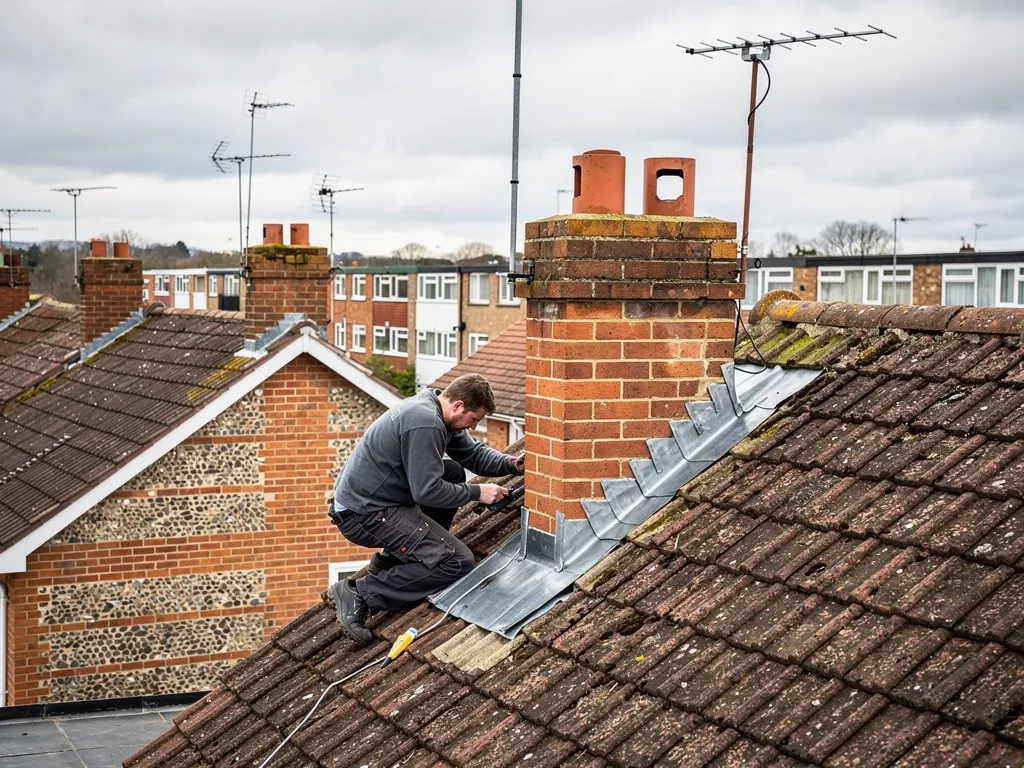
Where a roof meets a tower or chimney, the lead flashing and the pointing around it fail together. Re-pointing without renewing the flashing, or the other way round, leaves a leak waiting. We deal with the junction as a whole, and the quote says which parts are repairs and which are renewals.
All of this is judged on the roof itself, not on the village's reputation, and the quote says plainly which faults are urgent and which can wait.