Row of stone cottages with steep stone slate roofs

Roofers in Meysey Hampton

Leaks, slipped tiles, chimney flashings and re-roofs in Meysey Hampton, from the cottages around St Mary's church to the farm buildings and newer houses beside the A417 towards Fairford.

Meysey Hampton's roofs, from church to farm lane

Rubble stone church with a slate roof
Around St Mary's church

The parish church of St Mary the Virgin was consecrated in 1269 and restored in 1872 to 1874 under James Brooks. It is listed at grade II*, built of rubble masonry and covered with slate. A church roof of this kind carries long runs of lead in its valleys, gutters and wall junctions, and those are normally the parts that need attention first. Older houses near a medieval church can have thick walls, steep pitches and chimney stacks that have been rebuilt more than once. On such buildings we study the line where roof meets wall, because rainwater tests that detail harder than any other, and a tired flashing there can leak for years before a stain appears indoors.

Stone-tiled cottage roof with mossy courses
Cottages and stone tiles

Meysey Hampton sits in the south of the Cotswolds, and Cotswold District Council's own roofing guidance observes that stone tile is the term favoured across the southern part of the district, with stone slate preferred further north. Where an older cottage still wears one, the covering follows a graded pattern, large stones low on the slope and small ones high up. Such roofs are heavy, they hang on wooden pegs, and they reward patient hands. A slipped stone or a rotted peg is a small job when caught early, and a large one once water has been running onto the rafters for a winter or two. We would always rather lift and re-hang a few stones than strip a sound slope.

Tiled farmhouse and barn roofs
Farm lanes and newer houses

Beyond the church the village loosens into farmsteads, converted barns and houses from later periods. A converted barn brings long rafter runs, broad planes of covering and, often, a modern roof window or two. Twentieth-century houses may carry concrete or clay tiles, with plain ridges, verges and flashings around chimneys and porches. They want ordinary, careful upkeep: ridge tiles whose bedding has crumbled, cracked tiles over a garage, and soft felt under a lean-to. Outbuildings and flat-roofed extensions are common additions on rural plots, and they tend to be the roofs nobody looks at until a ceiling stain gives the game away.

From Swindon to the Fairford road

Map showing Meysey Hampton and central Swindon. 14 road miles north-north-west of central Swindon.

Distance
14 road miles north-north-west of central Swindon
Council
Cotswold District Council
Council
Cotswold District Council
Conservation area
Meysey Hampton, designated 19 January 1972
Setting
South Cotswolds, about two miles west of Fairford on the A417

Asked by Meysey Hampton homeowners

Does the village conservation area affect a like-for-like repair?

A repair in matching material rarely needs an application. Changing the covering, or anything that alters how the roof looks from the street, is worth raising with Cotswold District Council first.

Can slipped stone tiles on an old cottage be refixed?

Usually, yes. Slipped stones are lifted, the pegs and battens checked, and the stones hung again in their courses. Stripping a whole slope is kept for roofs that are properly failing.

What gives up first on a roof near St Mary's?

Lead details and chimney junctions, as a rule. Valleys, abutments and parapet gutters carry the heaviest flow of water, so they show their age before the main covering does.

Q1

What covers the roofs around Meysey Hampton's church?

Roofer repointing a stone chimney stack above lead flashing
Brick and limestone cottages around a small village green

The short answer

St Mary's itself is built of rubble masonry with slate roofs, and it is grade II* listed. Nearby cottages and farm buildings carry a range of coverings: stone tiles on the oldest, slate on some, and clay or concrete tile on later work. The right repair depends on which one you have.

The village sits quietly on the A417, a couple of miles west of Fairford, and its roofs reflect several centuries of building. The church is the clearest record, and the cottages and farms around it fill in the rest of the story.

What does the church's slate tell you?

St Mary's was consecrated in 1269 and restored in the 1870s under James Brooks. Its listing describes rubble masonry and slate roofs. Slate is thinner and lighter than stone tile, laid in regular courses and held with nails, so its faults are different: nails rust through, slates slide, and lead flashings tire at the points where the roof meets a tower or a gable wall. A slate roof can look flat and sound from the lane while a dozen slates hang by a single corroded nail.

How are the stone-tiled cottages treated?

Cotswold cottages of this age often sit under stone tiles, and the work is specialist. The covering is heavy, laid with its largest stones at the lowest edge, and held on pegs that age far faster than the stone does. When a leak appears, we begin in the loft with a torch and work out whether the water is arriving through a gap between stones, a failed peg or a flashing at a chimney.

Where do the later tiles fail?

Concrete and clay tiles on twentieth-century houses are simpler. They fail at the ridge, at the verges and wherever a tile has cracked after frost. Our page on slate roofing covers the thinner coverings in more detail, and roof repairs explains how we trace a leak that has no obvious source.

Whichever covering you have, the first visit follows one pattern. Pictures are taken outside and up in the loft space, and the written quote lists exactly what we would do, so you can hold it up against what the camera saw.

Q2

Should a Meysey Hampton cottage keep its stone tiles?

The answer

Almost always, where the stones are sound. The weak points are the pegs, battens and flashings rather than the stone itself, and those can be renewed while the stones go back in place. A different covering changes the weight, the look and sometimes the consents needed.

When a stone-tiled roof lets water in, the instinct is to replace the lot. In practice the stone is usually the part that has lasted best, and Cotswold District Council's guidance on stone roofing says that with regular maintenance such a roof can easily last 100 years.

What fails first on a stone roof?

Pegs are the weak link. Each is driven through a hole near the head of a stone and hangs it over the batten, and with time they rot or split. Battens soften, and moss packed between the stones holds damp against the timber. Seen across the lane a roof may seem fine while its stones are held on very little.

How is replacement stone matched and sourced?

Cotswold stone slates are oolitic limestone, and the heritage policy reproduced in the council's guidance says limestone and sandstone should never be substituted for each other or used together. The same policy prefers new stone slates, and says reclaimed ones should only go back onto the building they came from. Taking stones off a neighbouring roof can strip someone else's building, so any replacement stone arrives with a note of where it was cut or salvaged.

How heavy is a stone roof?

The guidance puts a stone roof at about 1000 kg per 10 square metres, which is very heavy. A lighter covering is not needed by an old frame, and a heavier one raises a question for building control. Our Cotswold stone roofing page sets out how the courses are worked.

For most cottages the sensible route is to leave the stones in place, renew the fixings beneath them, and write the work up so each step is clear before it starts.

Q3

Who decides on roof work in Meysey Hampton?

Gloved hands fitting a weathered Cotswold stone slate
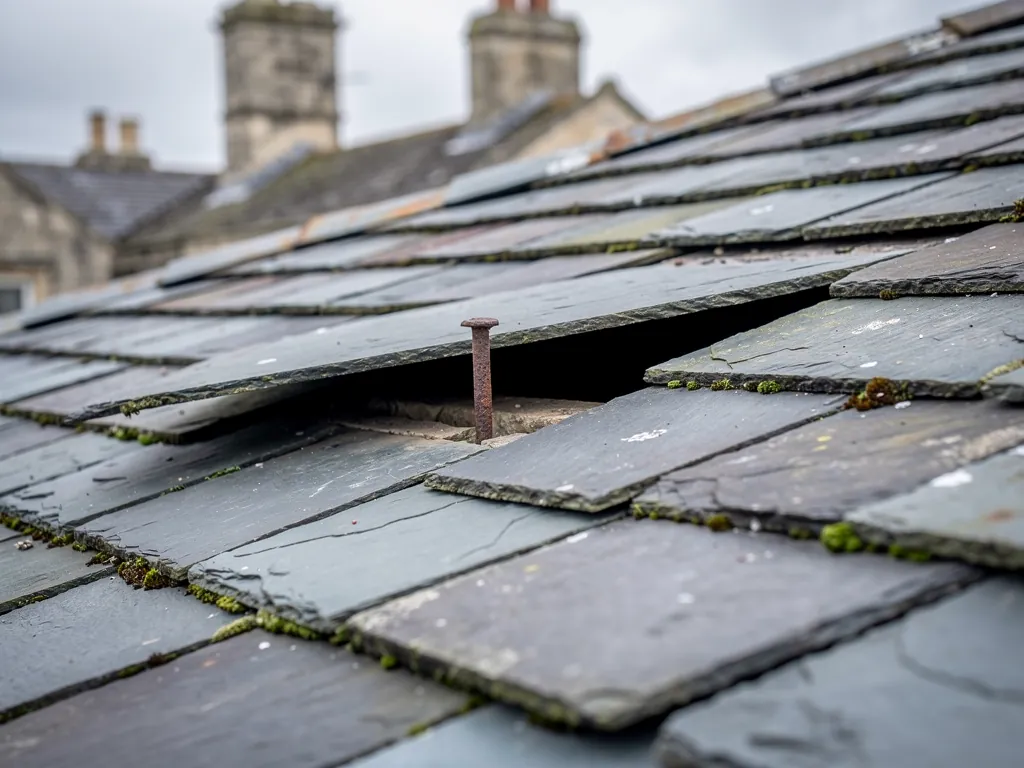
Slipped natural slate with an exposed nail on a weathered roof

The short answer

Planning here is Cotswold District Council's job, and the same council keeps its own building control team. Work in matching material rarely calls for an application, but listed buildings, a change of covering and larger re-roofs do. Church of England buildings in use follow a separate faculty route.

A great deal of roof work in the village needs no permission whatsoever: swapping broken tiles, re-bedding a ridge or refixing slipped stone with matching material is upkeep. Three situations are different, and the sooner you know which applies, the fewer surprises the project holds.

When does the conservation area matter?

Meysey Hampton's conservation area was designated on 19 January 1972. A repair that copies what is there leaves the village unchanged, so it seldom reaches the planning desk. A change of material, a roof window facing the street or an altered chimney is the sort of thing to raise with Cotswold District Council first. Our guide to roof window planning explains how that works for new openings.

What if the house is listed?

If your house is listed, work affecting its character needs listed building consent, and that includes the roofing material. The district's earlier local plan policy, quoted in its stone roofing guidance, said that replacing natural roofing on a listed building with modern alternatives would not be permitted where it would significantly harm its interest. Churches still used for Church of England worship go through the faculty system rather than that consent.

When do the Building Regulations apply?

A re-roof touching 25 per cent or more of the building envelope, or 50 per cent or more of the roof, brings Building Regulations into play, and the insulation levels may then need lifting. Cotswold District Council runs its own building control team, and we explain what is notifiable and handle the notification when work needs one.

Not sure whether your cottage is listed, or whether it sits inside the boundary? The council holds the answer, and we can read the roof while you wait for it.

Where the answer is not obvious, a conversation before the survey saves a second visit. Send us a photograph of the front elevation and the street, and we can tell you what we would ask the council before any covering is touched.


MythA conservation area means every roof repair needs consent.

FactMatching repairs seldom do. It is a new covering, or a visible change to the roof, that draws the council's attention.

Roofing services in Meysey Hampton

Questions from along the Fairford road

Why is lead such a regular repair on older roofs near the church?

Lead sits at the junctions where water is shed fastest: valleys, abutments, parapet gutters and chimney flashings. Those joints flex with temperature and eventually crack or lift. Renewing the lead, rather than smearing sealant over it, is usually the repair that lasts, and it is the part of a historic roof most worth doing properly.

Is a barn conversion near Meysey Hampton something you can re-roof?

Yes. Barn conversions have long rafter runs, big planes of tile and sometimes modern roof windows, and each of those has its own weak points. We check the ridge, the valleys and the window flashings, and the quote sets out each fault in writing beside the survey photographs.

Can you reach Meysey Hampton from Swindon for a survey?

Yes. The village falls inside the area we cover within 30 road miles of Swindon, and the survey includes photographs of your own roof. Check the areas page if you want to see the other places we reach.

Is thick moss on a stone-tiled roof a problem?

A light film of moss does little harm, yet thick cushions keep the stones and pegs wet. We remove it by hand where the surface is soft, because pressure washing can damage old stone and force water into the joints between courses, which makes the next leak worse.

Ask us about your roof

Tell us what’s happening and we’ll call you back.

  • Photos of what we find
  • A written quote
  • 10-year workmanship guarantee

Or call 01793 626096

Call Get a quote