New-build brick and render estate houses with grey tile roofs

Roofers in Poulton, Gloucestershire

Poulton's roofs range from houses beside the old priory ground to later homes on the village lanes. We repair, re-cover and make safe, and every job begins with a visit and ends with the price in writing.

Poulton's roofs, from priory to present

Old village houses beside a churchyard wall
Around the church and the old priory ground

Poulton is in the Domesday Book as Poltone, and Sir Thomas Seymour built what became the Priory of St Mary here in 1348. The priory served as the parish church until it was demolished in 1873, and William Butterfield's St Michael and All Angels took its place. Houses beside that long-settled ground are often old, with steep pitches, thick walls and rafters that have moved over centuries. A roof of that age has typically been mended many times, with different coverings meeting at awkward seams. Before pricing anything we work out what each slope is covered with, how the timbers are holding and where earlier repairs were rushed, because those answers tell us if patching can hold or a section must be stripped and relaid.

Long tiled roof slopes on a village lane
Cottages and farmhouses along the lanes

Away from the church, Poulton is a village of lanes, small plots and houses of different ages sitting close together. Older cottages and farmhouses tend to have long, uninterrupted roof slopes, gable chimneys and verges that project only a little beyond the wall, which makes the verge and the chimney flashing the usual weak points. We look at the lead around each stack, the pointing on the stack itself and whether the ridge is held by mortar alone. Many roofs in an old village have never been opened up, so a careful look from the ladder and from inside the loft saves a good deal of guesswork before a price is set.

Tiled and flat roofs on newer village homes
Twentieth-century homes and outbuildings

Not every roof in Poulton is old. Later houses, bungalows, garages and extensions bring concrete or clay tiles, felted porch roofs and flat sections over kitchens and utility rooms. These tend to fail in a different order from the old stock: tiles lose their ridge mortar, felt blisters along its laps, and gutters sag and spill onto the wall below. They also suit the simplest kind of job, a straight swap of like for like. When a flat roof is close to worn out, we say plainly whether a new membrane over the existing deck will do or the deck itself needs replacing, and which covering suits the building and the budget.

From Swindon to a former Wiltshire enclave

Map showing Poulton and central Swindon. 16 road miles north-north-west of central Swindon.

Distance
16 road miles north-north-west of central Swindon
Council
Cotswold District Council
Council
Cotswold District Council
Conservation area
Poulton, designated 17 February 1981 and reviewed in 1990
History
A detached part of Wiltshire until the Counties (Detached Parts) Act 1844

Poulton roof questions

Does Poulton's conservation area affect a roof repair?

Fixing like with like seldom needs an application. If the work would change how the roof looks, or the house is listed, ask Cotswold District Council before ordering materials.

Is it hard to roof a house beside St Michael's churchyard?

Not usually. Next to a churchyard wall the questions are access, where the scaffold stands and how the ground is protected. We settle those during the visit, and the price reflects them.

Why did Poulton belong to Wiltshire once?

It was a detached part of Wiltshire until 1844 and now sits in Gloucestershire. For roofing, that means planning and building control questions go to Cotswold District Council, not to Wiltshire.

Q1

What should I check on an old Poulton house roof?

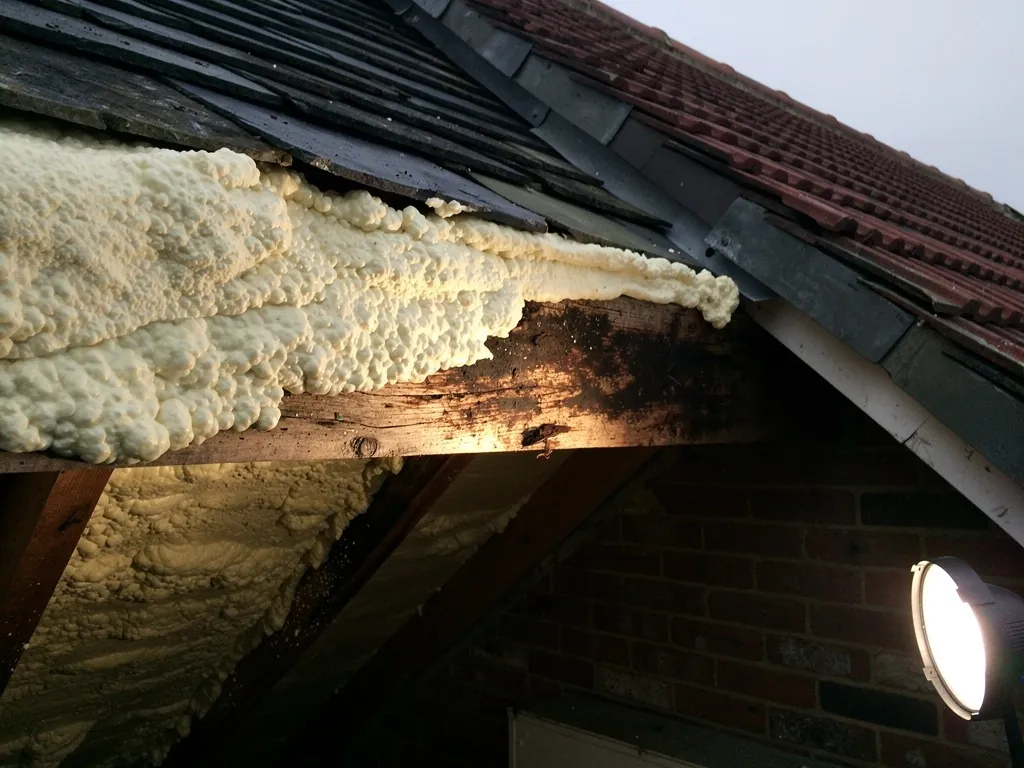
Spray foam cut away revealing damp-stained rafter timber
Torch showing a water-stained rafter beneath slates in a loft

The short answer

Begin where water enters: ridge, gable edges, chimney lead and valleys. On a house that has stood in the village for generations, the covering is often sound while the fixings, battens and lead around it have given up. A look from the ladder and from the loft separates the two.

Poulton has been settled since before the Domesday survey, so a roof here can be the latest in a long chain of repairs. The covering you see from the lane may be the third or fourth on that building, laid over timbers older than all of them. Reading that history is half of a good repair, and it is why we never quote from the road alone.

Where do leaks usually start?

Two slopes meet along the ridge, and its tiles are usually the first pieces to loosen. At a gable end the roof stops short of the wall at the verge, where the covering is cut back and sealed. Lead flashing bridges the gap where a chimney or wall meets the slope. On older houses these details tend to fail well before the main field of tiles, which is why we start at them and work outwards.

Inside the loft we look for daylight showing through the covering, damp marks on rafters, battens that have gone soft and underlay that has split. A dark stain on a timber beside a chimney usually points to a flashing, not a slipped tile, and the cure is lead work rather than a larger job.

Is a repair enough, or does it need re-laying?

If the covering is sound, a repair is normally the right answer: replace the failed pieces, renew the lead and fix the ridge properly. If battens and fixings have failed across a whole slope, stripping and re-laying that slope is better value than a string of small visits. Our roof repairs page explains when each is right.

On the survey we photograph each problem area, then send the pictures alongside the written quote, so you see what we saw before you decide anything.

Q2

How does stone tiling work in a south Cotswolds village?

The answer

A stone roof is sorted by size before it goes up, the heaviest pieces along the eaves and the lightest up by the ridge, each hung on a peg from a batten, and no two stones are quite alike. The council's guidance says stone tile is the usual term across southern Cotswold District. Repairs depend on matching size, thickness and stone type.

Poulton lies in southern Cotswold District, and the council's technical guidance on stone roofing is worth knowing even if your own roof is another material. It explains how traditional roofs were built, and therefore how best to mend them. The guide dates from 2000, so we treat it as a record of traditional practice, not a supply list.

How was a stone roof built?

When the quarried rock is split, it yields a great many short stones for every long one, so the longest slates are doubled up along the eaves and the shortest sit close to the ridge. Roofers call this laying in diminishing courses. Each stone hangs from a batten, pegged through a drilled hole at the top, and the guide notes that oak was usually cleft to make the pegs. A traditional stone roof is steeply pitched, usually at 47 to 55 degrees, and the guide describes such roofs as very heavy.

Where should replacement stone come from?

The guide's advice on sourcing is plain. New stone slates are preferred to second-hand ones, reclaimed stone belongs only on the building it came from, and limestone and sandstone should never be mixed. We follow the same thinking, because stripping a neighbour's barn to mend your house only moves the problem along the lane. A roof laid with the right stone, at the right size, also keeps the proportions of the building that people notice from the street, and it weathers into the surrounding roofs instead of standing apart from them for years.

If your house has a stone roof, our Cotswold stone roofing page goes through the work in more detail. If it has a different covering, the survey will say so and we will recommend what suits it, whether clay, slate or concrete.


Q3

Who signs off a Poulton roof inside the conservation area?

Rolled lead roof covering over a bay above white windows
Roofer repointing a stone chimney stack above lead flashing

The short answer

Cotswold District Council handles planning and runs its own building control team. Poulton's conservation area was designated on 17 February 1981 and reviewed on 25 September 1990. Repairs in matching materials rarely need an application, but changes to appearance and listed buildings need checking first.

Much of the work done to a roof requires no permission whatever. Replacing broken tiles, re-fixing a ridge and renewing lead all count as maintenance. Three situations change that, and it helps to know which applies before a quote is accepted.

What does the conservation area mean for appearance?

The council's map records Poulton's conservation area as designated on 17 February 1981 and reviewed on 25 September 1990. A straight like-for-like re-cover seldom needs planning permission, because the building looks the same afterwards. Swapping one material for another, or altering a chimney, is where the council may take an interest, so speak to its planning team before you commit.

What about listed buildings and church roofs?

Changing the appearance or materials of a listed house needs listed building consent, and that includes the material on the roof. Even a small change of colour or texture can count. A Church of England church goes through the faculty system instead, and a handful of other denominations share that kind of exemption from the council's consent rules. If you are not sure your own house is listed, ask the council and it can confirm.

When do the Building Regulations come in?

Re-covering becomes notifiable once it affects 25 per cent or more of the building envelope, or 50 per cent or more of the roof area. A new covering that is 15 per cent or more heavier also needs approval (the Planning Portal figures). Heavy stone makes that last point matter here. Cotswold District Council runs its own building control team, and we deal with the notification when one is needed. To discuss it first, our roof inspection and survey page explains what a visit covers.

MythA roof repair in a conservation area always needs an application.

FactMatching repairs rarely do; the council looks at changes to how the building appears.

Questions from around St Michael's

Why do Poulton roofs of different ages sit so close together?

The village has grown in layers: a settlement recorded in the Domesday Book, a priory founded in 1348, and later building up to Butterfield's church of 1873. Each period used the coverings of its day, and later repairs have mixed them. That is why we identify every slope on the survey before a price is set.

Will an old Poulton cottage roof need stripping to fix a leak?

Often not. If the covering is sound and the faults sit at the ridge, verge, chimney or a few slipped tiles, a targeted repair is the better job. We suggest stripping only when battens and fixings have failed over a whole slope, and the survey photographs show which case you have.

Do you cover the lanes and farms around Poulton?

Yes. Poulton sits comfortably inside the area we serve, and we work in the neighbouring villages of the south Cotswolds too. If your address is near the edge of what you think we cover, the list on the areas page settles it, or you can ring 01793 626096 and ask.

What does the guarantee on a Poulton job cover?

Our workmanship carries a 10-year guarantee, put on paper when the job ends. The promise is about the standard of the work we did, not parts of the roof we were never asked to touch. Your quote lists exactly what is included, and when we finish we tidy up and remove our waste.

Ask us about your roof

Tell us what’s happening and we’ll call you back.

  • Photos of what we find
  • A written quote
  • 10-year workmanship guarantee

Or call 01793 626096

Call Get a quote