Rear tiled roof of a brick semi seen from the garden

Roofers in Quenington

Work on the roofs of Quenington, from houses around St Swithin's and the old preceptory gateway to the former mills at either end of the village: repairs, re-covering, chimneys, lead and flat roofs.

Quenington's roofs, from gatehouse to mill

Old cottages beside a Norman churchyard
St Swithin's and the preceptory gateway

The heart of Quenington is old. St Swithin's church is Grade I listed and dates mainly from about 1100, and the gateway of the Knights Hospitallers' preceptory survives beside a medieval dovecote that is also Grade I. Houses in this part of the village share the streets with those buildings and often share their age. Roofs this old carry steep pitches, heavy timbers that have settled, and coverings that were repaired, patched and re-laid many times over. Anything attached to or close to a listed building becomes a conversation with the council before it becomes a quote, and we are glad to have that conversation alongside you.

Converted mill house beside a river
The two mills and the river

The Domesday Book records two mills in Quenington. By 1338 the two mill sites, one at each end of the village, held a water mill and a fulling mill, and both are private houses now. Converted mill buildings bring their own roofing questions: wide spans over former working floors, valleys where later additions meet the original, rooflights fitted when the use changed, and gutters that struggle with large catchment areas. Beside the River Coln the air stays moist through most seasons, so moss, algae and slow leaks at the eaves are common. These roofs are best checked in autumn, before leaf fall fills every gutter and valley with debris.

Farm outbuilding and cottage roofs in a village
Cottages, farm buildings and newer houses

Beyond the centre, Quenington has a spread of cottages, former farm buildings, barn conversions and more recent houses, with the Cotswold Water Park lying to the south and open fields to the north. Roofs on older farm buildings tend to be large, plain and under-ventilated, and may have been mended in several different materials over the years. Newer houses carry modern interlocking tiles and need simpler work: ridge bedding, cracked tiles, flashings, and the flat roofs over porches, garages and extensions, where felt or rubber membranes reach the end of their life long before the tiled slopes do. Outbuildings and garages with old sheet roofs can contain asbestos cement, which has its own handling rules, so never break or drill into suspect sheets yourself.

From Swindon to the Coln valley

Map showing Quenington and central Swindon. 19 road miles north of central Swindon.

Distance
19 road miles north of central Swindon
Council
Cotswold District Council
Conservation area
Quenington, designated in 1979
Setting
Village on the River Coln, on the Gloucestershire side of the Cotswold Water Park
Listed landmarks
St Swithin's church and the Hospitallers' gateway and dovecote, all Grade I

Quenington roof questions

Does Quenington's conservation area affect a roof repair?

Not if the repair uses matching material. A listed house, or any change of covering or chimney, should be put to Cotswold District Council before work is ordered.

Can you mend a roof beside the River Coln?

Yes. Damp valley air is hard on gutters, valleys and the lower courses of a roof, so we look closely at moss, blocked outlets and slow leaks at the eaves, and we photograph each one for you to see.

Is a former mill roof any different to repair?

Often. Wide spans, later extensions and added rooflights create junctions that a plain house does not have, and each one is checked on its own.

Q1

How are Quenington's old roofs repaired?

Roofers on a slate roof along a limestone village street
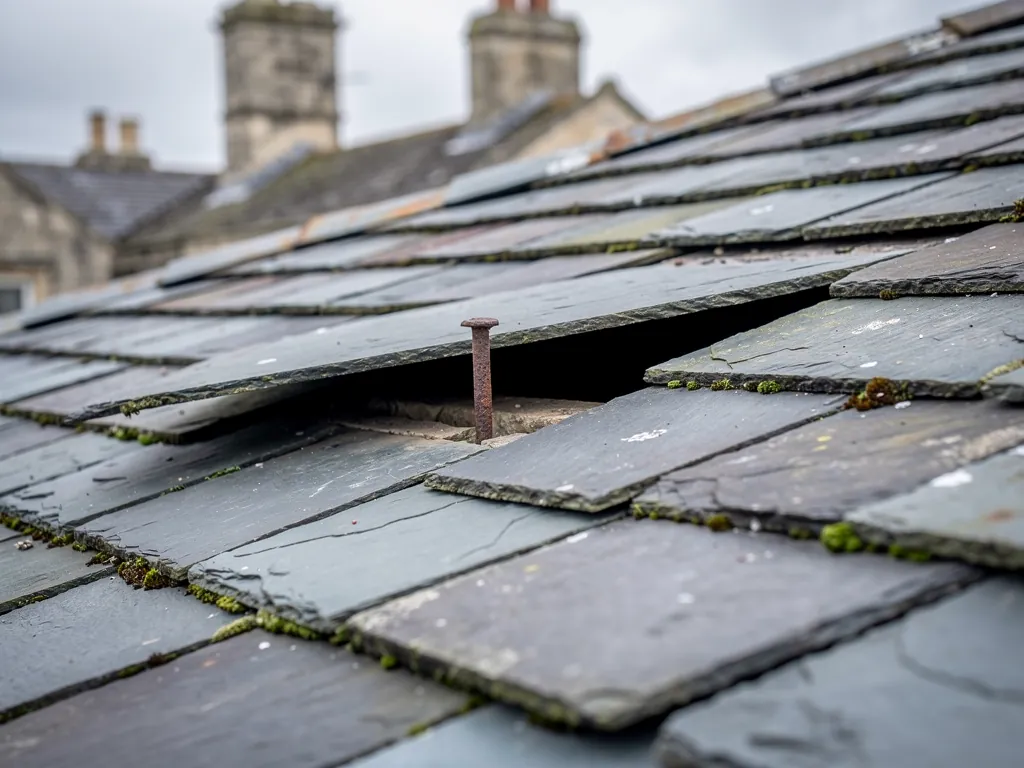
Slipped natural slate with an exposed nail on a weathered roof

The short answer

By working with the roof that is there. Old timbers have moved, coverings have been patched, and the aim is to cure the fault with matching materials rather than strip more than necessary. A survey with photographs shows the true state of the slope and decides how much work is needed.

A village with a Norman church, a Hospitallers' gateway and Domesday mills has roofs that have outlived several owners and several rounds of repairs. The sensible approach on all of them is patient and specific, and it starts from the building, not from a product list.

Why find the cause first?

Water often shows itself far from where it enters, running along a rafter or a felt lap before it drips. A stain in a bedroom may start at a slipped tile, a cracked valley, a failed chimney flashing or a gutter that has been overflowing against the wall. We trace the route before we propose anything, because treating the stain instead of the cause is the commonest way for a repair to fail within a season or two.

How is the existing covering matched?

Tiles and slates are replaced to match the size, colour and texture of the existing covering. Where a roof is stone slate, the courses shrink in size from eaves to ridge, so replacement stones must be chosen to fit that pattern. Our Cotswold stone roofing page explains how those roofs are laid and why reclaimed stone is handled with care.

Why do the fixings matter as much as the covering?

On many old roofs the covering outlasts whatever holds it up. Rusted nails, rotted pegs and softened battens let sound tiles slip. Replacing those, instead of the whole covering, is often the better answer and the cheaper one. It also keeps the weathered look of the roof, which matters in a village where so much is old. Pegs, nails and battens are cheap parts of a roof, but they decide how long the expensive parts stay up.

Each visit ends with photographs of your roof and a written quote, so the decision rests on evidence you can look at yourself at the kitchen table.

Q2

Can a converted mill or barn roof stay watertight?

The answer

Yes, with attention to junctions and drainage. Converted buildings have long spans, mixed coverings and added rooflights, and each join between old and new is a place water can enter. A survey that follows every valley, abutment and outlet usually finds the cause of a leak quickly.

Quenington's two mills and its former farm buildings were built to work, not to be lived in. Turning them into homes added insulation, windows and extensions, and the roofs have had to cope with each change that followed.

Where do converted roofs leak?

The weak points are rarely the large slopes. They are the places where one phase of building meets another: a lean-to against an old wall, a rooflight set into a slope, a valley between two ages of roof. Lead flashings, sealed joints and the stepped courses that carry water over a wall all need to be sound for the whole to hold. A single dried-out sealant joint can undo an otherwise good roof.

How does a big roof drain?

A big roof sends a lot of water to a small number of gutters. If the outlets block with leaves, water backs up under the lower courses or spills over the top of the gutter and runs down the wall. Cleaning outlets, resetting falls and fitting wider downpipes can solve a problem that looks like a failed roof, at a small part of the cost of re-covering. Cast iron or aluminium may suit older buildings better than plastic, and we say which when we write the quote. Our gutters, soffits and fascias page covers the repair options.

Can insulation cause what looks like a leak?

A roof insulated during a conversion has to be able to breathe. Where ventilation was overlooked, condensation can form on the underside of the covering and look exactly like a leak. We check for that before blaming the tiles, and we explain what the answer would involve, which is sometimes as small as a few vents at the eaves. Where a roof has been lined, boarded or sprayed on the underside, we say what we can and cannot see from the loft before offering a view.

Our view

Trace every junction before blaming the covering, because conversions leak at the joins.

Q3

Who needs to approve roof work in Quenington?

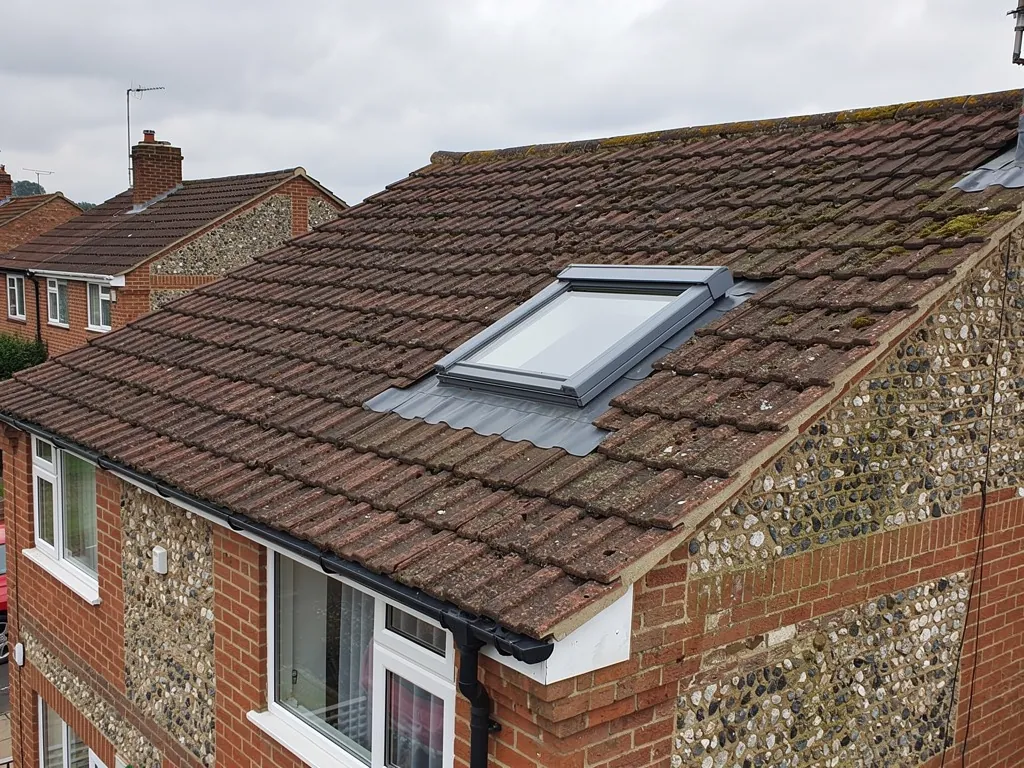
Roof window fitted into a brown tiled roof slope
Rolled lead roof covering over a bay above white windows

The short answer

Most repair work needs no approval whatever. Cotswold District Council acts as planning authority and also runs the building control team that deals with notifiable work. Consent is needed for any alteration that would touch what makes a listed house special, and a conservation area makes a change of material worth a call first.

Three different questions get mixed together when people ask whether roof work needs permission, and it helps to pull them apart before you spend any money.

Is planning permission needed?

Repairing a roof, or re-covering it in the same material, is not usually a planning matter, because the building does not visibly change. Quenington's conservation area was designated in 1979, and the village has several Grade I listed structures, so a change of material, a new rooflight on a visible slope or an altered chimney is worth raising with Cotswold District Council before you commit. For roof windows in particular, our guide to roof window planning sets out the questions to ask.

What if your Quenington house is listed?

Anyone who owns a listed building must obtain listed building consent before altering anything affecting its character, and the roof covering is a large part of that character. We begin with the same material laid by the same method, and any departure is talked through with you before a single order is placed. With Quenington's Grade I buildings so close to ordinary houses, it is worth checking the list entry for your own address before you assume either way.

Will a bigger Quenington re-roof need building control?

Once a re-roof grows past certain limits, Building Regulations apply and the insulation in the roof may have to be improved. Cotswold District Council runs its own building control team, and a registered building control approver offers a private alternative. We explain what applies to your roof and we lodge the notification whenever the work is notifiable, so you are not left holding the paperwork. Ask the council early if you plan to insulate at the same time, since new insulation and a new covering are often best done together.

MythRoof repairs in a listed village need permission every time.

FactRepairs in matching materials rarely do; changes to the look, or to the roof covering of a listed building, are the points on which the council will want to be consulted.

Questions from the Coln valley

Is a house beside St Swithin's churchyard harder to re-roof?

Not necessarily, and we do work on houses and outbuildings around it. The church itself is a Church of England building with its own procedure for repairs, so that goes through the parish. For neighbouring houses that are listed or inside the conservation area, we agree materials and method with you and, where needed, with the council. We would rather ask a question first than undo a job later.

Is Quenington beyond where you usually travel?

No. It is comfortably inside the 30 road miles we cover. Fairford, Cirencester and the villages along the Coln are all close, and our areas page lists each place we work, so you can see where your own address sits in relation to them. A survey visit to a village this close to Cirencester and Fairford is a routine run for us, not a special trip.

Why do roofs beside the Coln grow so much moss?

Damp, still air and shade from trees keep surfaces wet for long periods, and moss does the rest. It holds water against tiles and stone and can block valleys and gutters. Gentle removal, followed by a close look at the surface underneath, is better than heavy pressure washing, which can harm delicate coverings and drive water under laps.

Do old Quenington outbuildings with sheet roofs contain asbestos?

Some may. A building made or refurbished before 2000 should be treated as possibly containing it. Do not drill, break or scrub suspect cement sheets. Taking intact asbestos cement sheets away carefully is work that needs no licence, but the waste must be consigned correctly, so ask before disturbing anything.

Ask us about your roof

Tell us what’s happening and we’ll call you back.

  • Photos of what we find
  • A written quote
  • 10-year workmanship guarantee

Or call 01793 626096

Call Get a quote