Clay tile and slate rooftops of brick market-town terraces

Roofers in Latton

Roof repairs, re-roofing, moss removal and flat roofs in Latton, the Thames-side village by the Roman Ermin Way, from the twelfth-century church and older cottages to farm buildings and modern homes.

Latton's roofs, between the Thames and the Churn

Stone slate roof on a village church
The church and its Victorian rebuilding

Latton's parish church, dedicated to John the Baptist, dates from the twelfth century, was partly rebuilt by William Butterfield between 1858 and 1863, and was designated Grade I in 1955. Historic England's list entry records a stone slate roof over walls of limestone rubble, squared stone and some ashlar. Stone slate is laid in courses that diminish from eaves to ridge, so every replacement has to match the length and thickness of the stones beside it, and a patch of the wrong stone is obvious from the lane. Houses near the church, built to different dates, bring their own roof types, and we treat each of them on its own merits after a survey from the ground and the ladder.

Moss-covered tiled roof on a cottage
Cottages and houses beside the water

The parish boundaries follow the Thames, the River Ray, the River Churn and the Ampney Brook, so water is never far from Latton. What water nearby does mean is damp air, shaded north slopes and plenty of moss and algae on tiles, slates and flat roofs. Moss lifts tiles, blocks valleys and fills gutters, and wet leaf litter from nearby trees adds to it. A cottage roof with a mossy north slope often needs cleaning, re-pointing at the verges and fresh gutter brackets, rather than a new covering.

Barn conversion with a large tiled roof
Farm buildings and later homes

Latton and Eisey were granted to Cirencester Abbey in 1133, a reminder of how long this has been farming country. Today the village is a mix of farm buildings, barn conversions, older houses and newer homes, so the roofs run from old farm ranges to concrete tile and flat-roofed extensions. Outbuildings and large agricultural roofs may be covered in profiled sheet, which can be fibre-cement of an age that may contain asbestos. We identify before we disturb, and treat unknown sheeting with caution. On the newer houses, the usual faults are ridge bedding, cracked tiles and worn flat roof edges.

From Swindon up the Ermin Way corridor

Map showing Latton and central Swindon. 11 road miles north-north-west of central Swindon.

Distance
11 road miles north-north-west of central Swindon
Council
Wiltshire Council
Council
Wiltshire Council
Setting
A parish bounded by the Thames, Ray, Churn and Ampney Brook, by the Roman Ermin Way
Church
St John the Baptist, designated Grade I in 1955

Roof questions beside the Thames in Latton

Should I clean the moss off a Latton roof or replace it?

Usually clean and repair. Moss is a sign of damp air, not necessarily a failed roof. We remove it by hand, check the tiles underneath, and replace only the ones that have cracked.

Can you match stone slates like those on St John's?

Often, yes. We compare length, thickness and colour against the sound stones, and move good ones from hidden slopes to fill gaps on the visible ones, so the coursing is kept.

Is Latton in Wiltshire Council's area for building control?

Yes. Latton is in Wiltshire, so notifiable re-roofing goes to Wiltshire Council's building control team or a registered building control approver.

Q1

How do you repair stone slates such as St John's?

Roofer repointing a stone chimney stack above lead flashing
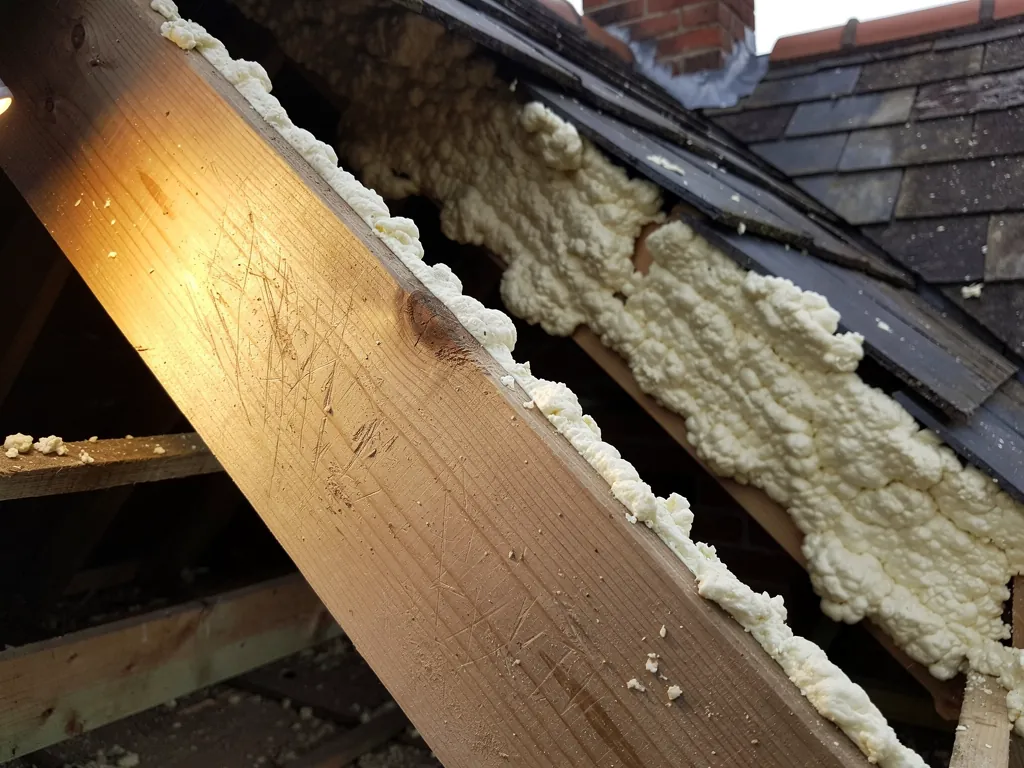
Scraped-back rafter beside thick spray foam under a slate roof

The short answer

By matching, not by approximating. The stones step down in size from eaves to ridge, so a repair only looks right when each new or reused stone has the length and thickness of its neighbours. Work starts with sorting and sampling, and the slope is rebuilt course by course.

St John's was partly rebuilt by William Butterfield between 1858 and 1863, and its list entry describes a roof of stone slate. Whether that covering is on the church or on a house, the principle for repairing it is the same: the coursing is part of the design.

Why is the coursing so easy to spoil?

A stone slate roof depends on each course running level across the full width of the slope, with the stones getting gradually smaller towards the ridge. Put in a stone of the wrong length and the course steps; use one that is too thick and it sits proud, leaving gaps that let water in. Slipped or cracked stones are therefore replaced from matching stock, and never from whatever is to hand.

Where does matching stock come from?

Sound stones from the back or hidden slopes can be moved to the front, with new matching stone placed where it will not be seen. Where a roof has been patched before with the wrong material, we point it out in the survey photographs so you can see what went wrong. Ridges, hips and valleys on these roofs have their own cut stones and lead, and each detail needs to be copied faithfully.

Where does a steep roof let water in?

Steep roofs shed water quickly, so the weak points are usually where roofs meet walls, towers and chimneys. Lead flashings there crack and lift after many years, and are replaced to the correct lead code. Our page on lead roofing explains the codes and what each suits.

A listed building follows its own rules, which we cover in the final chapter.

Roofs of this age also tell their own story. Nail holes in rafters, extra battens and mismatched ridge sections show where earlier repairs were made, and reading them helps us see what has failed before and why. We note them in the survey so the same fault is not patched over a second time.

None of this makes the repair mysterious. It takes time, careful sorting and a set of photographs taken before and after, and those pictures travel with the written quote, which lets you see the same roof we saw.


MythAny stone of the same colour will do for a patch.

FactSize, thickness and profile matter as much as colour, and a mismatch shows from the ground and can let water in.

Q2

Why does moss thrive near the Churn?

The answer

Moss likes damp, shade and slow-drying surfaces, all of which are common near rivers, trees and north-facing slopes. It does not prove a roof has failed, but a thick growth holds water against the covering, lifts tiles and blocks gutters, so it should be dealt with.

Latton's parish is bounded by the Thames, the Ray, the Churn and the Ampney Brook, and the damp air that goes with a river landscape is good for moss. We make no promises about the weather here, but the pattern is familiar from many riverside roofs.

What harm does moss do?

A thin film of algae is mostly cosmetic. Thick cushions of moss are different. They hold water against the tile surface, so frost can split the tile, and they push at the edges of tiles until the overlap opens. In valleys and gutters moss and leaf litter dam the flow, and water backs up beneath the covering.

How is moss cleaned off gently?

Our crew clears moss with hand tools and stiff brushes, starting at the ridge and working downwards so the debris falls clear of the roof. High-pressure washing can strip the surface from tiles and drive water under laps, so we avoid it on older roofs. Once the surface is bare, we look for cracked or slipped tiles that the growth was hiding, and the gutters are emptied.

How do you keep it from coming back?

A treatment applied after cleaning slows regrowth. Trimming overhanging branches, where they are yours to trim, helps more than anything else, because sun and wind dry the roof between showers. See our roof cleaning and moss removal page for how a clean is done and what to expect afterwards.

Timing matters too. A clean followed by a gutter clear-out before the leaves fall gives the roof its best chance of staying dry through the damp months, and any repairs that the clean uncovers can be done in the same visit.

If the moss is heavy and the tiles beneath are soft, a repair or partial re-roof may be the better value, and the survey photographs show which applies.

Q3

What approvals might a Latton roof job need?

Gloved hands fitting a weathered Cotswold stone slate
Brick end-of-terrace gable beside a limestone house, slate roofs

The short answer

Usually none for like-for-like repairs. Larger re-roofs need a building control application to Wiltshire Council or a registered approver, and anything listed, from the Grade I church to a listed farmhouse, needs listed building consent for changes affecting its character.

Latton is in Wiltshire, which means Wiltshire Council deals with building control and planning. Here is how the rules usually fall for a village house or outbuilding.

When does an everyday re-roof become notifiable?

As the Planning Portal explains, you do not normally need building control approval where less than 25 per cent of the total building envelope and less than 50 per cent of the roof is involved, so either figure being passed brings in approval, with a possible insulation upgrade. Approval also applies when the new covering weighs 15 per cent or more above the old. These are Building Regulations points, not planning ones, and the notification itself is something we take off your hands.

Who signs off work on St John's or a listed farmhouse?

St John's is listed at the top grade. It is an Anglican church in use, which puts it under the ecclesiastical exemption, with the Church's faculty system governing any changes. Listed houses and farmhouses have no such exemption: work that would affect their character needs listed building consent, which includes the roof covering.

Is the property in a conservation area?

If your property is near the church or in the older core, Wiltshire Council's planners can say whether any conservation area applies, and that answer belongs in hand before work starts.

Why ask the council first?

Properties near the church or the older farm ranges deserve the most care, because the answers there are less predictable than on a modern estate house, and the council can usually tell you in a single reply.

Matching repairs seldom cause problems. Switching to a different covering, fitting roof windows or changing a chimney can, and a short email to the council before pricing is cheaper than a retrospective application. We will tell you if we think a question is worth asking, and we will not start until it is settled.

Worth knowing

Like-for-like repairs are routine; ask Wiltshire Council before changing a covering on anything old or listed.

Questions from the Ermin Way and the river meadows

What can go wrong on a barn conversion roof in Latton?

Converted barns often have large, unbroken roof slopes with roof windows added, and the faults come from the junctions: flashings around roof windows, valley linings and eaves where the old structure meets new insulation. We trace leaks from the inside as well as the outside, because water can travel a long way along a rafter.

Is a Thames-side cottage roof more likely to hold damp?

It can be, particularly on shaded slopes. Damp air, trees and slow drying encourage moss and algae, and a roof that stays wet ages faster at its edges and laps. Regular gutter clearing and an occasional hand clean usually deal with it before it turns into repair work.

Do you take on farm sheds and stables around Latton?

Yes. We survey and quote for them in writing like any other roof. If the sheets are old fibre cement we treat them as possible asbestos until proved otherwise, and explain what that means for repair or replacement before any work begins.

Can you reach Latton quickly for an urgent leak?

Yes. Latton sits comfortably inside the area we cover. Storm damage and active leaks jump the queue, and the opening job is to stop water getting in. The lasting repair is planned afterwards, once we can see what the weather has done.

Ask us about your roof

Tell us what’s happening and we’ll call you back.

  • Photos of what we find
  • A written quote
  • 10-year workmanship guarantee

Or call 01793 626096

Call Get a quote