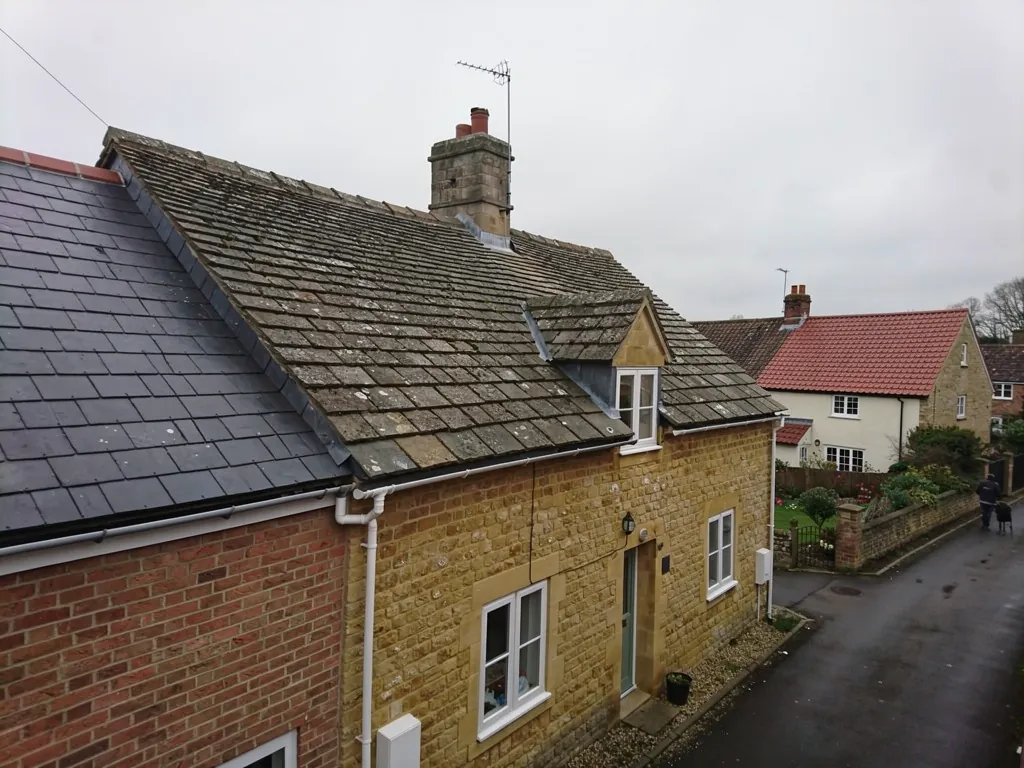
Brick end-of-terrace gable beside a limestone house, slate roofs

Roofers in South Cerney

Pitched roof repairs, stone slate work, extensions and flat roofs in South Cerney, from the old cottages on Silver Street and School Lane to the newer streets built out across the flat Thames flood plain.

South Cerney's roofs, from Silver Street to the lakes

Stone slate on cottages in a lane
Stone slate on Silver Street and School Lane

The council's conservation area statement says that historically most roofs in South Cerney must have had natural stone slates, probably replacing thatch, and it names Silver Street, School Lane and Upper Up as streets where stone roofs are a feature of the cottages. Stone slate is heavy and long-lived, laid with the biggest stones at the bottom and gradually smaller ones towards the top. The stone itself is rarely the problem. Pegs rot, battens soften and lead tires, and those faults let slates slip, so repair usually means renewing the fixings and putting the same stones back.

Welsh slate roofs and chimneys on a terrace
Welsh slate and the red tiled church roof

From the middle of the nineteenth century the same statement records Welsh slate arriving in the village, brought in by the railway, and later plain clay tiles, used on new buildings and as replacements for old stone roofs. Tanners on the High Street is its named example of a Welsh slate roof. Slate is a thinner, lighter material, and its common faults are rusted nails, slipped slates and worn flashings at chimneys and walls. The statement also notes that All Hallows Church has dressed stone walls, a square stone tower and a red tiled roof. Clay tile and slate each age in their own way, so a mixed street like this calls for a survey that treats every roof as its own case. What suits one covering can harm another.

Concrete tile roofs on a modern estate
A large village and its newer streets

With a population near four thousand, South Cerney is a good deal bigger than the old core around the church. Later streets and estates, such as Jubilee Gardens off the High Street, can carry concrete or clay tiles, and owners have added garages, porches, conservatories and extensions over the years. The typical faults are cracked tiles, ridge bedding that has crumbled, valleys choked with moss, underlay that has perished and flat roofs where puddles now linger for days. These jobs are usually straightforward once the cause is traced, and a survey separates the small repairs from the few that really need a larger job.

From Swindon to the Thames flood plain

Map showing South Cerney and central Swindon. 14 road miles north-west of central Swindon.

Distance
14 road miles north-west of central Swindon
Council
Cotswold District Council
Conservation area
South Cerney, first designated on 4 November 1970
Setting
The flat upper Thames flood plain, among former gravel pits, on the River Churn
Council
Cotswold District Council

Questions South Cerney households put to us

Does South Cerney's Article 4(2) direction cover my front roof slope?

Only if your property is one of those the direction names, and the statement is from 2002. Check with Cotswold District Council before changing a front-slope covering or adding a rooflight.

Can South Cerney's Welsh slate roofs be repaired rather than replaced?

Usually. Sound slates can be refixed with new nails or hooks, and slipped or broken ones replaced with matching slate, leaving the rest of the slope alone.

Why do flat extension roofs near the Churn lakes hold water?

Usually because the fall is too gentle or the deck has dipped. Standing water ages a membrane fast, so the lasting cure is to restore the fall, not to coat over the pond.

Q1

What roofs stand on South Cerney's old streets?

Roofers on a slate roof along a limestone village street
Cotswold stone cottage with a steep stone slate roof

The short answer

Natural stone slate on the oldest cottages, Welsh slate from the mid-nineteenth century, and red clay tile on All Hallows Church. The council's statement says most roofs here must once have been stone slate, probably replacing thatch.

South Cerney grew up on the flat gravel terraces of the upper Thames, beside the River Churn, and later quarrying turned much of the surrounding land into lakes. Its older streets show a layered history of roofing, set out in the council's conservation area statement.

Was stone slate the first covering?

The statement's view is that stone slate was the original covering for most roofs, with thatch before it. Stone roofs survive on cottages along Silver Street, School Lane and Upper Up. The pitch is steep and the stones are laid in diminishing courses, big at the eaves and smaller above, each hung on a peg over a batten. Our Cotswold stone roofing page explains how those courses and the ridge are built.

When did Welsh slate and tile arrive?

Slate came from the mid-nineteenth century and gave the Victorian houses a thinner, flatter look. Tiles are a third group, as at All Hallows, where the roof is red clay tile above dressed stone walls. When the three coverings share a street, a repair that suits one can be wrong for another, so the survey notes the covering on every slope.

What about the church, chapel and hall?

All Hallows has a square stone tower and dressed stone walls, and the village also has a United Reformed Church. Larger public buildings carry their own access and safety needs: long ladders and towers are not enough, and a proper scaffold is part of the price. Their roofs often combine pitched slopes with lead gutters and parapets, which need the same patient tracing of leaks as a cottage does.

What does the village hall's thatch show?

The statement also records the Victorian thatched roof of the Village Hall, whose front part was once a barn, a reminder that the older building types here are not all the same. We take photographs of each slope before quoting, so you see the evidence for whatever the written quote recommends.

Q2

Do South Cerney's Article 4(2) rules affect my roof?

The answer

Possibly, if your property is one of the buildings the direction names. The council's statement says the direction requires planning permission for a change of roofing material or a rooflight on the front slope, but the statement dates from 2002, so ask Cotswold District Council to confirm your address.

An Article 4 direction is the council's way of removing a permitted development right in a defined area or for defined properties. South Cerney's is an Article 4(2) direction, and it is narrower than many people assume.

Which houses does it apply to?

The statement describes the direction as removing permitted development rights from certain buildings in part of the conservation area, and a list of those properties is attached to it. It does not apply to every house in the village. If your property is not on the council's schedule, the direction does not bind you, though the conservation area itself still matters for other kinds of work.

What does it cover on the roof?

For the properties it names, the statement says planning permission is needed for a change of roofing material and for rooflights on the front roof slope, along with windows, doors, porches and other items. A matching repair does not change the roofing material, so it is not what the direction is aimed at. Replacing stone with a different covering is exactly what it is aimed at.

Do bigger re-roofs need Building Regulations approval?

Separately from the direction, a large re-cover brings Building Regulations into play. A building control application is not normally needed if the work affects less than 25 per cent of the total building envelope and less than 50 per cent of the roof. Cotswold District Council runs its own building control team, and we tell you where a job is notifiable and file the notification for you.

Why do we check before we quote?

The statement is a 2002 document, and the direction's current status is not something to assume. The council can tell you for your address. Our page on stone roofs in conservation areas explains how that conversation usually goes, and we ask before quoting anything on a front slope.

MythEvery house in South Cerney's conservation area is bound by the Article 4(2) direction.

FactThe statement says it covers a named list of properties, not the whole village.

Q3

How long will a South Cerney flat roof last?

Roofer rolling torch-on felt on a rear extension flat roof
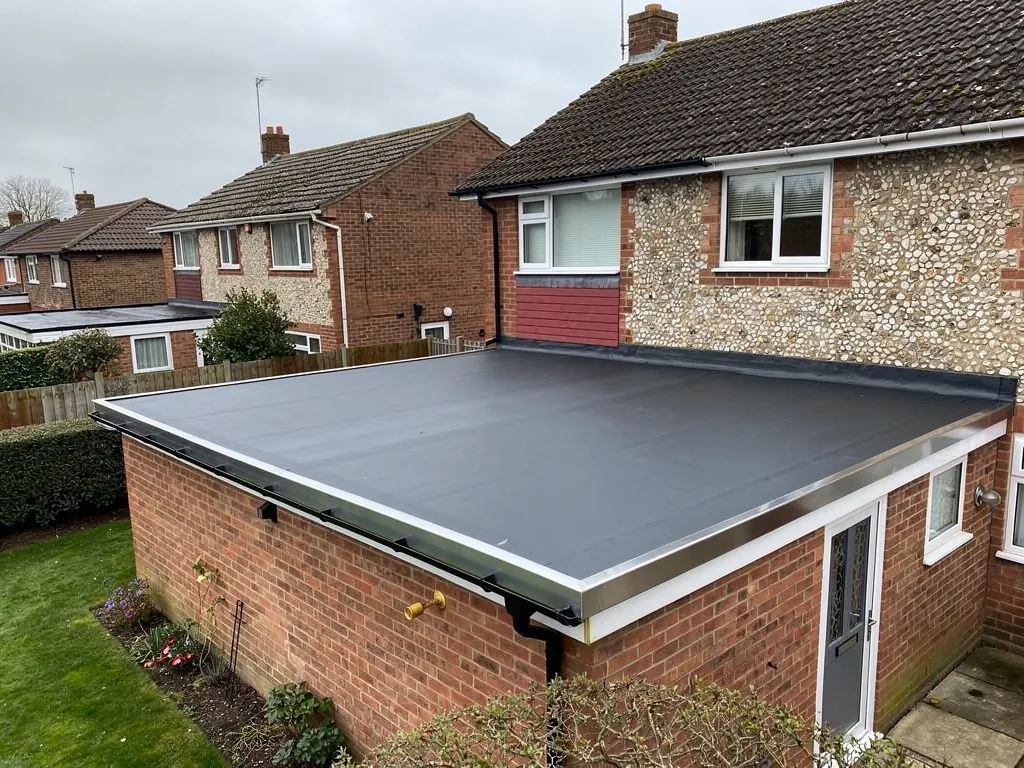
Finished black rubber flat roof on a brick single-storey extension

The short answer

Typical figures from cost guides are 20 to 30 years or more for EPDM rubber, 25 to 40 years for GRP fibreglass, and 10 to 20 years for torch-on felt. Those are ranges, not promises. Workmanship, falls and maintenance move a roof up or down within them.

South Cerney has many extensions, garages and porches with flat roofs, and the choice of covering for them matters more than most owners expect.

Which covering suits the roof?

EPDM is a synthetic rubber sheet, laid in one piece with few joints. GRP is fibreglass resin laid in place and finished with a topcoat. Torch-on felt is a layered bitumen sheet joined by heat. Each has its place, and the choice turns on the outline of the roof, how many upstands and pipes pierce it, and whether anyone will walk on it.

Where do flat roofs usually leak?

Most flat roof leaks start where the roof meets something else: a wall, a window, a pipe or an edge. Upstands that are too low let water creep over, and edge trims that have lifted let it run behind the covering. When we survey an extension roof, we look at those details before we judge the main sheet, because a sound membrane with a failed junction is the commonest story.

Why does the fall matter so much?

Every flat roof is laid to a slope, however slight; it is laid to a fall so that water runs off. Where the fall is poor, water stands, and standing water shortens the life of any covering. Fixing the fall during a re-cover costs more than patching, but it is what makes the new roof last.

Should it be patched, overlaid or replaced?

A small split can often be repaired with a patch or a new section of membrane. A deck that has rotted, or a roof that holds water across its width, cannot be repaired that way and needs stripping back to the boards. Where a patch properly cures the fault, a patch is what the quote recommends.

How firm are these lifespans?

The ranges below come from named guides, and they differ between sources, which is why we treat them as bands. Our flat roofing page explains how we choose between coverings and prices the job after the survey.


Typical flat roof lifespans quoted by cost guides
CoveringTypical lifeSource
EPDM rubber20 to 30 years or moreGreenSpec and Less
GRP fibreglass25 to 40 yearsLess (March 2026)
Torch-on felt10 to 20 yearsLess (March 2026)

Roofing services in South Cerney

Questions from the Churn-side lanes

Why do stone roofs on Silver Street slip even though the stones look sound?

The stone tends to outlive its supports. Pegs perish, battens go soft and nails corrode, so a stone drops out of its course while still perfectly good. We open up the affected patch, put in new timber and fixings, and rehang the same stones in their original pattern, which is a smaller job than a new roof and keeps the street as it was.

Can you reslate a Victorian roof without changing how the street looks?

Yes. Welsh slate can be sorted, the good slates reused, and any replacements chosen to match in size and colour. The aim is a slope that reads as the same roof from the lane, with only its fixings and flashings made new behind the slates.

Do you work on roofs around the lakes and former gravel pits?

Yes, houses and outbuildings around the lakes are within the area we cover. Access can be awkward on small lanes and soft ground, so we look at it during the survey and say how the scaffold or tower will be positioned.

Can mortar alone hold the ridge on an older South Cerney house?

Not on its own. Since BS 5534 was revised in 2014, ridge and hip tiles also need mechanical fixing, using clips and screws or a tested dry-fix kit. Many older ridges still rely on bedding alone, so a rebuild of a loose one adds the fixings, and we point out the others on the same roof.

Ask us about your roof

Tell us what’s happening and we’ll call you back.

  • Photos of what we find
  • A written quote
  • 10-year workmanship guarantee

Or call 01793 626096

Call Get a quote