Victorian brick terrace street with slate roofs and chimneys

Roofers in Somerford Keynes

Somerford Keynes lies beside the Thames in the western Cotswold Water Park, and a damp, tree-lined setting is hard on roofs. We repair, clean and re-cover them, and put the price in writing after a proper look.

Somerford Keynes roofs, from Saxon church to lakeside lane

An old village church beside a quiet lane
The church and the Manor House

The village first appears in writing in AD 685, and All Saints, a Grade II* church, stands on Saxon foundations, was largely rebuilt in the early thirteenth century, gained its tower in 1710 to 1713 and was restored in 1875. The Manor House, listed at Grade II, has a core of the late fifteenth or early sixteenth century, an eastern extension from the 1630s and a north-west wing of 1924. A building built in stages like that has roofs of several ages and pitches meeting at awkward valleys and abutments. On the oldest buildings the work is slow and careful, and we begin by finding out what the roof is made from and how it has been repaired, and only then think about what to lay. Old church and manor roofs also tend to have large, steep slopes, so the access, the safety arrangements and the weight of whatever we carry up all need working out before the first tile is lifted.

Tiled village houses under mature trees
Village houses and cottages

Somerford Keynes stands close to the river, and we never assume a particular local stone. Houses and cottages here may carry stone, slate or clay and concrete tiles, sometimes on the same building after generations of repair. What they share is the setting: trees, shade, damp air and a good deal of green growth. That means moss on north slopes, clogged valleys and gutters filled by autumn leaves. We identify the covering, test a few tiles for soundness and look at the timbers beneath before saying what the roof needs, because the right repair depends on that and nothing else.

A flat-roofed extension at the back of a house
Newer homes, extensions and outbuildings

Later houses, garages, conservatories and extensions fill in the rest of the parish, and a good number include shallow or flat sections where a full pitched roof was never going to fit. Flat roofs by water and trees take a beating: leaves hold moisture on the surface, ponding shortens the life of the membrane and overhanging branches scuff it. Conservatory roofs, whether glass or polycarbonate, age differently again, with seals and glazing bars giving up before the frame does. A short survey tells us whether a patch will serve or age and wear have gone far enough that replacing the whole covering is the better spend. We explain which, with photographs, and leave the decision with you.

From Swindon to the Thames at Somerford Keynes

Map showing Somerford Keynes and central Swindon. 16 road miles north-west of central Swindon.

Distance
16 road miles north-west of central Swindon
Council
Cotswold District Council
Council
Cotswold District Council
Conservation area
Somerford Keynes, designated 31 January 1989 and reviewed 15 March 2018
Setting
Thames-side, in the western part of the Cotswold Water Park

Common questions from Somerford Keynes roof owners

Why does moss build up so quickly near the Thames lakes?

Shade, trees and damp air keep roofs wet for longer, and moss thrives on that. We take it off by scraping, which treats ageing tiles more kindly than a high-pressure jet.

Does the village conservation area limit roof repairs?

Like-for-like repairs seldom do. Swapping one covering for another, or any job on a listed house such as the Manor House, is worth raising with Cotswold District Council before work begins.

Can you reach a roof on a lakeside plot?

Usually, yes. We check how close the water and ground conditions are, where a scaffold can stand safely, and plan the access before the written quote is prepared.

Q1

How do trees and damp wear out a Somerford Keynes roof?

Blocked gutter full of leaves overflowing down a brick wall
Lead-lined valley gutter between two slate roof slopes

The short answer

Wet roofs wear out sooner. Overhanging branches drop leaves and twigs into gutters and valleys, shade lets moss take hold, and trapped water works under tiles, into battens and along flashings. The cure is regular clearing and tidy gutters, with repairs to anything the moisture has already reached.

The parish runs along the Thames in lake country, and that is lovely to live in and demanding for a roof. Water is never far away, the air is often still and damp, and mature trees shade many of the plots.

When does moss start to do harm?

A little moss does a roof no harm. A thick cushion of it holds water against the covering, lifts the edges of tiles and blocks the channels that should carry rain off the slope. On clay and concrete tiles it can be taken off by scraping, which is gentle on the surface. We avoid blasting old or soft tiles with a pressure lance, because the jet can strip the face from them and force water under the laps. MyBuilder's roof cleaning guide (updated 21 August 2026) lists scraping among the methods and says a pressure jet risks harming fragile tiles. Whichever method is used, the aim is the same: clear the growth without wearing away the tile beneath.

Why do gutters and valleys fail first?

Leaves clog a gutter in an afternoon of wind in October, and a blocked gutter overflows down the wall behind it. Valleys, the internal angles between two slopes, collect the most debris and carry the most water, so they fail first. We clear them, check that the lead or tiles lining them are sound and look for signs of water tracking into the roof space.

How do you keep on top of it?

Cutting back branches, clearing gutters once or twice a year and treating moss early prevents most of the damage described here. Our page on roof cleaning and moss removal sets out the methods, and the gutters, soffits and fascias page explains the repairs that go with them.

Q2

Can an old Somerford Keynes building keep its roof?

The answer

Often, yes. A roof that has lasted centuries usually fails at its fixings, lead and timbers well before the covering itself wears out. Repairing those parts, and re-laying the covering where necessary, keeps the building's original character and costs less than starting again with something new.

Buildings like All Saints and the Manor House have been repaired and extended many times, and their roofs record each stage. Keeping an old roof is almost always the right instinct, as long as the structure below can carry it.

Which parts give up before the covering?

On old roofs the covering often outlives what holds it. Nails rust, pegs rot, battens go soft and lead flashings crack through fatigue. A few slipped tiles are a sign to look at the fixings, not only at the tiles. Where the covering is sound but the battens are gone, the better answer is to strip the slope, renew the timber and put the same tiles back. Where tiles themselves are laminating or crumbling, matching replacements are needed.

How is the existing covering matched?

Colour, size and the way a roof is laid all matter on a street people walk along. We match the existing covering, and where a building is listed, replacement material and method are discussed first. Somerford Keynes is a Thames-side village, so we do not guess at a local stone: the roof we find sets the repair.

Can the old frame take a heavier covering?

Putting a heavier covering on an old frame can overload it. A covering 15 per cent or more heavier needs approval under the Planning Portal guidance, so any change of material includes a check on the timbers, and where a roof was built for something lighter we tell you if the frame needs strengthening before anything is ordered. Often the simplest course is to keep the weight where it was. Our roof repairs page explains how we weigh repair against replacement.

Our view

Repair the fixings and lead first; replace a covering only when it has failed.

Q3

Who approves roof changes in Somerford Keynes?

Roofers on a slate roof along a limestone village street
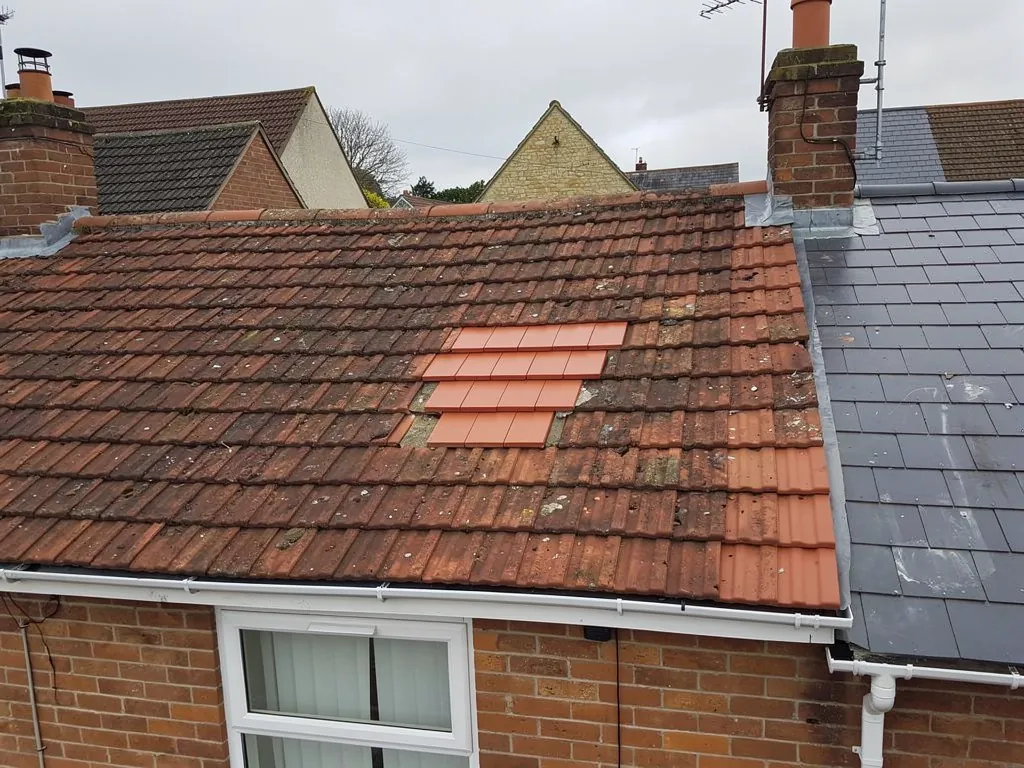
Patch of newly replaced clay tiles on a weathered terrace roof

The short answer

Cotswold District Council handles planning and building control. The village conservation area was designated on 31 January 1989 and reviewed on 15 March 2018. Matching repairs rarely need an application, but a change in appearance, or work on the Manor House or any listed building, should be checked first.

For most roof repairs, nobody needs to approve anything. A tile is replaced, a gutter cleared, a ridge re-fixed. Approval becomes a question once the job alters the building's appearance, its structure or its weight, and that is where a little preparation saves a lot of delay later. It also helps to know who to ask, which is why we set it out here.

What do the conservation area and listing mean?

The council's map records the village conservation area as designated on 31 January 1989 and reviewed on 15 March 2018, and no Article 4 direction is recorded for the village. A straight like-for-like re-roof seldom needs planning permission. All Saints is Grade II* and the Manor House Grade II, and work that would alter a listed building's character, including its roof covering, needs listed building consent. The Church of England deals with its own churches through the faculty system, a separate route from the council's.

Does a Somerford Keynes re-roof need building control?

Larger re-roofs are notifiable under the Building Regulations when they affect 25 per cent or more of the building envelope or 50 per cent or more of the roof. Cotswold District Council runs its own building control team, and a registered building control approver is the private alternative to the council. For a notifiable job we explain what is needed, handle the notification and tell you what the inspector will want to see. Where the work triggers a thermal upgrade, we discuss the insulation options with you first.

What happens if we find bats or nesting birds?

Bats and nesting birds are protected. Roofs near water and mature trees are places where either can turn up, so if we find evidence of them we stop work and take advice before going on. It is better for the animals, and it keeps your project on the right side of the law.


MythWork on a village roof always needs the council's permission.

FactMaintenance in matching materials rarely does; the council steps in when appearance or a listed building is affected.

Questions from beside the Thames Path

How often should a roof near the Cotswold Water Park be checked?

Once a year is a sensible habit, with a second look after a bad autumn of leaf fall. Damp, shaded roofs gather growth and debris faster. A visit covers gutters, valleys, ridges and flashings, and anything urgent is photographed and explained so you can decide what to do.

Is a flat roof on a Somerford Keynes extension worth patching?

Sometimes. We look at the deck, the falls and the membrane, and say whether a repair or a fresh covering suits better. Standing water is the usual enemy, so we check where it collects and why. Typical lifespans run from around 15 to 30 years, depending on the material and upkeep.

Do you cover the villages around Somerford Keynes?

Yes. Somerford Keynes lies well within our working area, and the neighbouring Water Park villages are covered too. For a particular address, ring 01793 626096, use WhatsApp, or pop the postcode into the enquiry form, and you will have an answer quickly.

What does the written guarantee on a Somerford Keynes roof include?

It is a 10-year workmanship guarantee in writing, covering how we did the work. It is not insurance. Your quote lists the exact scope, and once the job is complete we tidy the site and take our waste away.

Ask us about your roof

Tell us what’s happening and we’ll call you back.

  • Photos of what we find
  • A written quote
  • 10-year workmanship guarantee

Or call 01793 626096

Call Get a quote