The short answer
Mostly patient maintenance. Roofs on old village buildings fail at the details first: ridges, valleys, chimney flashings and eaves. Catching those early keeps the covering and the timbers beneath it sound, and often puts off a full re-roof for many years.
Stand by the church wall and you are looking at a building whose walls may be as old as the twelfth century, with wall paintings from the fifteenth or early sixteenth. The houses nearby have not stood that long, but many are old enough to share its problems, and a roof near a church often has a long record of earlier repairs hidden under it.
Q1.1Why do the details fail before the covering?
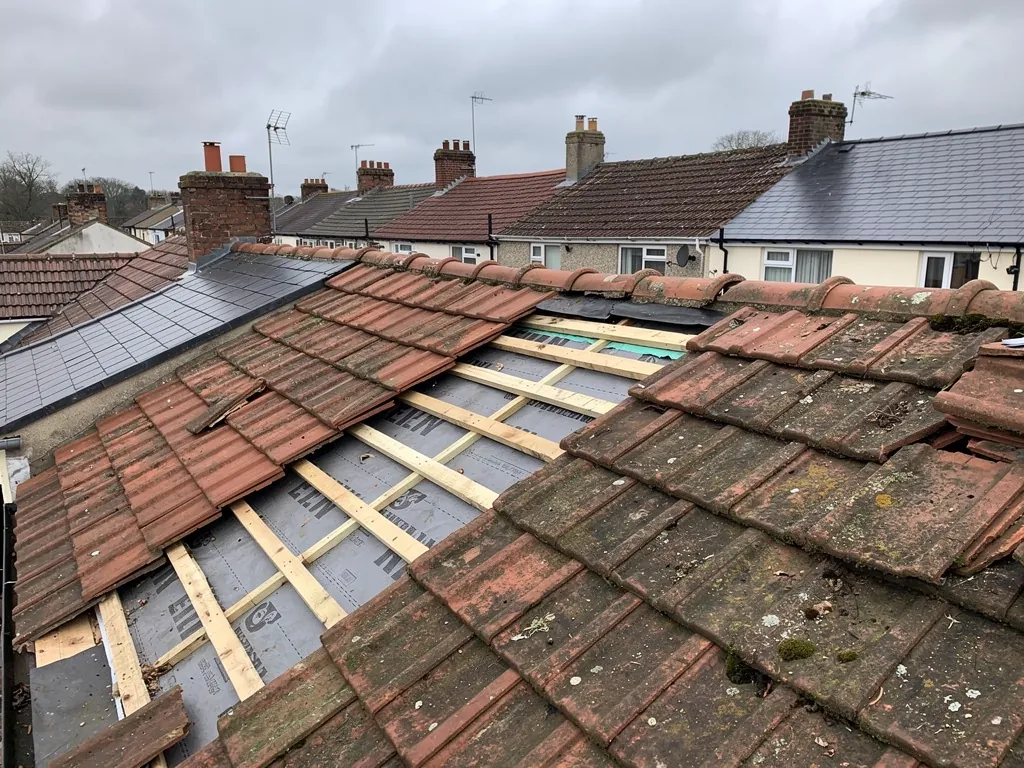
Tiles and slates are seldom what fails first. The ridge is. It runs along the apex of the roof, the join between opposing slopes, and the mortar bedded there years ago cracks, lets water in and loosens the tiles. Once a ridge tile moves, rain finds the gap long before anyone sees it from the ground. Hips, the sloping lines at a corner, and verges, the edges at a gable end, go the same way. Since the 2014 revision of BS 5534, a ridge or hip tile gets clips or screws in addition to its bed of mortar, which no longer carries the load alone. Any re-bed we do in Oaksey is fixed that way, and the ridge is checked end to end for movement.
Q1.2Where do chimneys let water in?
Chimney stacks take in water at three points: the pots, the flaunching, the cap of mortar that seats the pots on top of the stack, and the flashings. Flashings are lead strips turned into the brickwork to seal the join between stack and slope. Lead lasts well, but it moves with the weather, and a stack built into a thick old wall can draw a flashing out of the joint it sits in.
Q1.3What happens to the eaves and timber?
Water that gets in at the eaves rots the rafter ends and the wall plate beneath them, usually out of sight. We take photographs at the eaves from the ladder and again inside the loft, so you can see for yourself what is damp and what is dry before you read the quote.
Our roof repairs page follows a small fault from first look to finished repair, and the chimney repairs page covers stacks in more detail.