Victorian brick terrace street with slate roofs and chimneys

Roofers in Minety

Tiled, slated and flat roofs repaired and replaced in Minety, from the Grade I church in Upper Minety to the homes that grew up around the old railway station in Lower Minety.

Minety's roofs, from clay to railway

Old church roof beside village houses
Upper Minety and St Leonard's

Upper Minety is where St Leonard's church stands, listed Grade I in 1959, a fifteenth-century building on the site of an earlier church and restored in 1896. Buildings around a church of that age are the ones most likely to carry older coverings and old repairs, with roofs that have been patched, re-ridged and re-flashed by several generations. Surveys here look closely at the oldest timbers, the way the gables are finished and any lead around chimneys, because the frame under an old covering decides how long any repair on top of it will last. Chimneys, verges and the junctions of porches and lean-tos with the main roof get the same attention, as does the roofline: gutters, fascias and soffits that have rotted at the ends let water into the very timbers that carry the slope.

Terraced cottages with chimney stacks
Lower Minety and the railway years

Lower Minety grew after the railway arrived. Minety station opened in 1841 on the Cheltenham and Great Western Union Railway and closed in November 1964. Houses and cottages from the railway period onwards are often more than a hundred years old, and their roofs have normally been mended or re-covered at least once. Terraces and semi-detached pairs share party walls and stacks, so a fault at one house can start at the neighbour's chimney; we trace it before quoting. The usual faults are tired nails, cracked or slipped tiles, worn lead at the chimney and ridge tiles with nothing under them but mortar. Each is dealt with on its merits, from a handful of refixed tiles to a full re-cover.

Converted barn with a large roof
Farms, barns and newer homes

Minety lies in north Wiltshire between Malmesbury and Swindon, with the Swill Brook forming part of the northern parish boundary. In a rural parish like this, roofs include converted barns, farm outbuildings, garages and newer houses on the edge of the lanes. A conversion often brings a large span, rooflights and insulation that must be ventilated properly, while an outbuilding may have a profiled sheet roof. We start every survey by identifying the covering, because the right repair for a clay tile, a concrete tile and a sheet roof are three different jobs. Flat-roofed extensions and farm lean-tos need their own look at falls, upstands and where the rainwater goes once it leaves the roof, and a garage or a porch is often the first part of a property to show its age.

From Swindon out across the clay vale

Map showing Minety and central Swindon. 13 road miles west-north-west of central Swindon.

Distance
13 road miles west-north-west of central Swindon
Council
Wiltshire Council
Council
Wiltshire Council
Setting
A clay-vale village in north Wiltshire, with the Swill Brook on its northern boundary
Rail history
Minety station, open 1841 to 1964

Minety roof questions

Why is Minety associated with tile-making?

Local clay was used for medieval pottery and there is evidence of Roman tile-making here. A 1971 dig found ridge-tiles, pans, jugs and pots near the church.

Is a Lower Minety railway-era roof worth repairing?

Often, yes. Tired nails, loose ridges and worn lead are repairable faults. A survey shows whether the covering as a whole still has years left.

Is my Minety house in a conservation area?

Ask Wiltshire Council to confirm it for your address. If it is, we explain what that means before any material changes; matching repairs seldom need consent.

Q1

Do Minety's tile-making roots show on its roofs?

Weathered brick chimney stack with eroded joints and cracked pot
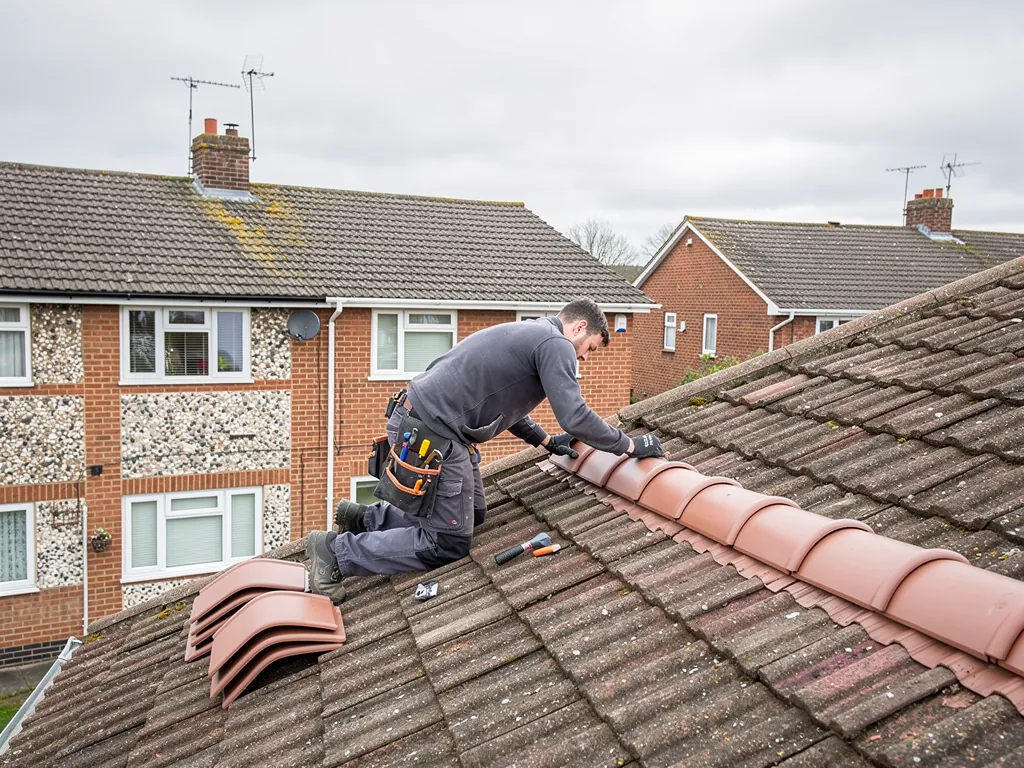
Roofer fixing new red ridge tiles along a concrete tile roof

The short answer

The village history is real: medieval Minety ware, local clay fired with timber from the Forest of Braydon, and evidence of Roman tile-making. That does not tell us what any roof today is made of, so each covering is identified at the survey and repaired in the same material.

Minety has an unusual claim for a roofing page. Pottery known as Minety ware was made in the fourteenth and fifteenth centuries, using local clay fired with timber from the Forest of Braydon. A 1971 excavation at a former hamlet south-east of the church found ridge-tiles, pans, jugs and pots, and there is evidence of Roman tile-making too.

What does the history tell us?

It tells us that clay roofing suited this ground long before the railway came. It does not tell us what is on your roof. A house here can carry clay tile, concrete tile, slate or something else, depending on when it was built and re-covered, so we do not guess.

Why does the clay vale matter?

Heavy clay ground moves with the seasons, swelling when wet and shrinking when dry, and old buildings on shallow footings feel it most. Over decades that movement can crack walls, tilt chimneys and open gaps where roofs meet. When we find a crack at a gable or a leaning stack, we think about the structure under the roof as well as the roof itself, and recommend a surveyor where the movement looks serious.

How is clay tile repaired on older buildings?

Clay plain tiles and pantiles last when they are fixed well. The commonest faults are failed nails, slipped tiles and ridges whose bedding has crumbled. Pantiles, with their curved profile, need careful handling at the verges and the eaves, where the end of each tile must be sealed and supported. We pay attention to the underlay as well, since an old roof often has none, or one that has torn. Our pitched roofing page describes how we repair and re-cover them.

Fired clay is a durable material, and a roof made of it deserves a repair that respects it, with tiles matched by size and colour wherever replacements are needed. Sound tiles are kept and sorted, then put back on new battens with fresh fixings, so you keep the look of the roof and get a new structure beneath it.


Q2

How do roofs in Lower Minety differ from Upper Minety?

The answer

Upper Minety is the older settlement around St Leonard's, while Lower Minety grew after the railway arrived in 1841. Roofs near the church tend to need careful, like-for-like handling, and railway-era houses tend to need attention to fixings, ridges and flashings.

Minety is really two settlements. Upper Minety is the older, with St Leonard's church. Lower Minety grew up after Minety station opened in 1841, and the station then served the village until November 1964.

What suits roofs in Upper Minety?

Near the church, buildings are older and more likely to be listed or to stand beside a listed one. Our approach is cautious: name the covering, track down the cause and repair in the original material wherever possible. For a listed building the starting point is identical materials and method, and any departure is discussed with you first.

What goes wrong in Lower Minety?

Railway-era streets were built quickly, in rows or small groups, so neighbouring roofs often share a problem. Mortar-bedded ridges, flashings at shared stacks and gutters screwed to tired fascias are all worth checking whenever one house on a row needs work. If your neighbour has a repair done, ask them what was found, and tell us when you book the survey. Our chimney repairs page explains how stacks and their leadwork are dealt with.

What about the lanes between the two?

The lanes between the settlements carry houses of many dates. The survey records the covering, the pitch and the state of the timbers on each, so the advice you receive is about your roof and not about the village.

Where a repair would only postpone a larger job, you are told, with the photographs that show why. Equally, where a small repair will do, we do not suggest a bigger one, and the written quote sets out the choice so you can decide with the photographs beside you.

Our view

Treat the church end with like-for-like care and the railway end with attention to fixings and flashings.

Q3

What approvals cover roof work in Minety?

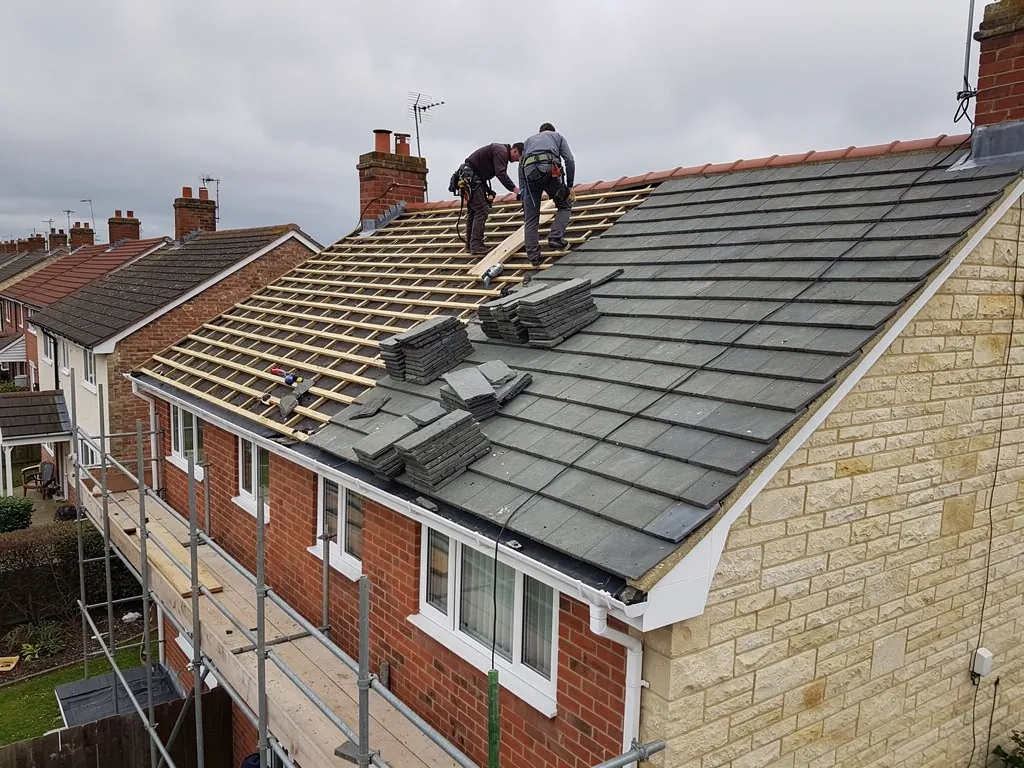
Two roofers fitting grey tiles on a part-battened house roof
Gloved hands fitting a weathered Cotswold stone slate

The short answer

Planning permission is seldom needed for a repair in the same material. St Leonard's is Grade I listed, and whether your own home sits in a conservation area is a question for Wiltshire Council. Larger re-roofs fall under Building Regulations, handled by the council's building control team or a registered approver.

Most upkeep on a Minety roof needs no permission. Rehanging slipped tiles, renewing a cracked ridge tile or fitting a new flashing in identical materials counts as maintenance. A few situations need more thought.

Do conservation areas or listing apply?

Whether any part of Minety is a conservation area is something to check with Wiltshire Council for your own address, and we ask the question at the start of the quote. If you do live in one, a change of covering is worth discussing with the council first. St Leonard's is Grade I listed, and nothing that changes a listed building's character can be done without consent. Where a Church of England church is still in use, the faculty system applies instead of the council. Buildings next to a listed church may be listed in their own right, and the council can tell you.

When does re-roofing need Building Regulations?

Below 25 per cent of the building envelope and 50 per cent of the roof, there is normally no building control application to make. Go past either line and approval applies, sometimes with an insulation upgrade. The Planning Portal also requires approval when the new covering is markedly heavier, by 15 per cent or more. Applications go to Wiltshire Council, whose building control team handles them, or a registered approver can take the job instead; where the job is notifiable we explain each step and make the notification ourselves.

What if bats or birds are found?

Bats and nesting birds are protected. If we find signs of either, work stops until you have been told what that means, and the timing of the job may move to suit.

How is the paperwork kept straight?

Before any covering is changed, we put the proposed material, the extent of the work and any consent questions into the written quote. That gives you a single document to show the council, a lender or a surveyor if they ask, and it means nothing about the approvals is left to chance on the day the scaffold arrives.

MythA listed church next door means your own roof is listed too.

FactListing applies building by building, and the council can confirm your own address.

Questions from Upper and Lower Minety

Why do some Minety roofs have mismatched ridge tiles?

Ridge tiles were often replaced piecemeal as they cracked or lost their bedding, using whatever came to hand. We match the ridge to the roof where we can and, where a whole run has failed, re-bed the lot with mechanical fixings so it looks uniform and stays put.

Can you work on a converted barn roof in Minety?

Yes. Barn conversions bring large spans, rooflights and insulation that needs ventilating correctly. We survey the covering, the structure and the roofline, and report on each. Larger conversions may have been signed off under Building Regulations, so dig out any paperwork before the survey; it tells us what the roof was built to do and what insulation sits inside it.

Do you cover farm buildings and garages around Minety?

Yes, within the 30 road miles of Swindon that we cover. Sheet roofs, felt roofs and tiled outbuildings are each approached differently, and the quote says what is proposed for each building. If an older sheet roof could contain asbestos cement, we handle it carefully and explain what the survey finds.

Is a mortar-only ridge in Minety a problem?

It can be. Under BS 5534:2014 a mortar bed on its own no longer holds ridge and hip tiles; clips or screws do the fixing too. Every survey includes the ridge, and where the bedding is failing we propose added fixings or a dry-fix system.

Ask us about your roof

Tell us what’s happening and we’ll call you back.

  • Photos of what we find
  • A written quote
  • 10-year workmanship guarantee

Or call 01793 626096

Call Get a quote