New-build brick and render estate houses with grey tile roofs

Roofers in Brinkworth

Roof repairs, re-roofing, ridges and flat roofs in Brinkworth, from the stone-roofed church and the older houses along the B4042 to the newer homes strung out on the ridge above the Dauntsey Vale.

Brinkworth's roofs, strung along the ridge

Old stone slate roof on a village church
Around St Michael's church

The parish church of St Michael is Grade I listed, built across the fourteenth and fifteenth centuries, with walls of stone rubble and a roof of stone slate. It is the clearest guide to what the oldest buildings here were once covered with. Stone slate runs from large pieces along the eaves to small ones beneath the ridge, and the whole covering is a serious weight for the timbers underneath. Older cottages and farmhouses near the church may have kept stone slate, or been re-covered in clay or Welsh slate at some point in their lives. We confirm which covering a roof truly has before suggesting a repair, because a patch in the wrong material shows for years.

Mixed tiled roofs along a village road
A linear village on the B4042

Brinkworth is a linear settlement, built out in a long line along the B4042 rather than gathered round a green. A village that grows like that collects houses from every period, so neighbours can have quite different roofs: one steep and gabled with an old chimney stack, the next a low bungalow roof, the next a modern tiled pair. For us that means every job starts from the building rather than the street. Shared party walls, chimney flashings on older stacks and verges where one roof meets another are all places where a leak can begin, and each needs careful inspection, either up a ladder or from the ground with a long lens.

Tiled bungalow roof and flat-roofed porch
Chapels, farms and newer infill

A Primitive Methodist chapel was built here in 1828, a reminder that Brinkworth grew in stages, and Malmesbury Abbey held the manor until the Dissolution. Alongside the older buildings sit later houses, bungalows, garages and extensions, with flat or gently sloping roofs on many porches, lean-tos and rear additions. Those later roofs bring their own faults: ridge tiles bedded on mortar by itself, dry verges that have lost their cement, and felt or single-ply coverings on a flat roof that are well past their best. These are usually straightforward repairs, and a survey tells you whether yours is one.

From Swindon to the Dauntsey Vale ridge

Map showing Brinkworth and central Swindon. 10 road miles west of central Swindon.

Distance
10 road miles west of central Swindon
Council
Wiltshire Council
Council
Wiltshire Council
Setting
A ridge-top village above the Dauntsey Vale, about a mile north of the M4
Church
St Michael, Grade I listed, with a stone slate roof

Roof questions from the Brinkworth ridge

Does a roof on Brinkworth's ridge need extra ridge fixing?

Often a sensible upgrade. On an open ridge-top, ridges and verges meet the wind first, so we add mechanical fixings or specify a tested dry-fix system, instead of trusting bedding mortar by itself.

Can you repair a stone slate roof near St Michael's church?

Yes. We match slates by size, hang them in graded courses and reuse the building's own stone where it is sound. A listed building needs the council's say first.

Which council deals with Brinkworth roof work?

Wiltshire Council. Its building control team handles notifiable re-roofs, and its planning team answers questions on listed houses and any change of covering.

Q1

How should a Brinkworth stone slate roof be repaired?

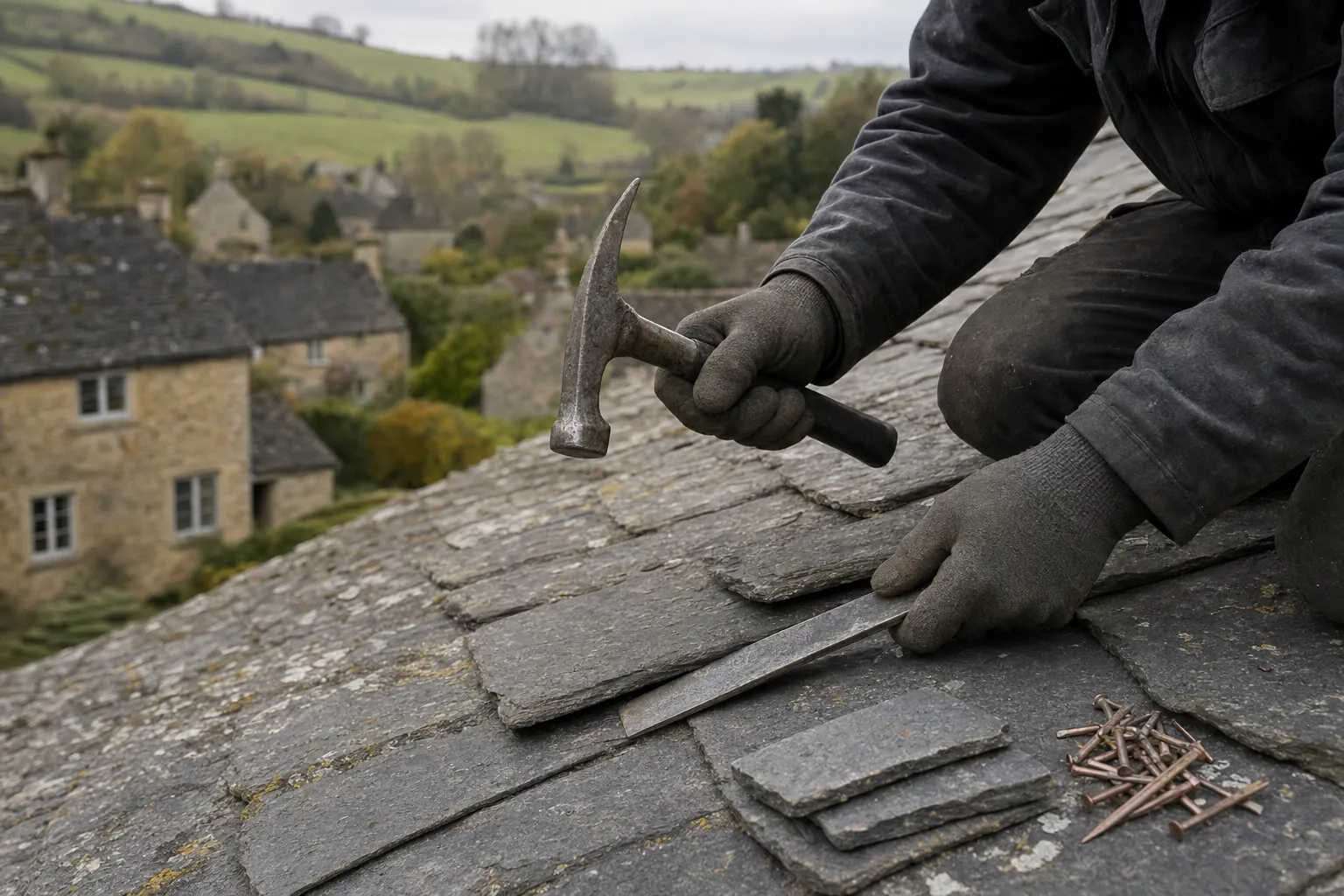
Gloved hands fixing a stone slate with hammer and nails
Roofers on a slate roof along a limestone village street

The short answer

Carefully, and with as little stripped as possible. Stone slate roofs fail at the pegs, battens and bedding long before the stone itself wears out, so the usual repair is to refix slipped slates and renew fixings, then lay the same stone back in its courses.

Brinkworth's parish church has stone rubble walls and a stone slate roof, and that tells you a good deal about how the village was built. Stone slate is a slow, heavy, hand-laid covering, and it is repaired in a different way from slate or tile.

What goes wrong first on a stone slate roof?

The slates hang from battens by a peg or nail through a hole near the top. Pegs rot and nails rust, so slates slip while the stone is still perfectly good. Moss packs into the joints and holds water against the timber. Where the ridge and the gable ends sit, the mortar that once sealed the edges cracks and drops out, and wind then gets underneath.

Can the slope be repaired rather than replaced?

Where only a few slates have slipped, we refix them with new fixings and leave the remainder alone. Where a whole slope is sagging, we lift it in sections, set the stones out on the ground by size, fit new battens, and put the stones back starting with the largest pieces along the eaves and finishing with the smallest under the ridge. Damaged stones are made up from matching stock rather than from whatever is easiest to find.

Why photograph the slope before stripping it?

Before any slate comes off, we photograph the slope so the pattern can be copied exactly. A stone roof has a gentle wave from decades of settling, and we work with that instead of flattening it. Our page on Cotswold stone roofing describes the method in more depth, and roof repairs covers smaller faults.

For a roof you are unsure about, the survey photographs show what has slipped, what has cracked and what is still sound, so the written quote is for the repair the roof needs and nothing beyond it. The workmanship on any Brinkworth job carries our ten-year written guarantee.


Q2

Do roofs on an exposed ridge age faster?

The answer

Not necessarily the whole roof, but the exposed parts work harder. In a ridge-top village like Brinkworth, the ridge line, the verges and the eaves meet the wind first, so those are where fixings loosen and where we look hardest when we survey.

Brinkworth sits on a ridge looking over the Dauntsey Vale, and that position is what separates a roof here from one tucked into a hollow. We do not quote weather figures for the village, but the idea is simple: there is little to shelter a roof on open ground, and gusts find weak fixings quickly.

Where does the wind do its work?

The ridge is the top edge where the two slopes join, capped with ridge tiles. The verge runs up the gable end, the sloping edge where the covering finishes and is sealed against the wall. Both are held with mortar, with clips or with a dry-fix system. Since BS 5534 was revised in 2014, ridge and hip tiles are expected to have a mechanical fixing alongside any bedding mortar. Older roofs often pre-date that, and a ridge bedded years ago may be held by little more than habit.

What do lifting and rattling tiles lead to?

A loose ridge tile rattles in a gale and eventually drops. A cracked verge lets driven rain behind the covering and into the roof space. Neither costs much to put right if caught early, and both are far easier to deal with after a survey than after a ceiling stain appears.

Which repair suits a tired ridge?

For an isolated fault, we re-bed the affected tiles and clip them down. Where the whole line is tired, we take it off and fit a tested dry-fix system, which needs less upkeep afterwards. Our ridge, verge and dry-fix page sets out the options and when each suits a roof.

If you have found tiles on the lawn or heard something rattling above the bedroom on a blustery night, send us a photograph and you will hear our view before you book anything.

MythA ridge that has stood for years does not need checking.

FactMortar-only bedding is no longer relied on, so an older ridge deserves a look at its fixings however long it has stood.

Q3

Who approves roof work on a Brinkworth house?

Brick end-of-terrace gable beside a limestone house, slate roofs
Rolled lead roof covering over a bay above white windows

The short answer

Most repairs need no approval. Larger re-roofs fall to Wiltshire Council's building control team or a registered building control approver, and a listed building, including the church and any listed houses, needs consent for changes that affect its character.

Brinkworth lies in Wiltshire, so the council that answers is Wiltshire Council. The rules are the ones that apply across England, but it helps to know which of them touch your job before you choose a roofer.

Do repairs and re-covering need approval?

Refixing slipped tiles or laying a ridge afresh in the same materials counts as maintenance. According to the Planning Portal, building control approval is not usually required where less than 25 per cent of the total building envelope and less than 50 per cent of the roof is involved. Pass either limit and approval comes into play, which can mean upgrading the insulation as well. Swap to a covering that weighs 15 per cent or more above what came off, and approval is needed for that too. We explain where your job sits against those figures and file the Building Regulations notice ourselves when one is due.

What applies to listed houses and the church?

St Michael's is Brinkworth's Anglican parish church, so for as long as services are held there the ecclesiastical exemption covers it, with changes going through the church's own faculty system. A listed house is different: any work that alters its character calls for listed building consent, and a change of roof covering can be exactly that. Whether a particular house in the village is listed is something to confirm with Wiltshire Council or the national list.

Is my house in a conservation area?

If you need to know whether a conservation area takes in your street, Wiltshire Council's planners hold the maps, so raise it with them before a change of covering is ordered. Repairs in matching materials rarely trouble anyone, but swapping one covering for another deserves a phone call first.

We tell you early when a job is likely to need that conversation, so the paperwork route is clear before a single tile is lifted.

Before you start

Matching repairs are routine, but a listed house or a different covering is worth a word with Wiltshire Council first.

Questions from along the B4042

Why do neighbouring houses in Brinkworth have such different roofs?

Brinkworth grew in a line along the road over a long period, so older stone-roofed buildings sit beside later houses and bungalows. Each period used different coverings and details, which is why we survey the building in front of us, not the street, and quote for what that particular roof needs.

Is it worth re-bedding a ridge on a house near the church?

Usually, if the covering beneath is sound. A ridge is among the cheaper parts of a roof to renew and one of the likeliest places for water to get in, so we re-bed it and fix it mechanically, or fit a dry-fix system, then report on the rest of the slope from the photographs we take on the day.

Do you work on the farm buildings and garages around Brinkworth?

Yes. Barns, garages, outbuildings and lean-to roofs get the same survey and written quote as a house. Some carry fibre-cement or profiled sheeting that needs careful handling, and if we suspect asbestos cement we tell you before anything is disturbed and explain the safe route.

Can you reach Brinkworth for a leak after a storm?

Yes. The village is comfortably within our patch. Leaks and storm damage go to the front of our list, and the first job is always to make the roof safe. The permanent repair follows once we have seen what the weather has done to the covering.

Ask us about your roof

Tell us what’s happening and we’ll call you back.

  • Photos of what we find
  • A written quote
  • 10-year workmanship guarantee

Or call 01793 626096

Call Get a quote