Flat-roofed garages behind brick semi-detached houses

Roofers in Dauntsey

Tiled and slated roofs, chimney stacks, lead and flat extensions looked after in Dauntsey, whether the house stands close to the church of St James the Great or on the far side of the M4 in the Avon floodplain.

Roofs on the Dauntsey Vale floodplain

Old village roofs beside a church tower
Around St James the Great

The church of St James the Great is Grade I listed, with a 14th century nave and aisles, a bell tower of 1620 and a north-east chapel of 1656. A house standing close to a building of that age has often been re-covered more than once, so its roof can carry layers of past repairs: old nails, mismatched patches, flashings put in at different times by different hands. When we survey one, we look at what is actually holding the covering on before we talk about replacing anything. Frequently the lesser job is the correct one: renew the fixings, refix the slipped tiles and renew a failed flashing. Where a roof is listed, the covering stays in the original material and is laid as it always was. Photographs taken from the ridge show how much of the roof has been patched.

Large old house with tall chimney stacks
Park House and the older big houses

Dauntsey Park House, north of the church, has a 14th-century core and is Grade II* listed. Houses with that kind of age tend to have awkward roofs: several ridges at different heights, valleys where one roof meets another, chimney stacks that have been rebuilt, and lead flashings patched time after time. Valleys and chimney junctions are where water usually finds its way in, so we start there. On a listed house the plan is to keep as much of the original fabric as possible, and a repair in matching material is a very different thing from a change of covering. Listed building consent is the legal route when a job changes what the building is. Park House is a reminder that a big old roof is rarely one roof but a set of them joined together, each with its own weak points and its own access problems.

Slate roof on a Victorian house
Canal, railway and later building

The Wilts & Berks Canal was cut across the south of the parish around 1801, passing Dauntsey Lock, and the Great Western Main Line opened north of the canal in 1841. Canals and railways are the reason Welsh slate became an ordinary roof covering for ordinary buildings across the country in the nineteenth century, so slate on a house of that age is no surprise. Dauntsey station opened in 1868 and closed in 1965, and a branch line ran to Malmesbury until 1933. Newer houses often carry concrete tiles, and extensions, porches and garages bring flat roofs, which age faster than pitched ones. A flat porch roof needs different attention from a slate main roof, and the survey treats them separately.

From Swindon out to the Dauntsey Vale

Map showing Dauntsey and central Swindon. 13 road miles west of central Swindon.

Distance
13 road miles west of central Swindon
Council
Wiltshire Council
Council
Wiltshire Council
Setting
The Dauntsey Vale, on the floodplain of the upper Bristol Avon
Church
St James the Great, Grade I listed

Dauntsey roof questions

Does a Dauntsey roof repair ever need the council's say-so?

Matching repairs to an ordinary house usually do not. A listed house is different, because changing its roof covering can call for listed building consent, so ask Wiltshire Council's planning team before agreeing a plan.

Does living on the Avon floodplain make a loft damp?

Not by itself. Lofts go damp from leaks, blocked ventilation and warm moist air rising from the house, and those are the things we check.

Do you work on both sides of the M4 in Dauntsey?

Yes. Both halves of the village are inside our area, and the survey photographs and written quote work the same on either side of the motorway.

Q1

What does the Dauntsey Vale do to a roof?

Blocked gutter full of leaves overflowing down a brick wall
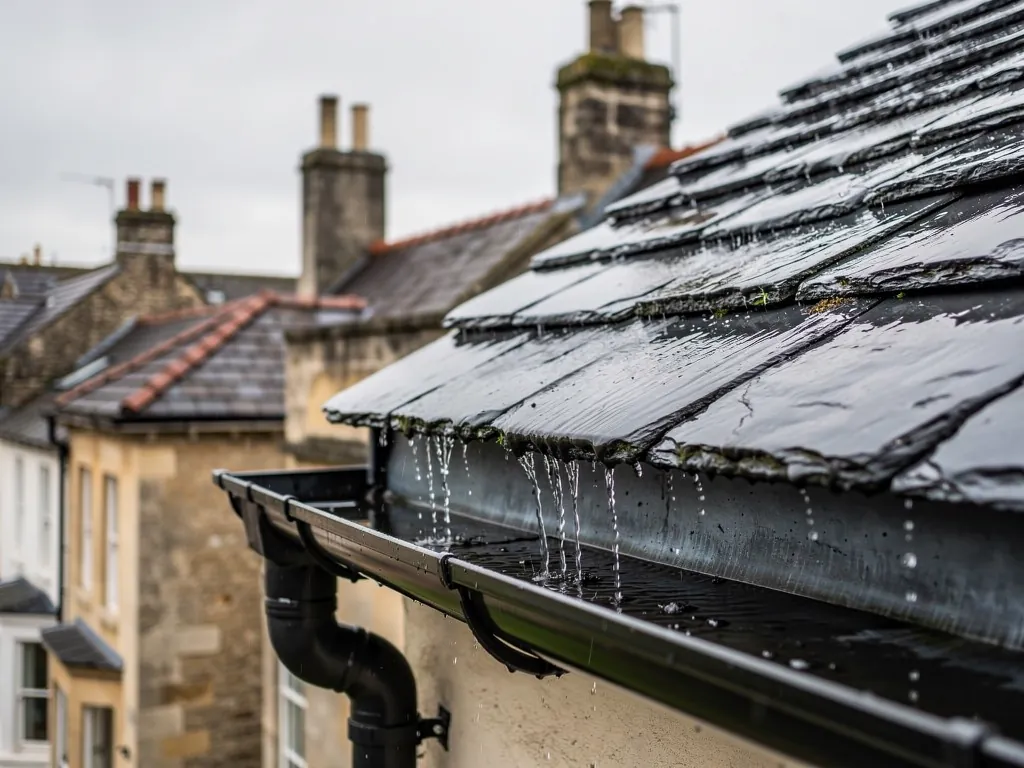
Rainwater running off slates into a black gutter and downpipe

The short answer

Nothing directly, because ground water does not climb onto a roof. The effects are indirect: shaded, damp corners hold moss, and gutters and downpipes that clear badly leave water running down walls and onto roof edges. We start with the gutters and the moss, then look at the loft.

Dauntsey gives its name to the Dauntsey Vale and sits on slightly higher ground within the floodplain of the upper Bristol Avon. Low, level country with a river and a canal nearby is green, sheltered and often damp, and the roofs here live in that air.

Why do moss, shade and leaves matter?

Moss grows wherever a roof stays wet and misses the sun: north slopes, slopes under trees and the lower courses along the eaves. A little moss is cosmetic. A deep mat holds water against tiles and slates, lifts their edges and drops clumps into the gutters, where they block the outlets. We remove it by hand or with a method that suits the covering, and we do not pressure-wash anything delicate. Cleaning is only worth doing if the roof underneath is sound, which is why the survey comes first.

What goes wrong with gutters and downpipes?

Overflowing gutters are a common cause of damp walls and rotten fascia boards. Leaves, moss and sagging brackets are the usual reasons. Where the boards behind have rotted, the fix is renewal, and our roof repairs page explains how we separate a quick clear-out from a repair that needs a scaffold.

Is a damp loft always a leak?

A loft that feels damp is not always a leaking roof. Warm air from bathrooms and kitchens rises into the loft and condenses on cold timbers, and blocked eaves vents make it worse. We look at the underlay, the insulation and the ventilation together, because patching a tile will not cure condensation, and fitting vents will not cure a leak.

If you are not sure which problem you have, send photographs of any ceiling stains with a few of the roof taken from the lane or garden, and the survey will sort one problem from the other. Mention which rooms are affected and whether the marks grow after rain or after a cold night, because that detail points to the cause before anyone climbs a ladder.

Q2

Who decides on work to a listed roof here?

The answer

Wiltshire Council's planning team decides whether listed building consent is needed. Dauntsey has a Grade I church and a Grade II* house, and consent applies to any work that would change a listed building's character, covering included. Matching repairs are usually the easy case, but ask before you commit.

Dauntsey's best-known buildings are old and protected: the Grade I church of St James the Great and Dauntsey Park House, Grade II* with a 14th-century core. Plenty of ordinary houses in the village are not listed at all. What matters for you is which category your own roof falls into.

How do I know if my house is listed?

A listing entry records what is protected, and a call to the council settles whether your address is on the list. Listed building consent is required for works touching the character of a building listed as a building of special architectural or historic interest. Putting a different material on the roof can do that. Swapping a few slipped tiles for matching ones usually does not, but we would rather you checked than assumed.

What do you bring to the conversation?

Before a listed roof is priced, we photograph it close up and write down what is there: the covering, the fixings, the lead, the pitch. Those photographs let the council see exactly what is proposed, and they make our written quote easier to compare with anyone else's.

Are churches different?

Church buildings in use for worship can fall under a separate system of control rather than the council's consent route, and which system applies depends on the denomination. If you look after a church or chapel, ask the body that governs it before anything else, and have the survey photographs ready for them.

For private homes the position is simpler. Begin with a repair in the original material, fixed the original way, and add to that only if the survey shows it cannot do the job. Our slate roofing page covers how we approach older coverings.

Our view

On an old roof the smallest repair in matching material is usually both the right job and the easiest one to get agreed.

Q3

When does a Dauntsey re-roof need Building Regulations?

Rolled lead roof covering over a bay above white windows
Long flat roof on a 1960s brick building being re-covered

The short answer

Rarely for repairs. Staying under 25 per cent of the building envelope and under 50 per cent of the roof keeps most jobs clear of any application. Go past either figure, or choose a covering 15 per cent or more heavier, and Wiltshire Council's building control team or a registered approver has to be involved.

Most roof work in a village like Dauntsey sits well inside the limits, and nobody needs to apply for anything. Knowing where the limits are helps you judge a quote that suggests otherwise.

What are the two thresholds?

The Planning Portal sets two tests for repairs and re-covering. Under 25 per cent of the total building envelope must be affected, and under 50 per cent of the roof; pass both and no application is normally needed. The envelope means the walls, floor, roof, windows, doors and roof windows together. Go over either limit and approval applies, and the whole roof may need its insulation brought up to current standards.

Does the weight of a covering matter?

Swapping to a covering that adds 15 per cent or more in weight is a further trigger for approval, since the rafters must carry the difference. Stone is heavy, and slate is lighter, so the change from one to the other matters. We check the existing structure and the new covering before we quote, rather than finding out halfway through.

Who handles the notification?

Should your roof fall inside the rules, we explain the consent route and make the Building Regulations notification ourselves. That means Wiltshire Council's building control team, or else a registered building control approver, which is the name for private approvers since April 2024. A thermal upgrade, where one applies, is explained before the written quote is agreed, so it never arrives as a surprise on site.

To find out whether your plan is over the line, send a few photographs and the rough size of the roof, and we will tell you before anything is booked. A porch or garage re-cover is usually far below both limits, while a full strip of a main roof may not be.


MythEvery re-roof needs a building control application.

FactRe-covering below the Planning Portal thresholds does not normally need one, though a heavier covering or a larger job does.

Roofing services in Dauntsey

Questions from the church, canal and vale

Why do some roofs in the Dauntsey Vale hold moss so thickly?

Damp, sheltered and shaded roofs stay wet longer, and moss takes hold on the slopes that miss the sun, under trees and along low eaves. A deep mat keeps the covering wet, so we clear it and then check whether the tiles or slates underneath are sound before suggesting any further work. Cleaning a failing roof is wasted money.

Will you repair, rather than replace, an old house near St James the Great?

If a repair truly cures the fault, yes, in matching materials and methods. We photograph the roof, explain the fault and the smallest proper fix, and flag anything that touches a listed building so it is raised with the council before work is booked.

Do you cover the villages near Dauntsey?

Yes. Dauntsey sits inside the area we work across, which reaches every place within 30 road miles of Swindon, and the villages around the vale on the Brinkworth side are covered in the same way. The areas page lists each place we serve if you want to check yours.

Is a flat roof on a Dauntsey extension worth patching?

Sometimes. A small, localised split in a sound membrane can be patched properly. Where the deck is soft, water has travelled under the covering or ponding is widespread, a patch only delays the problem, and a new covering costs less than repeated call-outs. Our photographs show which of the two you face, and the quote we write names the job we recommend and why. Extension roofs on older houses also fail where they meet the main wall, so the flashing there gets as much attention as the surface.

Ask us about your roof

Tell us what’s happening and we’ll call you back.

  • Photos of what we find
  • A written quote
  • 10-year workmanship guarantee

Or call 01793 626096

Call Get a quote