Street of 1960s brick bungalows with concrete tile roofs

Roofers in Great Somerford

Pitched and flat roof work, chimneys and re-roofing for Great Somerford homes, from the stone church and the old manor house by the motte to the newer houses, farm buildings and extensions spread across the Avon valley.

Great Somerford's roofs, from motte to meadow

Old stone church and tiled roofs
Around the church and the Mount House

The village centre gathers around the church of St Peter and St Paul, a Grade I listed building of rubble stone, chiefly 14th and 15th century and restored in 1865. The Mount House, a 16th-century manor refronted in the 19th century, is Grade II* listed. Buildings of this age and standing are repaired rather than renewed. Their roofs have usually been patched many times over, so we study what is really there before proposing anything: the pitch, the timbers underneath, the fixings and the lead at every junction. The aim is the narrowest repair that stops the water, in matching materials, with the council consulted wherever the building's character is involved.

Mixed tiled roofs on village houses
Cottages, farmhouses and later homes

Great Somerford has homes from several periods, so no single roof type describes them all, and that is worth knowing before a survey because the faults differ. An older clay-tiled or slated roof tends to show slipped and cracked pieces, nails that have rusted through and worn lead flashing, the metal that keeps the joint between roof and wall watertight. A later concrete-tiled roof usually gives trouble at the ridge, at the verge (the sloping edge at a gable end) and in the felt beneath. We identify the covering first, with photographs, and we price only what that particular roof turns out to need.

Flat roofed extension with fresh edging
Outbuildings, porches and extensions

Village plots carry more than the main house. Garages, porches, rear extensions and farm-style outbuildings are often roofed in a flat or low-pitched covering, and those roofs generally call for work well before the house roof does. Felt that has blistered, an EPDM sheet (a single rubber membrane) that has lifted at an edge, or GRP (glass-reinforced plastic) that has crazed at a joint can each let water in quietly for months. Mature trees add leaf litter and shade, which keep dampness against a low roof and block its outlets. We look at outlets, upstands and edges first, because clearing a blocked outlet is a far simpler job than laying a new covering.

From Swindon to Dauntsey Vale

Map showing Great Somerford and central Swindon. 15 road miles west of central Swindon.

Distance
15 road miles west of central Swindon
Council
Wiltshire Council
Conservation area
Great Somerford, on Wiltshire Council's list
Setting
Dauntsey Vale, beside the River Avon
Planning authority
Wiltshire Council

What Great Somerford roof owners need to know

Is my house inside Great Somerford's conservation area?

The village appears on Wiltshire Council's list of conservation areas, so confirm the boundary with the council before you change any material. Matching repairs rarely need an application, and we will go through the council's map with you.

Can you repair a roof near the Mount House?

Yes, using matching materials and methods. Where your own home carries a listing, nothing that touches its character should begin before consent is in place, and we settle the method with you and the council before a ladder goes up.

Do the Avon valley trees cause roof problems?

They can. Falling leaves block gutters and valleys, and shade keeps moss alive on a slope. Regular clearing and a look at the outlets often matter more than any large job.

Q1

How does listing affect roofs near St Peter and St Paul?

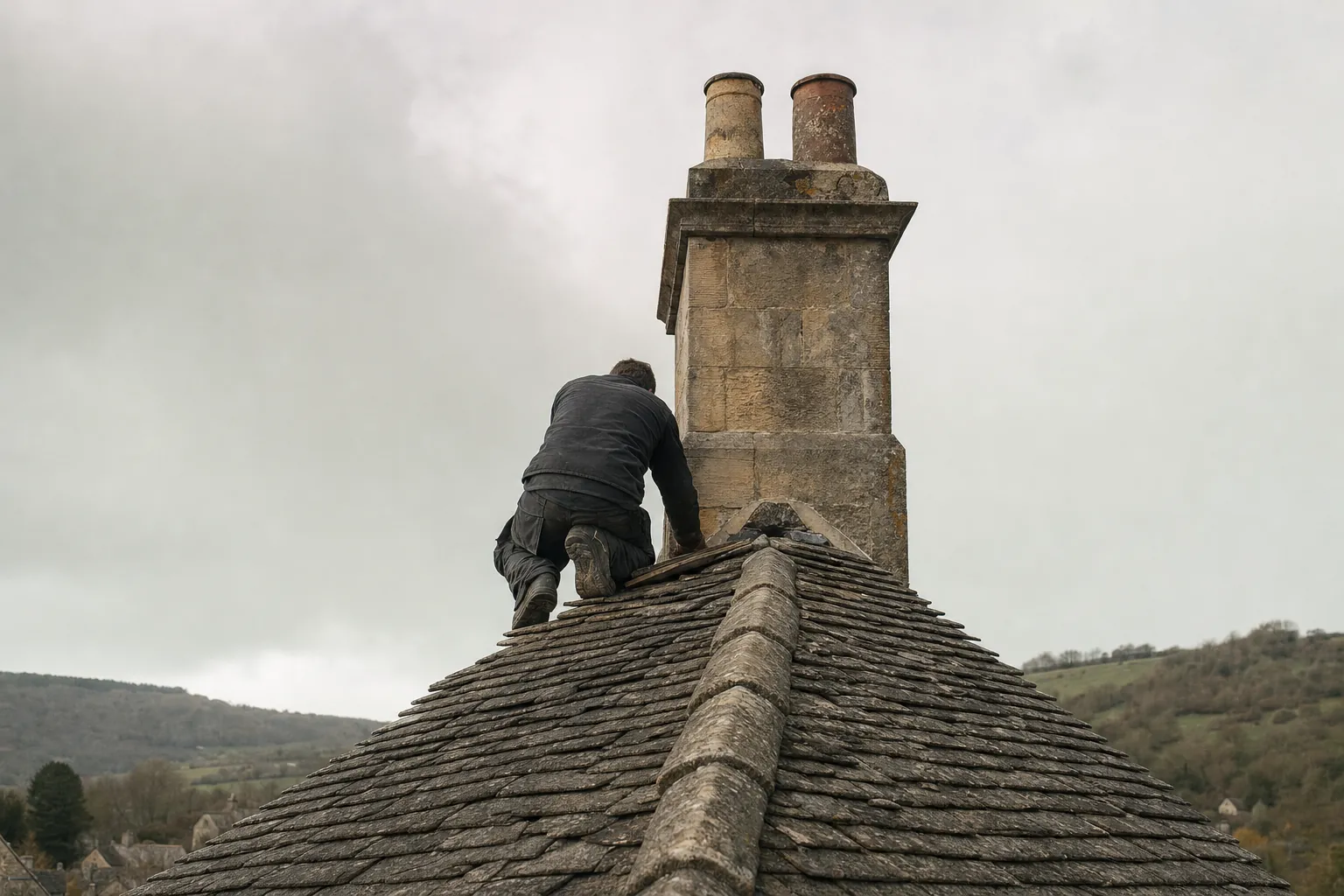
Roofer on a stone slate ridge beside a stone chimney
Roofers on a slate roof along a limestone village street

The short answer

A listed building is protected as a whole, roof included, so a job that would alter its character needs consent from Wiltshire Council. The parish church follows the Church of England's own faculty system instead. A neighbouring private house gets no such exemption, so it pays to ask the council before changing a covering.

The church of St Peter and St Paul stands at the heart of Great Somerford, and the Mount House is not far from it. Both are listed, and the listing shapes how roof work is planned nearby. This answer covers what that means for an ordinary house in the village.

What does a listing actually protect?

A listed building is protected as a whole, roof included. Anything that would change its character calls for listed building consent from the local planning authority, which here is Wiltshire Council. Swapping a covering for a different material, altering the pitch or changing a chimney can all count. Refixing a few slipped pieces in the same material is another matter, but when in doubt, ask the council before work begins. Breaking the rules is an offence, and no roofer should start without knowing where the line falls.

Why is the church treated differently?

Church of England worship still goes on in the parish church, so the ecclesiastical exemption applies: changes go through the church's own faculty system, not through listed building consent. A private house beside it gets no such exemption. If your house is listed, or stands close enough to the church that its roof forms part of the view, the council's conservation officers are the people to ask.

What happens on a survey of an older roof?

We photograph every slope, verge and flashing and note which parts are original. The ridge, the line along the top where two slopes meet, gets particular attention. The written quote then describes the repairs we propose, so you and the council can see exactly what is intended. Our roof repairs page explains the process, and the page on tiled roofs in conservation areas goes further.


Q2

Why does moss keep returning on valley-floor roofs?

The answer

Moss needs damp and shade. A village on the floor of a river valley, with mature trees and damp air, offers both, so a freshly cleaned roof can green over again. Scraping and treating the surface is only half the answer; clearing overhanging growth and keeping gutters flowing stops the dampness building up again.

Great Somerford sits in Dauntsey Vale, near the south bank of the River Avon, and the Brinkworth Brook runs into the river at the parish's north-western corner. Low ground beside water is often damp, and damp is what moss and algae feed on.

Where does moss do real damage?

A thin green film is a cosmetic matter. Thick moss is another thing: it soaks up rain and keeps it pressed against the surface, lifts the edges of tiles and slates, and can plug the small gaps a roof relies on to drain and dry. In a roof valley, where two slopes run together into a channel of their own, a moss mat can turn a trickle into an overflow that finds its way into the loft. Tiled roofs that stay wet for long spells also take frost damage more readily than dry ones.

How can a roof be cleaned without harming it?

Pressure washing can strip the face from concrete tiles and drive water under the laps, so we prefer careful scraping and a soft treatment, then check the roof for cracked pieces. Cleaning tells you something too: once the moss has gone, loose tiles and crumbling mortar are far easier to spot. Our roof cleaning and moss removal page covers the methods in detail.

How do you stop it coming back?

Cut back branches that overhang the slope, keep gutters and downpipes running clear, and have someone look at the roof once a year. A short visit in autumn, after the leaves have dropped, catches most trouble early. Where a shaded slope will not stay clean, we tell you so, and suggest a regular light clean rather than an expensive one-off job that will not last.

MythMoss only spoils the look of a roof.

FactA deep mat of moss stays wet, nudges up tile edges and can choke the gaps that let a roof dry out, so it is worth clearing.

Q3

Who approves a re-roof in Great Somerford?

Rolled lead roof covering over a bay above white windows
Long flat roof on a 1960s brick building being re-covered

The short answer

Most like-for-like repairs need no approval at all. A larger re-roof can fall under the Building Regulations, and Wiltshire Council's building control team, or a registered building control approver, deals with those. Planning questions, including listed buildings and the conservation area, go to Wiltshire Council.

Many people assume any roof job in an old village needs a string of permissions. In practice the routes are quite clear, and we explain which one applies before we price anything.

Does like-for-like maintenance need approval?

Replacing broken pieces, setting a ridge back on its bed or renewing a flashing, each in matching materials, counts as maintenance. That does not usually need planning permission, unless the building is listed or a direction has taken that right away. Where the house is listed, speak to the council first.

Which re-roofs are big enough to need building control?

By the Planning Portal's test, no building control application is normally required while under 25 per cent of the total building envelope and under 50 per cent of the roof is affected. Anything over those figures needs an application, and a thermal upgrade may follow. A covering that weighs 15 per cent or more extra needs sign-off too. In Great Somerford the route runs through Wiltshire Council's building control team or a registered building control approver, and we file the notification ourselves wherever one is required.

What about the conservation area and listed buildings?

The council lists a conservation area for the village, so a change of material or a new roof window on a front slope merits a conversation with the council. Our skylights page covers roof windows. The Mount House is Grade II* listed and the church Grade I, a reminder of how much of the village is protected. Wiltshire Council can tell you whether your own property is among it, and we will happily read the listing details with you before the survey so nothing is missed. Neighbours' roofs can look identical from the lane and still be treated differently by the rules.

Our view

Ask Wiltshire Council before changing a material, and keep every like-for-like repair genuinely like for like.

Questions from around the church and the motte

Is the church roof the same as the roofs on the village houses?

Not necessarily. The church of St Peter and St Paul is built of rubble stone and dates chiefly from the 14th and 15th centuries, while the Church of England's faculty system governs what happens to its roof. Village houses went up and were re-roofed in many different periods, so we identify each covering on survey, with photographs, before recommending any repair. Two neighbouring roofs can need quite different work, and the quote reflects that, with photographs attached so you can see each point for yourself.

Will you take on a barn or garage roof in Great Somerford?

Yes. Garages, barns, porches and rear extensions often carry flat or low-pitched roofs that need different methods from a house. Falls, outlets and edge details come first on our list, and the written quote covers each building clearly, so you can decide what to go ahead with.

Does your area include the Avon valley villages around Great Somerford?

Yes. We work in the villages along the Avon valley and across north Wiltshire, as part of the area within 30 road miles of Swindon. Our full list of places sits on the areas page, and if you wonder whether we reach your address, one call to 01793 626096 or a WhatsApp message will settle it.

Are ridge tiles on old village roofs held on mortar alone?

Often they are, because that was ordinary practice for a long time. After the 2014 revision of BS 5534, ridge tiles stopped being left to rely on mortar, so a re-bedded ridge from us is pinned or clipped as well, or fitted as a tested dry-fix system with no mortar bed at all. Loose ridge tiles are among the first faults we look for, from the ground and again from the ladder, and a rattling one after a gale is a good reason to call.

Ask us about your roof

Tell us what’s happening and we’ll call you back.

  • Photos of what we find
  • A written quote
  • 10-year workmanship guarantee

Or call 01793 626096

Call Get a quote