Rear slate roofs and chimneys of Victorian terraces

Roofers in Lea, Wiltshire

Repairs, replacement roofs and chimney work for Lea, from the houses around St Giles' church to the farm buildings and cottages of a parish that also takes in Garsdon and Cleverton.

Lea's roofs, from church tower to brookside

A village church tower beside tiled houses
Around St Giles' church

St Giles' keeps a fifteenth-century west tower, while the rest of the church was rebuilt and enlarged in 1878, so one building carries two very different ages of roof. A Victorian nave roof and a medieval tower parapet fail in different ways. The tower is a matter of lead, drainage and masonry; the nave is a matter of battens, nails and the valleys between pitches. Houses close to a church of this kind are often older than their roofs, which have been covered afresh at some point in their lives. The question at survey is how much of the original timber still carries the load, and whether the roof was ever stripped back to the rafters or simply patched over. Where roofs sit under tall trees, leaf litter and moss trap damp along the eaves, and a gutter that looks tidy from the lane can be full behind the fascia.

A large old stone house with several roof pitches
Garsdon and the larger old houses

Lea shares its parish with Garsdon and the hamlet of Cleverton, and Garsdon Manor is Grade II* listed: a fourteenth-century house with seventeenth-century additions. Buildings with that sort of layered history are a roofer's lesson in joins. Where a later wing meets an earlier one there is a valley, an abutment or a chimney stack, and each is a spot where rain can get past the covering. Roofs of this age and listing grade are repaired in the covering they were built with, using methods that leave the historic timbers alone, and a change of material is never ours to decide alone. Farmhouses and barn conversions in the parish raise the same questions on a smaller scale, usually with a long run of ridge and several gable ends to keep watertight.

A small chapel with a slate roof
Brookside cottages and the chapel

The Woodbridge Brook runs through the parish and the Charlton Stream marks its western edge, and low ground near water tends to hold damp air and moss. Zion Chapel was built by Calvinistic Methodists around 1808, rebuilt in 1861 and still in use in 2018. A rebuild of that date is the kind of building where we would expect natural slate and check rather than assume. Small cottages, outbuildings and extensions along the lanes usually include a porch, lean-to or garage with a flat or shallow roof. Those age faster than the main roof and tend to be the first thing to leak, so we look at them on the same visit rather than leaving them for the next storm.

From Swindon to the Woodbridge Brook

Map showing Lea and central Swindon. 15 road miles west of central Swindon.

Distance
15 road miles west of central Swindon
Council
Wiltshire Council
Council
Wiltshire Council
Conservation area
Lea, on Wiltshire Council's register
Parish
Lea and Cleverton, with Garsdon

Lea roof questions

Is my house in Lea's conservation area?

Lea has a conservation area on Wiltshire Council's register. Whether your house is inside it depends on the boundary map, so check that before any change to materials.

Can a leak near St Giles' be a tower or lead problem?

Yes. On a church, or an old house with a tower, the leak often sits at lead flashings, parapet gutters or a blocked outlet rather than in the main roof slope, which is why the survey starts at the joins.

Do brookside cottages need different roofing?

Not a different covering, but more attention to moss, shaded slopes, gutters and loft ventilation, because damp ground and overhanging trees keep a roof wet for longer after rain.

Q1

What goes wrong on roofs near St Giles'?

Blocked gutter full of leaves overflowing down a brick wall
Terraced house roof stripped to rafters inside scaffolding

The short answer

Church-side roofs suffer at their joins rather than their middles. Lead flashings dry out and split, valleys silt up with leaves, gutters overflow onto old walls, and fixings on Victorian work reach the end of their life. A tower or parapet adds lead and masonry to the list, and each needs a different repair from a tiled slope.

Lea's church tells you what to look for. The west tower is fifteenth century and the body of the church was rebuilt in 1878, so a single site contains medieval masonry and Victorian carpentry. Houses around it share that mix of old walls and later roofs.

Why do flashings and lead fail first?

Flashing is the strip of metal, usually lead, that seals a roof where it meets a wall or chimney. On old buildings it takes the weather at every junction, and it is the part that fails first. Lead that has been dressed over and over cracks at the folds, and a patch of sealant over a crack only hides the next leak. We read the lead before we touch it: how thick it is, where it has split and why, whether it was ever fixed so it could move with the heat of the day.

What happens when valleys and gutters fill up?

Where two slopes meet in a trough, that trough is called a valley, and under trees it fills with needles and leaf mould. Water backs up and runs sideways under the covering. Gutters next to old walls are the same story: an overflowing gutter soaks a wall for years before anyone sees a stain inside.

How do Victorian fixings fail?

Roofs from the 1878 era were nailed with iron or early steel. After a century and a half the nails corrode, slates slip, and the roof still looks sound from the road. A ladder survey shows it, and so do close photographs, which we send with the quote.

Our roof repairs page shows how we tell a small patch from a bigger repair, and the lead roofing page covers the metalwork in more detail.

Q2

Should a Garsdon farmhouse roof be repaired or renewed?

The answer

Repair when the structure is sound and the covering is failing in patches; renew when the timbers, battens or fixings have gone across a whole slope. On an old house the narrowest repair that works is usually the right one, and a survey with photographs of the roof shows which side of that line it falls.

Garsdon sits in the same parish as Lea, with a Grade II* listed manor and farmhouses of several ages around it. For any house of that kind, the first rule is to avoid doing more than the fault requires. Old roofs are part of the building's character, and each unnecessary strip loses some of it.

Which faults can stay small repairs?

A few cracked tiles, a split valley liner or a loose ridge can be dealt with in a visit. We refix, replace to match and leave the rest of the slope alone. This is the fix to prefer when the battens underneath are sound, which we confirm from the loft side as well as from outside.

When does the roof need renewing?

If battens are soft, nails are rusting through across the slope, or the underlay has perished, patching becomes a repeat cost. A strip and re-cover with sound reclaimed material where it exists, or new to match, then costs less over the life of the roof. We say plainly which route we recommend and why, and the written quote prices it after the survey.

What about the older additions?

A farmhouse that has grown in stages has valleys and abutments where the stages meet. These are the places to inspect on any renewal, because a new covering on a failed junction leaks just as the old one did. Our pitched roofing page sets out what a full re-cover involves.

If the building is listed, the choice of covering is not ours alone to make, and the conversation with the council comes before the quote is accepted.

Our recommendation

Repair what the survey shows is sound, and renew only the slope where the structure has failed.

Q3

Who decides about roof work at a Lea chapel or church?

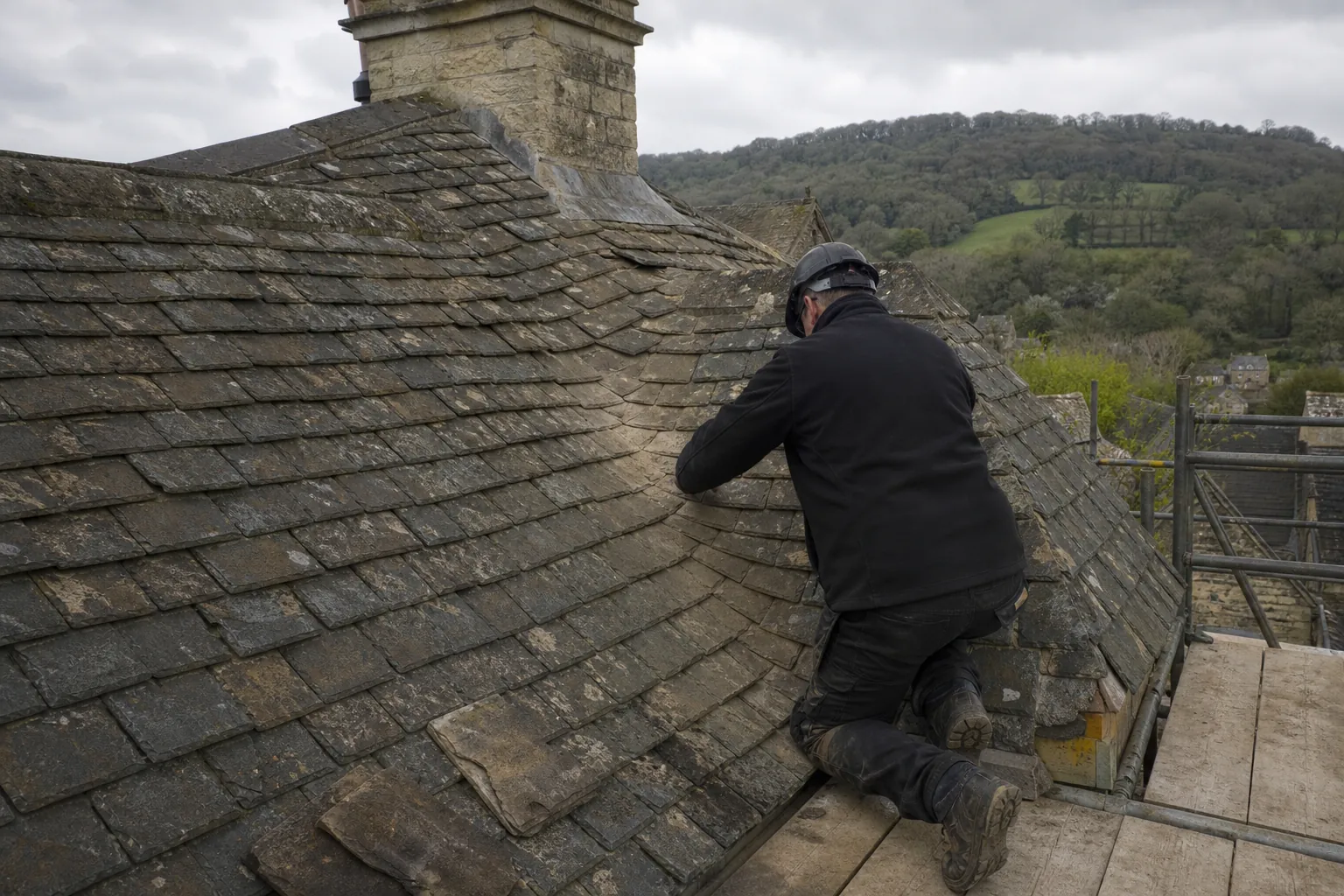
Roofer working on a sweeping stone slate roof valley
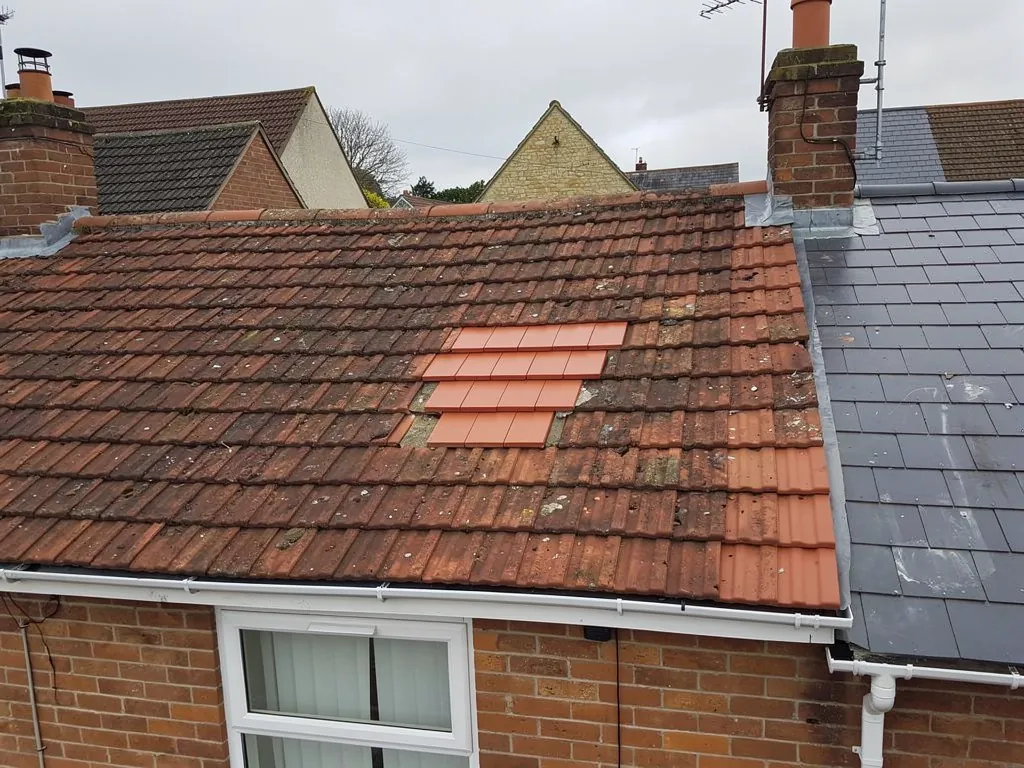
Patch of newly replaced clay tiles on a weathered terrace roof

The short answer

The answer turns on the denomination and the trust that holds the building. St Giles' is still used for worship, so works there go through the diocese's faculty system, not listed building consent. A chapel may need the council's consent if it is listed, so ask Wiltshire Council before any work is priced.

Lea has two places of worship with very different histories, and the route to permission differs for each. This matters mostly to the people who run them, but it also helps neighbours understand why a roof repair can take longer than expected.

How do St Giles' repairs get approved?

The ecclesiastical exemption spares a small group of denominations from listed building consent for churches they still use for worship. The Anglican church is one of them, and its permissions come by faculty from the diocese. St Giles' falls in that group, so its roof repairs follow the faculty route, run by the parish and not by us.

What about Zion Chapel and other chapels?

Zion Chapel passed from Calvinistic Methodists to Congregationalists and then Baptists, and was still in use in 2018. Whether a chapel falls within the exemption depends on the denomination and how the trust holds it, so the owners should ask Wiltshire Council before work is priced. A chapel that has closed for worship is subject to the normal listed building rules.

What applies to an ordinary home?

For a house, planning permission is seldom the issue when the same covering goes back. The Planning Portal sets two tests: work touching less than 25 per cent of the total building envelope and also less than 50 per cent of the roof normally goes ahead without a building control application. Past either limit, approval applies, and Wiltshire Council's building control team or a registered building control approver deals with it. We explain the position and deal with the paperwork where the rules apply.

Lea has a conservation area on Wiltshire Council's register, so a change of covering or the look of a front slope is worth a call first.

MythEvery church roof needs listed building consent for repairs.

FactChurches in use by the main denominations are exempt, and the Church of England deals with works through a faculty.

Questions from along the Woodbridge Brook

Why do Lea's older roofs leak at the walls and not the slopes?

Because the joins are the weak points. Where a roof meets a chimney, a gable wall or a later wing, a thin strip of lead or a bedded flashing keeps the water out, and those strips dry out, crack and lift long before tiles or slates give up. Lead dressed over and over cracks at the folds, so a roof may look fine from the lane while the junctions are close to failing. Pointing out where the lead has lifted, with a close photograph, is the quickest way to show an owner what is happening.

Do you reach Garsdon and Cleverton as well as Lea itself?

Yes. Both lie within the parish of Lea and Cleverton and within our 30 mile range. The roads are narrow in places, so we plan access for ladders and deliveries before the visit, and ask about parking and any overhanging branches when you book the survey.

Will a roof near the Woodbridge Brook grow more moss?

Often, yes. Shaded slopes under trees and roofs in low ground near water stay damp for longer, and moss holds that damp against tiles and slates. We remove growth where it is causing harm and look at gutters and shading so it does not return quickly. Tree work, where needed, is for the owner to arrange.

My ridge tiles are bedded in mortar. Is that still acceptable?

After the 2014 revision of BS 5534, a ridge or hip tile held only by mortar no longer meets accepted practice; each tile is also fixed mechanically. On a village roof where the ridge has been left alone for a long time, we check the bedding and add clips or screws, or specify a ridge system that has been tested as dry-fix, if it is loose. Mortar is not banned, it simply cannot be the only fixing. The change is worth knowing about before you accept a quote that only mentions re-pointing.

Ask us about your roof

Tell us what’s happening and we’ll call you back.

  • Photos of what we find
  • A written quote
  • 10-year workmanship guarantee

Or call 01793 626096

Call Get a quote