Brick and limestone cottages around a small village green

Roofers in Alvescot

Stone-slate repairs, chimney work, re-covering and flat-roof renewals in Alvescot, from the limestone cottages around St Peter's church to the newer homes on the road towards Carterton.

Alvescot's roofs, from limestone cottage to old station road

Limestone cottages with stone-slate roofs
Limestone cottages and stone slate

The West Oxfordshire conservation area appraisal says the village's houses and cottages are generally built from local pale oolitic limestone in coursed rubble and are topped with stone-slate roofs. That sentence explains most of what we are asked to look at. Coursed rubble walls are thick and take up water, so a leaking gutter or a failed flashing soaks into the stone for a long time before it shows indoors. Stone-slate roofs are heavy and pitched steeply, and their faults are slipped slates, failed pegs and open joints at the ridge and the valleys. The appraisal also records an unusually high proportion of eighteenth-century buildings, so many of these roofs sit on timbers well over two hundred years old.

Village church tower above cottage roofs
The church and its neighbours

St Peter's parish church is Grade II* listed. It has a medieval font, a fifteenth-century west tower and was restored in 1872, which tells you how often a village church roof has been rethought. Houses near the church share its setting, and their roofs call for the same care: stone copings at the gables, lead where roofs meet walls and chimneys set into thick masonry. A repair that reuses the right stone and puts lead back with proper laps keeps the group looking consistent, and avoids the odd modern patch that catches the eye from the churchyard. Work close to a listed building is worth discussing with the council before it begins, even when the house itself is not listed.

Garage and porch roofs on village homes
Later houses, extensions and outbuildings

Alvescot is a village of fewer than five hundred people, about one and a half miles south of Carterton, and it has grown beyond its old core. Newer houses, bungalows, garages, porches and rear extensions bring other roofs to the village, and each has its own habits: concrete tiles, clay pantiles, felt and single-ply flat roofs. The East Gloucestershire Railway served the village from 1873 until the line closed in 1962, and the land around the old route has its share of outbuildings, sheds and small workshops, many with felt or sheet roofs that have never been looked at since they were put up. Flat roofs on these buildings tend to fail at the edges and the upstands, long before the membrane is worn through in the middle. From the garden a flat roof can look fine while one corner admits water, and a close look from the ladder settles it quickly.

From Swindon to the Bampton Vale

Map showing Alvescot and central Swindon. 17 road miles north-north-east of central Swindon.

Distance
17 road miles north-north-east of central Swindon
Council
West Oxfordshire District Council
Council
West Oxfordshire District Council
Conservation area
Alvescot, designated in 1988
Setting
Bampton Vale village on limestone, south of Carterton

Alvescot roof questions

Do Alvescot's limestone walls change how a roof leaks?

Yes. Thick rubble walls hold water, so damp appears late and far from the source. We trace the leak from the roof downwards, not from the stain upwards, and the survey photographs show what we found.

Is Alvescot's 1988 conservation area a problem for re-roofing?

Not for like-for-like work. A change of material or a listed building is a different matter, and West Oxfordshire District Council is the place to ask.

How do you deal with an urgent leak in Alvescot?

The village is well within our area. Leaks and storm damage come first for us, and the opening visit aims to stop water entering; the full survey and written quote follow after.

Q1

What holds an Alvescot stone-slate roof together?

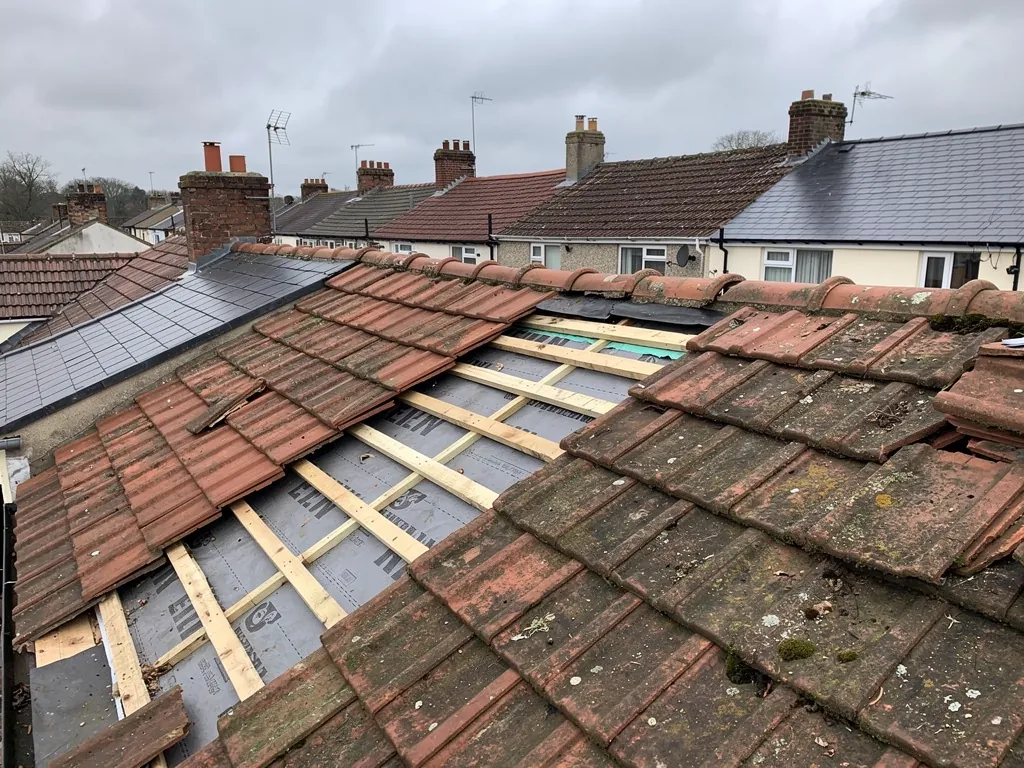
Clay tile roof opened to battens and membrane for repair
Roofer repointing a stone chimney stack above lead flashing

The short answer

Pegs hold each slate to its batten, a timber frame carries the load, and thick limestone walls support the whole. When a leak starts, the pegs, the battens and the lead at chimneys and valleys are the first things to check, long before the stone itself is blamed.

The Alvescot appraisal pairs local limestone walls with stone-slate roofs and says the pairing is general across the village. It also notes that the Bampton Vale sits where geology moves from oolitic limestone in the north to cornbrash limestone, then Oxford clay and river gravels to the south, which is a good reason local builders used what lay close to hand.

Why do pegs and battens fail first?

In the traditional method, each stone slate hangs from a wooden peg driven through a hole at its head. Pegs are small and often the weakest link: they rot or snap, the slate slides down a little and a gap opens. Battens behind them can soften too. A roof with a dozen slipped slates may simply need its fixings renewed, and the slates rehung in their original order. Slates that have split along their bedding, by contrast, are best replaced, because a cracked stone will not hold a peg for long. We keep the sound ones, sort them by size and use them again where we can.

How is lead let into the stone?

Lead is what keeps a junction watertight where the roof meets a stack, a gable or a neighbouring roof. On a stone cottage the lead is usually let into the masonry and pointed. Once the pointing goes, water creeps behind the lead and into the masonry. We repoint with a mortar that suits the stone, and renew the lead if it has split. Hard cement is the wrong choice on old limestone, because it traps moisture and can pull the face off the stone.

How is the right repair chosen?

The right job is often smaller than people expect. Our Cotswold stone roofing page describes the approach to stone slate in general, and roof repairs explains how we decide between patching and replacing.

Q2

Why do Alvescot chimneys and flat roofs fail early?

The answer

Chimneys sit on the most exposed part of the roof, with joints on every side, so pointing and lead fail first. Flat roofs over extensions and outbuildings tend to give out at the edges and upstands. Both are modest jobs when caught early and expensive once water has entered the wall, where it can stay hidden for a whole winter before anyone sees a mark indoors.

A village the size of Alvescot has more chimneys and flat roofs than its skyline suggests. Each one is a place where small faults grow if nobody looks.

Why do chimneys in thick walls leak?

Chimneys on old stone houses are tall and thick, and they carry the weather on all four faces. Mortar between the stones erodes, the flaunching that beds the pots (the mortar collar round each one) cracks, and lead round the base of the stack lifts away. The usual remedy is to repoint with lime-based mortar, renew the flaunching and replace any lead flashings that have split. Where the stack itself has moved, it may need rebuilding to the shoulder or below. Our chimney repairs page explains how we judge which.

How many years will a flat roof on an Alvescot extension last?

Rear extensions, porches and garage roofs across the village are often flat or low-pitched. A flat roof lasts fifteen to thirty years, according to MyBuilder (updated 21 August 2026), depending on the material and how well it was laid. Trouble begins at the perimeter: the upstands against walls, the edge trims, and the collars round rooflights and outlets. Patching works for a localised fault. When the membrane is tired across the whole roof, a new one is the better answer.

Does a new flat roof need more insulation?

Replacing the waterproof layer on a flat roof counts as renovation of a thermal element under Approved Document L, so the insulation may need improving at the same visit. We explain what that means before the quote is agreed.

Any of these jobs can be photographed and assessed on one visit. The written quote follows, and we tell you which jobs are urgent and which can wait.

Our view

Catch a failing junction early and it is a repair; leave it and it becomes a wall.

Q3

Who decides on roof work inside Alvescot's conservation area?

Long flat roof on a 1960s brick building being re-covered
Rolled lead roof covering over a bay above white windows

The short answer

Planning here is decided by West Oxfordshire District Council, and Alvescot's conservation area was designated in 1988. Matching repairs rarely need an application. Swapping materials, or touching a listed building such as St Peter's, should be raised with the council beforehand.

Alvescot's conservation area dates from 1988, and the council's character appraisal for it is a short, readable document that explains what the council values: limestone, stone-slate roofs and the spread of eighteenth-century buildings.

Do everyday repairs need an application?

Rehanging slipped slates, replacing a split flashing or repointing a chimney in matching materials counts as maintenance, with no application involved, and a re-roof in the same material is treated alike. Planning questions arise when the covering changes, say from stone slate to concrete tile, or when the roof's shape or appearance is altered. Because the appraisal values the stone-slate roofs so plainly, a switch away from them is the change most likely to draw the council's interest.

Does an Alvescot re-cover trigger Building Regulations?

Building Regulations apply once a re-cover reaches a quarter of the building envelope, or half of the roof. Approval can also apply if a new covering weighs 15 per cent or more than the old. The building control body may be the council or a registered building control approver; we explain which suits the job and send the notification wherever one is required.

What about listed buildings and St Peter's?

St Peter's is Grade II* listed and is a Church of England church, which puts changes to it through the faculty system. A listed house in the village needs listed building consent before anyone alters its special character, and a different roofing material can count as exactly that. If you are unsure about the status of your own house, the council can confirm it.

Our skylights page covers roof windows, which have their own planning rules and are worth reading before you commit.


MythA conservation area means every roof repair in Alvescot needs permission.

FactMaintenance and like-for-like re-roofing seldom do; it is changes to material or appearance that the council reviews.

Questions from the Bampton Vale

Is a stone-slate roof in Alvescot too old to repair?

Age alone is not the test. The slates can outlast the pegs and battens beneath them, and a roof from the eighteenth century may need only fixings, lead and pointing renewed. We check the timbers from the loft, photograph each slope and recommend a strip only if the structure or the stone is failing. Otherwise the quote describes the least invasive repair that stops the leak, and nothing larger.

Do you work near the old East Gloucestershire Railway route?

Yes, anywhere in Alvescot and the lanes around it. Properties near the former railway are the same mix of cottages, sheds and later homes as the rest of the village, and we survey them in the same way, with photographs and a written quote.

Why are my Alvescot walls damp when the roof looks fine?

Rubble limestone walls soak up water from a leaking gutter, a loose flashing or a failed bit of pointing, then release it slowly. By the time damp shows indoors, the cause may be a long way off. We follow the water back up through the roof and eaves first, and refer you to a damp specialist only if the roof is cleared.

Does a hand-bedded ridge on an Alvescot cottage need replacing?

Not necessarily. If it is sound, it can stay. If it needs re-bedding, BS 5534:2014 means mortar by itself can no longer be trusted, so we add mechanical fixings. A traditional stone ridge is a different case, and we reset it by hand with a suitable mortar.

Ask us about your roof

Tell us what’s happening and we’ll call you back.

  • Photos of what we find
  • A written quote
  • 10-year workmanship guarantee

Or call 01793 626096

Call Get a quote