Edwardian brick villas with clay tile roofs and decorative ridges

Roofers in Aston, Oxfordshire

Aston sits a few miles south of Witney with the Thames along its parish edge, and its roofs run from older cottages in the conservation area to Victorian buildings, farm ranges and newer homes.

Aston's roofs, from hamlet to riverbank

Cottage roofs with brick chimney stacks
The old hamlet and its cottages

Aston was historically a hamlet in the ancient parish of Bampton, and West Oxfordshire District Council designated its conservation area in 1998. The older cottages in a place like this were built over centuries, with later extensions, rebuilt chimneys and patched slopes that rarely match one another. A cottage roof can carry two or three coverings on different sides, laid by different hands. Our survey records which is which, because matching the neighbouring slope in size, colour and laying pattern is what stops a repair from showing. We would rather re-fix a good covering than renew it, and we tell you plainly where that line falls, slope by slope, with a photograph of each one.

Gabled Victorian roofs with decorative ridges
St James and nineteenth century work

The parish church of St James was built in 1839, restored by Joseph Clarke in 1862 and altered again between 1885 and 1889. Buildings of that period tend to share a recognisable roof language: steeper pitches, decorative ridges, carefully detailed gables and verges, and lead where roofs meet walls. Where a house or outbuilding dates from the same era, the slope and the detailing guide the repair. Gables and verges are the parts that take the wind, so the survey also looks at how well the bargeboards and the tiles beside them are held, and their bedding and fixings are what we inspect first on this kind of roof.

Barn roofs and rooflights on a farm range
Farm ranges, outlying hamlets and newer homes

The civil parish takes in Cote, Shifford and Chimney as well as Aston itself, so the roofs include barns, stores, farm buildings and converted ranges as well as houses. Wide-span roofs of that kind move in wind, collect leaves where trees overhang, and often have rooflights. Newer homes in the village bring ordinary concrete or clay tile roofs, where the ridge, a hip or a flat porch roof tends to ask for work years ahead of the main slopes. Garage roofs and rear extensions follow the same pattern, because they are built lighter and covered in thinner material. A survey on this variety of buildings means opening every junction, not just glancing up from the lane.

From Swindon to the Upper Thames

Map showing Aston and central Swindon. 20 road miles north-east of central Swindon.

Distance
20 road miles north-east of central Swindon
Council
West Oxfordshire District Council
Council
West Oxfordshire District Council
Conservation area
Aston, designated in 1998
Setting
An Upper Thames village south of Witney, with the river as its parish boundary

Aston roof questions

Is Aston's conservation area likely to affect a repair?

Putting back the material that is already there seldom raises a question. If the covering or the street view is going to change, raise it with the district council's planning officers before any tiles are ordered.

Do Aston's barns and farm ranges need a different roofer?

They need a different approach, not a different firm. We check spans, purlins, rooflights and gutter capacity, since a long roof sheds a lot of water in one place.

Why does moss collect on roofs near the Thames?

Shade, trees and damp air let moss settle on tiles and slates. It holds water against the covering, so we remove it gently and look for the shaded corners that keep refilling.

Q1

How should we repair an Aston cottage roof?

Reclaimed Cotswold stone slates sorted by length beside a limestone wall
Roofer repointing a stone chimney stack above lead flashing

The short answer

Slowly and in matching material. Cottage roofs here have commonly been reworked more than once, so each slope is mapped first, then repair with tiles or slates of the same size, colour and laying pattern, and only strip a slope when re-fixing cannot cure the fault.

A cottage roof is a record of the house's history. Chimneys have been rebuilt, dormers added or removed, and the covering renewed one slope at a time. Reading that record is the first stage of any repair.

Why map the cottage roof first?

We walk the roof, photograph each slope and note which areas are original and which are later. Original coverings often hold years of life if they are well fixed, and re-fixing them is usually the cheaper and kinder route for the building. Patches from earlier repairs are the usual source of trouble: the wrong size of tile, a cement fillet that has cracked away, or a flashing dressed too stiffly. Before anything is touched, the leak itself is traced to its entry point, a process set out on our roof repairs page.

How is a new slope matched to the old?

If one slope has to be re-covered, the new work needs to sit comfortably beside the old. That means choosing tiles by size, thickness, texture and colour, then laying them at the gauge the existing roof uses. Reclaimed tiles can help, though they must come from a source that does not strip another building of its own roof, and they should be sorted for cracks before they go back up. A visit to a salvage yard with the old tile in hand beats ordering from a picture.

Does Aston's conservation area matter?

Aston's conservation area dates from 1998. West Oxfordshire District Council publishes a map for it, and we advise checking that map and, if your house is listed, asking the council before you commit. Like-for-like repair work rarely needs consent, whereas a change to the roof's visible form or material can.

At handover the garden is left tidy and the rubbish goes with us, and you keep the photographs of what we found, which gives the next owner a record too.

Q2

What does a damp Thames-side village do to a roof?

The answer

Mostly it lets moss, algae and leaf litter build up. Shade and moisture near trees and water keep tiles wet for longer, which can loosen mortar, block gutters and hide a developing fault. Gentle moss removal and regular gutter clearing are the sensible response.

Aston is a village with the Thames as the southern boundary of its parish, and roofs in river country tend to stay damp longer than those on open, windswept high ground. That is a general observation, not a measurement, but it matches what we see on survey: moss in the shaded corners, green staining on north slopes, and gutters full of leaf mould.

What does moss actually do to tiles?

Moss looks harmless and often is. The trouble is that a deep cushion of it soaks up rain and holds it on the tile surface, which means the roof stays wet long after a shower has passed. Removal is done by hand scraping or a soft wash. On older roofs we prefer a gentler approach, since MyBuilder warns that a pressure wash can harm delicate tiles. Hand scraping is slower, but it leaves the surface of the covering intact. Our roof cleaning and moss removal page covers the methods.

How do overhanging trees affect gutters?

Trees near the roof shed leaves, seeds and twigs that block outlets and gutters. A gutter that overflows wets the wall below, rots the fascia and starts damp patches inside. Clearing twice a year is a good habit where trees overhang, and a leaf guard can help where access is awkward. On a long farm-range gutter, a single blocked downpipe can leave a whole slope discharging down the wall.

Will the moss come back?

Moss comes back wherever the shade stays put. After a clean we point out the corners that will refill, so you know what to expect and whether trimming a branch would help more than another wash.

None of this is dramatic work, but it keeps a roof sound for longer and shows up the occasional slipped tile before the rain does.

What it typically costs

  • Flat roof moss removal£300 to £600
  • Pitched roof£450 to £850
  • Tile roof£400 to £750
  • Slate roof£500 to £1,000
National typical ranges for roof cleaning. The written quote for your roof follows the survey, and access and roof size set where it falls. MyBuilder roof cleaning cost guide, updated 21 August 2026.
Q3

Who approves a barn or cottage re-roof in Aston?

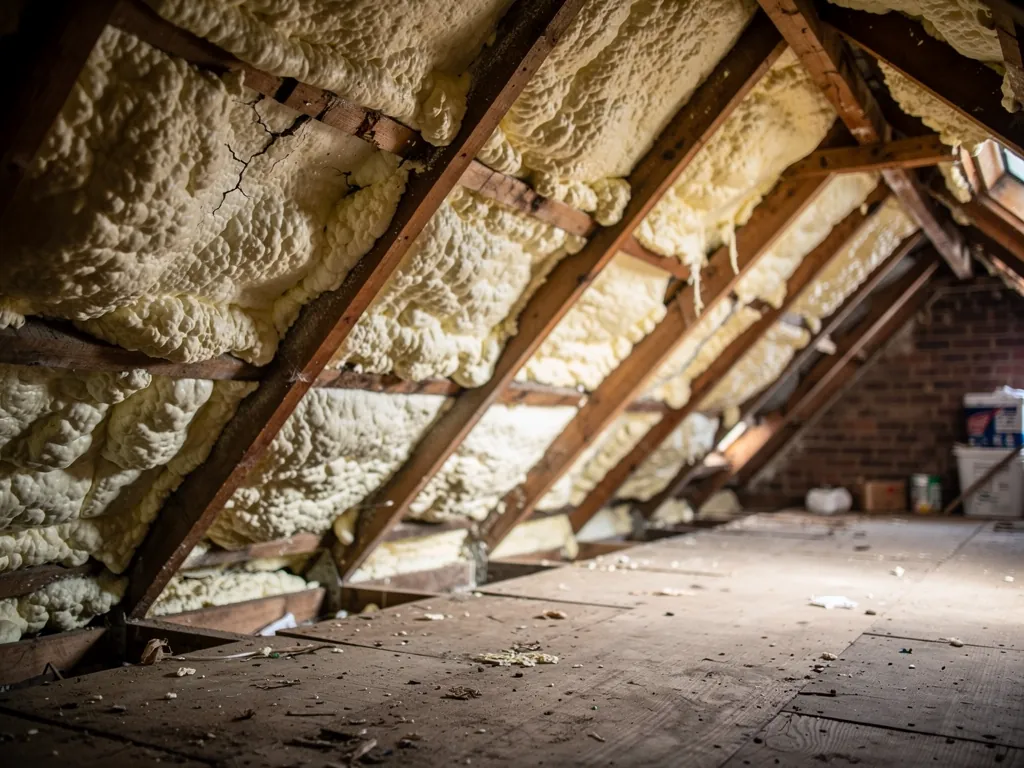
Loft rafters coated in yellowed spray foam insulation
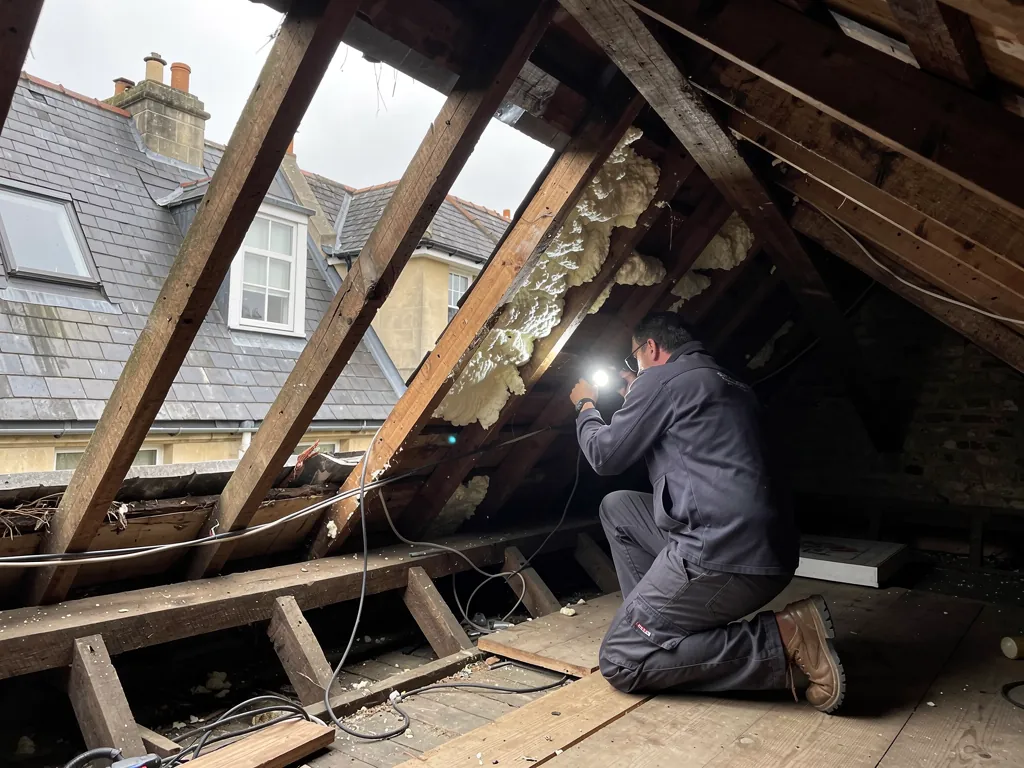
Surveyor checking spray foam on rafters with a torch

The short answer

West Oxfordshire District Council handles planning in Aston. Building Regulations apply to bigger re-roofs, and your building control body can confirm whether yours is notifiable. Work on a listed house that changes its character needs listed building consent first.

Most roof work in Aston needs no application at all. Tidying up a few slipped tiles, a cracked ridge piece or tired chimney flashings with matching materials counts as maintenance. Bigger jobs are where questions begin.

When does a re-roof need approval?

The Planning Portal puts the cut-off for a typical re-covering at under 25 per cent of the total building envelope together with under 50 per cent of the roof. Beyond those limits, or with a new covering 15 per cent or more heavier, approval applies. A roof stripped to the rafters and rebuilt is also treated by Approved Document L as work on a thermal element, which can bring in an insulation upgrade. We explain the position at survey and arrange the notice where one is needed.

What changes on a converted barn?

Barn and farm conversions deserve particular care, because their roofs often carry a lot of insulation and sometimes a rooflight or two. Replacing the waterproof layer or stripping to the structure can trigger the same thermal upgrade. A conversion with spray foam under the slates is a separate case that needs a careful look.

Where do planning and listing come in?

A like-for-like covering seldom needs planning permission. Switching material needs a conversation with the council, and a house on the statutory list needs consent for roof alterations that change how it looks and feels. The planning team at West Oxfordshire District Council can confirm whether your property is listed or lies within the Aston conservation area.

For a complete re-cover, our pitched roofing page follows the job from the first visit through to clearing up.

What tends to need approval on a roof job
The workWhat to check
Matching repairUsually nothing, unless the building is listed
Large re-coverBuilding Regulations, using the 25 and 50 per cent limits
Heavier coveringApproval where it is 15 per cent or more heavier
Different materialCouncil view, especially in a conservation area
Listed buildingListed building consent where the work alters its character

Questions from the Upper Thames

What roofs would I find on an Aston cottage?

It varies, and we do not assume. Cottages here have often been altered over centuries, so one house can carry different coverings on different slopes. We record each slope, identify the material and match it on any repair, whether that is tile, slate or something older.

Does the church of St James affect my roof work?

Only if you are repairing the church itself, which is a matter for the parish. St James was built in 1839 and restored in 1862. A house nearby is judged on its own listing and its own conservation area position, and West Oxfordshire District Council can confirm both.

Do you work in Cote, Shifford and Chimney as well as Aston?

Yes. The civil parish takes in those hamlets, and they all sit well within the 30 road miles we cover from Swindon. Send the address along with a note on the approach road or track, and the survey is arranged to suit.

Does a converted barn roof need different handling?

Often. Spans are wider, the insulation is usually deeper, and rooflights or an unusual covering may be present. Building Regulations can apply more readily once the structure is exposed. The survey picks these points up, and the written quote follows. We also check how a long roof drains, since all the water from a wide slope reaches one gutter.

Ask us about your roof

Tell us what’s happening and we’ll call you back.

  • Photos of what we find
  • A written quote
  • 10-year workmanship guarantee

Or call 01793 626096

Call Get a quote