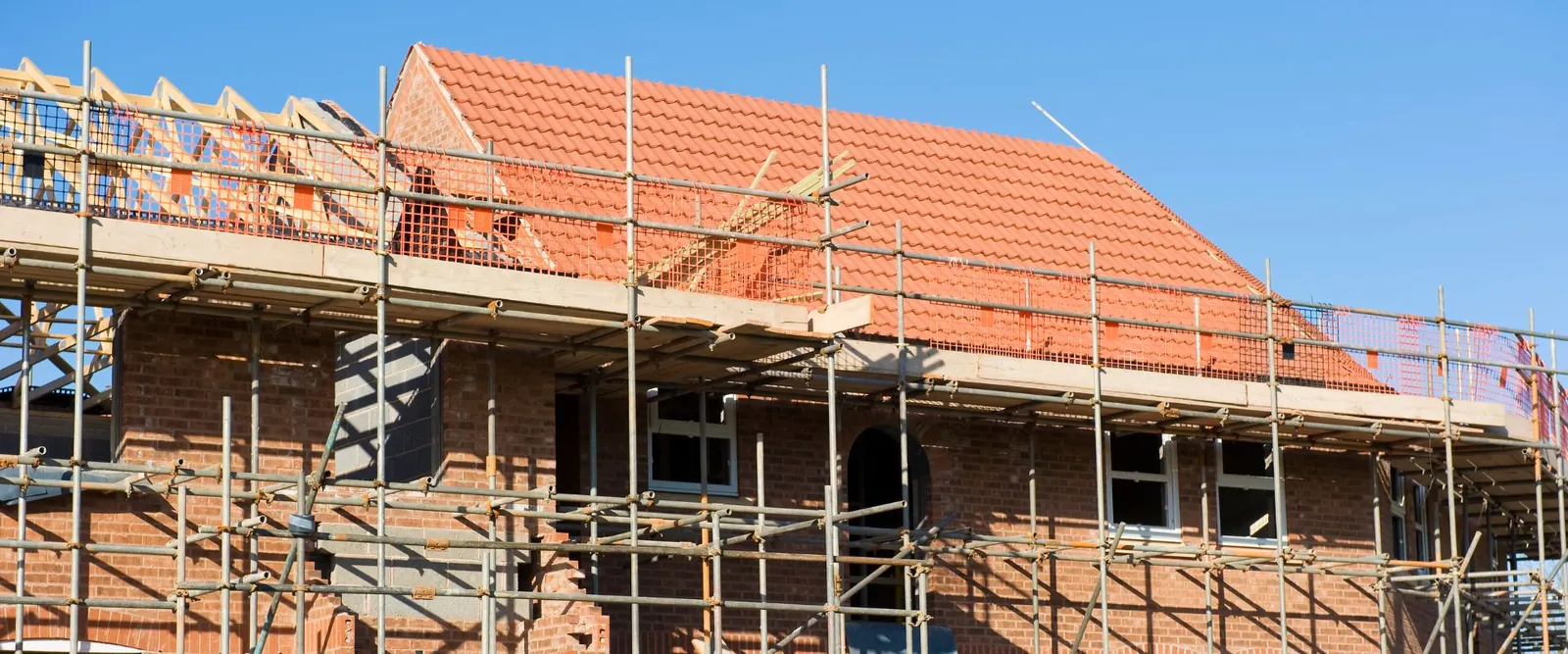
Edwardian brick villas with clay tile roofs and decorative ridges

Roofers in Ducklington

Ducklington roofing from the Windrush meadows to the old village core: slipped tiles, tired flashings, blocked gutters, moss, chimney stacks and flat extension roofs, all surveyed before anything is priced.

Ducklington's roofs, beside the Windrush

Old church roof beside a large barn
Church and tithe barn

St Bartholomew's, the parish church, is twelfth-century and was restored by E. G. Bruton in 1871. Nearby, the former tithe barn now serves as the village hall. Old churches and big barns share one roofing difficulty: long, high slopes with a great deal of edge. Ridges run a long way, verges are exposed, and a slipped covering far overhead can go unnoticed for years. A barn turned hall also carries gutters, downpipes and valleys added long after it was built, and those need clearing as regularly as the roof itself. Whatever the covering, we look from the ground and from a ladder before deciding whether scaffolding is truly needed.

Cottage roofs with chimney stacks
Older cottages and farmhouses

A charter of 958 already names Ducklington, and the Domesday Book of 1086 lists it, so the village has had plenty of time to gather buildings of every age. Its conservation area was designated in 1988. In a village like this, cottages and farmhouses of different periods stand side by side, and many have chimney stacks that have been rebuilt or repointed more than once. A covering is never assumed from the street. We check what is on the roof, whether clay or concrete tile, slate or stone, and what earlier repairs were made with, since a repair in an unsuitable material is a clue to the roof's history.

Concrete tiled houses with a flat porch roof
Newer houses and extensions

The village sits about a mile south of Witney, and like any village near a market town it has taken newer houses and added extensions to old ones. On a house built in recent decades the covering is commonly concrete interlocking tile, with plastic fascias and soffits under the eaves and a flat or shallow roof over the garage, porch or kitchen extension. These roofs fail in plain, fixable ways: ridge tiles that loosen when their bedding fails, frost-cracked tiles, felt that has worn thin on a flat section, and guttering that sags between brackets. They are usually repair jobs, and a repair is what we recommend unless the survey shows the whole covering is going.

From Swindon to the Windrush valley

Map showing Ducklington and central Swindon. 24 road miles north-east of central Swindon.

Distance
24 road miles north-east of central Swindon
Council
West Oxfordshire District Council
Council
West Oxfordshire District Council
Conservation area
Ducklington, designated in 1988
Setting
On the River Windrush, about 1 mile south of Witney

Ducklington roof questions

Does Ducklington's conservation area change roof work?

Only when the roof would look different. Ducklington's conservation area dates from 1988, so a new covering or a listed building should go to West Oxfordshire District Council first. A repair using the old material usually needs nothing filed.

Can a big old barn roof like the tithe barn be mended?

Yes. A barn that size has a long ridge, tall verges and valleys that collect a lot of water, and we pin down which part is failing before suggesting anything larger. Listed status, if a barn has it, would change the approach.

Do trees and river damp harm roofs near the Windrush?

They can. Overhanging branches drop leaves into gutters and shade the slope, which keeps it wet and encourages moss. Clearing gutters and treating moss in time keeps a roof near the water in good order.

Q1

How long will a Ducklington roof covering last?

Roofer repointing a stone chimney stack above lead flashing
Rolled lead roof covering over a bay above white windows

The short answer

It depends on the material, how well it was fitted and how it has been looked after. Natural slate can run past a century, clay and concrete tiles often last several decades, and flat roofs need replacing sooner. Typical ranges are guides, never promises, and the survey shows where your roof stands.

Ask any roofer how long a roof lasts and the answer is a range, because the same tile lasts much longer on a well-detailed roof than on a neglected one. For a village with buildings of every age, the useful question is which parts of your roof will wear out first.

Which coverings last longest?

Natural slate lasts longest of the common coverings: MyBuilder's guide, updated on 21 August 2026, quotes 80 to 100 years or more for slate laid properly, a long stretch for anything outdoors. Clay tiles often need replacing after 40 to 60 years, yet the Building Conservation Directory (2008) points out that some peg-tiled roofs are centuries old, so the figure is no hard limit. Concrete tiles are reasonably put at 30 to 60 years. Older sources disagree with each other, which is why we treat every number as a guide and look at the roof in front of us.

What wears out before the covering does?

The parts around the covering usually give up first. Lead flashing can last for over 80 years when correctly installed, according to MyJobQuote in September 2026, but mortar fillets and old felt do not. Gutters, fascias and the timber under the eaves go before the tiles above them. From the road a roof can seem fine while a stack or a valley leaks, so the survey captures every junction in photographs.

When does a flat section need renewing?

The flat roofs on porches and extensions have the shortest lives. A flat roof typically lasts 15 to 30 years, says MyBuilder, and a poorly fitted felt roof might fail in under 10, according to Less in March 2026. The church and the tithe barn have stood for centuries, but a flat kitchen roof from the 1990s may already be due for a look. How we choose between patching and renewing is set out on our roof repairs page.

Q2

Do trees and river damp harm Ducklington roofs?

The answer

Trees and a damp valley do cause problems, mainly through leaves in the gutters and moss on shaded slopes. Neither is a reason to replace a roof. Clearing gutters, treating moss gently and checking the junctions each year is usually enough to keep water out.

Ducklington sits on the Windrush, with water meadows, mature trees and gardens close to many houses. That is lovely to live beside and a little harder on a roof than an open, dry street.

What do leaves and branches do?

Leaves block gutters and valleys, and a blocked gutter overflows behind itself, down the wall and into the soffit timber. Branches that brush the tiles rub the surface and shade the slope, which stays damp longer than its neighbour in the sun. A tree that is too close is worth discussing with its owner or the council, as a large tree may be protected and a conservation area can bring its own rules for tree work.

Is moss a problem or just untidy?

Moss in a light film is mostly cosmetic. A deep cushion, though, keeps the surface wet and can prise tiles up at their edges. Cleaning matters most on concrete tiles and on shaded north-facing slopes. MyBuilder, updated 21 August 2026, puts moss removal on a pitched roof at roughly £450 to £850 and cautions that a jet wash can harm fragile tiles, so we pick a gentler method where the roof calls for it. Our roof cleaning and moss removal page covers the options.

Which gutters need attention first?

Start with the run under the lowest branch and any valley that drains a large slope. Check the downpipe below it for blockage too, since a clear gutter that empties into a full pipe still overflows. If the gutter has sagged, the fall to the outlet has been lost and it will hold water between brackets. Our gutters, soffits and fascias page explains when a realignment is enough and when the run should be replaced.

Q3

What approval does a Ducklington roof job need?

New brick house with a red tiled roof inside scaffolding
Terraced house roof stripped to rafters inside scaffolding

The short answer

Most repairs need none. A big re-roof can come under Building Regulations, a markedly heavier covering needs approval, and anything listed needs listed building consent before its character is touched. The conservation area dates from 1988, and West Oxfordshire District Council handles the planning side.

Re-roofing a Ducklington house is usually a straightforward matter of surveying, quoting and doing the work. Three things can add a step, and it helps to know which applies before you sign anything.

Does the size of the job matter?

The Planning Portal says you will not normally need a building control application if less than 25 per cent of the total building envelope and less than 50 per cent of the roof is affected. Bigger jobs, and coverings 15 per cent or more heavier, need Building Regulations approval, which can bring an insulation upgrade. We tell you which case you are in and look after the Building Regulations notification when work is notifiable, through your building control body.

Does the conservation area matter?

Ducklington's conservation area was designated in 1988, as West Oxfordshire District Council's published list of conservation areas shows. A re-roof that keeps the same material and look generally falls outside planning control. Switching covering, or making a prominent alteration, is work to put to the council in advance. Not certain the house lies inside that line? The council can confirm that, and pricing waits until you know.

What about the church and listed buildings?

If a building is listed, nothing that alters how it looks or was built can start without listed building consent, roof material included. The village church, St Bartholomew's, is Church of England, so changes to it run through the faculty route under the ecclesiastical exemption. Should the tithe barn, a farmhouse or your own cottage turn out to be listed, we settle the method with you ahead of any booking.

Before you commit

Find out if the building is listed or inside the conservation area before you settle on a covering.

Ducklington questions, from church to meadow

What would you look at first on an old Ducklington cottage?

The chimney stack and every spot where the roof butts against a wall, since junctions are where old roofs tend to let water in. Then come the ridge, the verges and the battens under the tiles. The aim is the smallest repair that stops the water, with photographs from the survey to back it up.

Do you work in Ducklington as well as in Witney?

Yes. Ducklington is about a mile south of Witney, and both lie inside the 30-mile ring around Swindon we work in. Other Windrush valley villages and towns are named on the areas page.

What do I get in writing after the survey?

The quote is on paper and the survey photographs are of your own roof. Our workmanship carries a 10-year guarantee, again in writing. Afterwards the site is swept clear and the rubbish goes off with us. If another quote is in your hand, check it covers VAT and scaffolding.

Is a flat extension roof near the village hall worth repairing?

Often it is, when the fault is local, for example a split at an edge or a failed joint at a wall. If the whole membrane has worn out, renewing it is better than chasing leaks. Part L can apply when a flat roof's waterproofing is replaced, so we explain the insulation position before you decide.

Ask us about your roof

Tell us what’s happening and we’ll call you back.

  • Photos of what we find
  • A written quote
  • 10-year workmanship guarantee

Or call 01793 626096

Call Get a quote