Victorian brick terrace street with slate roofs and chimneys

Roofers in Hailey, Oxfordshire

Roof repairs, stone slate re-laying, chimneys and ridge work across Hailey and its hamlets, from the limestone cottages of Delly End and Poffley End to the modern houses on the village fringes.

Hailey's roofs, from Delly End to Poffley End

Cottage roofs in grey limestone country
Limestone cottages under stone slate

The village appraisal dates its period houses and cottages to the seventeenth and eighteenth centuries and says they use local grey oolitic limestone, laid as coursed rubble. Above those thick walls the appraisal singles out stone slate as the roof covering, with a bundle-thatch outbuilding at Poffley End the only thatch in the village. Each stone is thick and weighty, graded so the large ones sit low and the small ones high, and pinned to the battens with pegs. The faults are rarely dramatic: a peg lets go, a stone slips, moss holds water against a joint. Judging whether a slope wants a handful of stones rehung or a complete strip and rebuild is the main call we make on these houses.

A large stone farmhouse roof with gables
The Old Manor House and the farmhouses

Hailey's earliest surviving structure is the Old Manor House, which dates from the late fifteenth century, began as a hall house and was remodelled around 1600. Gigley Farm, Hailey Manor and Downhill Farmhouse are among the larger houses, and they use ashlar, the smooth dressed stone, rather than rubble. Roofs on buildings like these are large, steep and often broken up by gables, chimney stacks and valleys, so a leak may start at a flashing or a valley instead of in the open slope. They also sit on old timbers that have moved over centuries, which is why a look at the structure from inside the loft is part of every visit to a house of this age.

Tile and slate on newer houses
St John's church and the later houses

The Church of St John Evangelist was designed in 1866 by Clapton Crabbe Rolfe, whose father was vicar of Hailey, and it gives the village a Victorian landmark among its older stone. Newer building in and around Hailey carries whatever covering was chosen at the time: clay or concrete tile, slate, and flat or low-pitched roofs on porches, garages and kitchen extensions. The appraisal notes virtually no red brick in the village, so a tiled roof sits against a limestone background and its colour matters when we match a repair. Those later roofs bring familiar faults: cracked tiles, loose ridges, tired felt and failing flat-roof coverings.

From Swindon to Delly End and Poffley End

Map showing Hailey and central Swindon. 27 road miles north-east of central Swindon.

Distance
27 road miles north-east of central Swindon
Council
West Oxfordshire District Council
Conservation area
Hailey, designated in 1992
Council
West Oxfordshire District Council
Setting
A Cotswold-edge village west of Witney

Quick answers for Hailey's stone slate roofs

Does Hailey's conservation area affect a stone slate repair?

Rarely, if the stone and method stay the same. Hailey's conservation area dates from 1992, so a change to a roof's appearance, or work on a listed building, goes to West Oxfordshire District Council before we start.

Can a Hailey stone slate roof be patched?

Usually. We rehang or swap the slipped and cracked stones, matching each by type, and renew pegs, battens and valleys only where they have given out, so the rest of the covering keeps its age.

Why do old limestone chimneys here leak at the roof line?

Pointing weathers out of the joints and the lead flashings tire, so water finds the gap between stack and slope. Repointing and new lead often cure it without disturbing the roof around it.

Q1

What holds up a Hailey stone slate roof?

Reclaimed Cotswold stone slates sorted by length beside a limestone wall
Brick and limestone cottages around a small village green

The short answer

The stones are rarely the weak point. A Hailey stone slate roof usually fails at the pegs, battens or leadwork, or where moss and frost have lifted the courses. The cure is to renew what holds the stones and re-lay the same stone in diminishing courses, with matching stone for any that have perished.

Hailey's conservation area appraisal names stone slate as the village's roof covering, and it describes the houses and cottages of the seventeenth and eighteenth centuries as built in local grey oolitic limestone, laid as coursed rubble. Those two facts shape nearly every roofing job here: heavy stone on thick walls, carried by old timber.

How is a stone slate roof laid?

Stones are graded down the slope: the largest form the eaves, frequently doubled, while ever smaller ones climb towards the ridge. Traditionally a cleft oak peg passes through a hole high on each stone and hooks it over its batten. Once a peg has rotted, the stone drops, and water reaches the timber beneath.

What does a repair involve?

Around the fault we lift the courses, replace any softened pegs and battens, then rebuild in sequence, adding like stone wherever one has cracked. We open as little of the slope as the fault allows, because every stone moved is another chance to break one. Valleys on these roofs were often swept, curving gently where two slopes meet. Cotswold District Council's technical guidance says plain mitred or open lead valleys are cheaper but look less satisfactory than the traditional form, so we raise that before suggesting one. Our Cotswold stone roofing page sets out the method in full.

How heavy is the roof above my head?

Very. Cotswold District Council's guide gives about 1,000 kg for every 10 square metres of stone slate roof, which is why the rafters and wall plates are looked at before any covering is swapped in either direction.

Our survey photographs, supplied with the written quote, show which of your own stones are sound. Having that record in hand also makes it easier to compare what a repair would involve with what a full re-lay would, before you decide.


Q2

Can I re-lay Hailey stone slates with reclaimed stone?

The answer

Reclaimed stone belongs on the building it came from. The heritage policy printed in Cotswold District Council's guide favours newly cut slates over second-hand, restricts salvaged ones to their own roof, and rules out swapping sandstone for limestone.

A wrong stone shows for decades, so the choice of replacement counts for as much as the repair.

Where should replacement stone come from?

Start with your own roof. Sound stones are graded by size and set aside, and the courses go back up with them. For any shortfall, the policy in the council's guide favours newly cut slates, since robbing another old building of its roof can wreck it, and it limits salvaged stone to the building or buildings it was lifted from. You will be told the origin of every stone before it is laid.

Why not use a cheaper concrete lookalike?

That policy ranks fibre-resin slates, concrete tiles and artificial stone as unfit for historic buildings. Reconstructed Cotswold-style slate is a concrete product, laid at a minimum pitch of 30 degrees according to one manufacturer's data sheet, and it can suit a plain modern extension. It is not the answer for a seventeenth-century cottage in a conservation area, where it would also change the way the roof weathers.

Does limestone slate mix with sandstone?

No. Sandstone and limestone slates are kept apart, never swapped or laid side by side, because the two weather and split in their own ways. Sawn slates, cut by machine instead of split by hand, can look flat and wrong against old stone, so we avoid them on period roofs. If you are unsure what stone your roof carries, the loft side of a few slates usually tells us.

Choosing stone for its fit, not its price, stops a repaired slope showing a patch for years. It also keeps the village roofscape intact for the next generation of owners.

Our view

Keep the stone your roof already has, renew the fixings behind it, and match anything new by type.

Q3

Which Hailey roof jobs need the council's say-so?

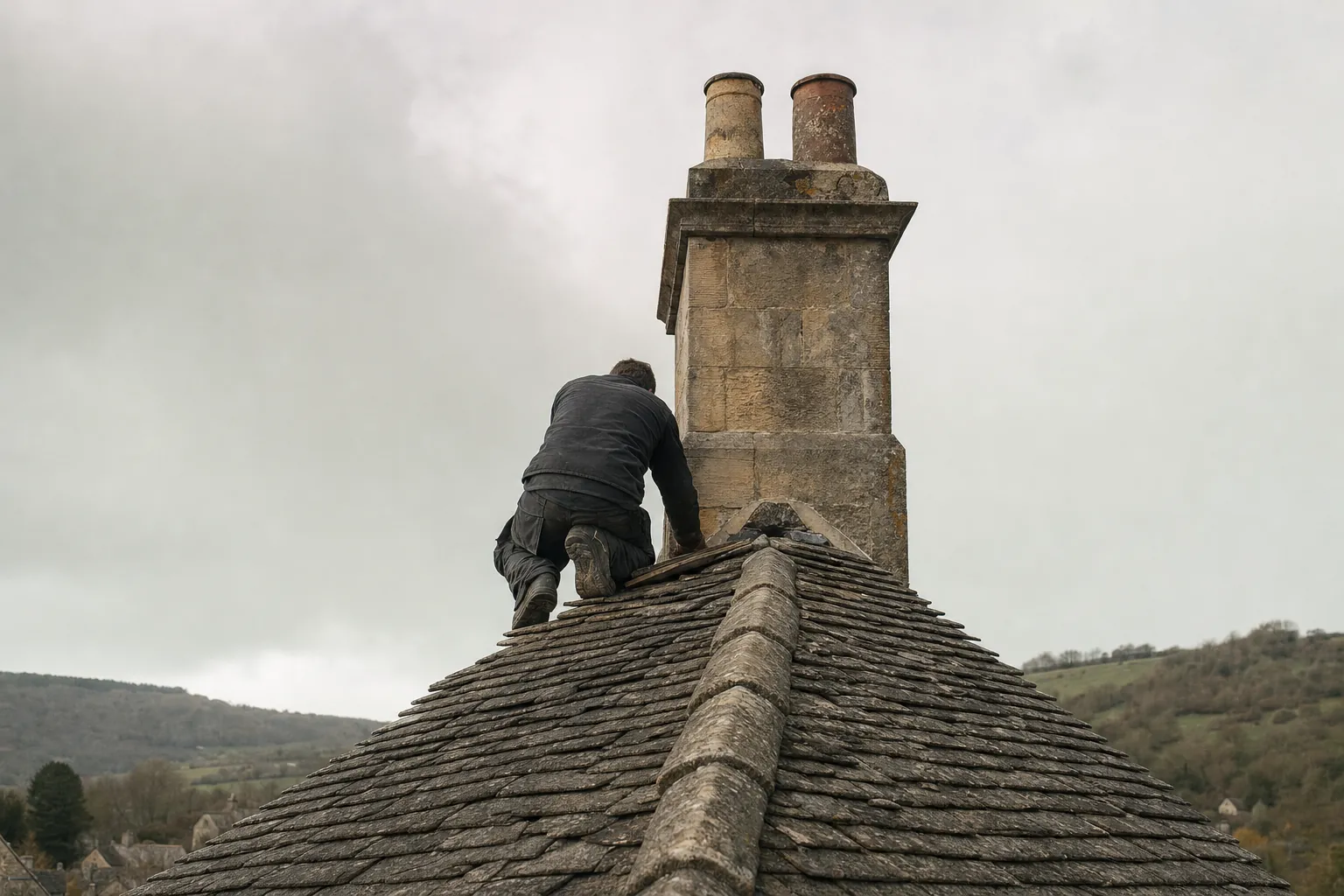
Roofer on a stone slate ridge beside a stone chimney
Brick end-of-terrace gable beside a limestone house, slate roofs

The short answer

Most repairs need no permission. Planning decisions in Hailey rest with West Oxfordshire District Council, which is the body to ask about a changed roof appearance or any listed building. Bigger re-roofs also engage Building Regulations, as your building control body can confirm.

Swapping a few stones, relaying a flashing or bedding a ridge anew with like materials generally sits outside planning control altogether. Three situations alter that.

Does the 1992 conservation area change a repair?

The conservation area dates from 1992 and followed a public consultation. Repairs that match leave the village unaltered, which is why they rarely trigger an application. Switching covering, or reshaping chimneys and rooflines, can, and the council's planning officers can tell you about your own house, including whether an Article 4 direction reaches it. If you plan roof windows, our skylights page covers the planning side.

What about the Old Manor House and other listed buildings?

Hailey has listed houses and farmhouses, among them the Old Manor House at Poffley End, listed Grade II*. Under the 1990 Act on listed buildings and conservation areas, any alteration touching a listed building's special character needs listed building consent, roof covering included. We default to identical stone fixed in the traditional manner and talk through every departure with you in advance.

When do Building Regulations apply to a re-roof?

By the Planning Portal's test, a building control application is not normally needed where under 25 per cent of the total building envelope and under 50 per cent of the roof is affected. Past either limit, or with a covering 15 per cent or more heavier, approval applies, and insulation may have to be upgraded. If notification is needed, we file it.

Ringing the council early is free and settles the position for your particular house, whether that is a cottage in Delly End, a farmhouse near Middletown or a modern home on the village edge.

MythAny roof repair inside a conservation area needs an application.

FactRepairs with matching stone are normally maintenance; the council's interest is in work that alters how the roof looks.

Questions from around Hailey and its hamlets

Why do Hailey's roofs carry stone slate rather than tile?

The village stands on limestone country, and its builders used what lay nearby. The conservation area appraisal describes local grey oolitic limestone walls and names stone slate as the roof covering. Any other covering, on a newer house or an outbuilding, is identified house by house when we survey, before a repair method is chosen.

Is a hall house like the Old Manor House roofed differently from a cottage?

The covering may be similar, but the roof is bigger, steeper and carried on older timbers, with more valleys, stacks and gables to keep watertight. The approach is also more careful, because a listed building's roof is judged on its character as well as its performance. We photograph the existing roof before any work starts.

Do you work in Delly End, Poffley End and Middletown?

Yes. Hailey and its hamlets all fall inside the area we cover, west of Witney. For a leak, we make the roof safe first, then work out a lasting repair once we know the cause.

Is it safe to scrape moss off a stone slate roof?

Done gently by hand, yes, and it helps. According to Cotswold District Council's guide, an annual scrape could double the life of a stone roof. Pressure washing can damage delicate roofing and loosen the bedding, so we avoid it. Our work carries a written guarantee of 10 years on workmanship, and we clear the site afterwards.

Ask us about your roof

Tell us what’s happening and we’ll call you back.

  • Photos of what we find
  • A written quote
  • 10-year workmanship guarantee

Or call 01793 626096

Call Get a quote