1980s estate houses with brown concrete tile roofs

Roofers in Leafield

Wind-lifted ridges, slipped tiles, failing flashings and tired flat roofs in Leafield, the high Cotswold village on the old edge of Wychwood Forest.

Leafield's roofs, from forest edge to plateau top

Ridge and verge tiles on an exposed hilltop roof
The high plateau village

Leafield sits 635 feet (194 m) up in the Cotswold Hills, about four miles north-west of Witney, and Leafield Barrow, the hill just north of the village, is counted among the highest points in Oxfordshire. Height decides a great deal about how a roof behaves here. Nothing stands between the plateau and the weather, so ridges, hips and verges take the first blow, and the fixings holding them are asked to do more than they would in a valley. Tiles that rattle in a gale, felt that flaps under the eaves and flashings that lift at an exposed gable are the faults we hear about, and they are usually cheaper to put right early than late.

Gabled cottage roofs with chimney stacks
Forest clearance and the Victorian church

The parish lies within the former limits of Wychwood Forest, and forest land south of Langley was cleared in 1857 and 1858. Sir George Gilbert Scott designed Leafield's church, built and consecrated in 1859 to 1860, with a bell tower that followed in 1874; it is dedicated to Saint Michael and the angels. Houses and cottages from this mid-Victorian spell of growth often have a plain, practical roof: a simple pitched slope, a chimney at each gable and a modest verge. Their age means flashings, bedding and battens are now due attention, and the chimney stacks are often the weakest part of the whole roof.

Large low-pitched roof on an industrial building
Langley and newer building

A large radio transmission station stood at Langley from 1912 to 1986, and the site has since served as a training college and a motorsport technical centre. Buildings of that kind are a different roofing job from a cottage: wide spans, low pitches, rooflights, gutters behind parapets and sheeted or membrane coverings that need planned inspection. Closer to the village, newer houses, bungalows and garages carry machine-made tiles, while porches and rear extensions are usually topped with a flat covering of felt or single-ply membrane. The same visit can usually cover both kinds of work, because a survey photographed from the ridge shows every roof on the property.

Up on the Cotswold plateau

Map showing Leafield and central Swindon. 26 road miles north-north-east of central Swindon.

Distance
26 road miles north-north-east of central Swindon
Council
West Oxfordshire District Council
Council
West Oxfordshire District Council
Conservation area
Leafield, designated in 1993
Landscape
Cotswolds National Landscape (AONB)

Leafield roof questions

Why do ridge tiles loosen so often on a hilltop like Leafield?

Wind meets the ridge with nothing to slow it down. Bedding cracks, tiles lift a fraction in every storm, and a ridge that depends on mortar is a weakness worth correcting.

Does a re-roof in Leafield's conservation area need an application?

A like-for-like covering rarely does. A new material or a different appearance might, so put the question to the planners at West Oxfordshire District Council before booking anyone.

Does one survey take in the house and the outbuildings together?

Yes. Garages, sheds and barns are inspected with the house, so the written quote covers whatever each roof needs and nothing is left out.

Q1

How does Leafield's hilltop wear a roof out?

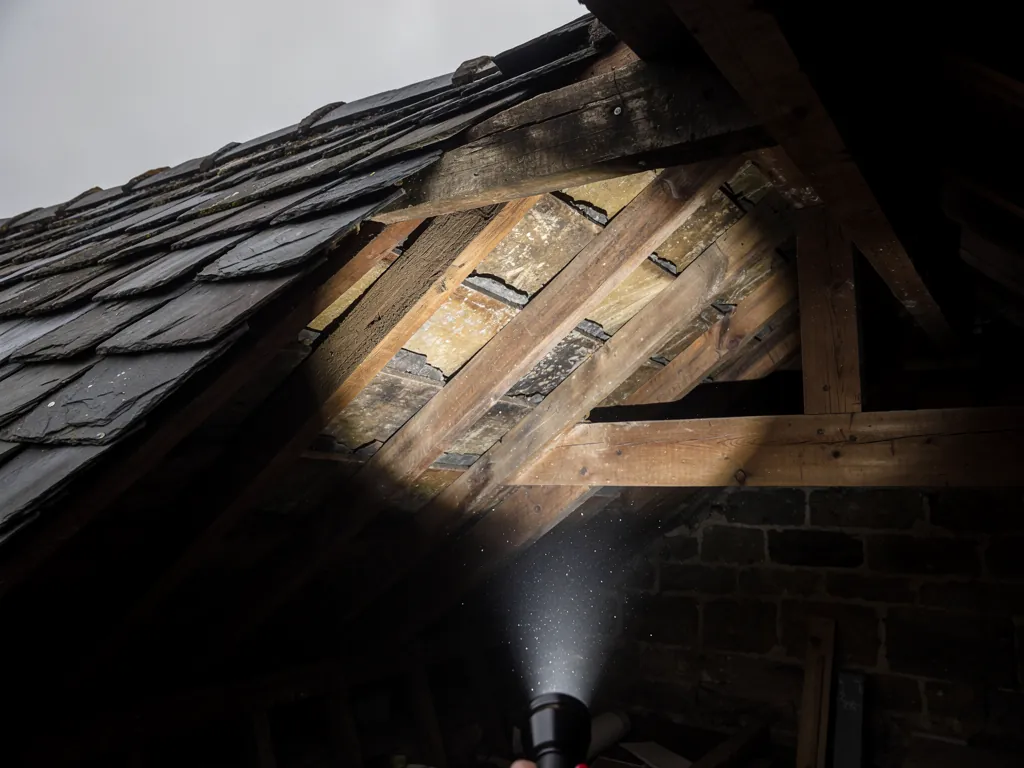
Torch beam lighting slate undersides and timbers in a loft
Close-up of natural slates with copper nails and lead flashing

The short answer

By wind first. A roof 194 metres up, with open ground around it, loses ridge bedding, verge pointing and loose tiles sooner than one in a sheltered valley. Water then finds the gaps. The fixes are mostly mechanical: better fixings, sound flashings and a ridge that does not rely on mortar alone.

Leafield's position is unusual even by Cotswold standards. At 194 metres it stands well above the surrounding valleys, with open plateau on every side. That height is the source of the village's good views and also of most of its roofing trouble.

What does wind do to a tiled roof?

It works on the weakest detail. A tile is not blown off in one piece; it lifts a few millimetres in each gust until a nail pulls or a clip fails. Ridge and hip tiles, bedded on mortar, crack along the joints and rock. Verges, the edges of the roof at a gable, let wind in underneath and loosen the cement pointing. The 2014 revision of BS 5534 removed mortar as the sole means of holding ridge and hip tiles, so fixings are added, and one route is a dry-fix ridge system tested under BS 8612. Our ridge, verge and dry-fix page sets out what each choice involves.

Does a tiled roof need ventilation?

Yes, and exposure makes it more important. Under a non-breathable underlay, Marley's guidance, based on BS 5250, calls for a continuous 10 mm gap along the eaves on roofs steeper than 15 degrees, with extra high-level ventilation above 35 degrees. Warm damp air escaping from a house into a cold loft condenses against the underside of the covering, and the timber suffers. We check eaves vents as part of every survey.

Slipped tiles are the commonest sign of trouble after a gale, and one slipped tile is rarely alone. The nail or clip that failed was holding in the same timber as its neighbours, so we check the rows either side and the battens behind. A single refixed tile may be all that is needed, but if the battens have softened or the nails have rusted, a larger section has to be stripped and re-laid. Either way, the survey photographs show you the evidence.

When a storm has already done its work, our first call is to make the roof safe, and the lasting repair is planned afterwards. Photographs taken at survey are yours to keep.

Q2

What permissions apply to a Leafield roof?

The answer

Most repairs need none. Leafield has a conservation area, designated in 1993, and lies within the Cotswolds National Landscape, so changes to a roof's look are best discussed with West Oxfordshire District Council. Larger re-covers may need a building control application, and the church follows the faculty route.

A conservation area and a National Landscape sound like heavy restrictions, yet for a typical repair neither changes much. What they do is raise the stakes on any work that alters the roofline seen from the street or the lane.

What do the local designations mean in practice?

West Oxfordshire District Council's list of conservation areas records Leafield as designated in 1993 and marks it as having no appraisal document. With no appraisal to read, the council's planners are the best source for a view on your own property. A mend in matching materials seldom calls for an application. Swapping slate for another covering, or altering a chimney, is worth a conversation first.

The Cotswolds are a National Landscape, a name in use since 22 November 2023, though the legal designation remains AONB. The landscape body gives advice; the council gives decisions. On its own the status leaves a straightforward matching re-roof where it was.

Where does Building Regulations approval come into a re-roof?

The Planning Portal gives the test. Re-covering generally needs no building control application while under 25 per cent of the total building envelope and under 50 per cent of the roof is touched. Pass those figures, or pick a covering that weighs 15 per cent or more extra, and approval is needed; better insulation may follow. We tell you at survey where the job stands against those limits and we manage the Building Regulations notification when one is due, via the council's building control team or a registered building control approver.

What about the church?

The village church is an Anglican building in regular worship, which brings it under the ecclesiastical exemption; any roof work there is approved through the faculty system, not by the council.

MythA National Landscape designation means a roof cannot be repaired without approval.

FactRepairs that match the existing roof carry on as normal; the designation shapes major changes, and the council still makes the decisions.

Q3

How are big flat and low-pitched roofs looked after?

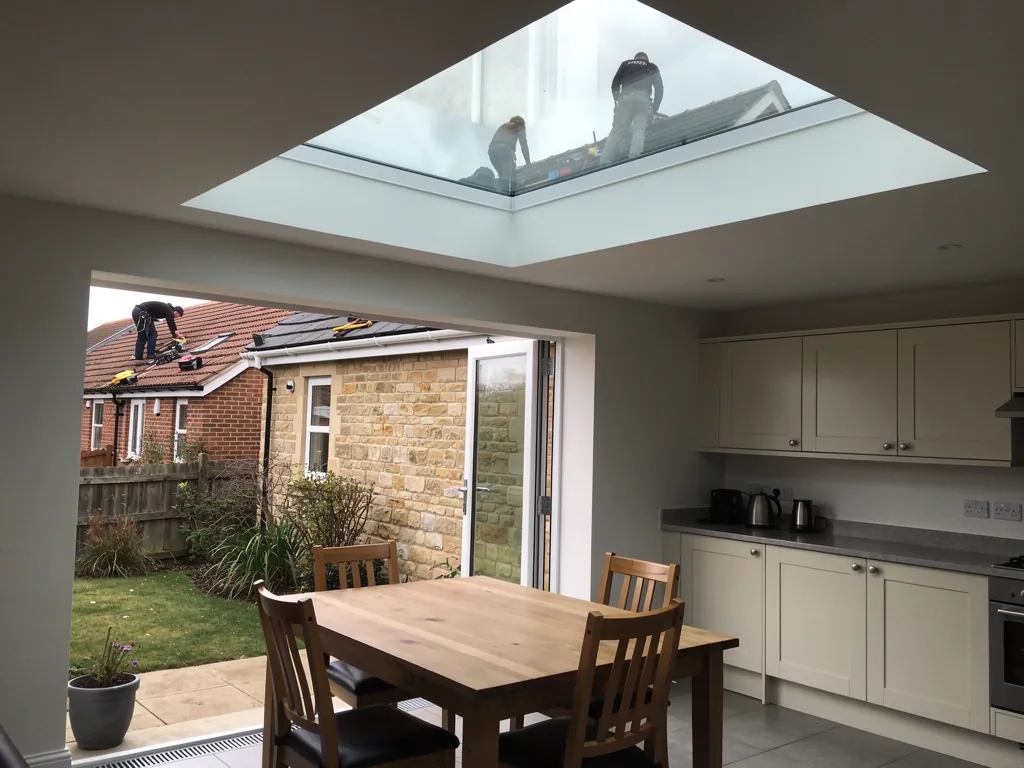
Kitchen-diner lit by a large flat rooflight in the ceiling
Long flat roof on a 1960s brick building being re-covered

The short answer

With a planned inspection and a repair to match the covering. Flat and low-pitched roofs on large buildings, like those at the old Langley site, last about 15 to 30 years depending on material, and small faults grow quickly. Mending a split seam early is a small job, while a failed ceiling is a large one.

Leafield's history includes some large buildings. The Langley radio station ran from 1912 to 1986, and the site was later redeveloped as a training college and then a motorsport technical centre. Roofs on buildings of that scale and use obey different rules from a cottage slope.

How long does a flat roof covering last?

It depends on the material and the workmanship. MyBuilder, in a guide updated on 21 August 2026, says a flat roof typically lasts 15 to 30 years. Sources vary by covering: GreenSpec gives EPDM an expected service life of 20 to 30 years, Less puts GRP at 25 to 40 years, and torch-on felt at 10 to 20 years, with a good job able to last 20. Those are typical figures, never promises.

Why do large roofs leak at the joins?

Sheets expand and shrink, seams open, and rooflight kerbs and gutter linings crack where movement concentrates. Falls matter too: the design target is 1 in 40 so that the finished roof achieves at least 1 in 80, and a roof that ponds water is a roof that fails sooner.

Can a business keep trading during repairs?

Usually, if the work is planned in sections and the building is made safe at the end of each day. Our commercial roofing page describes the approach. Fragile materials, such as old cement sheeting or rooflights, are treated as hazards before anyone steps on them.

Planned maintenance suits a large site better than emergency calls. A yearly walk across the roof, a clear-out of outlets and gutters, and a note of any movement at seams or rooflights keeps small faults small. The record of what was found and fixed also helps if a building changes hands or a landlord asks about the state of the roof.

Smaller outbuildings, such as garages and porches, run on the same reasoning at a smaller size. A garage whose felt has nearly run its course needs a repair-or-replace decision just like a factory roof, and the survey photographs make that decision visible to you before any money is committed. Inside the village, we also look at what lies under any flat roof, because a rotted deck or blocked outlet changes the answer from a patch to a re-cover.


Published lifespans for common flat coverings
CoveringTypical lifeSource
EPDM20 to 30 yearsGreenSpec
GRP fibreglass25 to 40 yearsLess
Torch-on felt10 to 20 yearsLess
Flat roofs generally15 to 30 yearsMyBuilder

Questions from the top of the Cotswold hill

Is my Leafield roof more at risk of wind damage than one in Witney?

Probably, because Leafield stands far higher and has little shelter. Ridges, verges and eaves take more wind here, so their fixings matter most. We check them first, then the flashings and underlay, before saying whether a repair or a bigger job is justified.

Do roofs from the 1850s clearance period need special care?

They need an informed survey. Flashings, battens and chimney stacks from that era are well past their first life, and many have been repaired more than once. We note each earlier repair, then decide whether a targeted fix will hold or the slope needs re-covering.

Can you work on a Leafield house with Victorian Gothic detailing?

Yes, as long as we know what is original. The preaching cross is medieval, with a Gothic Revival shaft and top added in 1873, and similar Victorian details on houses call for careful matching. Where a building has special interest, we check whether listed building consent is needed before anything changes.

Do you cover Charlbury, Minster Lovell and the villages near Leafield?

Yes. Charlbury, Minster Lovell, Finstock and Shipton-under-Wychwood sit inside the 30-mile reach from Swindon. Call, or send a WhatsApp message with your address, and we will confirm you are within reach before a survey goes in the diary.

Ask us about your roof

Tell us what’s happening and we’ll call you back.

  • Photos of what we find
  • A written quote
  • 10-year workmanship guarantee

Or call 01793 626096

Call Get a quote