Roofers on a buff brick estate house with grey tile roofs

Roofers in Shipton-under-Wychwood

Slipped coverings, failing flashings, tired chimneys and full re-covers in Shipton-under-Wychwood, from the old buildings around the green and St Mary's to the newer homes and outbuildings along the Evenlode.

Roofs between the green and the Evenlode

Old stone buildings facing a village green
Around the green and St Mary's

The village green is the best place to see how old Shipton is. The Shaven Crown Hotel overlooks it, a building that is mainly fifteenth century and was once a guest house run by the monks of Bruern Abbey, and St Mary's church stands close by with a tower dating from about 1200 to 1250. A roof that has sheltered people for centuries has usually been touched by many hands, so we begin by reading what is already there: the size of the coverings, the pitch of each slope, the timbers beneath and any earlier patch that was done badly. Steep pitches, gable ends and tall chimneys put verges, ridges and flashings at the centre of the job, and scaffold access on a tight frontage needs planning before anything else.

Tall stacks on a grand old house
Shipton Court and the larger houses

Shipton Court was built around 1603 for the Lacey family and sold to Sir Compton Reade in 1663. Big historic houses of that kind bring roofs of a different order: long runs of rafter, several valleys, parapets with gutters set behind them, and stacks that carry many flues. Leadwork lives in those hidden places, and a fault there often shows as a stain on a ceiling a long way from where the water gets in. Inspecting these roofs is slow, careful work. We photograph every valley, parapet and flashing so that you see what we see before any scaffold goes up.

Tiled roofs on newer houses and extensions
Newer homes and outbuildings

Away from the green, the village has later houses, extensions and outbuildings along the Evenlode valley, and their roofs follow a different logic from the old core. A house from the last century may carry clay or concrete tiles, a slate roof or a flat-roofed extension. Typical trouble is a run of slipped tiles, a ridge fixed on mortar alone, tired felt over a porch or garage, or gutters that have drifted out of fall. Barns and outbuildings near the edge of the village can go years without anyone looking up at the roof. What we suggest depends on the building, and it is often a smaller job than owners expect.

Shipton in the Evenlode valley

Map showing Shipton-under-Wychwood and central Swindon. 24 road miles north-north-east of central Swindon.

Distance
24 road miles north-north-east of central Swindon
Council
West Oxfordshire District Council
Conservation area
Shipton-under-Wychwood, designated in 1989
Landscape
Cotswolds National Landscape
Council
West Oxfordshire District Council

Roof questions around Shipton's green

Does Shipton's conservation area affect roof repairs?

A repair that leaves the roof looking as it did seldom needs consent. Switching to a different covering, or doing anything to a listed house, is a reason to phone West Oxfordshire District Council before agreeing a price.

Is a roof overlooking the village green hard to access?

It can be. Frontages on the green are old and tight, so scaffold position and a loft inspection come first, and after that you get a written quote built on what the roof needs.

Does the Cotswolds National Landscape change re-roofing here?

Not for a straight re-cover. The National Landscape body advises and West Oxfordshire District Council decides. A bigger alteration to the roof shape is where the council's view matters.

Q1

How is an old roof near Shipton's green assessed?

Long flat roof on a 1960s brick building being re-covered
Reclaimed Cotswold stone slates sorted by length beside a limestone wall

The short answer

By looking before lifting anything. We note the covering, the pitch, the timbers and earlier patches, photograph every slope and flashing, and only then say whether the answer is a mend, a partial re-lay or a new covering. Older buildings get the least intrusive fix that works.

An old roof is a record of everything done to it. Around Shipton's green and church the buildings are old enough that several generations of work can sit on one slope, and the first task is to tell the sound work from the work that is hiding the fault.

What does the survey actually cover?

We start outside with the covering. Are the pieces the same size and thickness, do they lie flat, and are the fixings still holding? Then come the details that give up first: ridges, verges (where the roof finishes beside a gable wall), valleys, the flashing round each stack, and the line where an extension meets an old wall. In the loft we look for daylight, damp staining, soft timber and any scrap of felt or board tacked in as a quick fix. Each finding is photographed, so the written quote that follows is tied to pictures of your own roof.

How do you tell a mend from a re-lay?

A few slipped pieces over sound timber is a mend. A slope where the fixings have gone along its whole length is a different animal, because patching only pushes the leak further down. Where the covering is good but the battens and nails have worn out, lifting the same material and laying it again often beats buying new, and it keeps the look of the building. Where the covering itself is failing, replacement is the right answer and you will hear that from us plainly.

What about access on a tight frontage?

Old village frontages often leave little room for a scaffold. Pavements, shared drives and neighbouring roofs all shape the plan, and so does what the old walls can safely carry. We talk it through at the survey so nothing comes as a surprise later. Our roof repairs page covers the repair side in more detail.

Our last job is sweeping the site and carting the rubbish away, so the lane outside looks the way it did.

Q2

Is a stone slate roof here worth keeping?

The answer

If the covering is stone slate, usually yes. Traditional guidance says a looked-after Cotswold stone roof can easily reach 100 years. The stone tends to outlive its pegs and battens, which makes new fixings under the original slates a better bet than a new covering.

Should a Shipton roof wear stone slate, the stone is the valuable part. Cotswold District Council's technical guidance for owners states that with regular upkeep such a roof can easily last 100 years. It dates from 2000, but it describes how these roofs have always been looked after.

Why do the fixings give up first?

Each traditional slate hangs from a wooden peg pushed through a small hole near its upper edge, with the peg resting over a timber batten. Pegs go soft, battens decay, and slates drop out of line long before the stone itself is spent. That is how a roof can leak badly while most of its covering is still sound. Stripping the slope, renewing battens and fixings, then laying the same slates back in order is the repair that respects the roof.

What are diminishing courses?

The largest slates run along the eaves, and each course above steps down in size towards the ridge, which roofers call diminishing courses. A good repair keeps that pattern. Random sizes, or sawn pieces cut all to one dimension, look wrong from the lane and sit badly on the slope. The guidance also cautions that concrete tiles and similar substitutes do not suit historic buildings.

Can the old timbers carry a different covering?

Stone slate is very heavy, and the timbers under it were built for that load. Moving to another covering, lighter or heavier, alters the loading, and a covering 15 per cent or more heavier requires approval under the Building Regulations. We check the structure before quoting, and our Cotswold stone roofing page sets out how we approach these roofs.

If yours is clay tile or slate instead, the same idea applies: keep whatever is sound and renew whatever is tired.


Q3

Who decides on roof work in Shipton's conservation area?

Roofer repointing a stone chimney stack above lead flashing
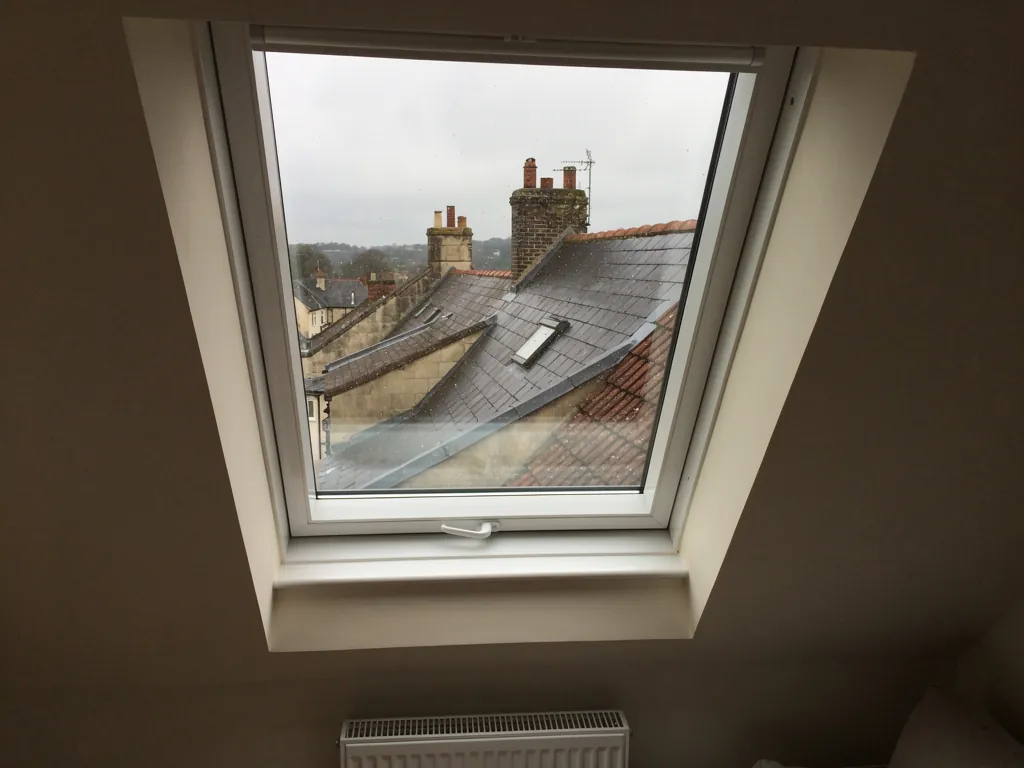
White roof window seen from inside a loft room

The short answer

West Oxfordshire District Council decides planning matters, including conservation area and listed building questions. Many repairs need no application at all. Larger re-covers may need building control, through the council or a registered building control approver, and we tell you which applies and lodge the notification ourselves.

Most roof work in Shipton needs no permission whatsoever. Replacing a slipped piece, or renewing a flashing so it looks the same afterwards, is upkeep. Three situations are different.

How does Shipton under Wychwood's conservation area affect a roof job?

The village's conservation area was designated in 1989, a date taken from the district council's published list of designation years. Where the roof ends up looking exactly as before, an application is seldom on the cards. A fresh type of covering, a roof window facing the lane or a reshaped chimney invites closer scrutiny, so put the question to West Oxfordshire's planners at the outset. For roof windows, our skylights page explains the planning side.

Where do listed buildings and the church fit in?

On a listed house, the council's consent comes first for any change to what makes the building special, the covering included. St Mary's is Anglican and still used for worship, so the ecclesiastical exemption applies: alterations are approved through the Church of England's faculty system, not by the council.

At what point does a re-roof reach building control?

Building control approval is generally not required when the job touches under 25 per cent of the total building envelope and under 50 per cent of the roof itself. Cross either line and approval becomes necessary, and an insulation upgrade in the loft may be part of the deal. A registered building control approver or the council's building control team deals with it; we say which route fits your house and lodge the notification.

Unsure whether your house is listed or falls within the boundary? The district council can confirm either, and we will read its answer alongside you before a quote is written.

MythAnything done to a roof inside a conservation area needs planning permission.

FactA mend that leaves the roof unchanged seldom does; the council looks hard at alterations to its appearance.

Roofing services in Shipton-under-Wychwood

Questions from around Shipton's green

Why does a roof beside Shipton's green so often leak at the chimney first?

Old stacks are tall, exposed and usually the oldest part of the roof. The flashing where stack meets slope tires, the pointing weathers and the cement on top cracks, so water finds a way in at the joint long before the main covering fails. Every survey includes a close look at the stacks, and a failing flashing is often a modest repair rather than a rebuild.

Can you mend the roof on an old house near St Mary's church?

Yes, with materials and methods that suit the building. If the house is listed, the method is settled with you before a tile moves, and we point you to West Oxfordshire District Council whenever the roof's character is in play. The 10-year workmanship guarantee comes in writing, and the quote follows the survey.

Do you cover the other Wychwood villages and the Burford side?

We do. The village falls inside our 30 road mile circle round Swindon. The Evenlode valley and the villages around Shipton are included, and our areas page sets out each place we reach if you would like to check yours first.

Do older Shipton roofs still have mortar-bedded ridge tiles?

Some do, since mortar was the usual bedding for a long time. BS 5534:2014 stopped mortar alone being trusted with ridge tiles, so a re-bedded ridge here carries clips or screws too, or else a tested dry-fix ridge replaces the mortar entirely.

Ask us about your roof

Tell us what’s happening and we’ll call you back.

  • Photos of what we find
  • A written quote
  • 10-year workmanship guarantee

Or call 01793 626096

Call Get a quote