Victorian brick terrace street with slate roofs and chimneys

Roofers in North Leigh

Repairs, re-covering, chimneys and leadwork in the village north-east of Witney, from the cottages around the late Saxon tower of St Mary's to the newer streets running out towards East End.

North Leigh's roofs, from tower to tile

Old stone cottages and a church tower
Around St Mary's church

The bell tower of St Mary's is late Saxon, probably built in the first half of the eleventh century, and the church also holds a fan-vaulted Wilcote chantry chapel of the early fifteenth century, restored by G.E. Street in 1864. Houses near a church of that age are among the oldest in the village. In this part of Oxfordshire, older houses commonly carry stone slate or clay tile over limestone walls, though only a look at the roof can confirm which one a given house has. Thick walls, steep gables and deep chimney stacks make the detailing at verges and abutments the main interest. Repairs here are done with the grain of the building, never against it.

Long pitched roof on a barn conversion
Farm buildings and converted barns

North Leigh sits beside Akeman Street, a Roman road that forms part of the northern edge of the parish, and the land around it has long been worked. Working farm buildings tend to be long, with wide roof spans and heavy old timbers, and a good number have since become homes. A converted barn raises its own roofing questions: how much weight the old frame can safely carry, how the roof is insulated without trapping damp, and where rooflights can go without breaking up a plain slope. Those decisions are best settled before any covering is ordered, and the survey is where we raise them. Moisture trapped in an old frame is a quiet, slow problem, so it is better caught on paper than found in the rafters later.

Brick houses with interlocking tile roofs
Newer streets and the edges of the village

Outside the old core, housing from the twentieth century onwards fills the roads towards East End and the Witney side. Concrete and clay interlocking tiles are the usual coverings there, over felt or breather underlay that has often dried out with age. Typical faults include cracked tiles, ridge bedding that has failed, verges whose cement fillet has crumbled away, and flat roofs over porches, kitchens and garages that were never as durable as the pitched roof beside them. The fascia and soffit boards behind the gutters deserve a look during the same survey, since rot there goes unseen from the road. Houses of a similar age tend to share the same weak points, so the faults on one street are a useful guide to the next.

Beside a Roman road

Map showing North Leigh and central Swindon. 29 road miles north-east of central Swindon.

Distance
29 road miles north-east of central Swindon
Council
West Oxfordshire District Council
Council
West Oxfordshire District Council
Setting
Village beside the Roman road Akeman Street, about 3 miles north-east of Witney
Church
St Mary's, Church of England, with a late Saxon tower

Clear replies for North Leigh roof owners

Is North Leigh a conservation area village?

North Leigh is absent from West Oxfordshire's conservation area list. Individual houses can still be listed, so ask about your own address before changing a roof.

Does the Roman villa affect roofing nearby?

No. The villa stands about half a mile north of East End, in English Heritage care, and does not affect ordinary houses in the village. Our usual survey and written quote apply.

Does a converted barn roof need special handling?

Often. Old timbers, large spans and added insulation all need thought. We look at the frame, the ventilation and the way the roof was last altered, as well as the covering itself.

Q1

What roofs stand around St Mary's in North Leigh?

Brick and limestone cottages around a small village green
Roofer repointing a stone chimney stack above lead flashing

The short answer

Mostly the oldest houses in the village, plus the church itself. Walls are commonly limestone, and the coverings in this part of Oxfordshire include stone slate and clay tile. What your particular roof carries needs checking on site, because later repairs often changed it.

A church with a late Saxon tower tells you something about the village. Building here goes back close to a thousand years, and the houses nearest the church carry marks from each period. Roofs get patched, re-ridged and re-pointed until the original pattern is hard to read.

How do you spot a stone slate roof?

Stone slate roofs are thick, heavy and uneven. Each course is smaller than the one below, so broad stones sit low and little ones high, and the surface has a soft, mottled colour that new copies struggle to match. If that describes your roof, our Cotswold stone roofing page explains how such roofs are repaired, re-laid and matched. Clay plain tiles are smaller, thinner and slightly curved, and they are laid in tight, regular courses.

What does a church roof have to do with my house?

Very little, in law. Because St Mary's is a working Church of England church, the ecclesiastical exemption applies and its roofs are handled by faculty, the Church's own consent route, rather than by listed building consent. No such exemption reaches the neighbouring houses; if yours is listed, ordinary consent rules apply.

Why do older roofs near a church leak at the chimney?

Stacks on old cottages are broad and tall, built from soft stone or brick, and the lead around them has often been renewed more than once, sometimes with a different weight of sheet each time. A flashing that is too thin for the job cracks where it bends. Water finds the joint between lead and masonry first. A new flashing and a repointed stack is frequently enough, and we try that route before suggesting a rebuild. Our chimney repairs page describes the options.

Q2

Are many North Leigh roofs listed or protected?

The answer

The village is not on the district council's conservation area list, so protection comes through individual listings. A few houses around the church may be listed. On those, listed building consent is required for anything that changes the building's character, and a like-for-like mend is treated very differently from a change of material.

West Oxfordshire District Council keeps a public list of its conservation areas and the years they were designated. North Leigh does not appear on it. That removes one layer of control, but it does not mean nothing is protected.

Who can confirm if my house is on the list?

The district council holds that information, and the national heritage list is public. Ask before the survey if you are unsure, since the answer shapes the plan: the covering is matched, the fixings suit the material, and nothing is swapped for a cheaper substitute. A listed roof is not priced here until the consent position is clear.

Does a roof repair ever need permission here?

Planning permission is seldom involved when the roof goes back as it was, even on an older house. Building control is a separate question. The Planning Portal puts the thresholds at under 25 per cent of the total building envelope and under 50 per cent of the roof; approval is also needed where a new covering makes the roof 15 per cent heavier or more. At the survey we place your job against those figures and, if a notification is due, we make it.

What if I want roof windows in an old stone house?

That is a design question as much as a legal one, and it is worth settling early, because the position of a window decides which rafters are cut and where the flashings run. Our conservation rooflights page lists the options, and the council's planning team can advise on a listed property before you commit.

MythWithout a conservation area, nothing about a village roof is controlled.

FactListing protects individual buildings anywhere, and larger re-roofs can still need building control approval.

Q3

What fails first on North Leigh's older cottages?

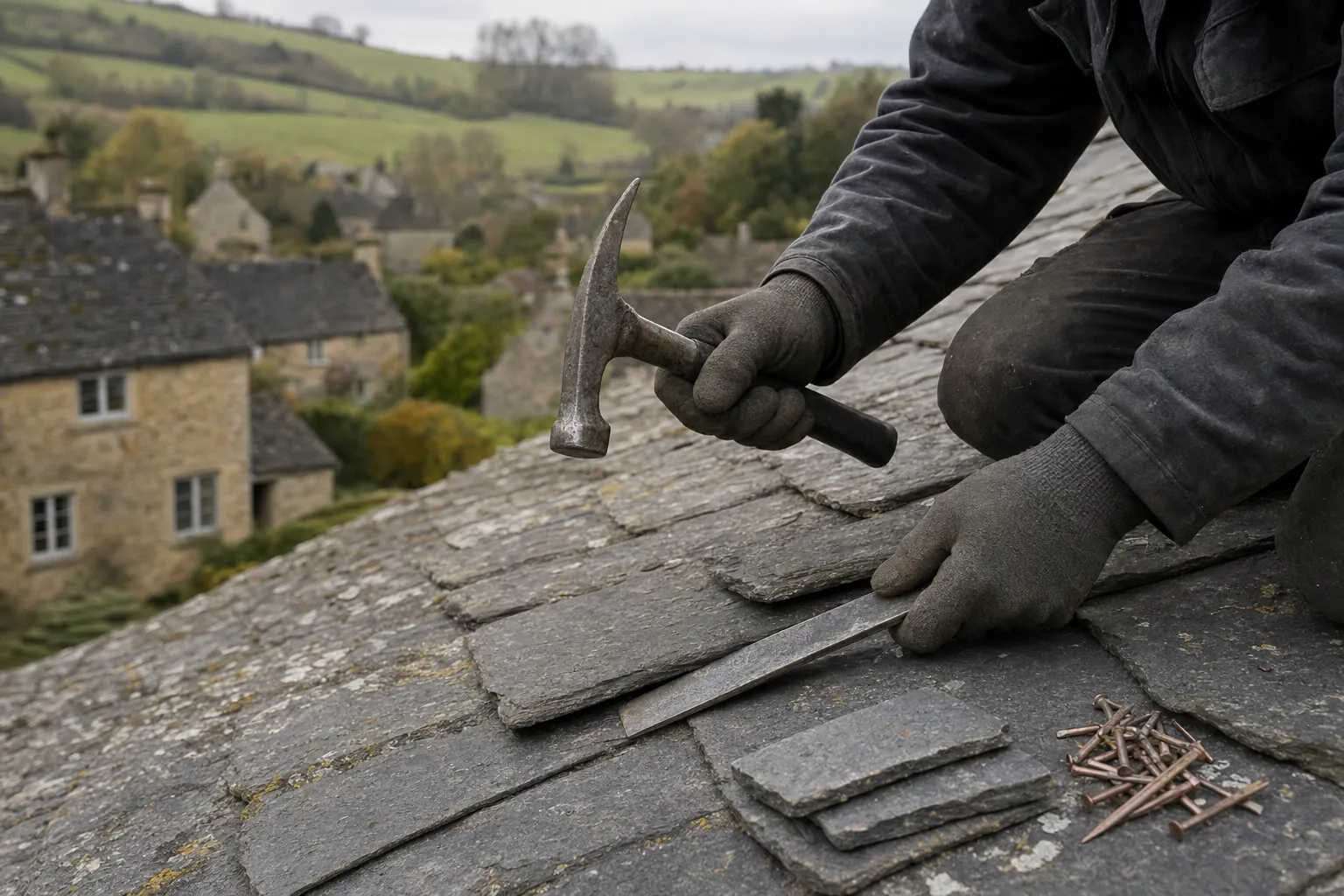
Gloved hands fixing a stone slate with hammer and nails
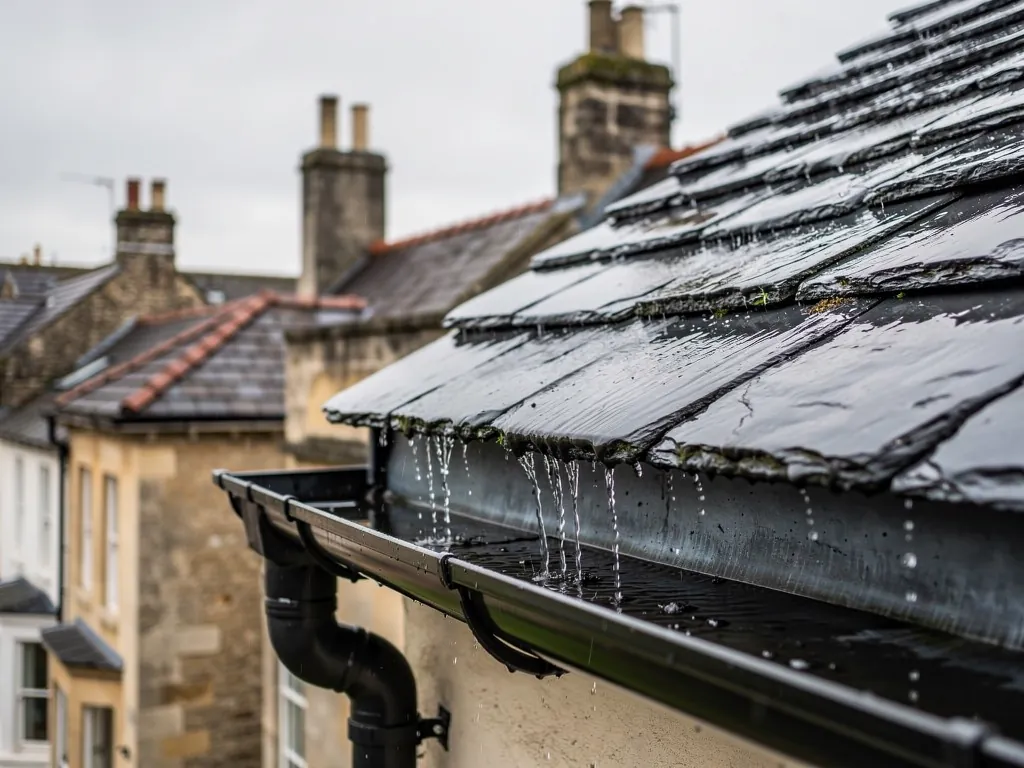
Rainwater running off slates into a black gutter and downpipe

The short answer

Usually the weakest joints rather than the whole covering: lead around chimneys, the cement at verges, the pegs or nails holding stone and slate, and gutters left clogged season after season. Finding the one that is letting water in is the real work, and often a modest repair is enough.

People expect an old roof to wear out evenly, but they fail at specific points. The covering may be perfectly good across most of a slope while one joint admits water for years.

Why do verges and gables crumble?

At a gable end the covering finishes against the wall, and a cement fillet or a row of bedded tiles keeps it in place. Rain and frost break that bond over time. Once it opens, wind drives water behind the verge and into the wall head. Re-bedding and refixing is a small job if caught early, and a much larger one when the timber behind has rotted.

How can I tell if the nails or pegs have failed?

Slipped slates or stones lying lower than their neighbours are the clue, as are gaps of daylight seen from the loft on a bright day. On slate the nail rusts through, and on stone slate the peg decays. In both cases the surrounding stones are usually sound, so we refix them rather than renew them, and we use new fixings suited to the material. Stainless or copper nails are the usual choice for slate, and oak or a modern equivalent for stone.

Do gutters really matter on a stone cottage?

They matter a great deal. When a clogged gutter spills over, the wall below stays wet, and soaked stone then draws damp inwards. Our roof repairs page explains how a gutter and a roof are examined together. Where a defect is small we fix only the defect, and the work carries our 10-year workmanship guarantee, in writing.

Photographs from the survey show each fault, so you can see why a given repair is proposed before you agree to it. If you would rather talk it through first, ring 01793 626096 or send a message on WhatsApp, and the enquiry form is on every page.


Our approach

Refix and repair what is sound, and renew only what has really failed.

Questions from Akeman Street and the green

Can a thick stone wall support a heavier roof covering?

The walls are rarely the limit. The roof timbers are, together with the wall plate they sit on. A heavier covering than the one it replaces needs the structure checked by someone who can read it, and a weight rise of 15 per cent or more needs building control approval. Stone slate is much heavier than clay or concrete tile, so a swap in either direction is considered carefully before anything is ordered.

Do you work on roofs around East End and the surrounding hamlets?

Yes. East End and the lanes around it fall within our area from Swindon, and the Witney side of the village is just as easy to reach. If you want to be sure of an address, ring 01793 626096, send a WhatsApp message, or look down the areas page for the list of places we cover.

Is it worth repairing a leaking flat roof on a kitchen extension?

Often, provided the boards under it are dry and solid. A new EPDM or GRP covering suits a sound deck: EPDM comes as a single rubber sheet, while GRP is fibreglass laid wet and left to cure. A deck that has gone soft needs renewing first, and that changes the job and the price. Our survey photographs make it plain which of the two applies to you, and the price is then put in writing. The smaller repair wins whenever it will really hold.

Who deals with a leaking roof on a barn conversion?

We do. Stopping the leak and making the building safe comes first; tracing the cause follows. After that we look at the whole roof: covering, timbers, ventilation and any insulation. Converted barns have large spans, so access and scaffolding belong in the plan, and the written quote allows for them. At the end the site is left clear, with our waste taken away.

Ask us about your roof

Tell us what’s happening and we’ll call you back.

  • Photos of what we find
  • A written quote
  • 10-year workmanship guarantee

Or call 01793 626096

Call Get a quote