
Walk down any Swindon street and you will see most of the choices at once. White and black plastic on the newer estates, cast iron on a few Victorian terraces, aluminium on extensions and some commercial units, and now and then a run of zinc or copper on a house where someone wanted a particular look. The gutter is a small part of the building by area, but it is the part that decides where the rainwater goes, so the material matters.
Choosing between them is partly cost, partly how the house looks and partly how much upkeep you will tolerate. This guide takes each material in turn, then compares them side by side. If you already have cast iron and want to know whether to keep it, see cast iron gutters. For the broader service, start at gutters, soffits and fascias.
uPVC: the default for most houses
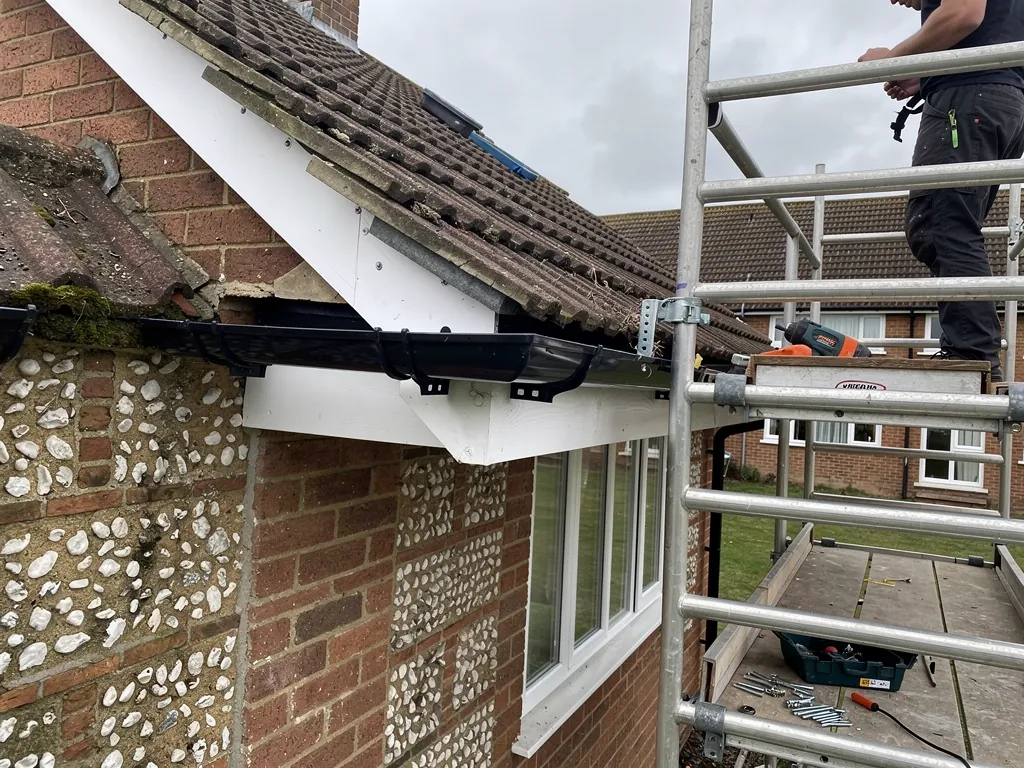
Plastic guttering became the standard from the 1970s because it is light, quick to fit and cheap to produce. It comes in half-round, square and ogee profiles, in white, black, brown, grey and a few woodgrain finishes, with matching fittings for corners, outlets and stop ends. The parts push together with rubber seals, which means a competent fitter can replace a whole run in an afternoon on a typical house.
The weaknesses are known. Ultraviolet light slowly makes the surface brittle and chalky, and the colour fades, particularly on white and brown. Seals dry and perish, and joints start to weep long before the channel itself fails. Brackets are plastic as well, so they flex under a load of wet leaves and let the run sag. In hot weather the sections expand, which is why the joint seals have a movement allowance, and a gutter fitted tight into its unions can pop open in a heatwave.
A good plastic system, properly bracketed and kept clear, gives years of trouble-free service. A poor one, stretched across too wide a bracket spacing, will droop within a few winters. Most of the grief people have with plastic guttering comes from the fitting, not the material.
Which profile?
Half-round is the common choice and the most forgiving. Deep-flow or square profiles carry more water, so they suit big roofs and valleys that deliver a lot to one point. Ogee follows the shape of a classic moulded fascia and looks right on period-style houses. Our page on gutter profiles goes into the shapes in more detail.
Aluminium: light, rustproof and crisp
Aluminium gutters are made of pressed or extruded metal with a powder-coated or painted finish. They do not rust, they hold their colour for a long time and they are rigid enough to span longer bracket gaps than plastic without sagging. Many are formed on site as one continuous length, so there are no joints along the run except at corners and outlets. You may see these called seamless gutters, and we have a page on seamless gutters.
They are well suited to modern houses with sharp architectural lines, to extensions and to commercial buildings, where long runs and a clean look matter. The metal is a good fit with aluminium fascias and capping, so a finished roofline in one material looks coordinated. The main drawbacks are cost, which is higher than plastic, and the damage a careless ladder can do: aluminium dents and the dent shows. Cut edges and fixings of different metals in a damp spot can also corrode where they meet, so we pay attention to what is touching what.
Colour and finish
Powder-coated finishes last well, though a chipped coating on a scratch can start to bubble. Ask for the colour code so any repair matches.
Cast iron: heavy, durable and demanding
Cast iron was the material for gutters and downpipes on British houses from the Victorian era until plastic took over. The channels and fittings are poured into moulds, so the details, such as ogee sections, decorative brackets and hopper heads, are heavy and detailed. A well-painted cast iron gutter looks exactly right on a Victorian or Edwardian house, and it is often what a conservation officer expects to see on a protected one.
The price of that is weight and upkeep. Each length is heavy enough that fixings must go into sound timber, and a rotten fascia will not hold it. It needs painting, inside and out, to keep rust at bay; once the paint fails and rust gets going, the iron can pit through. The bolted and putty-sealed joints leak with age and are fiddly to re-make. Iron is also brittle, so a frozen blockage or a knock from a ladder can crack a section, though a crack can sometimes be repaired.
Cast iron is still made today, and cast aluminium copies of the profiles are common because they are lighter and rustproof. Whether to mend or renew an iron run turns on the condition of the metal that is left, and our guide to cast iron gutters sets out how we decide.
Steel, zinc and copper
These three are less common on ordinary houses but worth knowing.
Galvanised and coated steel
Steel gutters have a zinc coating, sometimes with a paint or plastic layer over it. They are strong and used on industrial units and some commercial roofs, where a long span and tough handling matter. If the coating is scratched, the steel beneath can rust, and the cut edges of a lined sheet are the weak spot. On a house the look is utilitarian.
Zinc
Zinc gutters are made from rolled sheet that develops a soft grey patina. A zinc manufacturer says well-designed and well-installed zinc roofing can pass the century mark. That figure is for roofing sheet, not gutters, but it explains the metal's long-life reputation. It is a material for people who like a natural finish and are prepared to pay for good workmanship, since soldered or folded seams need a skilled metalworker.
Copper
Copper gutters start bright and turn brown, then green, over years of weathering. They suit period houses, high-end new builds and some listed buildings, where lead and copper sit naturally. The cost is high, and copper must not be allowed to drain onto zinc or galvanised steel below, because the run-off can attack those metals. Staining from copper run-off on stone and render is also something to plan around.
How the materials compare
This table is a guide, not a ranking. The best material is the one that suits the building and the owner.
| Material | Weight and fixing | Main weakness | Suits |
|---|---|---|---|
| uPVC | Very light; plastic brackets | Fades, joints weep, sags if under-bracketed | Most modern and mid-century houses |
| Aluminium | Light but stiff | Dents; costs more than plastic | Extensions, modern houses, long runs |
| Cast iron | Heavy; needs a strong fascia | Rust if unpainted; brittle | Victorian and period houses, protected buildings |
| Galvanised steel | Strong; heavy-duty fixings | Rust where the coating is damaged | Industrial units, outbuildings |
| Zinc | Light sheet; skilled seams | Needs a specialist; staining by acid run-off | Design-led or heritage work |
| Copper | Light; soldered or folded | High cost; run-off stains | High-end, period or listed buildings |
On cost, MyBuilder's gutter, fascia and soffit guide, updated in August 2026, puts gutter replacement at £30 to £70 per metre. That is a national spread across materials and sites, and where a job lands within it depends on the material, how hard the eaves are to reach and how long the run is. Our gutter replacement cost guide works through it.
Brackets, joints and downpipes
What holds a gutter up and what joins its sections decide how well it works. Plastic systems rely on clip-in brackets, usually fixed to the fascia but sometimes to rafter feet on a house with no fascia board. Manufacturer guidance asks for brackets no more than 500 mm to 900 mm apart depending on the system, and closer in places that see heavy snow. A run laid with a wider gap looks fine on the day and begins to dip within a couple of winters.
Metal systems use heavier brackets, often screwed or bolted through the fascia into rafter ends. Cast iron may be held with rise-and-fall brackets that let the fall be adjusted. Joints are the next weak point: plastic relies on rubber gaskets, iron on bolts and sealant, and aluminium on sealed overlaps or welded seams. The material you pick fixes which of these you live with, and that influences how often a run needs attention. Our page on gutter bracket spacing explains the numbers.
Why the fall matters in every material
Makers of plastic systems suggest a slight slope to the outlet, roughly 1:600 to 1:350 depending on the system. Too flat and water stands in the channel; too steep and it looks wrong and can overshoot the outlet in heavy rain. Our guide to gutter fall explains how it is set.
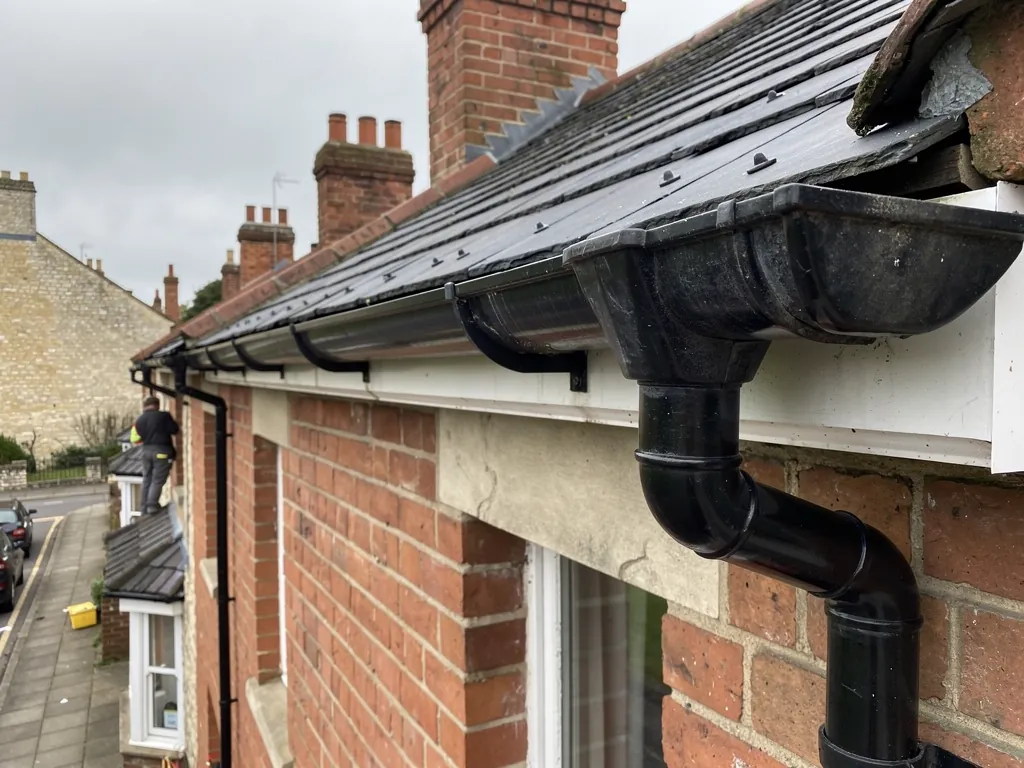
The downpipe is part of the same choice. Plastic pipe is the usual partner for plastic gutter, and aluminium pipe goes with aluminium. Cast iron downpipes, with their ears and nailed-on brackets, are heavy and strong and can take a knock at ground level that would crack plastic. On a house with a bay window or a shared gutter junction, a hopper head catches water from a wastepipe or from two roofs and passes it into one pipe.
Matching matters for looks and for fit. A plastic pipe jammed into a cast iron socket needs the right adaptor, or the joint leaks. If a downpipe discharges into a combined drain or a water butt, the connection at the foot matters as much as the pipe, and our guide to downpipes deals with that. We aim to leave a house with one consistent system, not a patchwork of materials that were fitted at different times.
Choosing for your house, including protected buildings
Four questions settle most decisions.
- What is the house? A Victorian terrace in a conservation area wants cast iron or a convincing cast aluminium match. A 1990s estate house is happy with plastic.
- What is the fascia like? Heavy metal needs sound timber behind it. If the board is rotten, the fascia comes first. Our guide to fascia and soffit materials compares the options.
- How much upkeep suits you? Plastic and aluminium ask for little more than a regular clear-out. Cast iron wants repainting. Copper and zinc want a good installer, and then little.
- How big is the roof? A large roof with a long valley delivers a lot of water in a short time, so channel size and outlet position matter as much as the metal.
If your fascia has been covered with capping, the gutter brackets must fix through the capping into the timber behind, which affects which brackets and which gutters will work. See fascia capping for that.
Gutters are on the front of the house and change how it looks. Where a property is listed, replacing a gutter in a different material can count as an alteration needing listed building consent, and in a conservation area or under an Article 4 direction an application may be needed for something that would otherwise not need one. Swindon Borough Council lists 27 conservation areas, with Article 4 directions in Bishopstone and the Railway Village.
Check with the council's planning and conservation team before ordering material for a protected property, and with the district council if you live in a village outside the borough. Like-for-like replacement is the lowest-risk route. We can tell you what is on the house now, photograph the profile and size, and talk through what would match.
Cleaning and upkeep suit every material. Our gutter cleaning guide covers methods, timing and the checks worth making each time, and after our survey the written quote names the material and the length of gutter it covers. A 10-year workmanship guarantee in writing goes with the finished job, and the old gutter leaves with us.