
Look at the gable end of a house, the triangle of wall under the roof pitch. The sloping board that follows the roof edge there is the bargeboard. It hides the ends of the roof timbers, gives the verge a clean line and keeps wind and rain from getting under the last row of tiles.
It also takes a beating. Rain runs down it, sun bakes it, and the cut ends and joints are open to every shower. A tired-looking bargeboard is usually telling you about the paint, the timber behind it, or the verge above it. This guide explains how the parts fit together, how rot starts, what shows from the pavement and how we choose between a repair and a new board. It sits within our wider gutters, soffits and fascias work.
What a bargeboard is and what sits behind it
A gable-ended house has a roof that stops at the wall rather than sloping to a gutter. The sloping edge is the verge. Along it, the roof structure often overhangs the wall slightly, and the bargeboard is fixed to the face of that overhang to cover the timber ends. Hipped roofs have no bargeboards, which is why you only meet them at gable ends, dormers and some porches.
Behind the board there is usually more than you would guess. Many houses have a small timber frame called a ladder, short pieces that stick out from the gable wall and carry the overhang. The bargeboard is nailed or screwed to the ends of that frame. Under the overhang a soffit board may close the gap, and above it the last course rests on an undercloak, a narrow strip of slate or fibre-cement. Where the gable meets the eaves, the bargeboard joins the fascia, the board that carries the gutter, and that corner is a favourite entry point for water.
Is a bargeboard the same as a fascia?
No, although they often match. A fascia runs along the eaves and carries the gutter. A bargeboard runs up the slope and carries nothing. It does not hold weight, but a loose one catches the wind like a sail.
Why do some houses have none?
Flush verges finish level with the wall and are pointed or dry-fixed, so there is no overhang to cover. The work there is on the tiles and fixings.
How bargeboards rot
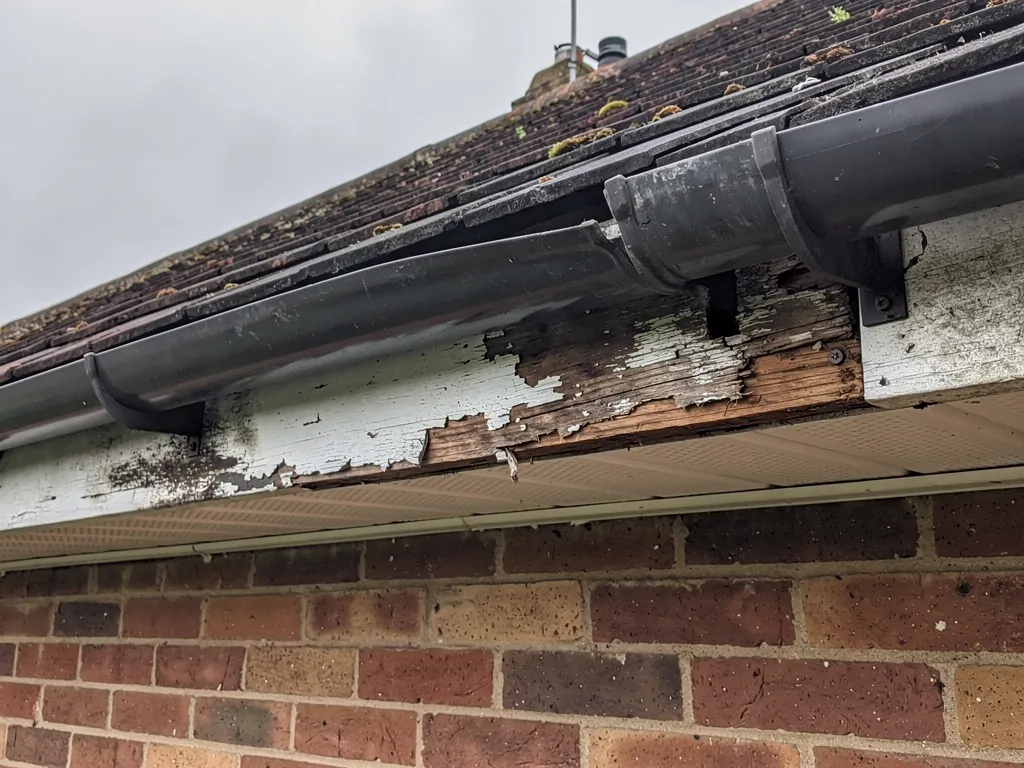
Timber rots when it stays wet and cannot dry. A bargeboard manages that in several ways. The long top edge catches roof run-off. The cut ends at the apex and the bottom are end grain, which draws water in like a bundle of straws. The back face often sits against a damp frame. And where the board overlaps the soffit or fascia, water lodges in the joint.
Paint is the first defence and the first to fail. Once it blisters or flakes, bare timber takes up water with every storm. Over several winters the surface softens, the fibres break down and the board splits along the grain. Paint applied over soft or damp wood holds for a year or so, then fails again, because it only covered the problem.
The verge above decides how wet the board gets. If the mortar under the verge tiles has cracked or fallen out, rain runs behind them and down the back of the board. A leaking gutter at the corner soaks it from below, and a blocked one that spills at a gable can keep the lower end wet for months.
Rot often starts from behind or above, so a well-painted face can hide a soft board. Press a screwdriver gently into the lower end. If it sinks in, the timber has gone.
Birds and wasps use gaps where a board has pulled away, and their nests hold moisture against the wood. Bats and nesting birds have legal protection, so mention any you have seen.
Signs of trouble you can see from the ground
A good look from the pavement tells you a lot. Stand back far enough to take in the whole board, ideally in low side light so the surface shows, and check for these.
- Paint that peels or bubbles, or grey and black patches underneath it.
- Dark staining running down the board from the verge, which points to water behind the tiles.
- A board that dips along its length, or a gap where two lengths meet at the apex.
- Cracks along the grain, or pieces missing from the lower end.
- Verge tiles on an uneven line, or crumbs of mortar on the path below.
- Moss and lichen on the board itself, which shows it stays damp.
If the gable is high, binoculars or a phone zoom do the job, and a photograph helps us before the survey. A board that has come away from the frame and moves in the wind is urgent. It can fall onto a path, a car or a person, and the fixings that held it may also have been holding the verge tiles.
Does a small crack mean the whole board has to go?
Not necessarily. A single shrinkage crack in firm timber is cosmetic and can be filled and painted. What matters is whether the wood around it is sound. Soft, spongy or crumbling timber means the problem has gone past the surface.
What if the paint looks fine but the roof leaks nearby?
Check the verge and the gutter corner first. A leak at a gable can run behind a bargeboard and show as damp on the wall below the roof, with the board looking untouched from the front.
Repair or replace: how we decide
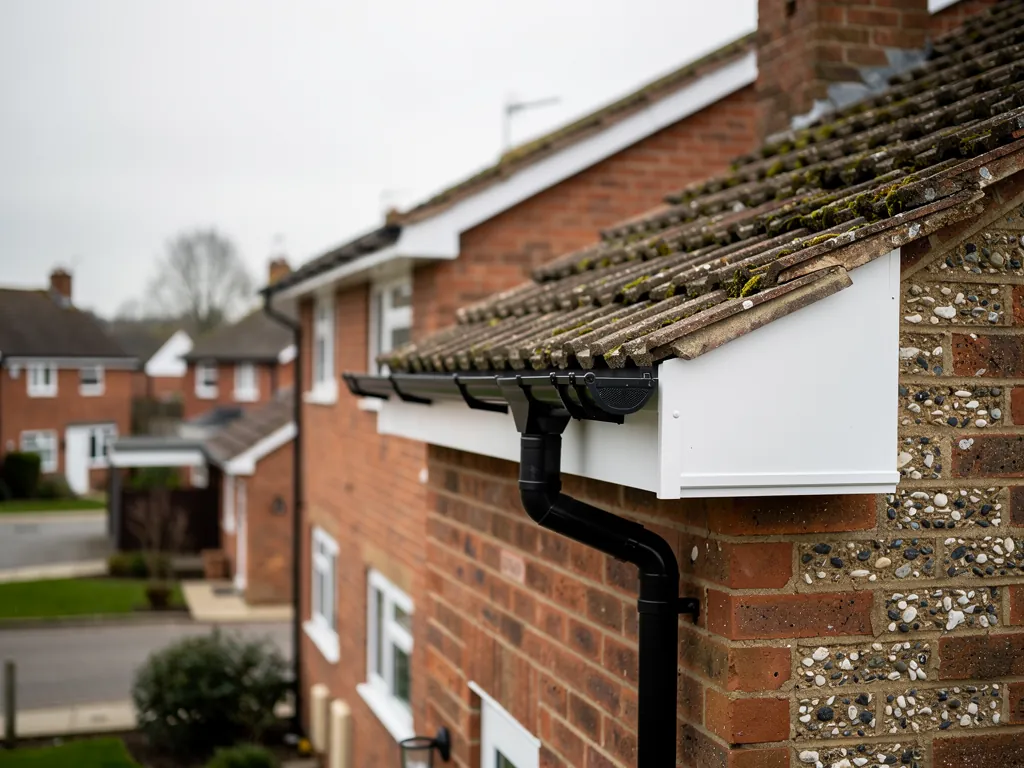
The smaller job is usually the sounder choice, so we start by finding how much of the board is still good and what lies behind it.
Repair makes sense when rot is local, for example the lower end of one board, and the rest is firm. The soft section is cut out, a matching piece is spliced in, and the whole board is primed and painted on every face and edge, including the end grain. Epoxy repair systems can rebuild small damaged areas on decorative profiles that would be costly to copy. They only suit timber that is otherwise sound, and they do not cure the cause. If water still gets in, the repair fails again.
Replacement is better when rot runs along much of the board, when it has split at the fixings, when an earlier repair has failed, or when the frame behind is soft too. Replacing only the visible board without checking what it is fixed to is a common mistake. A new board nailed to rotten backing will not stay put.
Can a new board go straight over the old one?
It can, and some firms do it, but covering a rotten board traps the problem. We would remove the old board, inspect the ladder frame and rafter ends, put right what we find and fit the new board to sound timber.
Do both sides of the gable need doing together?
Not always. If one side is sound it can stay. Matching colours usually looks better, and the scaffold is already up, so ask us to price both options. Our survey photographs show your own gable, and the written quote follows.
Timber, uPVC or composite: choosing the material
The material decides how often the board needs attention and how it behaves when wet.
Painted softwood is the traditional choice and suits older houses. It can be cut to any profile, repaired in sections and repainted in any colour. It needs a fresh coat every few years, and the end grain must be sealed before fixing.
uPVC is a plastic board that is washed rather than painted. It does not rot and it is light. It needs correct fixing and some air movement behind it, because a board nailed tight can warp in heat, and one that has gone yellow or grey is hard to restore. It sits flat, so on a house with a decorative timber bargeboard it looks plain by comparison.
Composite and cement-based boards sit between the two. They are stable, take paint and resist rot, but are heavier and cut differently from timber.
How much does a bargeboard cost?
MyBuilder's guide to gutter, fascia and soffit replacement, updated 21/08/2026, gives around £195 for a bargeboard and roughly £20 to £40 per m² for scaffold. These are national typical figures. Your price depends on gable height, profile, material and whether the frame needs work.
What will the guide figure not tell me?
It cannot tell you what is behind the board. Our price comes once we have seen the frame, the verge and the gutter corner for ourselves.
The verge above the board
A new bargeboard under a failing verge is money wasted. The two work together.
At a gable the last row of tiles overhangs the edge slightly so water falls clear of the wall, with an undercloak beneath. The tiles are then bedded in mortar or held by a dry-fix verge system. On older houses mortar is the only thing holding them. Verge tiles on newer work are clipped or screwed as well as bedded, and BS 8612:2018 covers dry-fix systems tested for the job.
If the mortar has cracked, tiles can lift in high winds and water finds its way down behind the board. Re-bedding the verge or fitting a dry verge at the same visit means the scaffold goes up once.
Who should do the work, a roofer or a carpenter?
The board is carpentry, but the verge, undercloak and junctions are roofing. The best result comes when one team does both, because the order matters: tiles are lifted back, the board is fitted, and the verge is rebuilt over it.
Should the gutter be looked at too?
Yes, where it meets the bargeboard. A leaking joint there will soak a new board from below. Our guide to soffit vents and loft ventilation covers the neighbouring eaves detail.
Period houses, decorative boards and conservation areas
Older houses often have bargeboards made to be seen. Victorian and Edwardian gables carry shaped, fretted or carved boards, sometimes with a finial at the apex and drop pieces at the ends. Swindon's older streets and the villages around it have plenty, and a quick plastic swap changes how a whole street reads.
The better approach is to copy what is there. A profile can be traced, a pattern made and the board cut from new timber, using a surviving original as a template where it is still readable.
Before changing the material, profile or look of a board on a listed house or one in a conservation area, ask the council. A like-for-like swap rarely needs a planning application. Works that affect a listed building's character do need listed building consent, and Article 4 directions can pull everyday changes back under control, as in Swindon's Railway Village. Swindon Borough Council's planning team can advise, or your own council outside the borough.
Our guide to roofline work in conservation areas covers the process, and our page on black roofline deals with colour on the modern side.
Can I swap an old timber board for uPVC on a period house?
Sometimes, but not where consent says otherwise. Ask the council first.
What happens on the day
Bargeboard work is done from scaffold, usually on the gable side only. We strip back to sound timber, take off the old board in sections, check the ladder frame and rafter ends and fix any soft wood before the new board goes on. The new board is sealed on every face and cut end, then painted or finished. The verge, undercloak and the corner with the fascia and gutter are rebuilt or checked at the same stage.
Rubbish goes with us when we finish. The work carries a written 10-year workmanship guarantee. Wherever you get prices, ask whether VAT and scaffolding are in them, because those two move a total further than anything else.
Water landing at the foot of a gable often comes from the drainage below, so our guide to downpipes and drains shows what to look at on the ground.