
Swindon has plenty of old streets, but only a few where a roofer has to read the council's paperwork before touching a slate. The Railway Village is the best known: terraces built for the Great Western Railway's workforce, now a conservation area with listed cottages and a planning direction that dates back to 1980. Several other places on the council's conservation list bring their own, lighter, set of conditions.
This guide sticks to what Swindon Borough Council has published about its heritage areas. It is not a substitute for asking the council about your own address, and nothing here is legal advice. What it should do is tell you which questions to ask, in what order, so a slate repair, a re-roof or a new roof window does not stall halfway up the scaffold. For the basic planning tests that apply nationally, see our guide to planning permission for roof work.
How the Railway Village became a protected area
The story matters because the date of each protection decides which rules sit on your house. The council's appraisal of Swindon's Railway Conservation Area records that the cottages were statutorily listed in 1970. The railway village itself was designated as a conservation area in 1975, and the neighbouring railway works were designated separately in 1987.
Those two areas were later merged, amended and extended. The appraisal says Swindon's Railway Conservation Area was designated in 2020, while the council's statutory notice is signed on 13 April 2021, so the safest way to describe it is that the village has formed part of the wider Railway Conservation Area from 2020 to 2021 onwards. The earlier 1975 designation still tells you how long the village has been treated as a place whose appearance is worth keeping.
Three layers therefore overlap on many streets: listing of individual buildings, conservation area status, and an Article 4 direction. Each one asks a slightly different question of a roofer. Listing is about the building. Conservation area status is about the street. The direction is about the everyday rights that owners would otherwise have without applying for anything.
If your house is anywhere near the old railway works or the village streets, assume at least one of these layers applies until the council tells you otherwise.
What the appraisal says about the roofs themselves
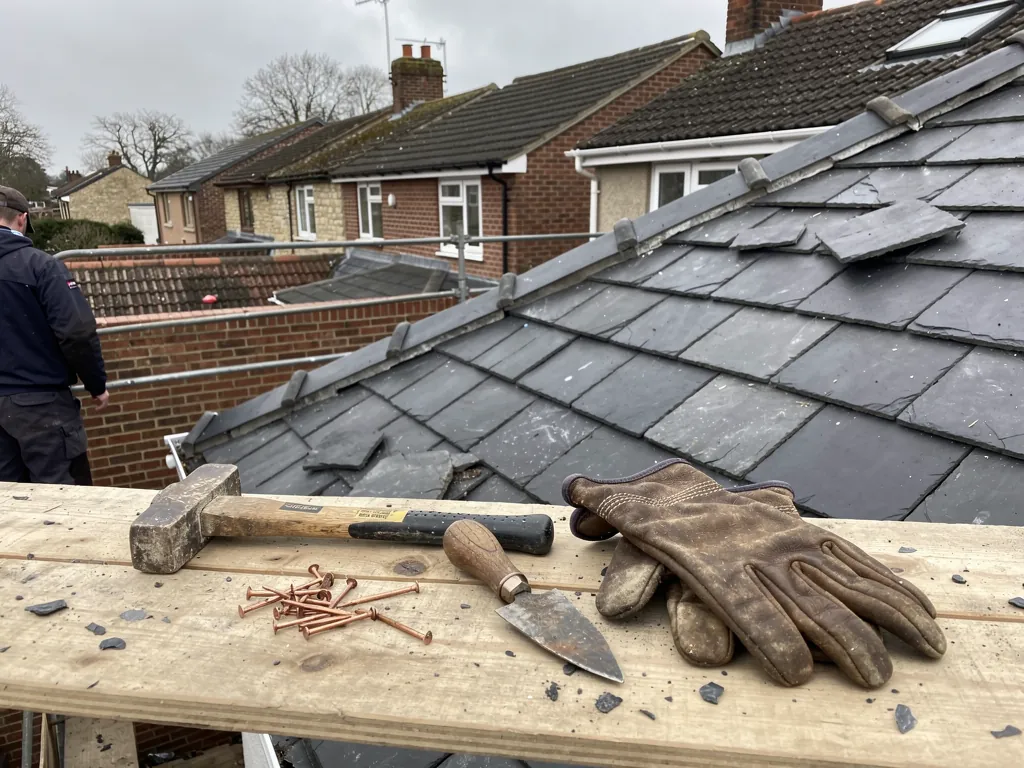
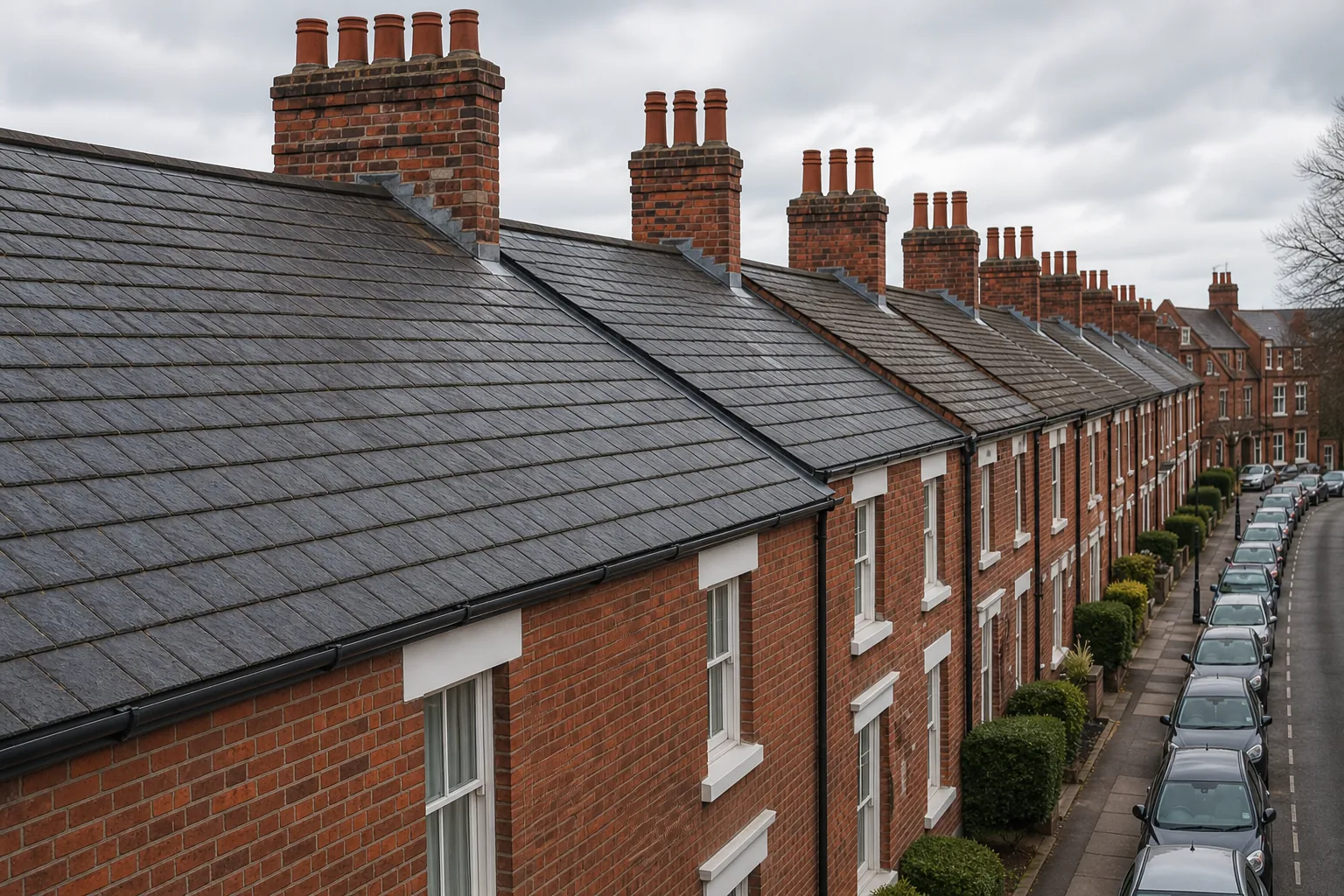
The council's appraisal describes the village's "heavy-looking pitched slate roofs" and says that the roofs are generally slate. That is a sourced statement about this particular area, and it is the starting point for any specification. A roof that has always been natural slate is normally repaired and re-covered in natural slate, laid in a way that keeps the same proportions and the same look from the street.
The appraisal also records that the 1970s refurbishment of the village included repairs to slate roofs. Many slates you can see today may therefore have been disturbed, replaced or refixed in living memory, which is useful to know: a roof that has been patched over fifty years often has a mix of sources, sizes and fixings, and a survey will pick out which sections are tired and which are sound.
Why slate size and headlap matter here
Natural slate needs a minimum pitch and a headlap, the amount each course overlaps the one two courses below, to shed water properly. Cupa Pizarras, a slate manufacturer, reads BS 5534 as putting the floor at 20 degrees for 500 mm natural slates, and the headlap it asks for grows as the pitch flattens. Terrace roofs in the village are steep enough that this is rarely the concern. The point of mentioning it is that a like-for-like slate roof is a specification, not just a colour, and the details matter.
Our pages on Victorian slate roofs and slate roofing in conservation areas cover how we approach the work itself.
The 1980 Article 4 direction and what it brings in
Most householders never need to think about permitted development, because the national rules let you do many small jobs without applying. An Article 4 direction withdraws some of those freedoms in a defined area, so that the council sees the proposal first. The government's planning guidance describes it as a direction under article 4 that lets the Secretary of State or the local planning authority take away named permitted development rights from a mapped area.
The appraisal states that an Article 4 direction is in force in Swindon's Railway Conservation Area, over the residential streets of the village together with Church Place. It dates from 1980. The appraisal says it brings in the need for permission to repaint the outside of a house, to extend or alter it in any way, to put up garden structures and to form a vehicle cross-over.
The wording to notice is the open one about alteration. Altering how a roof looks, with a new covering, an added rooflight or a rebuilt stack, is worth raising with the council ahead of any order for materials. Plain matching repair is a different matter and does not usually count as development at all, but where repair ends and alteration begins is something only the council can confirm for your street.
The council also notes on its conservation areas page that Bishopstone has its own Article 4 direction, so the Railway Village is not the only place in the borough where this applies.
Listed cottages and listed building consent
The cottages were listed in 1970, and the council's leaflet issued with the direction states that most of the properties are listed, and that consent for listed buildings is usually needed. Your first job is to learn whether your own house is listed.
The law behind listed building consent is simple to state. Section 7 of the 1990 Act says works that alter a listed building so as to affect its character need authorisation, and section 9 makes doing them without it an offence. The roof forms much of what a street shows to passers-by, so a change of covering, pitch, ridge detail or flashing on a listed house is exactly the kind of work the consent system looks at.
Repairs versus replacement
Replacing a few slates with matching slates is ordinarily maintenance. Stripping and re-covering the whole roof in a different material, or altering lead details, is more likely to need a conversation and possibly consent. Where an owner is unsure, a written note from the council on what it will accept is worth more than any assumption.
If you would like a second pair of eyes before you ask, a period roof survey gives the council or a conservation officer the condition evidence they will want to see.
The 27 conservation areas on the council's list
The council's conservation areas page lists these places: Badbury; Bishopstone; Blunsdon St Andrew; Broad Blunsdon; Castle Eaton; Chiseldon; Hampton; Hannington; Highworth; Hinton Parva; Hodson; Liddington; Lower Blunsdon; Lower Wanborough; Sevenhampton; Stanton Fitzwarren; Stratton St Margaret at Kingsdown; Stratton St Margaret at Lower Stratton; Swindon Old Town at Devizes Road; Swindon Old Town; Swindon Old Town at Prospect Place; Swindon Old Town at Town Gardens; the Swindon railway conservation area; Rodbourne Cheney; Upper Inglesham; Upper Wanborough; and Wroughton. That is 27 entries by our count; the page itself does not give a total.
For roof work, conservation area status has a handful of consequences that the council lists in its notices: consent is needed for demolition, applications are given special publicity, and anyone intending to work on trees must give the council six weeks' notice. None of that stops a sound repair. What it does mean is that visible changes get a second look.
Two of the entries sit partly or wholly within the North Wessex Downs, according to the council's own appraisals of Liddington and Upper Wanborough. National Landscape status adds a further set of planning considerations, which we cover on the National Landscape roofs page.
You can read the full list and the contact address for conservation questions on Swindon Borough Council's conservation areas page.
Dishes, aerials and roof windows
The Railway Village appraisal takes a firm line on television aerials and satellite dishes fixed to a chimney or a slope. The council says it will resist them, and an application would need planning permission plus listed building consent where that applies. If you are renting or buying a house there, a dish on the front slope is something to check before you assume it can stay.
Roof windows need a more careful answer. Nationally, an alteration to a roof slope can fall within permitted development, and that can remain true in a conservation area, but it does not apply to listed buildings, and it does not apply where the council has removed the right with an Article 4 direction. In the Railway Village you therefore start with the direction and the listing, not with the national rule. The point is the same for a new window as for a replacement: ask first, show the council drawings, and be ready for questions about size, position and how far the frame sits above the slates. Our guide to conservation rooflights explains what that looks like, and the roof window planning page covers the national rules.
Chimneys deserve their own mention. They are part of the roofscape and are often listed with the house, so flaunching, repointing and pot replacement should keep the existing character. Our listed chimney repairs page goes into lime mortar and matching brick.
A sensible order of work for a heritage roof
The sequence we suggest is the same whichever of the 27 areas you live in, with the Railway Village at the strict end of the scale.
- Check the listing of your house and whether your street falls inside the Article 4 direction. The council's conservation team can confirm both.
- Have the roof surveyed. Photographs of the actual slates, flashings and chimney give you evidence of what is failing, which helps you argue for repair rather than replacement.
- Describe the proposed work in terms of material, size, fixing and colour, not just "re-slate".
- Ask the council whether the work is repair, alteration, or something that needs consent, and keep the reply in writing.
- Only then agree the written quote and a start date.
Our quote is written and arrives once the survey is done, and our habit of proposing the smallest job that mends the fault suits a heritage roof. Where consent is needed we explain it and help you prepare the information the council asks for. Skyline Swindon Roofing works across the town and the villages around it, and our work carries a 10-year workmanship guarantee in writing.
If you are curious about the wider heritage around the roofs, our guide to Swindon's attractions points out where the railway buildings and the Old Town streets show their roofs best. For work in a listed house, a general contractor and a roofer often both have a part to play, and roofer or builder explains who should do what. Roofing in these streets also relies on traditional skills, which is one reason the trade matters to us, as explained in how to become a roofer. Last, a heritage roof lasts longest with regular attention, so keep the seasonal maintenance checklist handy.