
People come to roofing from school, from other trades, from warehouses and offices, and from a few years of wanting to work outdoors. There is no single door. What the routes share is that the trade is learnt by doing, supported by formal training in safety and technique. Nobody becomes a competent roofer from a book, and nobody should be on a roof unsupervised on their first week.
This page explains the main ways in, what the work asks of you physically and mentally, and what a day looks like on a typical Swindon job. It is general careers information about the trade. It does not describe any particular firm's hiring, and nothing here is an offer of work. If you are on the other side of the fence and need a roofer, try our guide to choosing a roofer. The firm behind this page is Skyline Swindon Roofing, a Swindon contractor.
What roofers actually do
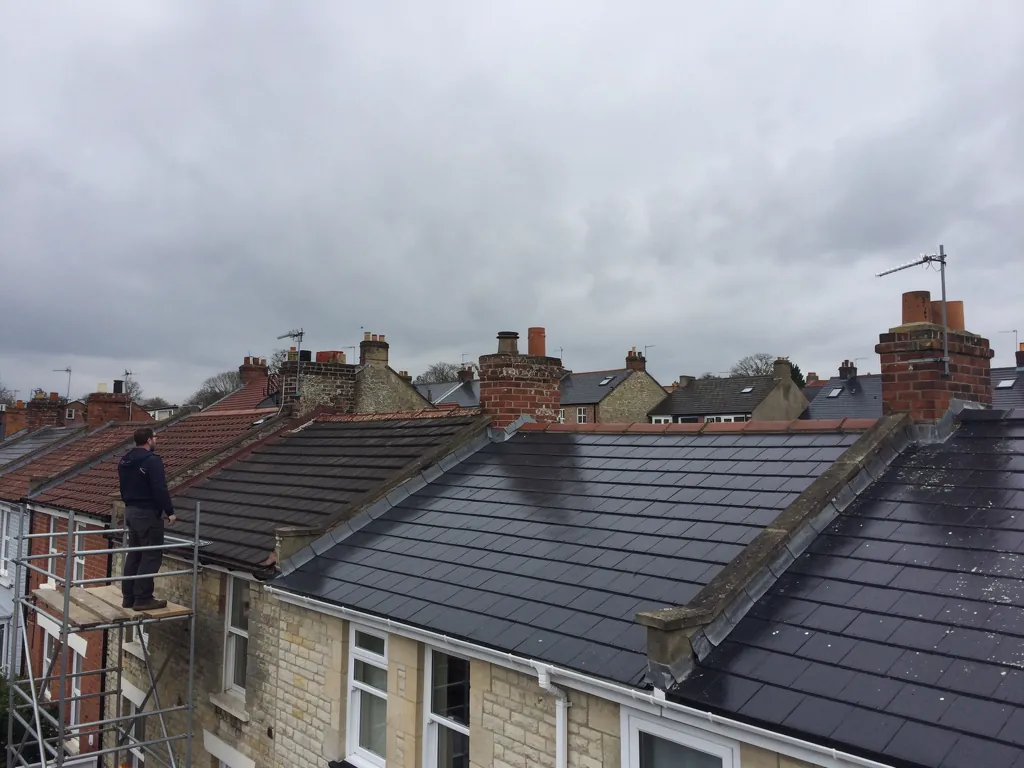
Roofing covers more than most people imagine. At its core it is keeping water out of buildings. In practice that means pitched roofs in tile and slate, flat roofs in felt, rubber or fibreglass, lead work around chimneys and walls, ridge and verge details, and the gutters and fascias at the edge. Some roofers specialise in one of these; many work across several.
The jobs are varied. A morning might be stripping a worn slate roof on a railway terrace, sorting what can be reused and what cannot. An afternoon might be dressing lead flashings round a chimney or fitting a roof window. Emergency work, such as a make-safe after storm damage, can break into any plan.
Pitched, flat and heritage work
Pitched work involves laying battens, underlay and then the covering in courses from the eaves up. Flat roofing means working with membranes, adhesives and sometimes heat, and it is a different skill set. Heritage work, on stone slate or old clay, asks for patience and knowledge of how a building was originally put together. Our pages on pitched roofing, flat roofing and lead roofing show the range.
Roofing is also physical, outdoors and weather-dependent. You carry materials, work at height, kneel and stretch for hours, and finish a day tired in a good way. If that sounds appealing, read on.
Route one: an apprenticeship
An apprenticeship is the classic route and the one most people think of first. You are employed by a roofing contractor, paid a wage, and spend part of your time working on roofs and part in formal training with a college or training provider. Over the course of the programme you build up both skill and a qualification.
Apprenticeships suit people who are leaving school or college, and they also suit adults changing career, though pay and eligibility rules vary by age and circumstances. The details change, so check the current position on the official government apprenticeship service rather than relying on any website's summary, including this one.
Finding an employer
The hard part is often getting taken on. Roofing firms are mostly small businesses, and many do not advertise. Ways in include:
- Searching the government's apprenticeship listings.
- Asking your college's construction department about employer links.
- Contacting local roofing firms directly with a short, polite message and an offer to do a trial day.
- Speaking to a careers adviser at school or through an adult learning service.
What an employer wants to see
Reliability counts for more than experience at this stage. Turning up on time, being willing to learn, staying calm around heights and being comfortable with physical work all matter. A clean record of attendance at school or college helps because it is evidence of the first of those.
An apprentice usually starts on the ground: carrying, sorting, cutting, tidying and learning the names of everything. Time on the roof comes with training and supervision.
Route two: college courses and then work
Many colleges in the UK offer construction courses that include roofing. A full-time course gives you the basics in a workshop setting: how to cut and lay tiles and slates, how to form lead details, how to read a roof plan, and the vocabulary of the trade. Practising in a yard before you go on a real roof is a gentle way in.
The catch is that a course is not a job. Colleges teach technique, but the speed, judgement and routine of a working roofer come from a site. Many people use a course to show an employer they are serious, then move into an apprenticeship or a trainee role.
Short courses and tasters
If you are not sure, a short taster course or a training day can help you decide. Some providers run introductory sessions in roof work or working at height. They are cheaper than committing to a year and give you honest information about whether you like the work.
Learning as an adult
Career changers sometimes find evening or weekend courses fit around an existing job. The principle is the same. Learn the basics, build a record of training, and look for an employer who will take you on and let you develop on the roof. Existing skills in carpentry, bricklaying, plumbing or general building can be a strong starting point because roofs touch every one of those trades.
Route three: learning on the job
Some people start as a labourer for a roofing firm and learn by working alongside qualified roofers. This is still common, particularly in small businesses. You begin with the basic tasks, get a feel for the site, and gradually take on more as you show competence.
On-the-job learning has strengths and risks. The strength is real experience from day one and an income while you learn. The risk is that training can be patchy. A good employer will make sure you get proper safety instruction, not just a ladder and a hammer. If you are learning this way, ask about formal training and qualifications that you can build up alongside the work. Without them it is harder to move to a different firm or go out on your own.
Questions to ask before you start
- Who will I be working with, and who is responsible for my safety on site?
- What training will I get, and when?
- Will I be paid for the time I spend in training?
- What happens in bad weather?
- Is there a route to a recognised qualification?
A firm that answers these clearly is more likely to be a good place to learn than one that dodges them.
Safety, working at height and the skills the trade needs
Falls from height are the main risk in roofing, and the trade takes them seriously. Anyone working on a roof needs training in how to work safely at height: how to set up and use ladders, scaffolding and edge protection, how to move materials, and how to stop things falling on people below. A site safety card, such as the one used across the construction industry, is commonly asked for and shows you have passed a basic health and safety test.
Training does not stop at the first card. Safe working includes understanding the load a roof can take, knowing which parts are fragile, and being willing to stop when conditions are wrong. Wind, wet slates and frost make a roof dangerous, and a good roofer sometimes decides not to go up.
Practical skills
Beyond safety, the trade needs:
- Measuring and setting out, so that courses run straight and gauges are even.
- Cutting slates, tiles and lead cleanly.
- Understanding water: how it moves across a roof, where it collects and how details such as valleys, flashings and soakers shed it.
- Working with fixings, from nails to clips to dry-fix systems.
- Basic carpentry for battens, fascias and small timber repairs.
Asbestos awareness
Anyone working on older buildings should be aware of asbestos. HSE's guidance is to treat anything built or refurbished before 2000 as a place that may contain asbestos. Cement sheets on garages and some soffit boards can contain it. Learning to recognise it, and to stop and ask rather than guess, is part of working safely.
A day on a Swindon roof
A typical day starts early, before the weather has made up its mind. The crew arrives, checks the site and the scaffold, and looks at the forecast. Materials are loaded or lifted into position, and the work is planned for the day: which slope, what stage, who is doing what.
On a re-roof of a terrace, the first job is often stripping the old covering and clearing it down a chute into a skip. The roof timbers are then checked. Damaged battens come off, new underlay goes on and the new covering is laid from the eaves upwards. Chimney stacks, party walls and valleys need their own detail work. Terraces share walls, so there can be a neighbour on the other side of the party wall who needs to know what is happening. Our guide to party walls and roof work covers when a notice is required.
Different buildings, different days
An estate house with concrete tiles goes faster, with larger units and a regular pattern. A stone-fronted cottage may need slates sorted by size and laid in diminishing courses, which is slower, precise work. The railway streets add conservation rules: our page on Railway Village roofs shows how much care they require.
Finishing the day
At the end, the roof is made watertight before everyone leaves, even if the job is unfinished. Tools are packed, rubbish is cleared and the site is left tidy. A roofer's work is judged partly by what the street looks like when they go. You can see a version of this day from the ground on a walk around the town; our guide to attractions in Swindon suggests places where the buildings are worth looking up at.
Progress, pay and where the trade can take you
Roofing offers a clear path for someone who stays with it. You begin as an apprentice or trainee, become a qualified roofer, and may then specialise in slate, lead, flat roofing or heritage work. Some roofers move into supervising crews, estimating, surveying or running their own firm.
Pay varies by region, experience, specialism and whether you are employed or self-employed. National cost guides give a sense of the market: MyBuilder, updated 21 August 2026, puts a roofer's day rate at £250 to £300, and Checkatrade quotes roofers at £280 to £360 a day or £35 to £45 an hour in its repair guide. Those are what customers pay for a roofer's time, not what a roofer takes home, and they include costs and overheads. Do not read them as a salary.
Specialising
Lead work is a skilled craft of its own, demanding precise bossing and dressing. Slate and stone roofing reward patience and a feel for natural materials. Flat roofing is about systems and details. Each has demand, and the specialist is often the person a general firm calls when it hits something unusual.
Going it alone
Going self-employed brings freedom and responsibility: insurance, tax, paperwork, marketing and quotes. That is a step to take after you have a track record and some business sense, not before. Many people stay employed for years, and do well.
Keep learning
Regulations, materials and fixings change. A change that arrived with BS 5534:2014 shows the point: ridge and hip tiles gained mechanical fixings on top of their bedding, and dry-fix systems tested to BS 8612 followed. A roofer who keeps up with such changes stays useful.
If you decide to get started, begin with a conversation: your college, a careers adviser or a local firm. Ask to see a roof job first-hand if you can. It is the best way to find out whether the trade suits you.