
Most lists of things to do in Swindon stop at the opening hours. We are a roofing firm based in the town, so we look up as well as around. Every place below has a roof worth noticing: a heavy slate pitch on a railway cottage, the long industrial spans of a former works, stone rubble walls on a hill, a country house with a church beside it.
Nothing here is a roofing lecture. Think of it as a day out with a second layer for anyone who has ever wondered why one street looks so different from the next. Check opening times and any entry details with each place before you travel, because they change. Where a roof detail is a general point rather than something about one named building, the wording makes that clear. For one famous street of roofs in close-up, see our guide to the Railway Village. We are Skyline Swindon Roofing, and the town is our patch.
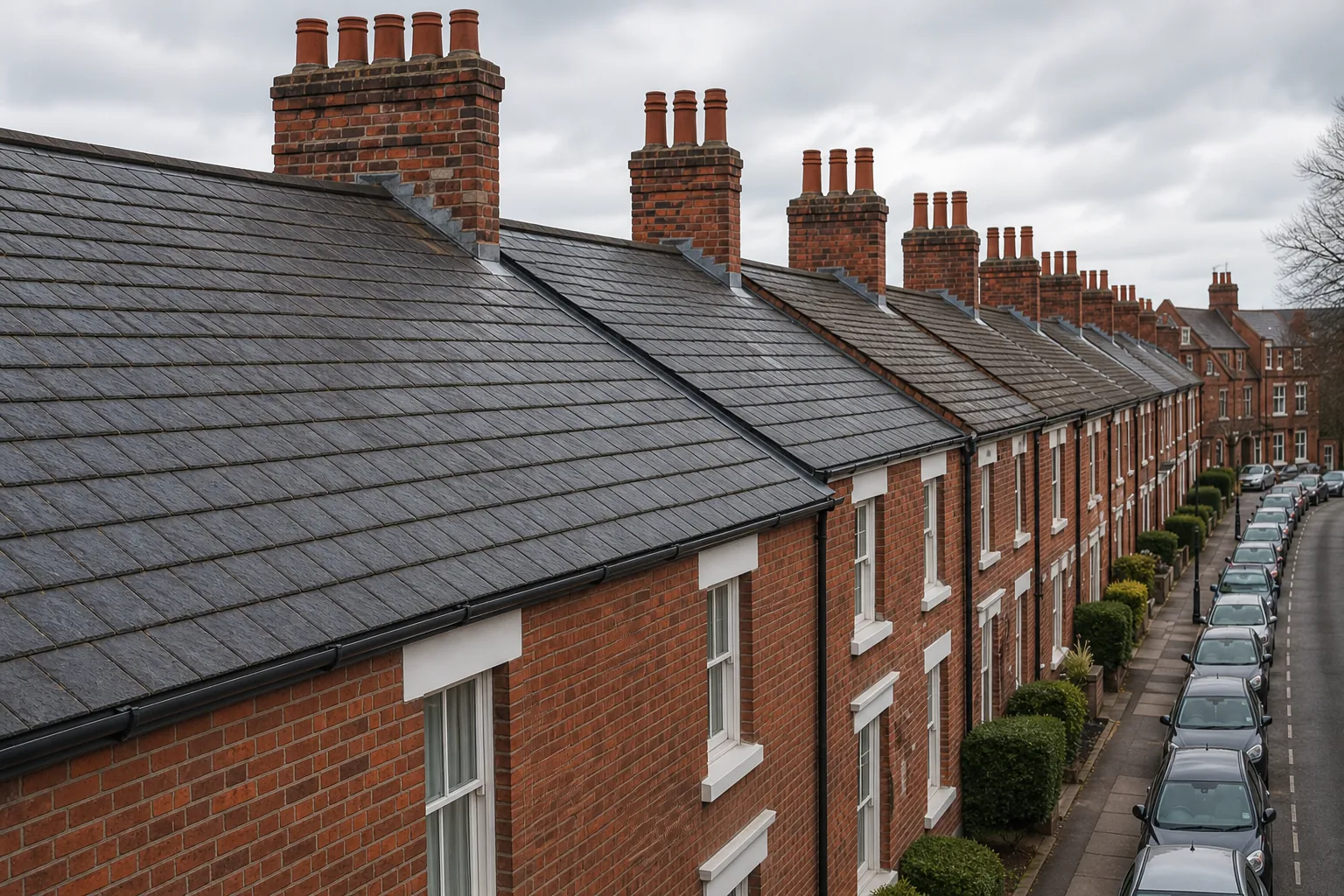
The railway heritage and why Swindon looks the way it does
You cannot talk about Swindon's attractions without starting with the Great Western Railway. The works shaped the town's streets, its terraces and its skyline long before anyone thought of a day out here. The railway museum, which tells that story, sits in a former works building and is the natural first stop for anyone new to the town.
From a roofing point of view, a visit gives you something unusual: a chance to see how a big industrial site was covered. Works buildings were built to be big, light and quick to put up. The roofs tend to be long, low-pitched spans with generous glazing so that men could work by daylight. When you are standing inside, look up. Rooflights, steel or iron supports and the junctions where one span runs into the next are all close enough to study in a way you rarely get from the street.
What the industrial roofs teach a homeowner
Big roofs fail at the joints, just as house roofs do. Where two spans meet there is a valley or a gutter between them, and where glazing meets a covering there is a flashing or a seal. That is true of a railway shed and of a lean-to on a terrace. If you take away one idea from the museum, make it that water is dealt with by laps, falls and gutters, and that the details matter more than the size.
The same logic is behind the way we approach commercial roofing: the covering is only as good as its drainage and its edges.
The Designer Outlet and the old works
The Designer Outlet is the part of the old railway works that most visitors walk through without thinking about its history. Shops now occupy buildings that were put up for engineering, and the big openings are still there for anyone to see. It is a good example of how an old industrial building can keep its shell and change its use.
That is worth thinking about when you look at the roofs. A building that has been converted needs its roof to do a different job from the one it was designed for. A workshop could be draughty and cold. A shop, a restaurant or a flat cannot. Converted buildings therefore tend to show later work on top of the original: new membranes, added insulation, rooflights replaced, plant and ducts fixed where there was once clear sky.
Why conversion roofs get extra scrutiny
When an existing roof is renovated and enough of it is affected, thermal performance has to be brought up as part of the work. The rules sit in Approved Document L, and the same ideas apply to a house loft conversion as to a former works. If you are ever planning to convert a space under a roof, our guide to how Part L affects a re-roof sets out when the whole roof has to improve rather than just the part you touch.
Look at the edges of the larger roofs around the site. Parapets, gutters and the lines where a roof butts into a higher wall are where owners of large buildings spend their maintenance money, because they are where the water goes.
Swindon Old Town: stone, slate and a hilltop roofscape
Old Swindon stands on a knoll, and the Old Town conservation area takes in the oldest part of that hilltop settlement. Wiltshire County Council made it the borough's first conservation area in 1969, and the boundary was redrawn in January 1981. If you walk around the streets here, you are seeing a different Swindon from the railway town below.
The council's appraisal names Swindon stone and limestone among the local building materials, built up either as rough rubble or as squared, coursed blocks. Early properties show mansard-type roofs covered in stone slates, and the shallow-pitched Welsh slate roofs of 8 to 14 Bath Road make a good contrast to the stone. The appraisal also notes that chimney stacks and clay pots add to a lively roofscape, and that replacement coverings in concrete tile or reconstituted slate have detracted from some buildings.
What to look for as you walk
Compare the colour and texture of the roofs along one street. Natural stone slate and natural slate weather and lichen over time in a way that a modern concrete tile does not. Look at the chimneys too. Pots, brick courses and the lead dressed round the foot of a stack are all details that wear out first.
If you own an old building here
A roof in a conservation area is not frozen in time, but it is watched. A plain swap of one covering for its twin seldom triggers a planning application, but a listing or an Article 4 direction on the street changes the answer, and the planning team at Swindon Borough Council can tell you where you stand. Our guide to re-roofing in a conservation area explains the questions to ask first.
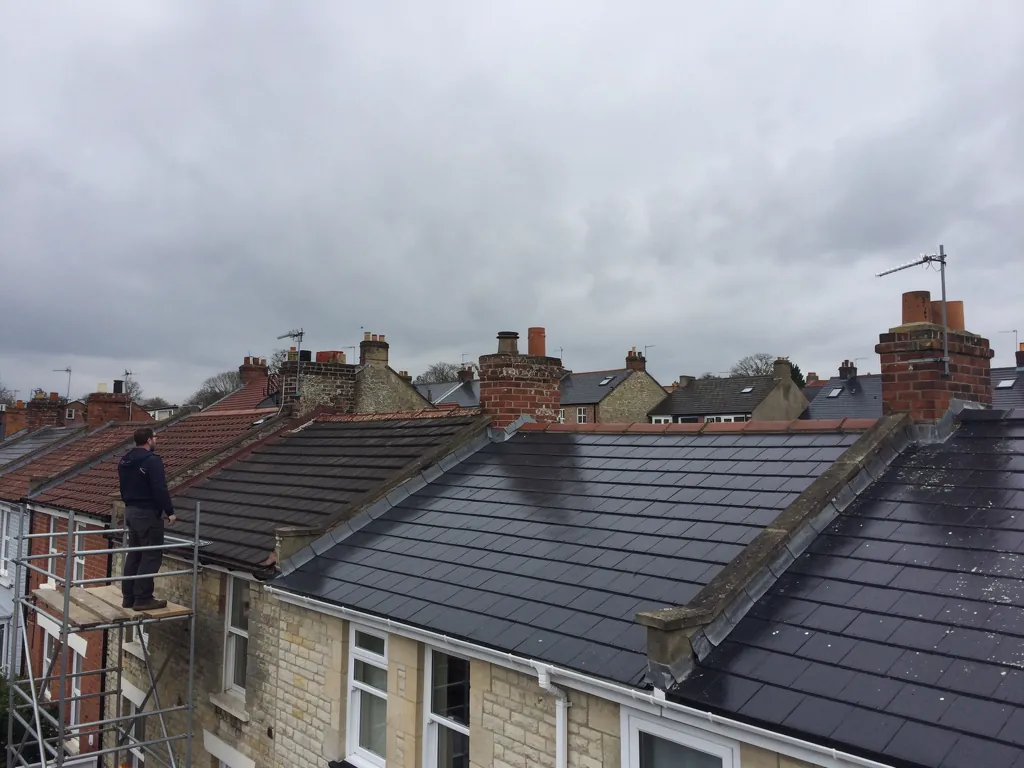
Lydiard Park and the parish church beside it
Lydiard Park is the town's best-known green space with a historic house at its centre, and the parish church stands right beside the house. For a roofer's eye, the pairing is useful because a house and a church of different dates sit within one view.
Church roofs and country house roofs are built differently from town roofs. A church has long, steeply pitched slopes over a nave, lead often used at the valleys, parapets and gutters, and a tower with its own covering. A large house has a mixture: pitched coverings, stacks of chimneys, hidden parapet gutters behind a balustrade and lead flats between the ridges. These hidden gutters are common in grander buildings, and they are the places that go wrong out of sight long before any stain reaches a ceiling.
Do churches need the same permissions as houses?
Not always. The ecclesiastical exemption still covers worshipping congregations of the Church of England (through its faculty system), Catholics, Methodists, the Baptist Union and United Reformed congregations. Unitarian and Quaker buildings sit outside it, as do redundant churches. Scheduled monuments need scheduled monument consent. If you are responsible for a place of worship, ask the right authority before any roof work.
For the rest of us, the lesson is simpler: grand buildings hide their drainage, so it is worth looking for downpipes, hopper heads and lead dressings when you are out in the park. Our page on lead roofing covers the material that makes most of those details work.
Coate Water and the edge-of-town villages
Coate Water is a country park on the southern side of the town, built around a lake, and it is the easiest way to get out of the streets for an afternoon. The park itself has few buildings to study, which is a reason to look further out. The roads around it lead into the villages and edge-of-town housing where the roof types change again.
South of Swindon you start to see the effect of the downs. The North Wessex Downs National Landscape is nearby, and roofs there are treated with more care in planning terms because the land counts as article 2(3) land. Planning decisions there rest with the council, and the landscape body only gives advice. Building materials in these villages can include local chalkstone and brick, with slate replacing thatch on some older properties. Wroughton is a good example. Its conservation area appraisal gives thatch, local stone and red brick as the old building materials, and says Welsh slate and imported brick spread as transport got better.
What exposed sites mean for roofs
Open ground and the edge of the downs give a roof more wind than a sheltered back street. We do not put figures to that, but it is one reason we look at ridge and verge fixings first on a roof in an exposed spot. Since BS 5534:2014 ridge and hip tiles are meant to be held by a fixing as well as by mortar, so those details deserve a check on any roof older than that.
A walk around a lake is a good moment to look at your own roof from a distance. A slipped tile or a leaning chimney is often easier to see from the far side of a field than from your own back garden.
How to spot roofs safely on a day out
Looking at roofs is free and needs no equipment, but a few habits make it more rewarding. Stand back. A roof reads best from across the street or from the far side of a park, where you can take in the whole slope rather than the last metre of it. A phone camera with a zoom gives more detail than most people expect, and binoculars are better still.
What to notice
- The covering: slate, clay tile, concrete tile or stone, and how evenly it sits.
- The ridge and the verges: whether the line is straight and the mortar intact.
- The chimneys: leaning, repointed or capped.
- The gutters: sagging, stained or sprouting greenery.
- The junctions: the point at which an extension joins the main roof, and how that joint has been sealed.
What not to do
Stay on the ground and on public land. Do not climb to get a better angle, do not fly a drone over other people's homes without checking the rules, and do not photograph a private house in a way that would bother the people who live there.
Many streets in Old Town and the Railway Village are terraces, where roofs and walls are shared. Work on one house can affect the next, and in some cases the law requires a notice to the neighbour. Our guide to party walls and roof work explains when that applies.
When the roof you spotted is your own
Sometimes a day out turns up something at home. You look at a handsome stone roof in Old Town, then come back and notice your own ridge line is not as straight as it used to be. That is not a reason to panic, and it is not a reason to rush into a big job either.
Begin by finding out what you are looking at. A visit with pictures of your own slopes tells you whether the fault is a few slipped tiles, a failing flashing or a covering near the end of its life. We will point you at the lightest repair that puts the fault right, and a written quote follows after we have been up and looked. Workmanship carries a 10-year guarantee on paper, and the site is left clear.
If you are weighing up who to call, read our guide to choosing a roofer before you make any calls. And if the day out has left you curious about the trade itself, how to become a roofer covers the routes in.
Roofing is a trade that rewards looking. Whether you are a visitor, a resident or someone thinking of working on roofs, a few minutes on the ground with your head tilted back will teach you more than a brochure.