
Listing is a legal protection for the special architectural or historic interest of a building, and it covers the whole structure, roof included. Lead sheet, the metal used for flashings, valleys, parapet gutters, dormer cheeks and flat roofs, is often part of that interest. It was chosen centuries ago for its working properties, it ages in a particular way, and its detailing, the rolls, drips and laps, is a craft in itself.
That is why a listed owner cannot treat a leaking flashing the way the owner of a 1990s semi can. A cheaper material or a quicker method may be perfectly sound but still wrong for the building, and carrying it out without permission can be a criminal offence. Below we explain the starting principle, when consent is needed, what counts as like-for-like, where substitutes are accepted and where they are not, and how we approach a survey. Our lead roofing page covers the wider subject, and we are not able to give legal advice, so your council's conservation team has the final word on any particular building.
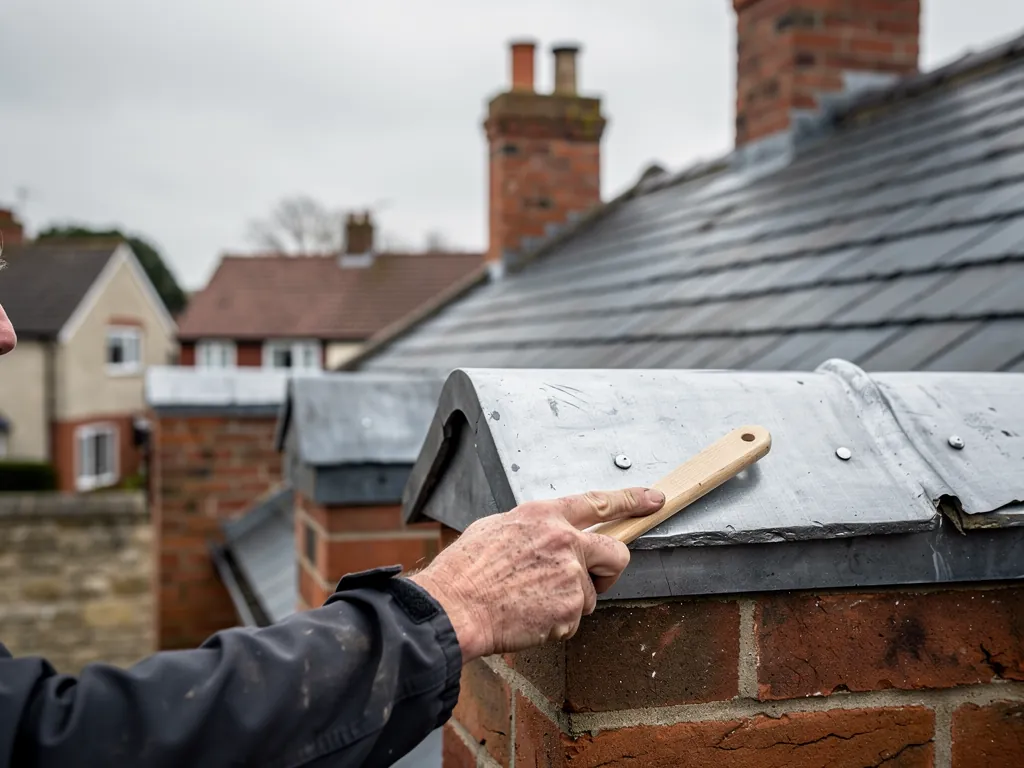
Why lead gets special treatment on listed roofs
The 1990 listed buildings Act (section 7(1)) stops anyone changing a protected building so as to touch its architectural or historic importance without authority, and section 9(1) treats breaking that rule as an offence. Those are the legal bones, and they apply to the building as a whole: the interior, the exterior and often structures within its grounds.
The roof is among the most visible parts of that character, and the metalwork on it is part of the picture. Lead on a Georgian parapet, on a bay beside a Victorian doorway or on the cheeks of an old dormer shows how the building was made. The colour and texture of aged lead belong to the building as much as the brick or stone around it.
Does every lead repair need consent?
No. Repairs that match the original in material, method and appearance, and which do not alter the character of the building, are commonly treated differently from changes. But the line between repair and alteration is not always obvious, and the decision rests with the local planning authority, not the roofer. If you are unsure, ask the council before work starts rather than after.
What does the council expect to see?
Expect a description of the work, photographs of the lead as it stands, and details of the new material, code and method. Our survey photographs and written quote are written to help with that, and where consent is needed we can explain what to put to the council.
What like-for-like actually means for lead
Like-for-like asks for identical material, laid in the identical position and shaped by the identical method. For leadwork that has four parts. The first is the metal: rolled sheet lead to BS EN 12588. The second is the thickness, where Royston Lead lists Code 4 to Code 8 for valleys and gutters, Code 5 upwards for parapet and box gutters, and Code 3 for soakers only, so a replacement should follow what the old work used in each position unless something specific justifies a change. The third is the detailing: the same pattern of rolls, drips, laps and chases. The fourth is the finish, since new lead is bright and then weathers.
An existing layout often tells a story. If the original flashing was cut into the mortar course in a particular way, or the valley is swept rather than hard, then a replacement that ignores those clues changes the look, even if every piece of lead is sound. We photograph the detail before we lift it and rebuild it to match.
What about modern improvements?
Fixing details can be improved without changing appearance. Stainless steel clips instead of old iron nails, a better underlay beneath a valley or lengths adjusted to allow for movement are changes that make the repair last without altering what is seen. We explain each one in the quote so the council can see what is being done.
Does lead look right straight away?
New lead is a bright silver and slowly dulls to grey. Where a listed building needs the new work to blend in sooner, a patination oil can be applied, as discussed in our guide to lead patination.
When consent is needed, and who gives it
Listed building consent is granted by the local planning authority. For most of Swindon that is Swindon Borough Council, and in the surrounding districts it is the relevant district or unitary council. Swindon's conservation team can be reached at conservation@swindon.gov.uk, and the council says it encourages people to apply online and to use pre-application advice. Where a village sits across a boundary, it is worth checking which authority covers the property.
As a rule, you should assume consent is needed when work changes the material, the appearance or the construction of the leadwork, or when the amount of work is large enough to alter the building's character. Examples include replacing lead with another metal, re-forming a valley in a different way, removing a parapet gutter or covering a lead flat roof with a different membrane.
Consent for listed work sits apart from planning permission and from Building Regulations. A single job can need one, two or all three, and the council will say which when asked.
What about conservation areas and Article 4 directions?
A property in a conservation area that is not itself listed follows different rules, and re-covering in matching materials rarely needs planning permission. An Article 4 direction can withdraw permitted development rights across an area, as the Planning Practice Guidance explains. In Swindon, the council's conservation area list notes Article 4 directions for Bishopstone and the Railway Village, so owners there should check before changing anything on the exterior.
Do churches follow the same route?
Not always. Places of worship still in use by five named denominations (Anglican, plus the Roman Catholic, Methodist, Baptist Union and United Reformed churches) come under the ecclesiastical exemption, and Church of England buildings use the faculty system. Every other faith, and any redundant church, goes to the council for listed building consent. Scheduled monuments need scheduled monument consent as well.

Where substitutes are not acceptable
Substitutes are materials chosen to look like or perform like lead at lower cost or lower theft risk: zinc, copper, bitumen-backed strips, EPDM, GRP and lead-effect membranes. On an unlisted house many are sensible, as our guide to lead alternatives shows. On a listed building they are a different matter, because each one changes how the roof looks, weathers and ages.
There is a clear principle behind this in conservation policy. The Cotswold stone slate guide published by Cotswold District Council reproduces English Heritage policy, which rejects resin-fibre slates, concrete tile and artificial stone as unsuitable replacements for real stone slates on historic buildings. The same reasoning applies across materials: a replacement that imitates the original rather than being the original usually counts as a change. Its local plan extract is stricter: taking natural roofing off a listed house and fitting modern materials is refused where it would seriously harm the building's interest.
Is there any case for a substitute?
Sometimes. Hidden flat roofs behind a parapet, where the lead covering cannot be seen and has failed repeatedly, are sometimes accepted with another covering if the council agrees and the original is recorded. Theft can also be a reason, as set out in our piece on lead theft. But it is the council's decision, with the reasons laid out, not a roofer's call on the day.
Can a substitute be done as an emergency?
A temporary covering to stop water is not the same as a permanent change. Stopping the water comes first, and we tell you what the temporary measure is and that permanent work will wait for any consent.
Bays, porches, dormers and flats on listed houses
Lead appears in the same places on a listed building as on any other, but each is more sensitive. A porch or bay roof in lead is often a defining feature of a Georgian or Victorian front elevation. Replacing it with felt or GRP changes the edge profile, the junction with the wall and the way light sits on the roof. Our guide to lead bay and porch roofs covers how they are built.
Dormers carry their own challenges. The cheeks and flat tops of old dormers are sometimes lead, and rebuilding a dormer to a modern pattern is an alteration. If the cheeks need recovering, the repair can follow the old pattern of rolls and welts. See lead dormers for how they are set out.
Flat roofs behind parapets or between pitched slopes often use lead, and repairs there should respect the original falls and the route water takes off the roof. Our guide to lead flat roof repair sets out what can be fixed in place and what needs relaying.
What about the Railway Village?
Swindon's Railway Village is a good example of how layered the rules can be. The cottages were statutorily listed in 1970, the area became a conservation area in 1975 and was folded into Swindon's Railway Conservation Area in 2020 to 2021, and an Article 4 direction adopted in 1980 covers the residential streets. In its appraisal the council calls the roofs generally slate, and adds that equipment fixed to chimneys or roofs, such as aerials and dishes, will be resisted. Owners there should expect to speak to the council about almost any visible roof change.
How we survey and quote a listed roof
The survey is the same careful look we give any roof, with extra attention to what is original. We photograph every piece of leadwork: flashings, aprons, valleys, gutters, cheeks and flat sections. We note the code where we can tell it, the way joints are formed and how the lead meets walls and chimneys. Anything that looks old or unusual gets a close-up.
From that record we write a quote that says what needs doing, what the minimum repair is and what a full replacement would involve, because we would rather price the smaller job when it properly solves the fault. The quote states whether we expect listed building consent to be needed, but the council makes that call, and the quote tells you so. Ask whether VAT and scaffolding sit inside any quote you are given, since access to a listed roof can account for a big share of the cost.
Do you handle the application?
We explain the points the council is likely to raise, supply photographs and a description of the proposed work, and can help you prepare the details. The application itself is made by the owner or their agent, and we wait for consent before starting anything that needs it.
What happens on site?
Old lead is lifted carefully so its detailing can be copied, and the new work is formed to match. Finished work carries our 10-year guarantee on workmanship, in writing, and the offcuts and rubble go in our van.
If you have a listed building with a leaking flashing or a failing flat roof, send photographs or arrange a survey, and we will report what we find, what we would repair and what to raise with the council first.