
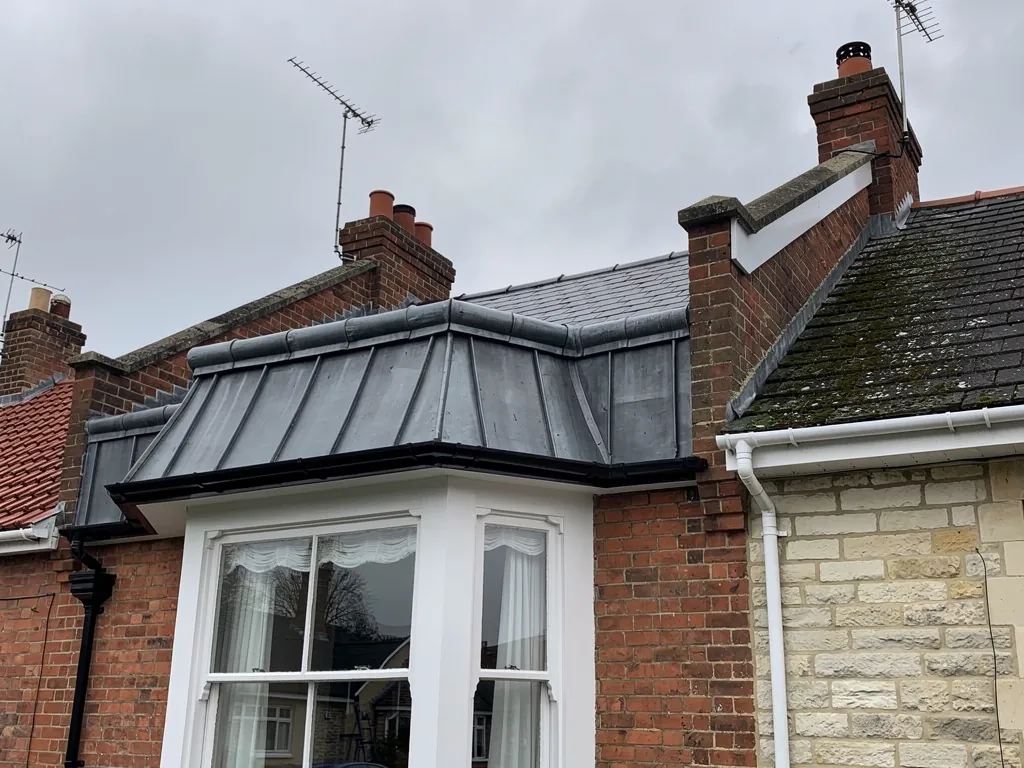
Look at the front of a Victorian or Edwardian terrace and you will often see a canted bay window with a little roof over it, or a porch hood sitting above the front door. Many of these are covered in sheet lead, shaped by hand over a timber deck and tucked into the wall above. They look modest. They are also among the harder roofs on a house to get right, because each corner of the bay is a junction, and water tests every junction sooner or later.
This guide explains how those roofs are built, why they fail, and what a proper re-covering involves. It covers the choice between lead and the alternatives, what the job costs in broad terms, and what to check before a roofer starts. For the wider picture of how the metal behaves, see our guide to leadwork explained or the main lead roofing page.
What a lead bay or porch roof is made of
Under the lead there is a deck, usually timber boards or plywood laid to a gentle fall away from the wall. Over the deck goes an underlay, which stops the rough timber from scratching the lead and lets the metal slide a little as it expands and contracts. The lead sheets lie on the underlay, joined along the slope by rolls, which are lead wrapped over a shaped timber batten, and across the slope by drips, which are small steps in the deck that let the next sheet overlap the one below.
At the top the lead rises against the wall in an upstand, with a flashing over it tucked into a brick joint. At the edges it turns down over a trim or into a gutter. On a bay window the roof has several faces, so the sheets are cut and folded to meet at hips, and every hip is a seam the roofer has to form neatly.
Why lead rather than a felt or rubber roof?
Because it can be bent over curves and angles that a rigid or glued sheet cannot follow, and because a lead roof is part of the period look. Neighbours on the same street often share the pattern, which is why conservation officers care about it. A canopy that has been replaced with a plain black membrane stands out from the rest of the terrace.
How these small roofs fail
The usual faults are few, and most trace back to movement. Sheet lead swells in sunshine and shrinks again after dark, and a small roof facing south works hard. If the sheets were laid too long, or fixed too tightly, the metal creeps downhill over the years and cracks along the folds. Splits tend to start at the corners of the bay where the sheet is bent in two directions at once.
Ponding is another cause. A porch roof that has settled, or a deck that has sagged where the boards rotted, holds water in a shallow pool. Standing water does not harm sound lead, but it finds any pinhole or hairline crack and soaks the deck below, and the timber then rots in a loop that gets worse every winter.
What does failure look like from inside?
Look for a brown stain on the ceiling of the porch or inside the bay window head, a damp line on the plaster above the frame or wallpaper lifting beside a bay in a front room. From the street, lead that has lifted at the wall upstand or bulged at a roll is a warning. Wind-driven rain can push under the flashing at the top, so the stain may show only when the wind is from one direction.
Repair or re-cover?
A single split in an otherwise sound sheet can often be mended. Lead can be welded or patched with a lead-on-lead repair, after the surface has been cleaned back to bright metal. That is a repair for a one-off crack, not for a roof that is cracking in several places. Patches at several points suggest the metal has been fatigued by movement and that the next crack is close behind.
Re-covering means stripping the old lead, checking the deck and the timbers under it, and laying new sheet. A roof that has been patched more than once, has a soft deck or has lead that is thin and pitted is usually a re-cover. We would rather tell you that after looking than quote for a patch that will fail by next winter. The rule cuts both ways: when a patch is enough to stop the water, a patch is the price you get.
Can the old lead be reused?
Generally no. Old lead stretches, thins and stiffens with age, and cracks when lifted and re-dressed. The new roof is laid in fresh sheet. Reusing old sheet would save little and shorten the life of the job.
Lead roofs on listed buildings follow stricter rules for the material and the detail, and consent may apply. Our guide to leadwork on listed buildings sets out what to ask the council.
Choosing the lead code and the details
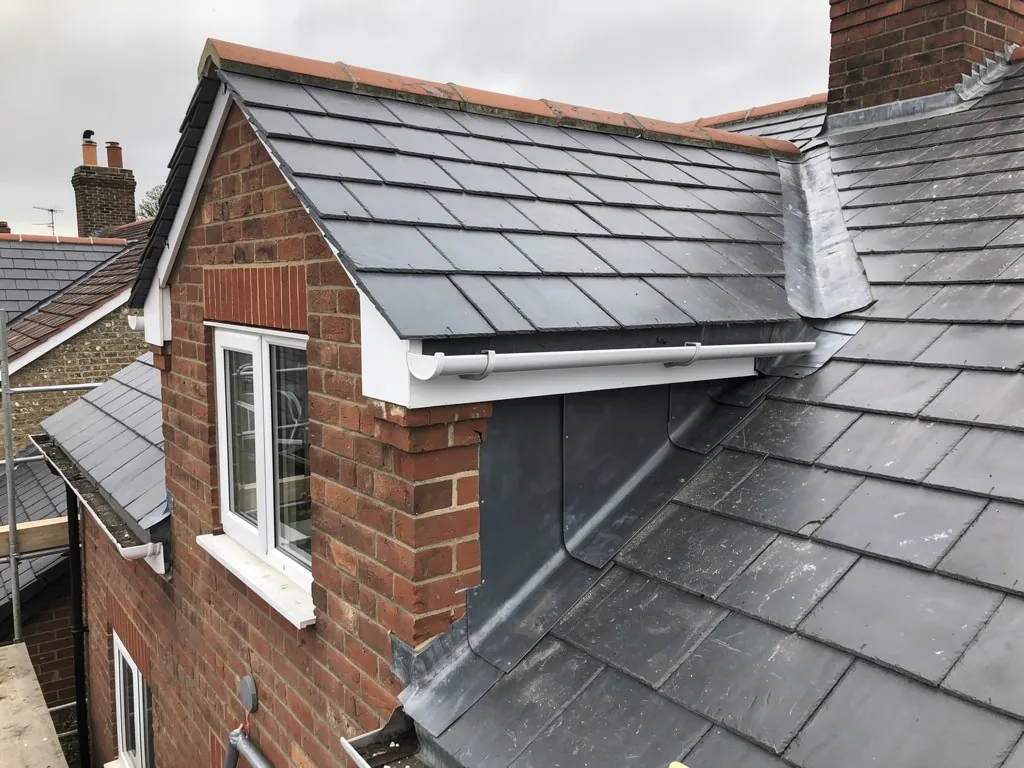
Lead for roofs is sold in numbered codes, from Code 3 to Code 8, and a higher number means thicker, heavier sheet. Royston Lead's cast sheet brochure lists Code 5 for flashings, dormers and gutters of several kinds, with Code 6 suited to large roofs, while Codes 7 and 8 are heavy duty. For a small bay or porch roof, Code 5 or Code 6 is the usual range, because those roofs are exposed and often walked on during maintenance.
Thickness does not make up for poor detailing, though. The three points that decide how long the new roof lasts are sheet length, fall and fixing. Sheets that are too long creep and split. A deck laid without enough fall leaves water standing. And lead nailed through its face, not clipped at its edge, is held so tightly that it cannot move when it warms. Our lead codes guide explains each code and where it is used.
What about the wall junction?
The top edge of a porch or bay roof meets brickwork, stone or render. The flashing is cut into a chase and wedged, then pointed with mortar. If the chase is in poor mortar, the flashing pulls out. We check the pointing, and repoint where needed, before the new lead goes on.
Lead, zinc or a different covering?
Lead is one choice among several for a bay or porch roof. Zinc is the nearest metal alternative and can be shaped into a similar profile, though it is stiffer and needs more care at the angles. GRP and EPDM suit a small flat porch roof with few corners, and give a jointless surface that has no folds to crack. Our lead against zinc comparison sets the two metals side by side.
What decides it is the building. A canted bay on a period terrace nearly always has a roof that was lead originally, and putting lead back keeps the street looking as it was built. A flat-roofed 1930s porch or a later canopy may be well served by a membrane.
Does the lead change colour?
Yes. New lead is bright and silvery, and it dulls to a soft grey as it weathers, forming a protective oxide on the surface. Rain that runs across fresh lead can leave white marks, which is a surface effect and not a fault. If you want to control how the metal weathers, our guide on lead patination explains the oil that is applied to new sheet to slow it down.
MyBuilder's flat roof cost guide, updated 21 August 2026, gives lead at £150 to £200 or more per m², against £70 to £100 for bitumen felt and £90 to £130 for EPDM. That is a cost per square metre of a whole flat roof, so a small bay roof may price higher per metre because of the corners.
Access, timber repairs and what drives the cost
Because these roofs are low, access can seem simple. A porch can usually be reached with a ladder or a small tower, but a first-floor bay is a different matter, and a bay on a busy street can need scaffold or a licence. Checkatrade's scaffolding guide (February 2026) gives around £875 a month for a semi-detached house, and MyBuilder's guide gives £850 to £1,200 for a typical two-storey house. A ground-floor porch should not need that; a first-floor bay might.
Beyond access, the price turns on the number of faces, the lead code chosen, how many joints meet at each corner and what is under the lead. Deck repair is the main unknown. Until the old lead is lifted, nobody can say whether the boards are sound. If they have rotted, new timber goes in before any metal does, and that adds to the work.
Should the window head and brickwork be looked at too?
Yes, and if the lead is coming off, it is the easiest moment to look. Water that has been getting in at a bay roof often damages the window head and the lintel above it. Timber window heads can be soft, and brickwork above a porch can be loose. We photograph what we find on the survey so you see it too.
Our written total follows the survey. If the deck proves worse than it looked, we stop and explain before adding anything to the job.
Looking after a small lead roof
A lead bay or porch roof asks for very little, but not nothing. Clear leaves and moss from the gutter and the corners once or twice a year, because debris holds water against the lead. Do not walk across the sheet in hard shoes, and do not hang planters or hooks from it, because the metal dents and thins under repeated pressure.
Do not smear sealant over cracks. It looks like a repair, and holds for a short time, but it traps moisture and makes a proper lead repair harder because the sealant has to be cleaned off first. If you suspect a crack, photograph it and ask for a survey.
How often should the roof be looked at?
A glance from a ladder or an upstairs window once a year is enough for most owners, after the autumn leaf fall. Bays that sit under trees need more frequent clearing. We also look at the window sills and the paintwork on the bay, because peeling paint at the head of the window is often the first visible sign that water is getting behind the lead.
When the job is finished, the ten-year guarantee on our workmanship is handed over in writing.