
Anyone who has had leadwork quoted will have heard the phrase "Code 4" or "Code 5" without being told what it means. The code is simply a shorthand for thickness. Each one carries a weight per square metre, a colour mark on the back of the sheet and a set of jobs it is normally chosen for. Rolled lead sheet for buildings follows the British Standard BS EN 12588, and the codes in this guide are those in use for it.
The point of knowing them is practical. A sheet too thin for its position tears or fatigues early, and one far thicker than needed adds cost and weight with no gain. This guide gives the figures, then explains which code goes where on a house, why length and fixing count for as much as thickness, and how to check what you have been quoted. The wider subject sits on our lead roofing page.

The six codes at a glance
Six codes cover almost all building work, numbered 3 to 8. Leadworx and Royston Lead both publish the figures below, and the thickness and weight rise in steady steps from one code to the next. The colour is a stripe or mark printed on the sheet so a roofer can tell the code at a glance, even when the roll has been cut.
| Lead code | Sheet thickness | Weight, per square metre | Colour on the sheet |
|---|---|---|---|
| 3 | 1.32 mm | 14.97 kg | Green |
| 4 | 1.80 mm | 20.41 kg | Blue |
| 5 | 2.24 mm | 25.40 kg | Red |
| 6 | 2.65 mm | 30.10 kg | Black |
| 7 | 3.15 mm | 35.72 kg | White |
| 8 | 3.55 mm | 40.26 kg | Orange |
Royston's own cast lead brochure gives Code 6 as 30.05 kg per square metre, a tiny difference, so you may see either figure. Between Code 3 and Code 8 the weight per square metre rises by well over two and a half times, which matters when a roof structure has to carry it.
Rolled sheet and cast sheet are made differently, and the two sources above describe each. For roofing on a house, the rolled sheet sold to the standard is what you will normally be quoted. The code numbers mean the same thing either way: a thickness and a weight.
What each code is used for
The published guidance links each code to particular parts of a roof. Royston lists the jobs by letter: soakers, flashings, pitched valley gutters, parapet and box gutters with tapered valley gutters, and dormers. Leadworx adds plain-English descriptions of what each is typically chosen for.
Code 3: soakers and light duty
Code 3 is recommended for soakers only. A soaker is a small, bent piece of lead sitting under each slate or tile at a wall or chimney. It is hidden, it is not walked on and it carries no weight, so the thinnest sheet is enough. Using Code 3 elsewhere, on an exposed flashing, risks early splitting.
Code 4: the general-purpose sheet
For ordinary flashing jobs, Leadworx calls Code 4 the sheet most roofers now reach for. Royston lists it for soakers, flashings, pitched valleys and dormers. It is light enough to dress into tight corners and thick enough to survive an ordinary house roof.
Code 5 and Code 6: the working codes
Code 5 suits flashings, valleys, parapet and box gutters and dormers. Code 6 is listed for the same positions and is described by Leadworx as the choice for large roofs. For a chimney on a house roof Code 4 or Code 5 is typical, and the written quote names the one we propose.
Codes 7 and 8: heavy duty
Royston lists these for gutters and dormers, and Leadworx describes them as heavy-duty sheet. A normal house seldom calls for either, because the extra metal is aimed at deep gutters and big, exposed areas.
Which code for which part of the house
Putting this to work, here is how the codes usually map onto the parts of a domestic roof. A change of one code up is common where the roof is exposed or where the owner wants a longer life.
Soakers and stepped flashings against a wall are classically Code 3 and Code 4 respectively on a plain slate or tile roof, though many roofers specify Code 4 or Code 5 for the flashing because it dresses better into a deep chase. Cover flashings over a chimney tray, and aprons in front of a chimney, take Code 4 or Code 5. Valley linings on a pitched roof take Code 4 or more, often Code 5, since two slopes drain into one channel. Our guide to lead valleys goes into the detail.
What about a lead flat roof?
Flat areas, such as a bay roof, a porch or the top of a dormer, are usually Code 5 or Code 6 in our experience. A flat lead roof is stepped on for maintenance, sits in the sun and carries standing rain, so the thicker sheet earns its keep. Our guide to lead flat roofs covers the build-up and the falls.
Remember that the code is only one of the specification choices. Underlay, bay length, rolls and drips matter just as much, and a thick sheet laid in lengths that are too long will still split.
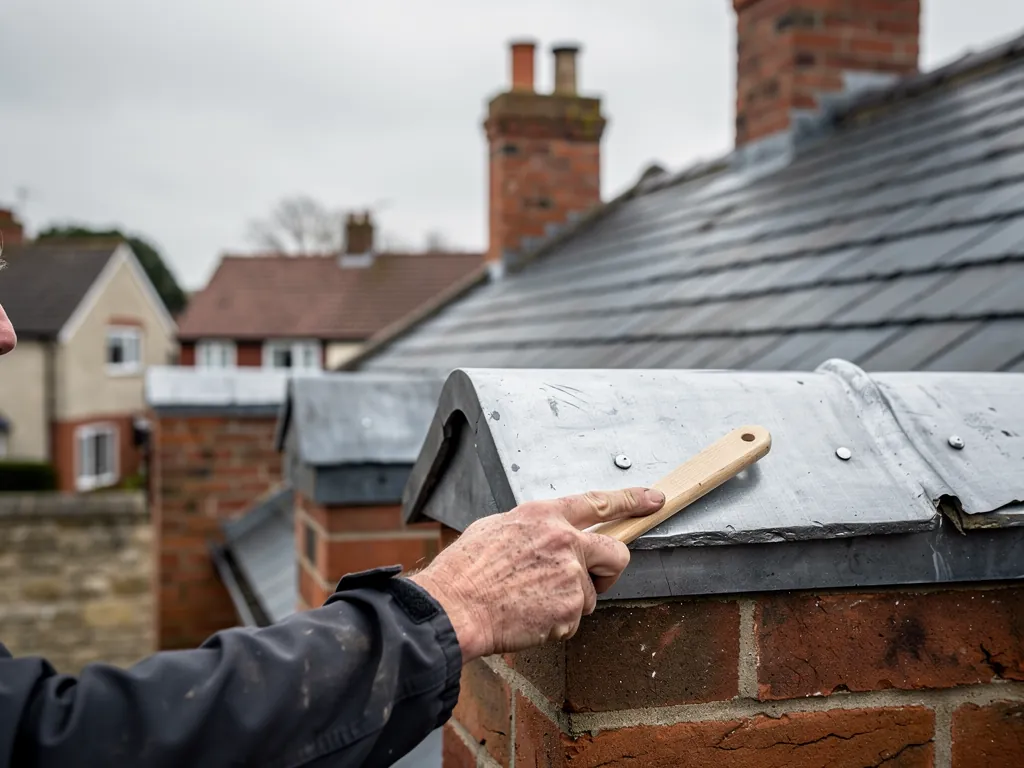
Why thicker is not always better
It is easy to assume the heaviest lead is the safest buy. It is not, for three reasons.
First, weight. Code 8 weighs well over two and a half times as much per square metre as Code 3. On a roof designed around thin lead, a move to much heavier sheet adds load on the timbers, and the Planning Portal lists a rise in covering weight of 15 per cent or more among the changes that call for building control approval. A small flashing is no concern, but across a whole roof the kilograms add up.
Second, stiffness. Thick lead is harder to dress into tight angles, and the extra effort can lead to creases and stress points where the metal is forced. A well-dressed Code 4 can outperform a badly dressed Code 6.
Third, cost. Material is priced by weight, so each step up in code adds to the bill. Checkatrade's October 2026 repair guide, excluding VAT, gives £50 to £70 per metre for Code 5 lead flashing not exceeding 150 mm and £80 to £120 per metre for stepped flashing. Moving to a higher code would raise those figures, by an amount that only a written quote can fix.
The right code is the one the job needs and no more. A roofer who offers the heaviest sheet for every flashing is selling weight, not a better roof.
Length, fixing and the real limits of a code
Lead moves with the temperature. A long sheet that is nailed or glued along its full length cannot slide, so every hot day stretches it a tiny amount and every cold night leaves it where it was. Over many seasons that is called creep, and it ends in cracks. The cure is not a thicker code but a shorter sheet, with expansion room left at the joints and clips instead of face nails.
That is why sheet lengths are limited by the job, and why a flat roof is laid in strips with rolls and drips rather than in one piece. Our guide to lead sheet lengths gives the details.
How long does the lead last?
MyJobQuote (22 September 2026) gives more than 80 years for lead flashing that has been fitted properly, and more than 100 years for the higher codes. For a lead flat roof, Less gives 50 to 100 years. Those are typical spans from cost guides rather than promises, and each one presumes good fixings and no damage. A thicker code gives more metal to lose before the sheet fails, but it does not protect a joint that was badly made.
For flashings specifically, see which code to use for flashing.
Handling and safety
Lead is a toxic metal, and the heavier the sheet, the more of it there is. The risk to a householder is low when lead is sound and sits outside, but the dust and fumes from cutting, welding or burning old lead are a different matter. Our guide on whether lead roofing is safe covers what the risk is and how to handle it sensibly.
Practical rules for a site apply to every code: wash hands before eating or smoking, keep offcuts and dust away from children and pets, and never burn lead scrap. Offcuts leave with us when the site is cleared, not into your garden bin.
Can I tell the code from the roof?
Rarely, once the lead is fixed. The colour mark is on the back or edge of a fresh sheet, and a laid sheet usually hides it. An old roof may show a stamped number on an exposed edge or on a hidden strip. The reliable method is to measure thickness with calipers at a cut edge, which a roofer can do on a repair, and compare it with the table above.
Mistakes people make with lead codes
Four errors recur on roofs that have gone wrong. The first is using one code everywhere. A stepped flashing, a valley lining and a roll on a flat roof ask different things of the metal, and a single choice across all of them means some part is too thin or another is wastefully heavy.
The second is confusing the code with the length. A Code 5 sheet cut in an overlong strip can crack sooner than a Code 4 sheet cut to a sensible length and clipped properly. The third is mixing thin lead with heavy fixings: stainless steel or copper nails through the face of a sheet hold it rigid and defeat the point of using a soft metal.
Does a thicker code fix a bad detail?
It does not. A wall chase that is too shallow, mortar that is crumbling or a fall that leaves water standing will defeat any code. The fourth mistake is spending on the sheet and neglecting the brickwork around it. When we survey a chimney or a dormer, the pointing and the chase come under the same scrutiny as the lead.
The best protection is to ask what is being fitted and why, then compare the answer with the figures in this guide. A roofer who can explain the choice in two sentences usually has thought about the job.
Checking the code on your quote
A good written quote names the lead code against each type of work. If it only says "lead flashing" with no code, ask. The reason to ask is not to catch anyone out. It is that two quotes for the same chimney can differ by a code, and that is a difference in metal as well as price.
When our survey is done, the photographs show your existing leadwork, and the quote says which code we propose for the soakers, flashings and valleys. A flashing on a chimney in Swindon's older streets may well be Code 4 or Code 5, and we explain why.
What should I ask a roofer?
Ask which code is proposed for each element, how long the sheets are, how they are fixed, and whether the pointing along the flashing is being renewed. Ask also what happens to the lead you already have. The answers tell you more about the job than the price does.
Our lead flashing cost guide sets out the figures that move the price, and a ten-year guarantee on workmanship follows the finished job, in writing.