
Lead flashing is the strip of sheet metal that seals the join between a roof and anything that rises through or beside it: a stack, a gable wall, the side of a dormer window. It is dull to look at and awkward to price, because the metal is only part of the bill. The rest is access, the state of the brickwork it tucks into, and how many faces of the stack need covering.
The ranges below come from national cost guides, each named with its date. They are typical UK figures, not Skyline prices. Where a guide quotes without VAT or without scaffold, we flag it, because those two words move a total more than the lead does. The price for your own house is a different matter, worked out from the stack itself and not from a national average. Before you compare numbers, it helps to know what each lead code means, which our lead codes guide sets out. The wider picture of what lead does on a house sits on the lead roofing page.
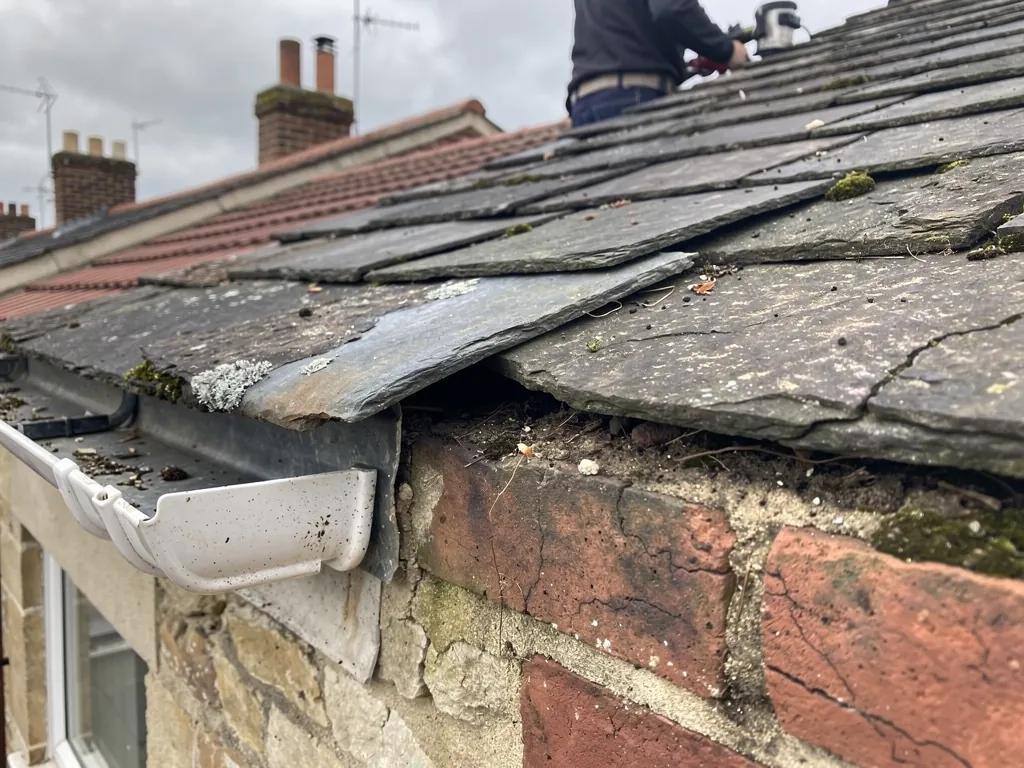
Per-metre rates for flashing lengths
The cleanest published rate is in Checkatrade's roof repair cost guide, in a table last updated in June 2026. It prices lead flashing by the metre run. A plain Code 5 flashing not exceeding 150 mm in width comes in at £50 to £70 per metre. Stepped flashing, the staircase-shaped strip that follows a sloping roof up a wall, costs more at £80 to £120 per metre. Checkatrade states both figures excluding VAT.
Width matters here. A flashing is quoted by how far it spreads up the wall and out across the tiles, so a wide apron over a bay window or a deep flashing along a high gable wall costs more per metre than a narrow strip. A stepped flashing costs more than a straight one because every step is cut, folded and fitted to a brick course, and the roof covering beside it has to be lifted and replaced as the work goes along.
| Type of flashing | Typical price per metre, excluding VAT |
|---|---|
| Code 5 flashing, not exceeding 150 mm | £50 to £70 |
| Stepped flashing | £80 to £120 |
Source: Checkatrade, roof repair costs, figures dated June 2026.
A short worked example shows how the numbers behave. A straight run of 4 m at the plain rate comes to £200 to £280. A stepped run of 3 m at the stepped rate comes to £240 to £360. Those are the metal and fitting for the flashing alone, which is why a whole job rarely lands exactly on a per-metre sum.
Chimney leadwork, with and without scaffold
Most people searching for this are thinking of one chimney. MyJobQuote, in a guide dated 22 September 2026, prices the work as a package. A patch repair to existing leadwork sits at £150 to £250. Replacing the leadwork in full costs £350 to £460 where no scaffold is needed, and £700 to £920 where it is. MyJobQuote gives an average of about £570 across jobs.
The gap between the two replacement figures is the scaffold, and it is a large share of the total. If you can reach the stack from a low flat roof, a ladder and a roof ladder may be enough. If the stack stands on a two-storey house with nothing beside it, a working platform at ridge height is the safe way to do the work, and it has to be put up and taken down whatever the lead costs.
MyBuilder's scaffolding guide, updated 21 August 2026, puts high-level chimney scaffold at £400 to £900. Checkatrade's scaffolding guide, last updated in February 2026, gives £660 per week for a chimney. Those two sit neatly inside the gap in the MyJobQuote leadwork figures, which is a useful cross-check if a quote for chimney flashing looks high.
Does the scaffold have to stay up all week?
Not usually. Chimney leadwork is a short job, and scaffold hire is charged by the period, so the cost depends on how long the structure stands. Where a stack also needs repointing or a new cap, doing everything in one visit avoids paying for the same access twice.
Why two chimneys never cost the same
A chimney stack on a roof needs lead on several faces. The front gets an apron, a flashing that spreads over the slope below the stack. The sides get stepped flashings or soakers, the small pieces of lead laid between courses of tile or slate. The back gets a gutter, because water running down the slope has to be steered round the stack. A narrow single flue needs less lead than a wide stack serving four fireplaces, and a stack in the middle of the ridge is a bigger job than one in the corner against a party wall.
MyBuilder's chimney repair guide, updated 21 August 2026, shows the spread. It prices a flashing repair at £250 to £1,200, and it splits chimney repointing by house type, with a bungalow stack at £200 to £700 and a central stack on a semi-detached house at £900 to £1,500. MyJobQuote's own figure for repointing is much lower, £250 to £350 for a standard stack, and the two guides do not agree. That disagreement is a fair picture of the real world: the same stack can be priced very differently depending on what the survey finds.
What does the survey look at?
The things that push a price up are the ones you cannot see from the garden. Mortar joints that have perished behind the old lead. Flaunching, the angled mortar bed that holds the chimney pots, that has cracked. Timber behind the back gutter that has gone soft after years of slow leaking. We photograph each of these so the written quote refers to your stack in particular.

Patch, partial replacement or the whole stack
A patch repair is the lowest-cost line in the guides at £150 to £250, and it suits a clear, local fault: a single split in a flashing that is otherwise flat and sound, or one lifted edge where the pointing has let go. Where a patch cures the problem, a patch is what we propose.
It stops being the right answer when the lead around it is tired. Old flashing that has been dressed and re-dressed work-hardens, and a patch on one corner can leave the next corner to split within a season or two. If the fault is cracking along several bends, fixing it in pieces costs more in call-outs than a single replacement. Our guide on why lead cracks explains the usual causes, and they decide whether a repair will last.
A patch is a fair price for a fault that is truly local. When a survey finds the same weakness on three corners, paying for one corner three times is the dearer route.
What about replacing only one side?
It is possible, and it is common on a stack where the front apron has failed but the side flashings were renewed more recently. The join between old and new lead has to be formed with care so that water cannot track along it, which is worth discussing at the survey.
What the lead itself adds
The metal is the smaller part of most leadwork bills, but the code you choose does change the number. Lead sheet is sold by code, which is a weight and thickness, from Code 3 at 1.32 mm up to Code 8 at 3.55 mm. Leadworx calls Code 4 the usual pick for everyday flashings, and Royston Lead's brochure lists Code 5 for flashings, pitched valley gutters and parapet gutters. Heavier codes cost more per square metre because there is more metal in every sheet, and a long run of heavy lead adds up quickly.
Thicker lead also tends to last longer. MyJobQuote reports that well-fitted flashing can reach 80 years or more, and 100 years or more in the higher codes. Those are typical ranges and not promises, but they explain why a quote for lead looks high next to a mastic or aluminium alternative that may need renewing sooner. Spreading a leadwork price across decades of use gives a different picture from the headline figure. The leadwork explained page shows where each piece of lead sits on a house.
Is the lightest code the sensible one?
Not if it is too light for the job. A flashing in a sheltered spot can use a lighter code, while a long, exposed run on a tall wall suits a heavier one. We choose the code to suit the position, then tell you which we have used.
Costs that sit around the lead
Several costs travel with a leadwork job without being part of the metal. Old flashing has to come off and be disposed of, and lead is a recyclable material, but the mortar and brick dust from raking out the joints are builders' waste. MyBuilder's roof replacement guide, updated 21 August 2026, puts disposal on a full roofing job at £100 to £1,000, which is a much larger job than a flashing, so only a small share of that applies here.
Repointing is the other companion cost. Lead flashing is held by lead wedges and sealed with pointing, so when the pointing has failed the joint is raked out and refilled as part of the work. If the brickwork itself is crumbling, the lead has nothing sound to sit in, and the stack may need repair before it can be flashed. That is why a quote for flashing alone can sit well below the final total once brickwork repair joins the list.
Is it worth doing the leadwork when the roof is already open?
Usually, yes. If tiles or slates beside the stack are being lifted for any reason, renewing the flashing at the same visit costs far less than coming back later, because the covering is already loose and the access is already in place. Lead that has done its time is a poor thing to leave under a brand-new slope.
Reading a leadwork quote
When a written quote for leadwork arrives, a few questions tell you whether you are comparing like with like. Does the total include VAT? Checkatrade states its roof repair rates without it, so a quote that includes VAT will be higher for exactly the same work. Does it include scaffold, or a tower, or neither? Which lead code is being used, and for which faces of the stack? What happens to the old lead and the rubble from repointing?
Our price comes as one total on paper, after a survey of the stack. Photographs of the lead on your chimney sit alongside it, so the figure has something visible behind it. We aim for a good and fair number, and the paper says whether scaffold and VAT are counted in. Rubble and old lead leave with us, and the workmanship carries a ten-year guarantee, also in writing.
Should I get more than one price?
If you want to, yes. Give each firm the same description of the stack, ask each whether scaffold and VAT are in the total, and check the lead code named. Two totals only compare fairly once those three points match.
If the leadwork is part of a bigger job, such as a chimney rebuild, the chimney repairs page covers the wider work. For flat roofs and bays, where lead is priced by area instead of by the metre, see lead flat roofs.