
Lead is not the first thing most people think of for a flat roof, yet it has covered bay windows, porches, parapet gutters and church aisles for centuries. A lead roof is not one large sheet. It is a series of narrow strips, each pinned along one edge and free along the other, laid between timber rolls and stepped down the fall at drips. That layout is what lets a metal that expands and shrinks with the weather stay sound for generations.
This guide explains how the system fits together: the deck beneath, the rolls, the drips, how sheet size is limited, which lead codes suit which part, and what published guides say about life and cost. If your roof is a small projecting one, such as a bay or a porch, the page on lead bay and porch roofs picks up from here. For the cause of failures, see lead flashing repairs, and for every other use of the metal start at the lead roofing hub.

The deck, the underlay and why lead needs both
Lead sits on a supporting deck, usually plywood or boards, with a layer between the two. Without that layer, the underside of the sheet would drag on the timber every time it expanded, and acids and moisture in the wood can attack the metal. The separating layer lets the lead slide over the deck by tiny amounts without tearing at its fixings.
The deck itself needs to be flat in the sense of being even, and fall gently towards the outlet. Lead is unforgiving of a deck that dips: water sits in the hollow, and a sheet that is laid over a dip pulls tight when the weather changes. A good deck is the main thing that separates a lead roof that lasts a century from one that fails in a decade.
Ventilation and insulation shape the build too. A cold roof has a ventilated void under the deck, while a warm roof puts insulation above the deck and keeps the structure inside the warm envelope. Both are workable under lead, but they are different builds with different details, and a roof that was built one way should not be repaired as the other. A full re-cover of a lead roof can also bring Part L into the picture, because that guidance treats this kind of renewal as work on a thermal element, and insulation levels may then need lifting. Ask your building control body how the rules fall on your own roof.
Does a lead roof need a fall?
Yes. Lead is laid to a fall like any flat roof so water runs off. The design aim is a clear, steady slope to the outlet, with no hollows, and the deck is set out to achieve it before any lead goes on.
Bays, rolls and why the sheets are narrow
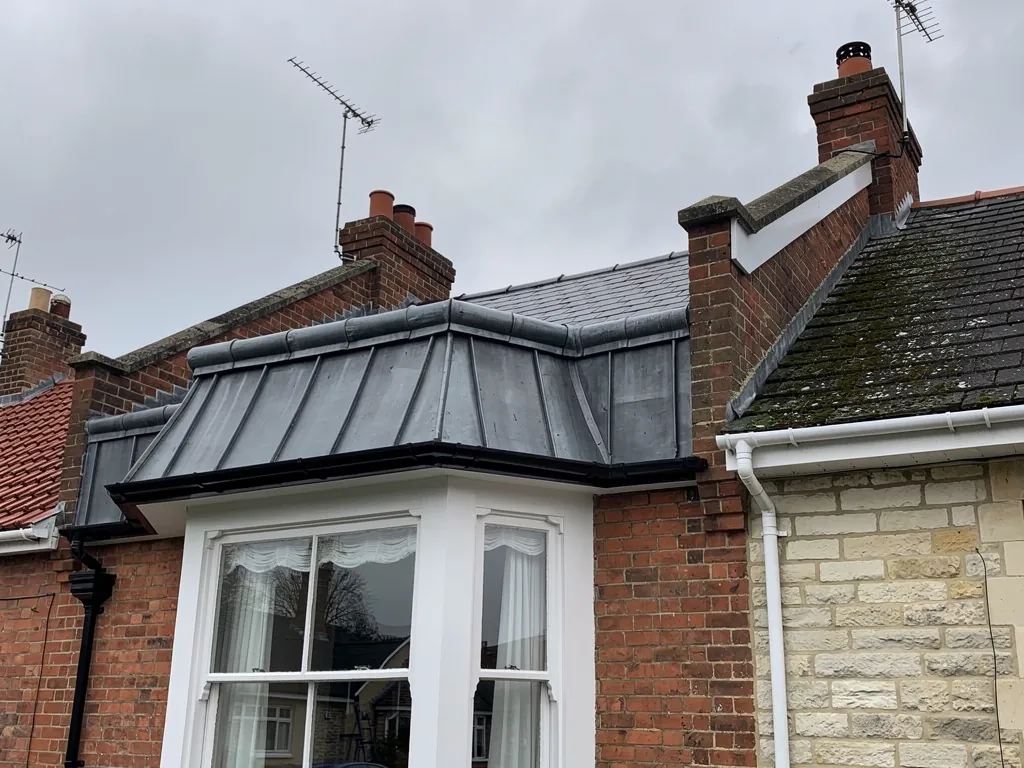
A bay is the strip of lead between two rolls, and it runs down the fall from the top of the roof to the bottom. A roll is a length of timber, rounded on top, fixed to the deck, over which the lead from the neighbouring bays is dressed and joined. Think of a ridged tray: the flat pieces are the bays, and the raised ribs are the rolls.
Why narrow strips and not a single wide sheet? Lead expands and contracts noticeably between a hot afternoon and a frosty night, and a wide sheet that cannot move will crack. Narrow bays confine the movement, and each one is held at the top only, so the rest can slide. Edges in the roll overlap one another, one tucked under, one dressed over, so that water cannot be driven between them.
Bay width follows the code chosen and the lead supplier's own guidance, so it is set for each job and not guessed. We use the sheet-size limits that go with the code chosen, and the page on lead sheet lengths explains why length is limited as well as width.
What are the alternatives to a timber roll?
A standing seam, where the edges of adjoining bays are folded together, is used in some settings, notably on shallow roofs where a rounded roll would look too heavy. Both systems control movement; the choice is as much about appearance as engineering.
Can old lead be reused on a new roof?
Sometimes, if it is still supple and the thickness has not worn away. Lead that has been dressed many times, or has cracked along its folds, is better recycled and replaced, because reusing it only carries the old weakness into the new roof.
Drips: the steps that shorten each sheet
Where a roof is long on the fall, the lead cannot run in one piece from top to bottom. A drip is a step formed in the deck, with the upper bay dressed over the edge and the lower bay tucked underneath. It does two jobs. It limits how far any single piece of lead can creep as it heats and cools, and it throws water safely onto the lower bay.
The step must be deep enough that wind cannot blow rain upward under the overlap, and the upper bay must hang far enough past the edge to shed water. Drips are one of the details a quick, badly planned job gets wrong, often by leaving them out and running the sheet too far. That produces a roof that looks neat on the day and begins to ruck up and split within a few winters.
On a small roof there may be no drip at all, because the fall is short enough for a single length. On a larger roof the drips sit at intervals set by the code and the manufacturer's guidance. A parapet gutter or box gutter between two roofs uses the same principle, with a sheet length restricted so the gutter stays flat and supple. The related page on lead valleys shows the same logic applied to sloping channels.
Why do lead roofs creep downhill?
Lead that is nailed too freely or laid too long gradually slides down the fall with each cycle of warming and cooling. You see a fold flattening at the bottom edge and a gap opening at the top.
Which code, and what size
Sheet lead is graded by code, each one a thickness and weight, from Code 3 at 1.32 mm to Code 8 at 3.55 mm. Royston Lead's cast sheet brochure lists the heavier codes for roofing work: it gives Codes 5, 6, 7 and 8 for parapet, box and tapered valley gutters, and Codes 4 to 8 for pitched valley gutters. Leadworx groups Code 6 as a large-roof sheet and Codes 7 and 8 as heavy duty.
For a flat roof the practical point is that a thicker code tolerates more movement and wear, and it permits larger sheets. A lighter code on a roof that is too wide splits at the folds. The code also changes the price, because the metal weighs more, and it changes the weight on the structure. Lead is heavy, and a roof that carried felt may need its joists checked before a lead covering goes on.
| Code | Thickness | Weight per m² | Colour mark |
|---|---|---|---|
| 5 | 2.24 mm | 25.40 kg | Red |
| 6 | 2.65 mm | 30.10 kg | Black |
| 7 | 3.15 mm | 35.72 kg | White |
| 8 | 3.55 mm | 40.26 kg | Orange |
Source: Leadworx and Royston Lead, both consulted October 2026. Our lead codes guide covers the full range, and the page on the lead code for flashing covers the lighter work around the edges of the roof.
How long a lead flat roof lasts
Less, in its flat roof cost guide last updated in March 2026, puts the life of a lead flat roof at 50 to 100 years. That is far beyond the other flat coverings in the same guide. Torch-on felt is quoted at 10 to 20 years, GRP fibreglass at 25 to 40 years, and EPDM at 30 to 50 years. MyBuilder's flat roof guide, updated 21 August 2026, puts flat roofs generally at 15 to 30 years. GreenSpec offers a more cautious EPDM figure of 20 to 30 years, so the sources disagree, and every number is a typical range and not a promise.
What lets lead outlast the rest is the metal itself. As it weathers, it forms a protective surface layer that slows further corrosion, and with the movement details above, it can flex for decades without splitting. What shortens its life is the same list in every case: a deck that dips, sheets cut too large, lead laid with no allowance for movement, and damage from foot traffic or fixings driven through it.
Maintenance is light but real. Clearing outlets and gutters so that water does not stand against the lead, looking over the flashing at every wall junction, and keeping heavy objects and ladders off the surface all help. Our page on how long a lead roof lasts goes through what to watch for.
Does lead on a flat roof get stolen?
It can. Flat roofs on garages and rear extensions are easy to reach, and the metal has resale value. Fixing method, visibility and alarms all play a part, and the alternative materials are covered on the lead alternatives page.
What it costs next to other flat coverings
MyBuilder's flat roof cost guide, updated 21 August 2026, lists lead at £150 to £200 or more per m², and sets it against bitumen felt at £70 to £100, EPDM at £90 to £130, GRP at £95 to £150 and PVC single-ply at £95 to £140. Lead is the dearest option on that list by some distance. A small bay or porch, with only a few square metres of roof, turns that into a modest total. A large garage roof or kitchen extension turns it into a substantial one.
Value shows up over a long period. If a lead roof lasts for 50 years or more and a felt roof lasts 10 to 20, the lead roof can cost less per year of use, assuming the felt would have been replaced two or three times in the same period. It also matters when appearance counts, as on a period bay window or a listed building, where lead is often the appropriate material and sometimes the required one.
Replacing like with like on a house that is listed may still need consent. Ask the council's conservation officer before altering the material or the shape of lead on a listed building.
Our own price is a single written total, produced after the deck has been inspected, so it reflects the area, the code and the access. Photographs of your deck come with it. Work is guaranteed for ten years in writing. Should the deck prove sound and only the edge details have failed, the quote proposes mending those instead of a whole new covering.