
Lead looks very different on the day it is fitted from the way it looks a year later. New sheet is bright, almost silver, and soft to the touch. Over time it dulls to the matt grey that most of us associate with old roofs and church towers. That grey is a thin layer on the metal, and how it forms decides whether a new roof looks even and settled or blotchy and streaked.
Patination oil is a product brushed or wiped on after fitting to steer that early weathering. You may see it named in a quote as work you did not expect, or notice a glossy sheen on lead that has just been laid. This guide explains what the oil does, what the white staining is that it guards against, what happens when it is left out, and how it fits in with the rest of a leadwork job. For the wider view of where lead sits on a house, see leadwork explained, or start at the lead roofing hub.
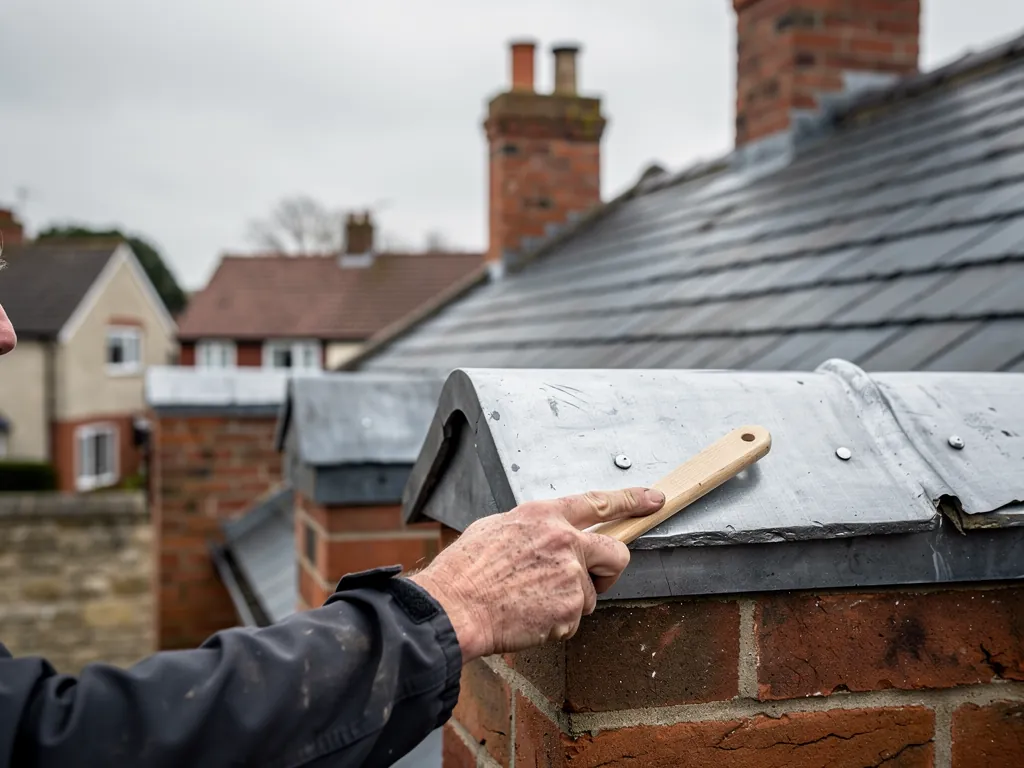
What happens to bare lead in its first months
Lead is a reactive metal at the surface, even though it is famously durable underneath. Left in the open, the bright face reacts with oxygen, moisture and carbon dioxide from the air and rainwater. The first product is a thin oxide, which turns the surface dull. Later, compounds containing carbonate form, and these make the characteristic grey patina that protects the metal beneath from further attack.
The trouble lies in the stages between. Weathering rarely proceeds evenly across a sheet. A flashing under an overhang stays drier than one fully open to rain. Water that sits in a hollow reacts differently from water that drains straight off. Where dew and dust collect on fresh lead, a pale, chalky deposit can form in patches, and each shower can wash some of it downhill. The result is a streaky, mottled surface for a period, and a trail of white powder where the water has run.
Natural patination does finish the job in the end. A lead roof left alone will usually settle into an even grey, and the white deposit mostly stops forming once the protective layer is complete. Oil is about managing the awkward early months, not about the long-term health of the metal.
Is the white deposit harmful to the lead?
Not in itself. It is a surface effect, and the metal beneath is intact. The harm is to appearance, and to the stonework or paint that the runoff lands on.
What patination oil actually does
The oil is a thin, water-repelling film. Applied to clean, dry lead, it holds raindrops off the metal and slows the early reaction with moisture and the air. While that film is in place the bright sheet darkens slowly and more evenly, and there is far less loose white powder to be rinsed down the wall. As the oil wears off over the following months, the natural patina is already forming underneath and takes over.
You might think of it as primer for a surface that has no paint. It does not seal the lead permanently, and it is not meant to. Nobody expects an oiled roof to look the same in ten years as it does in the first season; the point is to carry it through the awkward stage and let it arrive at the settled grey.
Products vary, and some are formulated to leave a more or less glossy finish, while others dry to a matt look. They are made for lead specifically, and ordinary oils from the toolbox are not a substitute. Some can leave a sticky residue that traps dust, and some do not weather away cleanly. We use a purpose-made patination product and apply it to the lead once the fitting and cleaning is done.
Weather plays a part in how smooth the result is. Oil applied just before a downpour has little time to set, and the film can be washed off unevenly, so the work is timed for dry conditions where the programme allows. Strong sun on a warm day can make the product flash off too fast and leave a patchy finish, which is why the lead is coated in a calm spell and in sections, not all in one rush.
Does oiled lead look different for long?
The sheen fades over the first weeks and months as the film breaks down. After that the lead looks like any other weathered lead, only with fewer stains on the walls beneath it.
The staining on stone, slate and brickwork
The main reason to bother is not the lead itself but what is under it. White carbonate washed off a new flashing lands on whatever the water meets next. On a chimney it streaks the brick face below the stack. On a bay window it marks the stone sill and the render. On a slate roof it can leave grey-white tails running down the slates beside a new valley.
On dark materials such as slate and engineering brick the marks show clearly, and on soft stone they can sink into the surface. Lead staining is most noticeable against Cotswold-style limestone and pale brick, where a white streak looks like a drip of paint. It is rarely permanent, and with time and rain it often fades, but on a house that has just been repaired, the owner usually sees it as a defect in the new work.
That is why oil is a routine item on jobs where lead sits above something visible: chimney stacks, front bay windows, porch roofs and parapets over stonework. Our page on lead white staining covers how to deal with marks that have already appeared, and why a gentle method beats a harsh one.
Any cleaning of stained brick or stone should start with plain water and a soft brush. Acid and abrasive methods can damage the surface far more than the stain ever did.

What happens when oil is left out
Many lead jobs carry no patination oil at all, and the roofs are fine. That is worth saying plainly. Lead on a high roof with no stonework below, or on a surface that will never be seen from the ground, may weather without anyone noticing the early blotchiness. Leaving the oil out is a legitimate decision where nothing is at risk from the runoff.
Where something is at risk, the outcomes differ. Without oil, the new lead gets its patchy phase in full view. White powder gathers in the folds and at the foot of each flashing and washes onto the face of the wall during every shower. After a few months it tends to settle, and the stains fade, but some owners are left with marks they did not expect and a wish that the matter had been raised at the quote stage.
There is a second, less visible effect. Untreated lead that stays damp, for instance under a pile of leaves or in a poorly draining gutter, forms deposits that cling in thick patches instead of weathering evenly. Those can be removed, but it is simpler never to give them the chance.
Context counts here. A flashing that sits directly above a pale limestone sill is a stronger case for oil than one above a dark slate roof where any streaking would be hard to see. Weighing up what lies below the lead is the quickest way to decide.
Can oil be added after the lead has been up for a while?
Yes, though it works best on clean, dry lead. If a white bloom has already formed, it is brushed back first with a soft brush, then the oil is applied. Applying oil over loose deposit just seals the unevenness in.
Storing and handling lead before it goes up
Staining is not only a roof-top problem. Lead sheet can mark in the store before a single flashing is cut. Stacked or rolled sheet that gets wet and stays wet, with no air between the layers, reacts in the damp and develops white patches of corrosion that are hard to remove. The result is a flashing that arrives on the roof already blotchy.
The practical rules are simple. Keep rolls and sheets dry and off the ground, so rainwater cannot pool underneath. Do not stack sheets flat against each other in a wet place. If lead has to be stored outside for a while, cover it loosely so air can move. If damp lead is delivered, it should be dried and separated before being used. Care of that kind prevents a blemish that oil would otherwise have to hide.
Handling matters too. Greasy fingerprints, a dusting of cement from nearby repointing and splashes of flux from soldering or welding all mark the surface, and each can show as a darker or lighter spot when the lead weathers. Cleaning the surface before oiling, with a dry cloth or a gentle wipe down, is part of the job. After welding, the burnt edge of a seam needs cleaning back before any finish is applied, and our page on lead welding explains how those seams are made.
Should the lead be wiped over before oiling?
Yes. Dust and debris trapped under the film show through it, so the surface is cleaned and left dry first.
Where oiling matters most, and what it costs
On a house, patination oil is worth specifying wherever lead sits above something you would hate to see stained. That means chimney flashings above brick or stone, bay window roofs above windows and sills, porch roofs and the lead around dormers. The page on lead bay and porch roofs shows why those small roofs are the ones owners look at most closely, and why a streaked finish stands out there.
It is also worth considering on listed buildings and in conservation areas, where the appearance of new leadwork is under closer scrutiny. In practice, whether to oil is a conversation about the look of the finished job, and your preference counts.
On price, the oil itself is a small item next to the lead and the labour. Published figures cover the lead and the work around it, not the oil as a separate item. Checkatrade's roof repair guide, with a table last updated in June 2026, gives Code 5 lead flashing at £50 to £70 per metre and stepped flashing at £80 to £120 per metre, excluding VAT, and MyJobQuote's guide of 22 September 2026 gives £350 to £460 for chimney leadwork without scaffold. Our lead flashing cost guide goes through what moves those totals.
Our quote is one written total, produced after the survey, and it tells you whether oiling is part of the job. Photographs of the lead and the surfaces below it come with the quote, which makes it easier to talk through the staining risk before work begins. Waste leaves with us when the job ends, and the workmanship is guaranteed for ten years, again in writing.