
Lead has been the default metal for roof junctions for centuries, and the reasons are plain. It bends to any shape, it lasts, and a competent leadworker can repair it decades later. Yet it is not the only choice, and on some roofs it is not the right one. A lean-to against a modern brick wall, a shed, a porch with a shallow slope or a roof that has lost its lead to thieves twice may be better served by something else.
This guide sets out the alternatives: self-adhesive strips, rubber and EPDM sheet, zinc and GRP. It says where each one suits and where lead is still the expected material, such as old stone, slate and listed buildings. No substitute should be sold as outlasting well-fitted lead, and we will not sell one that way. For the metal itself, start with our lead roofing page.
Where lead is still the expected material
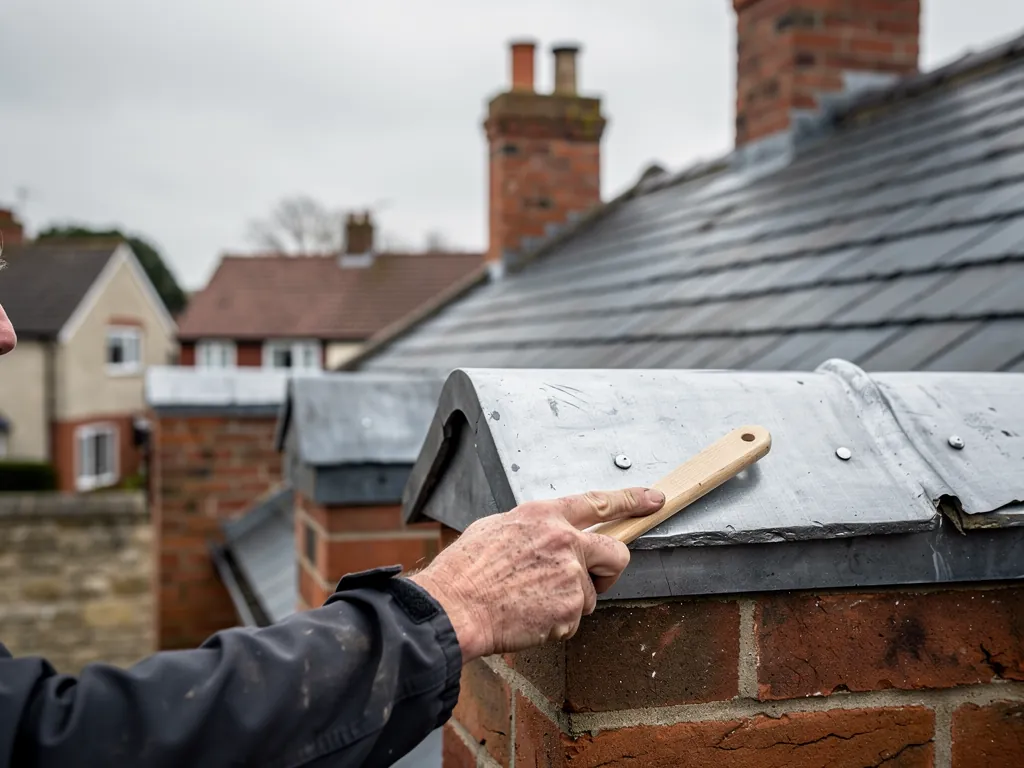
On a traditional building, lead is part of how the roof is meant to look and behave. Slate roofs, stone-slate roofs and old clay-tiled roofs were detailed around lead from the day they were built: soakers under each course, stepped flashings against the chimney, lined valleys and rolled ridges. Replace those details with something stretchy and black and the roof stops reading as the building it is.
Appearance is only half of it. Lead sits in the joints of old brickwork and masonry without needing glue to hold it, and it moves with the building. MyJobQuote, in a September 2026 cost guide, puts the life of a properly installed lead flashing at more than 80 years, rising beyond 100 for the higher codes. No glued strip comes with that kind of record.
Listed buildings and conservation areas
If the building is listed, changing the material of a roof junction can need listed building consent, because the law covers any alteration that affects its character. In a conservation area, and especially one with an Article 4 direction, the council can also have a say. Two Swindon examples are the Railway Village and Bishopstone. Ask the council's conservation team before you agree to a substitute. Our guide to leadwork on listed buildings covers this in more detail.
Self-adhesive and bitumen-backed flashing strips
These are the products most people mean by "lead-free flashing". A strip of aluminium or other foil, coated with bitumen on the back, comes in a roll. It is cut to length, pressed against the wall and the roof covering, and held by the adhesive layer, often with a metal or plastic bar along the top edge. Some are finished in a lead-grey or terracotta colour so they blend into the roof.
They are quick to fit, light, and of no use to a metal thief. On a shed, a modern lean-to or a roof that will be replaced within a few years, they are a sensible repair. They also help where a lead flashing has been stolen and the roof needs weather protection before a proper job can be planned.
Where they fall short
The adhesive depends on a clean, dry, sound surface. Old mortar, flaking brick and damp walls give it nothing to grip, and a strip pressed onto a dusty joint may lift in the first hard winter. Bitumen softens in strong sun and the coating can degrade with ultraviolet light, so the edges are often where trouble starts. They also cannot be dressed into a tight stepped profile the way lead can, so a stepped junction needs more care.
We treat a strip as a modest repair or a short-term cover, not as a like-for-like replacement for lead on a roof with a long life ahead of it.
Rubber and EPDM flashing
EPDM is a synthetic rubber, the same material many flat roofs are covered with. Used as a flashing it comes either as a stretchy pre-formed strip or as a cut-to-size piece of membrane glued to the wall. Because it is a rubber sheet, it follows awkward shapes and does not crack at a bend the way old lead can.
Where a flat roof is being re-covered in EPDM anyway, taking the same membrane up the wall as an upstand is the natural detail, with a metal or lead cover flashing over the top edge to keep rain from running behind it. This is a common arrangement on extension roofs and garages, and it avoids mixing a rigid metal junction with a flexible roof surface.
How long does it last?
Cost guides give a wide spread for the membrane itself. GreenSpec gives an expected service life of 20 to 30 years, while Less says 30 to 50 years with manufacturer warranties of 20 to 25 years being standard. We read that as 20 to 30 years or more, never as a promise. The weak points are the adhesive joints and the termination at the top of the upstand, which is why we do not rely on a bead of sealant there.
On a pitched roof against a brick wall, a rubber flashing is rarely the best answer. It lacks the weight to sit tightly against a stepped profile and it looks wrong against slate. The flat roof is where it earns its place.

Zinc and other sheet metals
Zinc is the closest relative of lead among the modern options. It is a sheet metal that weathers to a soft grey, can be folded and soldered or seamed, and is often used for flashings, small roofs and cladding. VMZINC, a manufacturer, states that a well-designed and well-fitted zinc roof can pass 100 years, while occasional cases drop to 60 years. A contractor quoted by HomeBuilding in 2020 put it between 60 and 100 years. Those are claims for the whole roof system, not for a flashing fixed by a casual hand, so treat them as the upper end of what is possible.
Zinc is stiffer than lead. It does not mould itself to a rough brick joint, and it needs expansion allowance, careful fixing and the right underlay. It also reacts with some other metals and with certain treated timbers, so how the junction is designed matters at least as much as the sheet.
Copper and stainless steel
Copper and stainless steel are used on higher-end work and on some chimney trays. Both are rigid and both carry a premium over lead in most situations. Copper washes green streaks onto the surfaces below it, which is acceptable to some owners and not to others.
For the full comparison, including how each metal weathers, see our guide to lead against zinc.
GRP and the flat-roof details
GRP, glass-reinforced plastic, is not a flashing material in the strict sense. It is a resin and glass-fibre skin laid in place and left to cure, and it forms a jointless covering that turns up a wall as part of the roof itself. For small flat roofs such as porches, dormer tops and garages, that continuity is its main attraction: there is no joint at the wall to fail, because the same material runs from the roof to the upstand.
Less gives a typical life of 25 to 40 years for GRP, and the CORC trade body page says 25 years or more if well maintained. As with any covering the figure depends on the deck beneath it staying sound. GRP is rigid once cured, so a deck that flexes or a timber frame that moves will crack it.
When the roof is the flat part
GRP works best when the whole small roof is being replaced, not as a patch around an old lead detail. A skilled installer will form the upstand, add a drip trim at the edge, and finish with a cover flashing in metal or a proprietary strip. If the same roof meets a stone or brick wall, the cover flashing at the top is often still lead, so lead and GRP can sit in the same detail.
Our flat roofing page covers the coverings we fit on flat and low-pitched roofs.
Theft, cost and the lead-free question
One reason owners ask about alternatives is theft. Lead is heavy, valuable as scrap and easy to peel off a roof. Church roofs, schools and empty properties are the usual victims, but a house can be hit too. If your flashing has gone, a lead-free replacement is a way to stop it being a target again. We cover the practicalities in our guide to lead theft, and our page on stolen lead and insurance explains what to ask your insurer before any work starts. We never promise that a claim will be paid, and we do not handle claims for you.
What does the swap cost?
Lead flashing is dearer per metre than most strips, and the cost guides reflect it. Checkatrade, in its October 2026 update, gives £50 to £70 per metre for Code 5 flashing not exceeding 150 mm and £80 to £120 per metre for stepped flashing, both excluding VAT. A glued strip or rubber upstand will usually cost less in materials, though the saving shrinks if the junction needs more preparation.
Price is not the only measure. A cheaper material that has to be redone sooner costs more across the years. When quotes arrive, ask of each one whether the total takes in VAT and scaffolding.
Choosing for your own roof
The right material follows from four questions. How old is the building, and does anyone control what it looks like? What does the junction meet: brick, stone, render or a timber wall? How long should the repair last? And is theft a real risk at that address?
For a Victorian terrace, a stone cottage or anything listed, lead stays the first choice and a substitute should be agreed in writing with the council first. For a 1980s estate house with a plain concrete-tiled roof, a quality alternative may be perfectly proper. For a flat-roofed extension, matching the new membrane to the flashing makes sense.
Do dormers and bays change the answer?
They do, because both have awkward angles and vertical cheeks where a stiff material struggles. Our guides to lead on dormers and the small lead roofs on bays and porches show where lead is hard to replace.
Our aim is the lightest repair that cures the fault. Sometimes that is mending the lead you have, sometimes a strip as a stopgap, and sometimes a full change of material. Photographs from the survey show your own junction, a written quote follows, and our work carries a ten-year guarantee on workmanship, also written down.