Brick end-of-terrace gable beside a limestone house, slate roofs

Roofers in Old Town, Swindon

Careful roof work for the hill-top market town: stone slate, Welsh slate, lead and chimney stacks on the houses and terraces of the Old Town conservation area.

Old Town's roofs, from knoll to Bath Road

Rubble stone walls on an old hill-top street
The medieval knoll

Old Swindon stands on a pronounced knoll on the eastern side of a hill, and the conservation area covers the historic core of the early hill-top settlement. The council's appraisal records local Swindon stone and limestone as the building materials, laid as un-coursed rubble or as squared, coursed stone. Walls of that thickness carry heavy roofs happily, but they also hold water, so a failing gutter or flashing soaks into stone and shows as damp a long way down. A hill-top position leaves ridges and verges more open to the wind, which makes their fixing worth checking. The medieval Holy Rood church survives only as remains in the park, so the oldest roofs here belong to the houses around it.

Mansard roof covered in stone slates
Stone-slate mansards

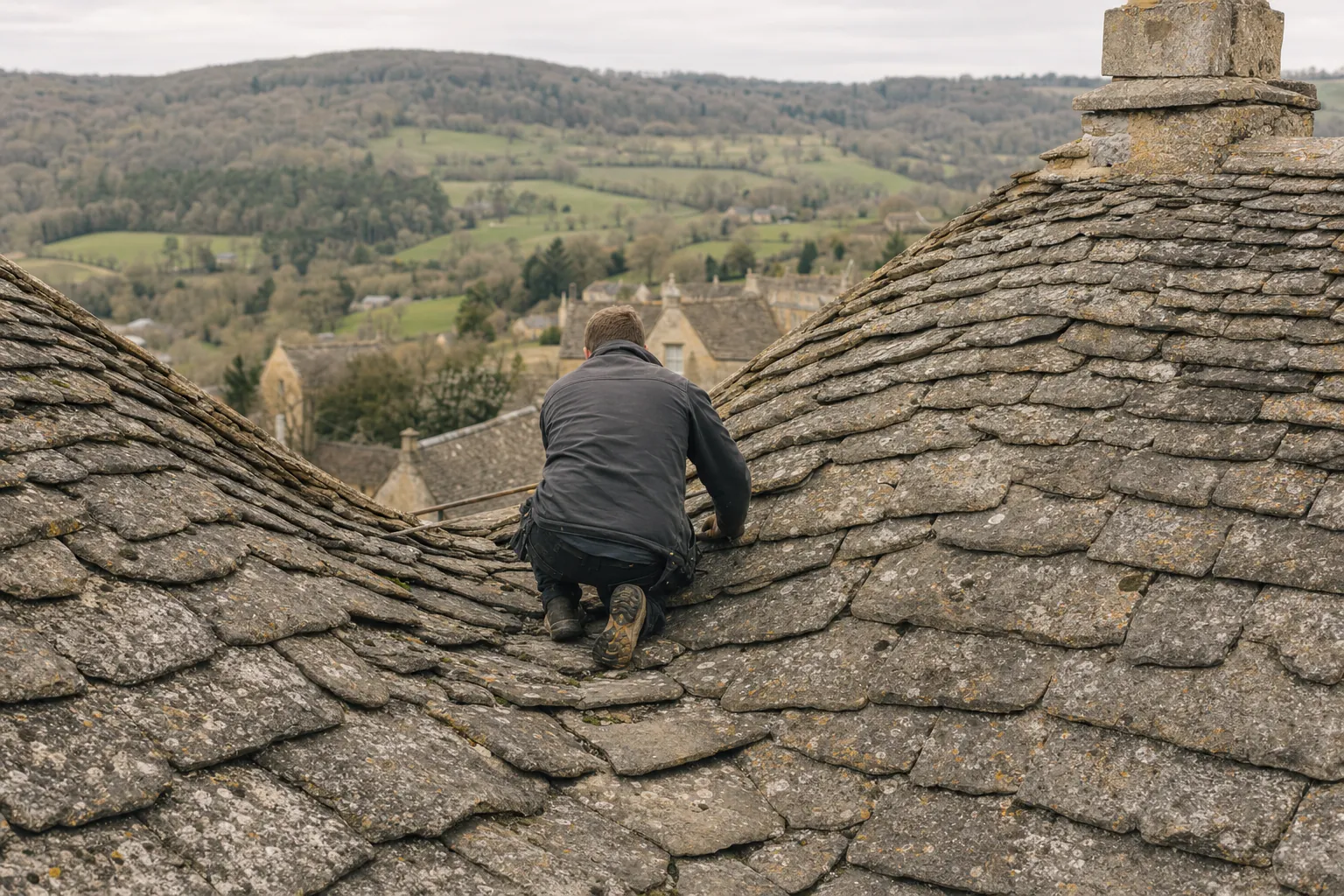
Early properties in the Old Town show mansard-type roofs with stone slates. A mansard has two pitches on each side, a steep lower slope and a shallower upper one, so the roof works hard as a wall as well as a covering. Villetts House, 42 Cricklade Street, dates from 1729 and carries a grade II* listing, though its own roof is largely hidden behind a parapet. Stone slates go on in diminishing courses, so the largest stones sit along the eaves while the smallest finish the top of the slope, and the whole covering is heavy. Repairs mean refixing, re-pegging and replacing individual stones, not stripping the slope. On a listed building, listing protects the covering along with the walls.

Chimney stacks with clay pots above slate roofs
Bath Road villas and the roofscape

Numbers 8 to 14 Bath Road, plain red brick houses of the early nineteenth century, have shallow-pitched Welsh slate roofs and unusual half-moon lunette windows in the top storey. Above them rise chimney stacks and clay pots, which the appraisal says contribute to a lively roofscape. Those stacks are what you notice first from the street, and what weathers fastest: pointing erodes, flaunching around the pots cracks, and the lead at the base lifts. The appraisal is also frank that some original coverings were swapped for concrete tile or reconstituted slate, to the loss of the buildings concerned. A repair in the original material preserves the street's appearance, and it is where we start.

From the town centre up to the Old Town

Map showing Old Town and central Swindon. 1 road miles south-south-west of central Swindon.

Distance
1 road miles south-south-west of central Swindon
Council
Swindon Borough Council
Council
Swindon Borough Council
Conservation area
Swindon Old Town, designated in 1969 and re-designated in January 1981
Setting
A hill-top medieval market town on a knoll

Old Town roof questions

Can the stone slates on a Cricklade Street house be repaired?

Yes, and repair is where we begin. A slipped stone is pegged back and a broken one is swapped for a match, with the whole slope stripped only if the timbers under it have given up.

Where do I look up whether my Old Town house is listed?

Swindon Borough Council's conservation and planning pages show listings and boundaries. If you are unsure, find out before work is priced, because listing changes the consent that applies.

Why do Old Town chimney stacks leak so often?

They are exposed on every side. Pointing erodes, the flaunching round the pots cracks, and the lead at the base lifts, so water finds the gaps long before the brickwork itself fails.

Q1

What covers the roofs of Swindon Old Town?

Roofer kneeling on diminishing courses of a stone slate roof
Reclaimed Cotswold stone slates sorted by length beside a limestone wall

The short answer

A mix that follows the town's growth: stone slates on early mansard roofs, Welsh slate on nineteenth century terraces such as 8 to 14 Bath Road, and later concrete tile or reconstituted slate where the original covering was replaced. Local stone and limestone form many of the walls beneath.

The Old Town grew from a medieval hill-top market settlement, and the council's conservation area appraisal reads its roofs as layers. The oldest are stone slate. The next layer is Welsh slate, which arrived with the nineteenth century expansion. The most recent is the concrete tile and reconstituted slate put on in some places when the original covering wore out.

How do stone slates behave?

Stone slates are heavy. The Cotswold District Council guide to stone roofing puts the weight at about 1,000 kg per 10 square metres, and the same principle of diminishing courses applies to stone slates elsewhere: large stones at the eaves, small ones at the ridge. The smallest are quite tiny, and every stone is individually pegged or nailed. Repairs have to work with that structure.

How does Welsh slate fail?

Welsh slate on the Bath Road terraces is thin, regular and light by comparison. It fails differently: nails rust through and slates slip, so a roof can look sound from the street and be sliding underneath. Matching the size, thickness and colour of replacements keeps the repair from showing.

What about later concrete or reconstituted coverings?

Where concrete tile or reconstituted slate has replaced the original, the roof looks different and weighs differently. Putting it right again can mean checking the structure and getting advice from building control, which we explain before you commit.

What can be seen from the ground?

Binoculars show a lot. A sagging ridge line, a stone that has slid out of its course, a stack leaning a little, or pots with no flaunching left are all visible from the street. We start there, then go up and photograph each fault so the evidence is in front of you.

Our stone roofing page sets out how stone slate work is carried out.

Q2

Who can touch the roof of a listed Old Town house?

The answer

Whoever does the work needs listed building consent if it would affect the building's character, and that includes changes to roofing material. Matching repairs are normally lower risk, but the council decides what counts, so check with its conservation team before you start.

Villetts House on Cricklade Street, built in 1729 and listed at grade II*, shows what the Old Town holds. There are listed buildings of many ages across the conservation area, and the rules that follow listing are the same wherever they stand.

What does the law ask of a listed house?

The Planning (Listed Buildings and Conservation Areas) Act 1990 says that any alteration of a listed building which touches its special architectural or historic character needs authorisation first. That authorisation is listed building consent, and doing the work without it is an offence. Stripping a stone-slate roof and re-covering it in another material would clearly be caught.

Where should replacement stone come from?

English Heritage's policy, reproduced in the Cotswold District Council guide of 2000, favours freshly quarried stone slates over reclaimed ones, limits reclaimed slates to the building they were taken from, and calls concrete and reconstituted substitutes unsuitable for historic buildings. Those principles guide how we approach stone-slate work here. They are traditional guidance rather than a rulebook, but they explain why a repair is usually preferable to a replacement.

How do we work with the council?

The council's conservation team can say what applies to your address. We describe the proposed work, with photographs, so the discussion starts from facts, and we do not begin until you know where you stand. If the council wants a sample, a method statement or a closer look at a stone, we help you provide it, and the timetable allows for that. Planning ahead this way avoids a half-stripped roof waiting on a decision.

Our slate roofing page covers the Welsh slate side of the same decision.

Our approach

Keep the original material, repair what is failing, and ask the council before changing anything visible.

Q3

How does the Old Town conservation area shape a re-roof?

Roofer repointing a stone chimney stack above lead flashing
Chimney stack taken down below roof level during removal

The short answer

A re-roof in matching materials seldom needs planning permission, but the council watches changes to the look of the street. The Old Town was the first conservation area designated in the borough, in 1969, and the appraisal specifically warns about unsuitable replacement coverings.

Wiltshire County Council first designated Swindon Old Town as a conservation area in 1969, the first in the Borough of Swindon, and its boundary was redrawn when it was designated again in January 1981. The council's list now includes several Old Town areas: the main area, Devizes Road, Prospect Place and Town Gardens.

Which jobs stay simple?

Repair or re-covering in the same material does not usually count as development, since the outward appearance stays as it was. Refixing slates, renewing lead and re-bedding a ridge all fall in that group when the materials match. We stay inside that line unless you ask us to leave it.

What does the council look at?

Changing the material, adding roof windows to a street-facing slope or altering a chimney can change the appearance, so they deserve a conversation with the council first. The appraisal itself regrets some replacement coverings, which is a plain statement of what the council values on these streets.

What happens to a leaking stack?

Stacks and clay pots add to the roofscape. A leaking stack is repaired where it stands, with new flaunching, repointing and lead, rather than being taken down. If a chimney breast inside is to come out, that is a separate job: Building Regulations approval is always needed, and if the wall is shared, the neighbour must be served notice too.

Where the work is bigger than a repair, we explain the consent route in the written quote. A re-roof that goes past the Planning Portal limits of 25 per cent of the building envelope and 50 per cent of the roof also brings Building Regulations into play, and Swindon Borough Council's building control team or a registered approver deals with that. Old walls and old rafters sometimes make the insulation upgrade awkward, so we raise it early.


MythLiving in the Old Town conservation area means any roof job calls for a planning application.

FactA matching repair or re-roof seldom does; what the council examines is any change to how the building looks.

Questions from the Old Town hill

Why are stone slate roofs in the Old Town so heavy?

Stone is simply dense. Cotswold District Council's stone roofing guide puts a stone slate roof at about 1,000 kg for every 10 square metres. That is why the timbers under a stone roof are substantial, and why swapping stone for another covering, or the reverse, calls for a check of the structure first.

Can you repair the lead on a roof behind a parapet?

Yes. Parapet gutters and valleys hide leaks well, because water follows the lead and drops out somewhere unexpected. We open up the likely spots, photograph the lead and report what is worn. Lead can last many decades when correctly laid, so often a section is repaired instead of the whole run renewed.

Are Old Town houses covered by an Article 4 direction?

On the council's conservation areas page, Article 4 directions appear only against Bishopstone and the Swindon railway village, so the Old Town is not named. A direction would remove some permitted development rights, which matters more for extensions and alterations than for repairs. The council's planning team can confirm what applies to your own address.

Do you work near Christ Church and the remains of Holy Rood?

Yes. Both stand in the Old Town and the streets around them are part of our regular round. The church spire is a landmark in the appraisal, and the Holy Rood remains in the park are a reminder of how old the settlement is. We work on the houses and buildings around them, and the same survey and written quote apply.

Ask us about your roof

Tell us what’s happening and we’ll call you back.

  • Photos of what we find
  • A written quote
  • 10-year workmanship guarantee

Or call 01793 626096

Call Get a quote