Rear slate roofs and chimneys of Victorian terraces

Roofers in Eastcott

Slate and tile roofing for Eastcott, the former hamlet the Bath Road once led to, where Victorian terraces meet the edge of the Old Town conservation area.

Eastcott's roofs along the Bath Road

Brick terrace with a low slate roof
The Bath Road terraces

Numbers 8 to 14 Bath Road are early nineteenth century red brick terraces with shallow pitched roofs in Welsh slate, and the council's Old Town appraisal says the road keeps a predominantly Victorian appearance. A shallow pitch is the key to how these roofs behave. Water leaves a low slope slowly, so slates need generous overlaps and sound lead at every junction, and a small gap lets rain blow upwards under the slates. The same appraisal notes that replacing original coverings with concrete tiles or reconstituted slates has detracted from some buildings, which tells you how much a street of matching slate is worth keeping. We repair in slate wherever slate is still there.

Mixed houses along an old village lane
The old hamlet

Eastcott began as a separate hamlet. The Old Town appraisal describes the lane from the Old Town out along Bath Road to Eastcott Road as once a rural lane from the Old Town to the hamlet of Eastcott. That history means the area is not one uniform street. Houses of different ages stand side by side, and the covering on each depends on when it was built or last re-covered. The Old Town conservation area runs along Bath Road as far as Eastcott Road, and Eastcott itself sits just outside the boundary, so the first question on any job is which side of the line the house falls. We help you read the council's map before work is priced.

Stone building with a hidden gutter and parapet
Listed and civic buildings

Bath Road is lined with listed early nineteenth century properties as well as Victorian terraces. Apsley House, the ashlar stone building that housed Swindon Museum until it closed in 2020, stands here, and so does the listed Bath Road Methodist Church of 1880. Roofs on buildings like these are often partly hidden behind parapets or set behind gutters in lead, so leaks show far from where they begin. Work on a listed building that affects its character needs listed building consent, and a church in use by the Methodist Church comes under the ecclesiastical exemption, which has its own rules. Before we quote for a building like that, we ask what protection it has.

From Swindon centre down the Bath Road

Map showing Eastcott and central Swindon. 1 road miles south-west of central Swindon.

Distance
1 road miles south-west of central Swindon
Council
Swindon Borough Council
Council
Swindon Borough Council
Conservation area
Swindon Old Town, first designated in 1969, runs along Bath Road as far as Eastcott Road
Setting
A former hamlet on the lower ground below the Old Town hill

Eastcott roof questions

Is my Eastcott house inside the Old Town conservation area?

Bath Road is within it as far as Eastcott Road, and Eastcott itself sits just outside. Streets near the line are worth checking on the council's map before any change to the roof.

Can a shallow Bath Road slate roof be repaired in slate?

Yes. Natural slate can be laid at low pitches if the overlap is increased to suit, and sound slates from your own roof are reused wherever possible.

Do Eastcott terraces need lead flashings renewed in time?

Lead lasts for decades, but the mortar or wedges that hold it can fail first. We check each flashing at the stacks and party walls and renew only the ones that have lifted.

Q1

Why do shallow Welsh slate roofs need special care?

Lead-lined valley gutter between two slate roof slopes
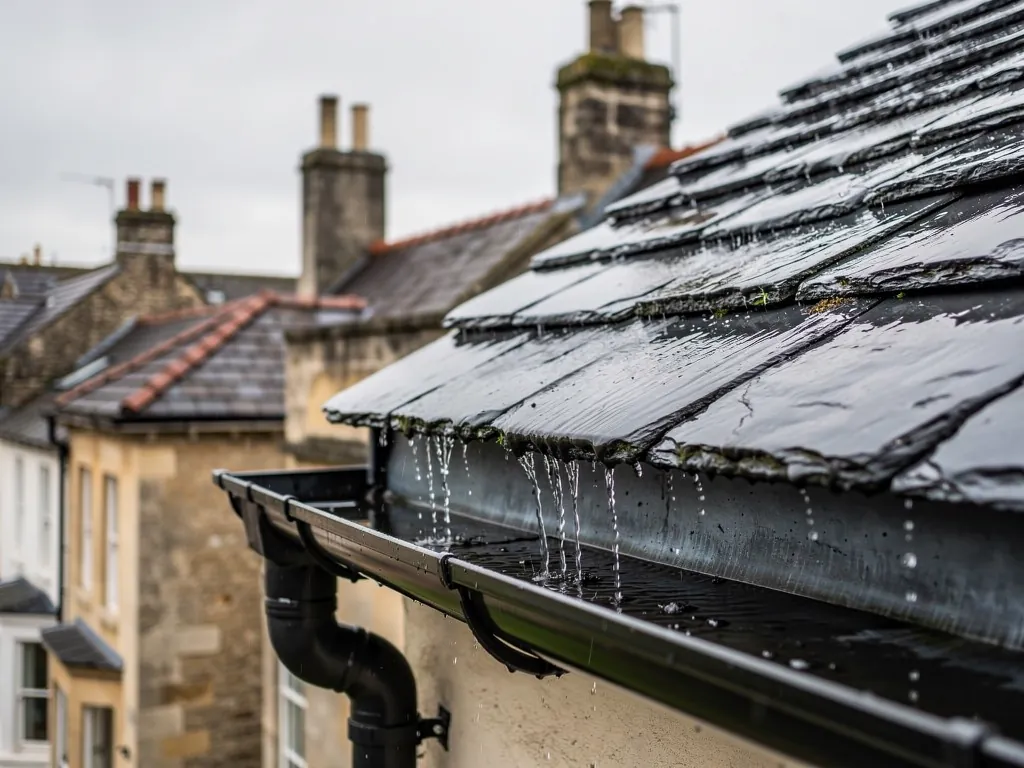
Rainwater running off slates into a black gutter and downpipe

The short answer

Because water runs off a low slope slowly, so the overlap between slates matters far more than on a steep roof. The lower the pitch, the more each slate must lap the one beneath, and a slate laid at too little lap can let wind-driven rain through.

The terraces on Bath Road have shallow pitched roofs in Welsh slate, and their low slope is part of their look. It is also what makes them fussy to repair. A slate that is perfectly adequate at a steep pitch can leak at a shallow one, simply because rain has longer to find a way through.

How much overlap does a shallow slate need?

British Standard 5534 gives a minimum roof pitch for natural slate of 20 degrees, for a standard 500 mm slate in moderate exposure, with a 115 mm headlap. The headlap is the distance each slate overlaps the course two rows below it. As the roof gets steeper, the required headlap falls. Cupa Pizarras publishes the figures, and the table below shows them for a common slate size.

What usually goes wrong on a low slope?

On a low-pitched roof, the usual faults are slipped slates, rusted nails and worn lead where the slope meets a wall. Replacement slate needs to match the originals in size and thickness, or the courses fall out of line. Reclaimed Welsh slate is often the best match, and we say where it has come from.

How should the lead be laid on a low slope?

Where a shallow slope reaches a chimney, a shared wall or a valley, the lead has to stand higher and lap further than it would on a steep roof. Code 4 lead is the usual choice for general flashings, and heavier codes go into valleys and gutters. A flashing that was fitted generously a century and a half ago can still fail because the slate beside it has dropped and exposed the joint.

Why photograph the roof first?

A shallow roof is hard to see from the ground. We photograph each slope closely, so you can see the individual faults and decide with us whether a repair or a re-lay is the better value. Our slate roofing page explains the process.


Minimum headlap for a 500 x 300 mm natural slate, moderate exposure
Roof pitchHeadlap
20 degrees115 mm
22.5 degrees105 mm
25 degrees95 mm
30 degrees80 mm
Q2

Does living beside the Old Town conservation area change roof work?

The answer

It can, depending on which side of the boundary your house is. The Old Town conservation area runs along Bath Road as far as Eastcott Road. Inside it, the council looks closely at changes to appearance. Outside it, ordinary rules apply, though the street's character still sets the standard we aim for.

The line on the council's map matters more than people expect. Two houses a few doors apart can sit on opposite sides of it, and the same job can be treated differently.

What if the house is inside the boundary?

The Old Town was first designated a conservation area in 1969 by Wiltshire County Council, the first in the borough, and re-designated with a revised boundary in January 1981. Replacing a roof with a matching covering still rarely needs planning permission. Changes to the look, such as a different material or new openings on a visible slope, are what the council examines. The council's conservation team will tell you what applies to your address.

And if it sits just outside?

Eastcott itself sits just outside the boundary. That does not mean anything goes, because the same Victorian streetscape continues, and a heavy concrete tile on a slate terrace looks wrong whichever side of the line it stands on. The appraisal says unsuitable replacement coverings have detracted from some buildings, and it is a fair warning for neighbours too.

Is there an Article 4 direction, and what about trees?

The council lists Article 4 directions only for Bishopstone and the Swindon railway village, not for the Old Town. Conservation areas do bring a six weeks' notice requirement for tree work, which is worth remembering if a tree overhangs the roof and the gutters.

If a lead roof or a gutter run needs replacing, the same principle applies: like for like, fixed properly. The Old Town appraisal also points to chimney stacks and clay pots as part of a lively roofscape, so a stack that is leaking is repaired and kept rather than taken down for convenience. A survey with photographs, such as our roof inspections and surveys service provides, lets you see the condition of each stack before you decide what to do with it.

Check the line

Look up your address on the council's conservation area map before choosing materials.

Q3

Can concrete tile replace slate on a Bath Road terrace?

Long flat roof on a 1960s brick building being re-covered
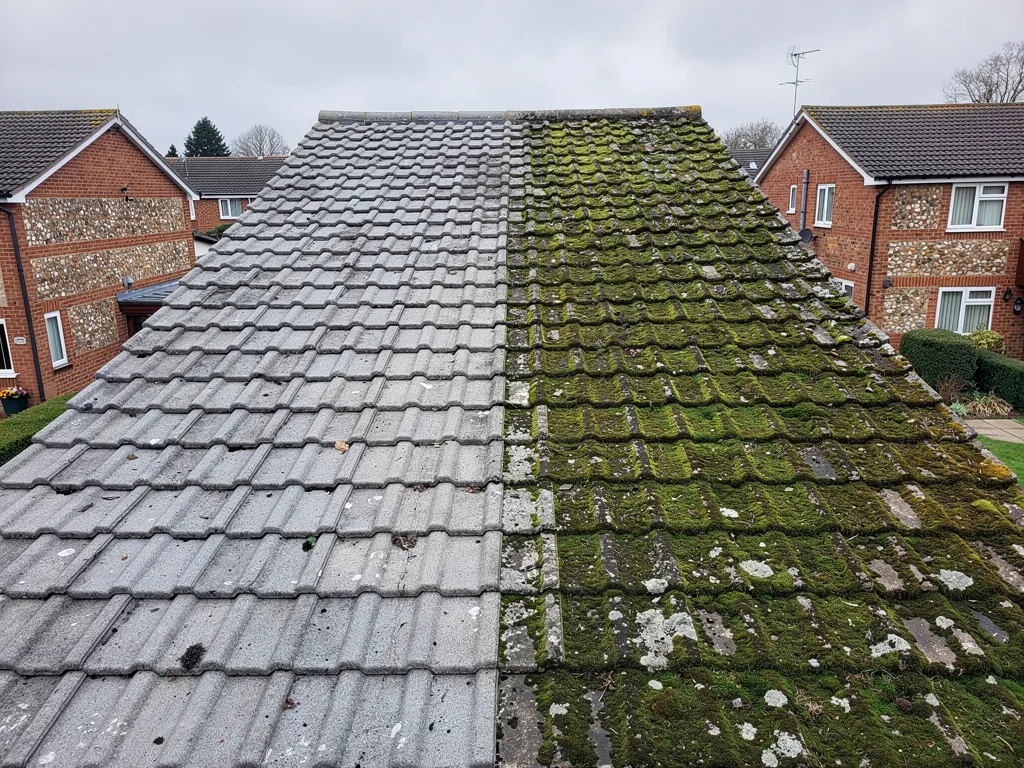
Roof half cleaned, grey tiles beside a moss-covered side

The short answer

It can be done, but it is rarely the right call. Concrete tile is heavier, so the structure must be checked and Building Regulations may apply. It also looks different on a terrace of matching slate roofs, which the council's appraisal has called out as detracting from some buildings.

Replacing slate with a cheaper-looking tile is a decision that many owners consider when a quote for re-slating comes back high. It is worth understanding what the swap really involves before deciding.

Is concrete tile too heavy for the rafters?

Concrete tile is heavier than natural slate. The Planning Portal says that a new covering that increases the weight of the roof covering by 15 per cent or more needs approval, and it advises a structural check. Approved Document A speaks of a significant change in loading as more than 15 per cent. A roof built for slate has rafters sized for slate, so we would look at the rafters and the purlins before agreeing to a heavier covering.

How does a swapped roof look from the pavement?

The Old Town appraisal says that concrete tiles and reconstituted slates have detracted from some buildings. A terrace where one house has swapped its slate stands out from the others, and in a conservation area the council may well take an interest.

What is the lower-risk option?

If the budget is the concern, a repair with matching slate often costs a fraction of a full re-roof, and a partial re-slate of the worst slope can be a middle course. Our tile-to-slate guide covers the reverse swap, which is sometimes the best way to restore a roof that was changed in the past.

Whichever way you lean, the written quote names the course we recommend and gives the reason for it. Small repairs are covered by our roof repairs work, and where re-slating only the worst slope is the sounder choice, the quote says so instead of pushing for the whole roof.

Questions from Eastcott and the Bath Road

Why do old slate roofs on Bath Road leak at the lead?

Lead flashing is the metal that seals the angle between a slope and a stack or wall. The metal itself lasts a very long time, but the mortar or wedge that holds its upper edge in place can fail, and water then gets behind it. On a low slope, the water has more time to creep, so a small lift in the flashing can cause a surprising stain indoors.

Does the Methodist church on the Bath Road follow different roof rules?

The ecclesiastical exemption from listed building consent covers churches in use by the United Reformed Church, the Baptists, the Methodists and Roman Catholics, plus Church of England buildings through the faculty system. Once a church stops being used for worship the exemption ends, and planning rules for the exterior still apply either way, so roof work on a Methodist church still in use goes through the Methodist Church's own consent process first.

Could you mend the roof of a listed house near Apsley House?

Yes, using the same materials fixed the same way. Repairs in matching materials seldom need consent, whereas anything touching the building's character does, roof covering included. Ahead of any work we settle the method with you, and if the plan drifts towards a different look we point you to the council's conservation team.

Do Eastcott's stacks and clay pots need attention too?

Often, yes. Chimney stacks on older houses are exposed on all sides, and the pointing, the flaunching that holds the pots, and the flashing at the base all weather. Repairing them is cheaper while the roof is already being worked on, so we look at the stacks on every survey and photograph what we find for you.

Ask us about your roof

Tell us what’s happening and we’ll call you back.

  • Photos of what we find
  • A written quote
  • 10-year workmanship guarantee

Or call 01793 626096

Call Get a quote