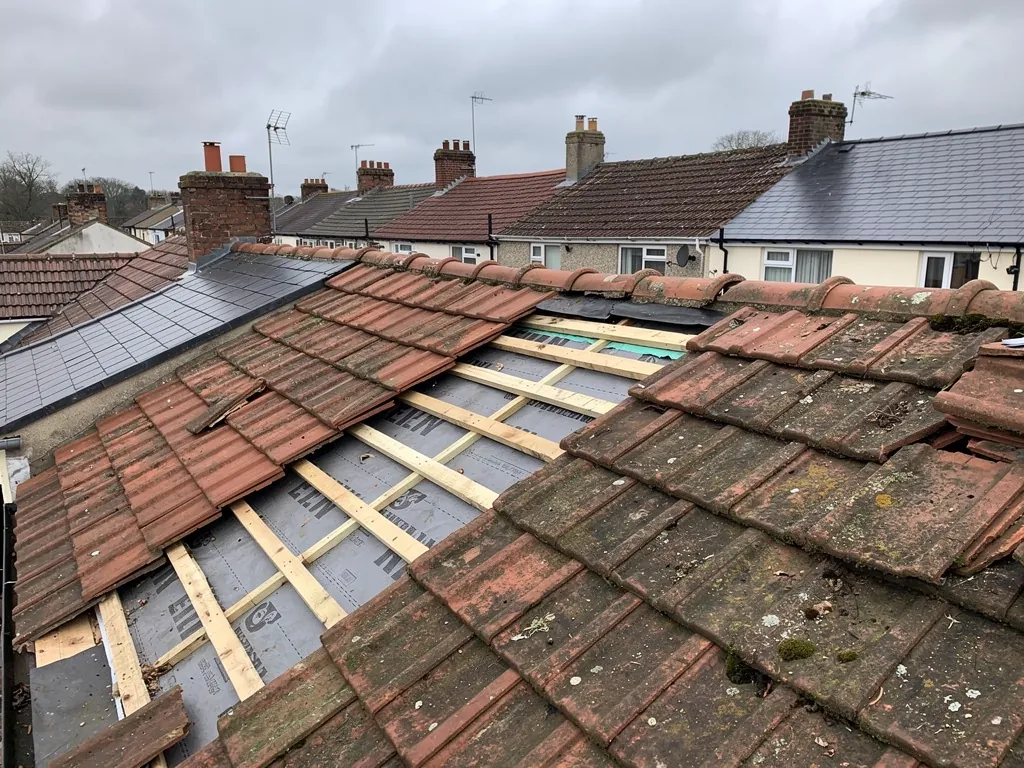
A damp patch beside a chimney breast is one of the most common reasons for a call, and in our experience of roofing generally the cause is a junction, not the roof covering. A flashing is lead strip that bridges the gap between brick and slope. A soaker is a smaller piece of lead, bent to an L, woven in under each slate or tile along a wall so the join stays dry.
Q2.1What goes wrong with the lead?
Lead moves with the weather and, over decades, it fatigues and cracks. Cement fillets that were used to seal old flashings shrink and drop out. Where the pointing around a stack has failed, water runs behind the lead and into the wall. Birds and weeds can lift a loose edge, and a chimney that is no longer used may have lost its cap.
Q2.2How is the lead repaired?
A neat repair re-dresses or replaces the lead, wedges it into a raked-out joint in the brickwork and pointed up in mortar or sealant, and it checks the flaunching, which is the mortar slope round the pots. Code 4 is the thickness commonly used for general flashing, with Code 3 reserved for soakers. Our lead roofing page covers the codes and the work in more detail.
Q2.3What if the stack itself is crumbling?
If the brickwork itself is crumbling, repointing or rebuilding may be needed before any lead is renewed. The survey notes it, with a photograph.
Where a chimney breast has been taken out inside the house, the roof above it deserves a second look, because the stack may now be unsupported. A stack is heavy, and it relies on the breast below for support, so we check how it is held before any lead goes back round it.