Concrete tiled estate rooftops towards green hills

Roofers in Kingshill

Kingshill sits on the limestone hill of Old Town, where Victorian villas, later houses and extensions all need roofs kept watertight. We repair, re-cover and re-lead them.

Kingshill's roofs, villa to extension

A tall villa with a shallow hipped roof
The listed Italianate villa

Kingshill House, listed at Grade II under Bath Road, is a stucco Italianate villa of about 1840 to 1860, and its list entry records a hipped slate roof. Houses in that style typically have low-pitched hipped roofs, deep eaves carried on brackets and chimney stacks set in a formal line, and they were commonly slated. Slate on a shallow pitch asks a lot of its laps and fixings, and the lead in the hips and valleys carries the burden of keeping water out. On a listed building every repair is judged by what it does to the character of the building, so the material, the method and the finish of lead details all matter. Any cabling, aerials or pipes fixed to a listed roof get the same scrutiny, because holes through slate and lead are where trouble starts later.

Mixed older houses on a hillside street
The hill and its older houses

Swindon's Old Town stands on a limestone hill about 450 feet above sea level, the original settlement above the later railway valley. High ground is windier than the valley below, so verges, ridges and the corners of hipped roofs take the strain first. Houses here were built and altered over a long period, so a single street can show slate, clay tile and later concrete tile side by side, with repairs of different ages meeting in awkward places. We read each roof as it stands, not as its neighbours look. Because exposure differs from one side of a house to another, we also note which slope takes the prevailing weather and give that side extra attention at the survey.

A brick house with a flat-roofed extension
Later houses and extensions

The Kingshill estate first came on the market in 1870, and around the older core stand houses from many later periods. What they share is the usual set of ageing parts: ridge bedding, verge edges, felt, flashings against walls, and gutters at the eaves. Extensions bring flat or low-pitched roofs, and conversions of large buildings, as Kingshill House itself changed use over time, tend to carry the repairs of several eras. Where a roof has been patched more than once, we start by establishing what is original and what is not. That tells us whether a fault is old, recent or the product of an earlier repair that was never quite right.

Where Kingshill sits

Map showing Kingshill and central Swindon. 2 road miles west-south-west of central Swindon.

Distance
2 road miles west-south-west of central Swindon
Council
Swindon Borough Council
Council
Swindon Borough Council, for planning and building control
Conservation area
None named Kingshill; check an address against the Old Town areas
Listed building
Kingshill House, Bath Road, Grade II

Roof questions from the Kingshill hill

Is Kingshill House's roof protected by its Grade II listing?

Yes, as part of the building. Anything that changes its character calls for listed building consent, and we talk matching repairs through with the council's conservation team.

Does the Old Town hill make Kingshill roofs more exposed?

Generally, yes. High ground catches more wind than the valley floor, so verges, ridges and hip corners take the load, and their fixings matter more.

Is Kingshill inside a conservation area?

Swindon Borough Council lists none named Kingshill, though several Old Town areas are close by. Check your address on the council's map before changing materials.

Q1

What roof does an Italianate villa carry?

Roofer repointing a stone chimney stack above lead flashing
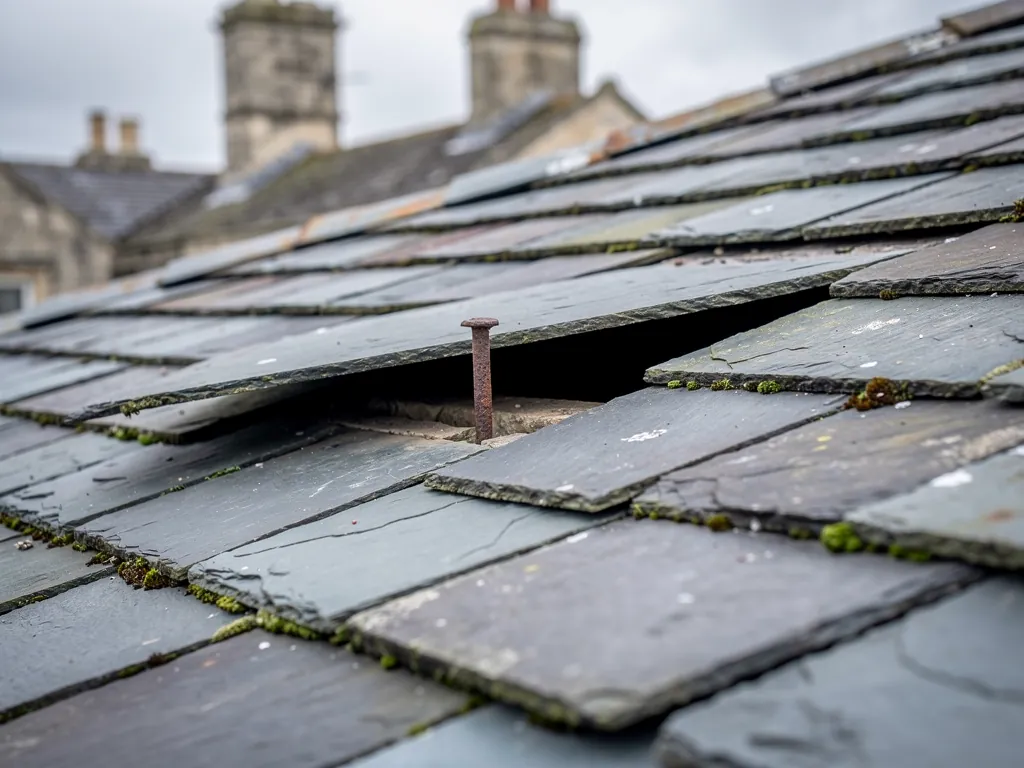
Slipped natural slate with an exposed nail on a weathered roof

The short answer

Villas in the Italianate style usually have a low-pitched hipped roof, wide eaves on brackets, and a covering of slate with lead in the hips and valleys. Because the pitch is shallow, the slate's laps, fixings and lead details do the work that a steep slope does elsewhere.

Kingshill House, built in the mid-1800s, gives the hill its best-known example of the style. The same features turn up on smaller villas and large houses nearby, so what follows applies well beyond the one listed building.

How shallow can a slate roof go?

Natural slate needs a minimum pitch of 20 degrees under BS 5534, as Cupa Pizarras sets out for a moderate-exposure roof with 500 mm slates, and hook fixings should not be used below 25 degrees. Low-pitched villa roofs sit close to those limits, so the headlap, the overlap of each slate by the one two courses above, matters more than usual. A slate that has slipped by a few millimetres can let water behind it. On a roof of this type we check the nail or clip on every slipped slate before refixing it, because a slate that slid once will slide again if the cause is not cured.

Why do the hips and valleys need lead?

A hipped roof slopes on every side, so it has hips instead of gables. Each hip needs a covering of ridge or lead, and every internal corner needs a valley gutter. These lead details outlive the slates around them if they are sound, but they split along folds and at their fixings. A tired valley is a frequent cause of a stain on a ceiling under the roof.

What about the deep eaves and brackets?

Deep eaves shed water clear of the wall, but the timber soffit and brackets are exposed to the weather. Rot there is a repair job for a carpenter as much as a roofer, and the two need to agree the sequence so that the new boards are not soaked before the roof is sealed, and our slate roofing page covers how the two trades fit together.

Chimneys on a villa are generally tall and plain, with a stack on each party wall or gable. Pointing, flaunching and the lead tray at the base all need checking on the same visit as the hips, and a cracked pot or a loose cowl is a quick fix while the access is in place.


Q2

Is the lead on a Kingshill villa worth saving?

The answer

Often, yes. Lead that is thick enough and not split can last for generations, and patching a failed joint is cheaper than stripping a valley. If it has thinned, cracked along folds or been repaired with bitumen, renewing the run in the right code is the better value.

On a Victorian roof, lead is the part that keeps working long after the first slates have been replaced. Judging it takes experience and a close look, because lead can look grey and tired while still doing its job.

How do you judge old lead?

Lead sheet comes in codes numbered by thickness, and the code chosen depends on the task. Leadworx calls Code 4 the usual pick for ordinary flashing jobs, with heavier codes kept for large roofs and valleys. A flashing that has lifted at a wall, cracked at a fold or been smeared with sealant is telling you something. We lift the edge, check the thickness and show you in photographs.

Should the lead be patched or renewed?

A short split at a fold can be repaired. A stained, creeping or buckled run is a sign of thermal movement that no patch will cure, and the better answer is a new strip fixed with proper laps and clips. Our lead roofing page explains the details, and the written quote makes plain where the new lead starts and stops.

Why not just use bitumen tape?

Self-adhesive flashing tape is a quick fix and sometimes a necessary one in an emergency. As a permanent repair on a Grade II building it is out of place, because it ages badly beside lead and can hide a leak that goes on soaking timbers below. We use it only to make a leak safe, and tell you when we have.

Valley gutters in lead are lined into the roof and often hidden by slates, so they are easy to neglect. We clear them, test them with water if needed and photograph the result, so that you can see whether the lining has failed or only the outlet has blocked. Where a run is renewed, the laps, clips and rolls are formed to suit the old pattern, so the finished detail looks right from the street as well as from the loft.

Lead sheet codes, as published by Leadworx and Royston
CodeThicknessTypical use
Code 41.80 mmGeneral flashing, light duty
Code 52.24 mmFlashings, valleys, general work
Code 62.65 mmLarger roofs
Q3

Do I need consent to repair a roof near Kent Road?

Long flat roof on a 1960s brick building being re-covered
Rolled lead roof covering over a bay above white windows

The short answer

Matching repairs on an ordinary house rarely need any consent. A listed building such as Kingshill House needs listed building consent before anything that changes its character is done, and a house inside an Old Town conservation area may have a view from the council. Check the address first.

Three questions decide the route: is the building listed, is it inside a designated area, and is the work like for like. Each is quick to answer, and the answers settle what we can do and what the council needs to hear.

What does listing change?

The 1990 Act on listed buildings and conservation areas makes it an offence to carry out works that alter a listed building's character without authorisation. Kingshill House is Grade II listed, so changing the covering from slate to something else would count. A repair using matching slate, fixed the same way, is a different thing, and we raise any doubt with you and the council's conservation team before work starts.

Is the house in a conservation area?

Swindon Borough Council lists 27 conservation areas, none named Kingshill, though several cover parts of Old Town. If you are in one, the council may want to know about a change of material or new roof windows. A roof re-covered in matching material seldom needs planning permission at all. Our roof repairs page covers small jobs that stay well within these limits.

When does building control step in?

A larger re-roof can need building control approval, from the council's team or a registered approver. When we start with a survey, we tell you which of these applies and handle the notification when the work is notifiable.

For a house that is neither listed nor inside a designated area, the route is the simplest one: no planning application, and building control only if the job is large. Even then, a roof that has not been touched for a long time deserves a record of its condition before work begins, which is what the survey photographs give you.

MythA Grade II listing means nothing can be done to the roof.

FactMatching repairs are normal on listed buildings; consent is needed for work that alters their character.

Roofing services in Kingshill

Questions from around Kent Road

Why do hips and valleys leak on Victorian villa roofs?

Because that is where the lead does its hardest work. Lead moves with the temperature, and over a long life it can crack along folds or lift away from the slates. Moss and debris in a valley make it worse. On inspection we can say whether a patch will hold or the whole run has to be renewed.

What has Kingshill House been used for over the years?

It was Swindon's maternity home from 1931 for over forty years, and later the Seymour Clinic for health service mental health care, which left the building in 2011. A large house that changes use tends to collect patched roofs, so we establish what is original before suggesting repairs. That habit applies to any older Kingshill house with more than one visible repair.

Do you cover the whole of Old Town and the hill?

Yes. Kingshill and the rest of Old Town fall within our area, which takes in the town and every place within 30 road miles. Our areas page lists them all.

What do I get from a survey on a Kingshill roof?

You are sent pictures of your own roof plus a quote in writing, naming the smallest job that will put it right. Our work is backed by a written 10-year workmanship guarantee, and the waste leaves with us. Phone 01793 626096, send a WhatsApp message or use the form to book.

Ask us about your roof

Tell us what’s happening and we’ll call you back.

  • Photos of what we find
  • A written quote
  • 10-year workmanship guarantee

Or call 01793 626096

Call Get a quote