Rear slate roofs and chimneys of Victorian terraces

Roofers in Lawn

Roofs in Lawn get shade, falling leaves and the odd tall branch from the old parkland around them. We repair, re-cover and clear them, with a written quote after a survey.

Lawn's roofs, from the park to the estate

Houses beside mature park trees
Beside Lawn Park

The Goddard family held the manor of Old Swindon from 1563 to 1927, and their manor house, rebuilt around 1770, was known as the Lawn by 1830. Swindon Corporation bought it in 1947, with 53 acres and the neighbouring Holy Rood Church, and the house was demolished in 1952. Its roof is long gone, but the park it stood in is still about 50 acres, and houses on its edge sit under mature trees. That setting is the main thing that shapes their roofs: shade that keeps slopes damp, moss that follows, and leaf fall that blocks gutters and valleys. A roof that is dry in July can be sodden under the trees by November, so we look at how each slope dries, not only at the tiles.

A row of similar estate houses
The Lawns estate

The Lawns housing estate sits beside the park and is one of its access points. The Victoria County History places the area known as the Lawn between the Marlborough road and Queen's Drive, where roads such as Sandringham Road and Windsor Road were built up with privately owned houses. On any of them we read the covering itself, which tells us more than a date would. Estates of this kind repeat a handful of house designs, which helps in one way: a fault found on one roof is a good prompt to look for the same fault on the next. Typical trouble spots are ridge bedding, cracked or slipped tiles, lead at chimneys, and the small roofs over porches, bay windows and garages, which age faster than the main slope and are easy to overlook from the ground. Where a pitched roof meets a flat one, the junction needs lead or a proper upstand, and that detail is where we often find the leak.

Older brick houses with tiled roofs
The Old Town side

Lawn lies within Old Town Swindon, the original settlement, and the area around it has older buildings than any estate. Holy Rood Church beside the park dates from the 13th century and keeps only its chancel. Older houses nearby may have clay tiles, slate or a mixture laid over many years, with repairs from different periods sitting side by side. The council lists several Old Town conservation areas, none of them called Lawn, so an older house here can be either inside or outside one. Nothing about the postcode settles it. We check the council's map for the address before advising on materials, because the answer affects what a repair may use, and we put what we found in the written quote.

Where Lawn sits

Map showing Lawn and central Swindon. 2 road miles south-south-east of central Swindon.

Distance
2 road miles south-south-east of central Swindon
Council
Swindon Borough Council
Council
Swindon Borough Council, for planning and building control
Conservation area
None named Lawn; several separate Old Town areas are nearby
Setting
Old Town, on the former Goddard family parkland estate

Roof questions around Lawn Park

Is Lawn inside an Old Town conservation area?

Swindon Borough Council lists no conservation area called Lawn, but several Old Town ones sit close by. Check a specific address on the council's map before planning anything beyond a like-for-like repair.

Do the trees around Lawn Park harm my roof?

Not directly, but they cause shade, moss and blocked gutters. Overhanging branches that scrape the covering or drop heavy limbs are the real risk, and they are worth dealing with early, before a gale makes the decision for you.

Does the church by Lawn Park need listed building consent for roof work?

For a Church of England church still in use, the faculty system applies instead. After a church closes for worship, ordinary listed building controls take over.

Q1

How do trees near Lawn Park affect a roof?

Blocked gutter full of leaves overflowing down a brick wall
Lead-lined valley gutter between two slate roof slopes

The short answer

Trees do not usually damage a roof directly. They shade it, which encourages moss, and they shed leaves, needles and twigs that block gutters and valleys. Blocked outlets push water back under the covering, which is how most tree-related leaks start. Regular clearing is cheaper than repair.

Houses by Lawn Park live with something most Swindon roofs do not: a mature canopy. The park is about 50 acres of old Goddard family land, and the trees that line it drop a great deal into the gutters of the nearest streets.

Why does moss grow on shaded slopes?

A slope that stays in shade dries slowly. Moss takes hold in the overlaps between tiles, keeps water pressed against the surface, and as it thickens it can push tiles up at their edges. Removing it is straightforward work, but the method matters: scraping by hand is gentler on old tiles than a pressure wash, which can damage soft or weathered surfaces. Our roof cleaning and moss removal page explains the choices.

What happens when gutters and valleys fill?

Leaves collect in the valley, the channel where two slopes meet, and in gutters that have lost their fall. When the outlet blocks, water spills over the back of the gutter onto the fascia or runs under the lowest course of tiles, where it can soak the felt and the batten ends without showing for weeks. If your gutters overflow in autumn, that is the first sign.

What about branches touching the roof?

Limbs that rub the covering wear it away, and a heavy branch in a storm can crack tiles or break a ridge. We do not fell trees, but we photograph the damage and tell you what has to be cut back before the roof is repaired, so the same limb does not undo the work next winter.

Autumn is the sensible time to look. Once the leaves are down, a gutter clear-out and a check of the valleys takes a short visit, and it shows whether a slope needs moss treatment before winter damp sets in. For a roof that is already leaking, the cause is usually found in the survey photographs, and the repair is sized to the fault.

What it typically costs

  • Flat roof moss removal£300 to £600
  • Pitched roof moss removal£450 to £850
  • Tiled roof moss removal£400 to £750
  • Slate roof moss removal£500 to £1,000
Typical national figures, not our prices. Access, roof size and the method chosen move the cost, and our written quote follows the survey. MyBuilder roof cleaning cost guide, updated 21 August 2026.
Q2

What should owners on The Lawns estate look for?

The answer

Start with the covering, because it tells you more than the estate's age does. Check ridge tiles, tiles that have slipped or cracked, the lead around any chimney, and the smaller roofs over porches and garages. If the roof was built or repaired before 2000, treat suspicious sheet material as possible asbestos until it is tested.

Estate houses are designed to be built quickly and repeatedly. That is a strength when something goes wrong, because a repair that worked on one roof usually works on its twin, but it also means one weakness can run along a whole street.

What should I check on the main slope?

From the ground, look for tiles sitting out of line, dark patches where water lingers, and ridge tiles that look uneven. In the loft, damp timber or daylight around the chimney points to a leak. A tile fault is often local, and a repair that replaces the broken tiles and refixes the loose ones solves it. Our roof repairs page sets out how we decide between repair and replacement.

Why do the small roofs fail first?

Porches, bay windows and garages are built lighter than the house, frequently with a shallow pitch or a flat covering, and they take weather from more directions. A garage roof of felt, EPDM or GRP depends on its edges and on water running off freely. If puddles sit on it a day after rain, the falls have gone wrong.

Could older materials contain asbestos?

HSE guidance says a building constructed or refurbished before 2000 should be assumed to contain asbestos somewhere. Corrugated cement sheeting on a garage or shed, or old board under the eaves, is the sort of thing to leave undisturbed until it has been properly identified. We stop and tell you if a survey turns up something of that kind.

The covering and the condition of the fixings tell us what a roof needs, whatever its date.

Chimneys deserve a mention on any estate roof. The stack is the highest, most exposed part, and the pointing, the flaunching (the mortar cap that holds the pots) and the lead at its base all weather faster than the tiles. A cracked flaunching lets water into the stack and down through the ceiling, and is a small repair if caught early. See chimney repairs if yours looks tired.


Where we start

Look at the small roofs and the lead first, because they fail before the main slope does.

Q3

Does roof work near Holy Rood need consent?

Roofers on a slate roof along a limestone village street
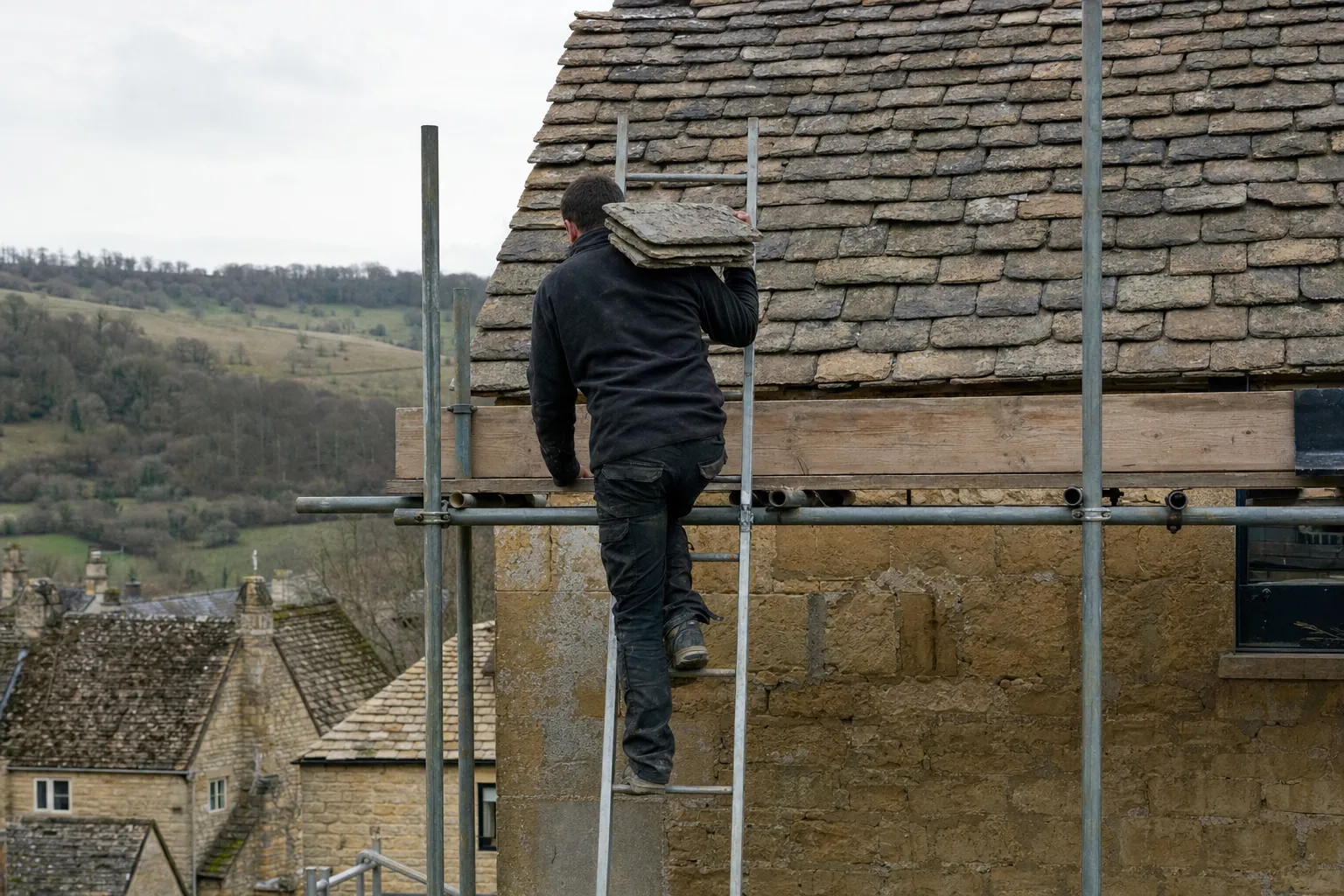
Roofer carrying stone slates up a ladder on scaffolding

The short answer

Most roof repairs near Lawn Park need no consent at all. Swindon's Old Town conservation areas, listed buildings and churches are the exceptions, and each has its own rules. If your address is in any of them, speak to the council's conservation team before settling on materials.

Lawn has no conservation area under its own name, but it sits in the middle of Old Town, where the council has designated several. Most owners will find their house is outside all of them. Some will not, so the first job is a quick check.

Does a conservation area or listing apply?

Planning consent is rarely asked for when a roof is renewed in the same material. A conservation area adds the chance that the council will have a view on a change of material, and a listed building needs listed building consent for any alteration that affects its character. The council lists 27 conservation areas, and Article 4 directions apply only in Bishopstone and the Railway Village.

What about the church buildings?

Holy Rood's surviving chancel is recorded under the Church of England parish of Christ Church. Anglican buildings still used for worship sit under the ecclesiastical exemption, and works are authorised by a diocesan faculty. After regular worship ends, ordinary controls apply, so a redundant church needs listed building consent. That rule explains why two buildings in the same street can follow different routes.

When is building control involved?

Larger re-roofs can need a building control application, and Swindon Borough Council runs its own team. We explain which category your job falls into at the survey and handle the notification when it applies. Our pitched roofing page covers the typical routes.

For listed buildings we start from like for like, meaning matching stone, slate or tile put back by the original method, and any departure from that is settled with you first. Replacing a natural covering with a modern one is the sort of change that draws the council's attention, so we raise it with you early and suggest a call to the conservation officers before any order is placed.

MythAnything built in Old Town needs consent before the roof can be touched.

FactA matching repair seldom needs it; consent questions arise with listed buildings and changes of material in a designated area.

Questions from around Lawn Park

Why does moss keep returning to roofs near Lawn Park?

Shade and damp air from the old trees keep the slopes wet, and moss thrives on that. Clearing it helps, but regrowth is likely unless the shade is reduced or the roof is treated. We point out which slopes are most affected during the survey so you can judge whether to cut back branches or simply plan for periodic cleaning. A treatment after cleaning slows regrowth but does not stop it, so we describe it as upkeep, not a cure.

Is any of the old manor house roof left?

No. Swindon Corporation bought it in 1947 and the house was demolished in 1952. The park and the chancel of Holy Rood Church, which dates from the 13th century, are what remain on the site. The Lawns estate and the park paths now take the place of the old grounds.

Do you work in Old Town as well as Lawn?

Yes. Lawn is within Old Town, and our patch takes in the whole town and everywhere within 30 road miles. Browse the areas page for the full list, and a survey in one part of Old Town costs no more effort than one in another.

What do I get with a roof survey in Lawn?

A set of photographs from your roof, taken during the visit, and a written quote naming the least work that will stop the leak. Finished work is covered by our written 10-year workmanship guarantee. Booking is by phone on 01793 626096, by WhatsApp, or through the form below, and we take every scrap of waste away when we leave.

Ask us about your roof

Tell us what’s happening and we’ll call you back.

  • Photos of what we find
  • A written quote
  • 10-year workmanship guarantee

Or call 01793 626096

Call Get a quote