Edwardian brick villas with clay tile roofs and decorative ridges

Roofers in Berkshire

Tiled, slated and flat roofs mended and renewed on the Berkshire side of the border, from racing yards in the Lambourn valley to the canal towns along the Kennet and the estates around Newbury and Thatcham. Every job starts with a survey and ends with a written quote.

Berkshire's roofs, from chalk downs to canal towns

Tiled cottages and stable roofs on a downland lane
The downland villages

Lambourn, East Garston, Great Shefford and Chaddleworth sit in folds of the chalk, and the North Wessex Downs National Landscape covers a good part of this ground. Lambourn lies along a winter stream in the Berkshire Downs, with a Grade I listed church beside a market place that once gave the village the name Chipping Lambourn. The houses range from old cottages with steep tiled roofs to long stable ranges with low pitches, deep eaves, lean-tos and loose boxes. Gutters on those eaves clog with leaf and moss, and the humblest outbuilding roofs of sheet, felt or old tile tend to let water in before the house does.

Red clay tile and brick on a market town street
The Kennet valley towns

Hungerford, Kintbury, Newbury and Thatcham grew beside the river, then the canal, then the railway. Many of the oldest buildings on Hungerford's High Street were timber-framed houses that later gained brick and tile fronts, a change the town made over the Georgian decades, and one or two keep thatch. The Victoria County History of 1924 recorded Kintbury church's roofs as red tile, with a south transept built in brick in 1713. Thatcham's houses were described in the Victoria County History as almost all red brick with slate or tile. On roofs like these we expect clay tile or slate on timbers that have shifted, so ridges, hips, valleys and chimney flashings are where faults usually start.

Concrete tiles on newer family homes
Estates and newer roofs

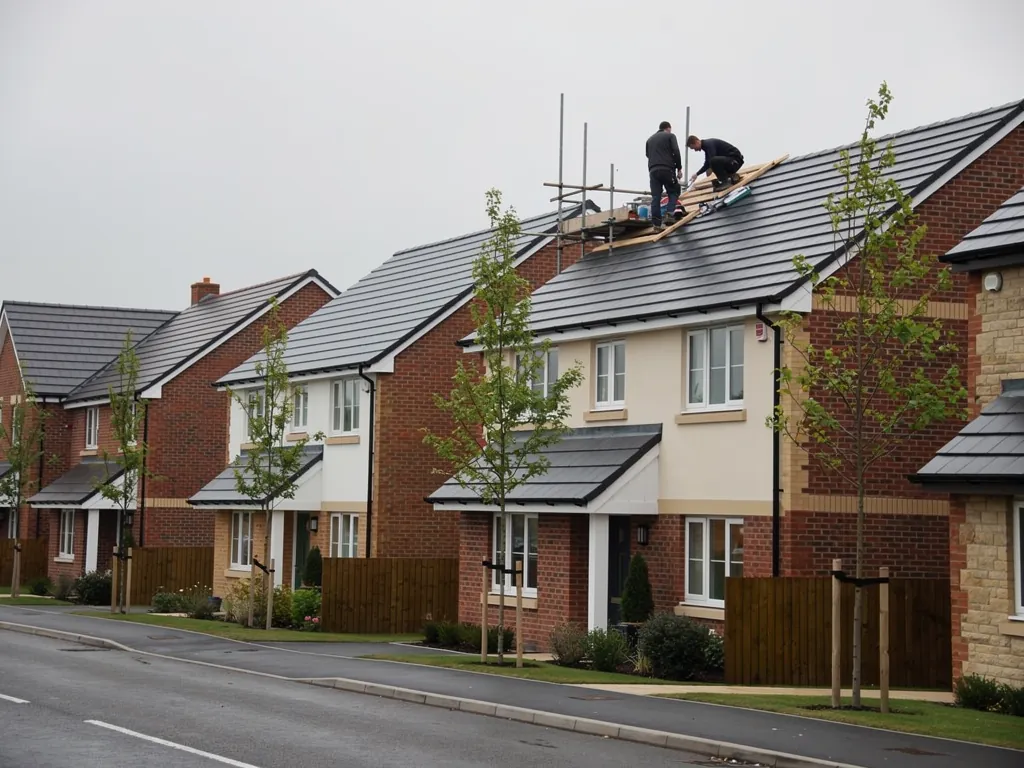
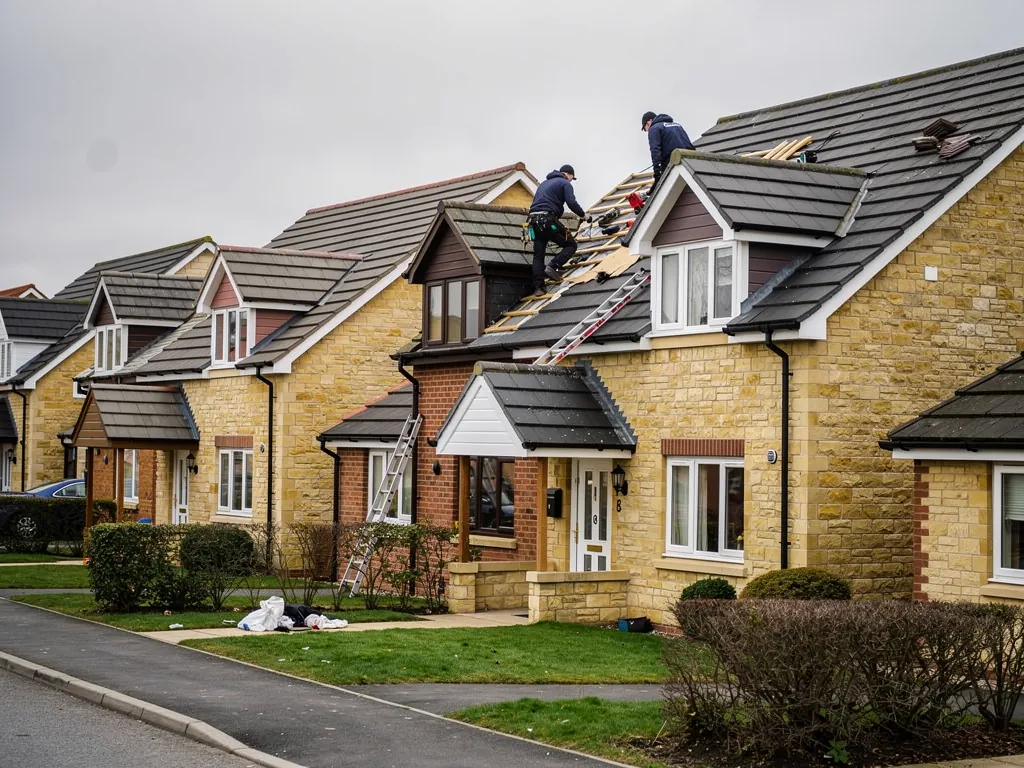
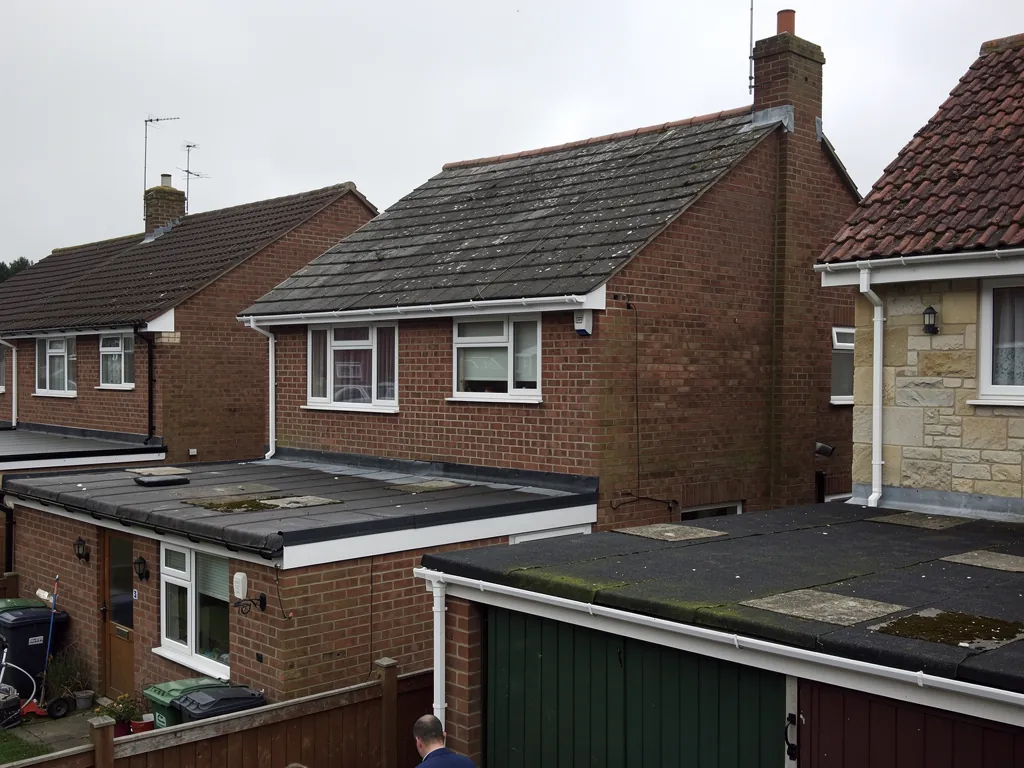
Around Newbury, Thatcham, Greenham, Cold Ash and Shaw, much of the housing is far newer than the villages on the downs. Thatcham grew from about 5,000 people in 1951 to well over 22,000 by 2001, and the streets built during that growth carry concrete interlocking tile, with flat-roofed garages, porches and small kitchen additions. The problems are predictable: ridge tiles whose mortar bed has crumbled, felt that has split on a flat section, and lead flashing that has lifted along the join with an older wall. Most of this is routine work, and the real decision is whether a repair settles the fault or the whole covering has run its course.

Berkshire places we cover

Every West Berkshire place within 30 road miles of Swindon has its own page, from Lambourn and Hungerford at the start of the Kennet valley to Newbury, Greenham and Thatcham at the far edge of our reach. Villages that belonged to Berkshire until 1974, such as Faringdon, Shrivenham and Wantage, now sit in the Vale of White Horse in Oxfordshire. Each has its own page and is covered the same way.

Map of the Berkshire towns we cover within 30 road miles of Swindon.

Berkshire roof questions

How far into Berkshire do you work from Swindon?

Along the Lambourn valley and the Kennet as far as Thatcham. Reading, Wokingham and Windsor are beyond our 30-mile reach by road.

Is a downland roof near Lambourn more exposed than one in Newbury?

Often, yes. Ridges, verges and eaves on open chalk ground take more wind than those in the shelter of the valley, so their fixings are worth checking first.

Do you work in the Berkshire villages that now sit in Oxfordshire?

Yes. Faringdon, Shrivenham, Wantage and Uffington were in Berkshire until 1974 and have their own pages, and we cover them as part of the same area.

Q1

What is on the roofs between Lambourn and Thatcham?

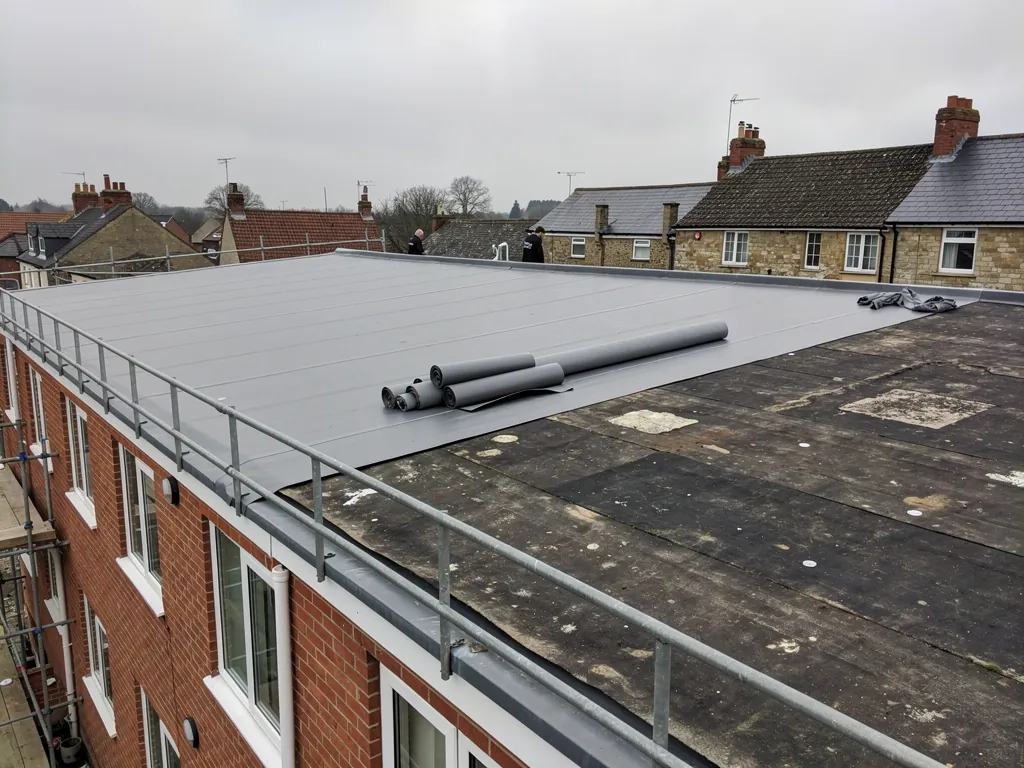
Long flat roof on a 1960s brick building being re-covered
Flat-roofed garages behind brick semi-detached houses

The short answer

Clay tile and slate on older houses, concrete tile on the estates put up after the Second World War, thatch on a few surviving cottages, and flat roofs over garages and kitchen additions. The valley towns and downland villages differ more in age and setting than in anything else.

Drive east from Swindon along the Lambourn valley and the roofs change with the ground. Up on the chalk the villages are small, spread out and often old. Down in the Kennet valley the town centres are older still, yet ringed by wide areas of later housing. The roofing work follows that pattern.

What goes wrong on old tile and slate?

Clay tiles from the eighteenth and nineteenth centuries are frequently hand-made, slightly uneven and hung on timber battens that have softened over decades. The tiles may be perfectly sound while the nibs, pegs and nails holding them have given up, so a roof slips one tile at a time. Slate behaves the same way: the stone survives and the fixings corrode. Both are usually repairable by lifting a section, renewing the battens and fixings, and relaying the good tiles or slates with gaps made up from matching reclaimed stock.

What about thatched cottages in the villages?

A handful of thatched buildings remain around Hungerford and the neighbouring villages. We work on the other roofs of such a property, the slated or tiled extension, the porch, the garage, the flat-roofed kitchen. We keep the thatch covered and clean while we work, and tell you about anything we notice on the main roof that deserves a specialist's attention.

Do stable yards need different roofing?

They do. Yards around Lambourn have long ranges of low roofs, often shallow, with overhanging eaves and a patchwork of tile, profiled sheet and felt. Laps, fixings and the flashings where one range meets the next are the usual leak points. Our roof repairs page sets out how we trace a leak on a building like this, beginning with where the water really enters rather than where it drips.

Where a yard roof has been patched many times over the years, we photograph each section during the survey so the quote covers what is actually there.

Q2

Does the downland setting change roofing near Hungerford?

The answer

Not for a matching repair or re-cover, which does not usually need planning permission. National Landscape status matters for larger changes such as new dormers, and the council, not the landscape body, makes the decision. Listed buildings and conservation areas add checks of their own.

Much of rural West Berkshire lies inside the North Wessex Downs National Landscape, the title that took over from Area of Outstanding Natural Beauty on 22 November 2023, with the same legal status. The partnership that looks after the area gives advice on planning, but it has no power to grant or refuse an application. West Berkshire Council decides.

Can I re-roof in the same materials without applying?

Usually, yes. Putting back the same covering seldom counts as development that needs planning permission, because the outside of the building looks as it did. That holds for a cottage in East Garston, a terrace in Hungerford or a house in Inkpen. The exceptions are listed buildings, where works that affect character need listed building consent, and homes where the council has withdrawn permitted development rights through an Article 4 direction or a planning condition.

What if I would rather change the covering altogether?

Swapping clay tile for concrete, or slate for something paler or lighter, changes how a roof looks. Put that to the council early, before money is committed. In a conservation area such as Lambourn, Hungerford, Kintbury or Newbury, anything visible from the street deserves the same caution. Not sure whether your house sits inside a boundary? The council's conservation pages map them, and we will go through the map with you at survey stage.

Does the landscape affect how the work is done?

The method stays the same. A downland roof still needs the same fixings, underlay, ventilation and flashings as one in a town. The real difference is exposure: on open ground the ridges, verges and eaves deserve a closer look, and we use mechanical fixings rather than trusting mortar alone. For larger additions such as dormers or loft rooms, take planning advice before design work begins, and see our skylights section for the roof window route.

MythAnything you do to a roof inside the North Wessex Downs needs permission.

FactMatching repairs seldom do. Councils look hardest where the appearance changes, or the building is listed.

Q3

Who handles building control for a re-roof in West Berkshire?

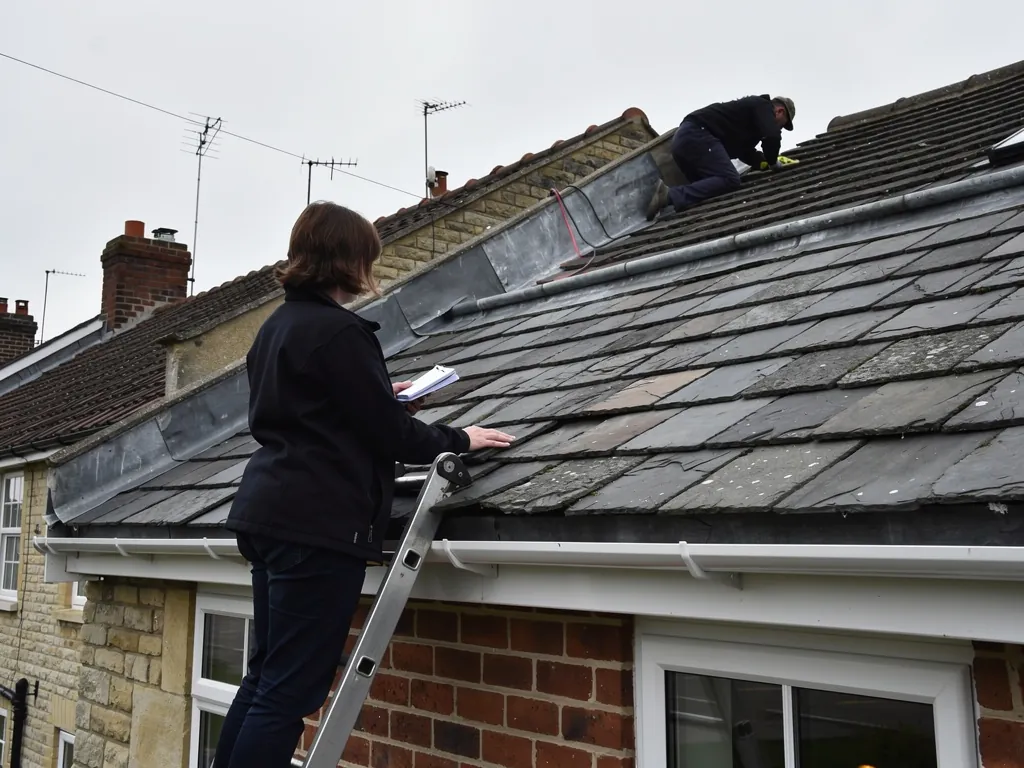
Surveyor on a ladder checking slates with a notebook
Concrete tile roof with moss, lifted tiles and a cracked ridge

The short answer

West Berkshire Council is served by Building Control Solutions, a shared service with Wokingham Borough Council. A registered building control approver is the private alternative. Whichever route applies, we explain what is notifiable and deal with the Building Regulations notification where the work needs it.

Most roof repairs need no application at all. Refixing tiles, swapping a cracked slate or relaying a ridge using matching materials counts as upkeep. A few situations differ, and the same rules apply whether the house is in Lambourn or on the edge of Newbury.

When must a Berkshire re-roof be approved?

Under the Planning Portal's guidance, a re-cover normally stays outside building control provided the job touches under 25 per cent of the total building envelope and under 50 per cent of the roof. Cross either line and approval applies, and the work may also trigger an insulation upgrade to the roof. Swap to something 15 per cent heavier or more and the same sign-off applies, which is why we ask what is on the roof today before suggesting a different tile.

Which body do I deal with?

For West Berkshire, the council's building control is delivered by Building Control Solutions, which also serves Wokingham. You may instead use a registered building control approver, the private-sector route in England since 6 April 2024. We tell you which applies to your job, and where work is notifiable we manage the notification so the completion paperwork reaches you.

Why does that matter if I am selling?

A buyer's solicitor may ask for evidence that notifiable roof work was signed off. Holding that paperwork saves delay later, and it is far easier to arrange at the time than to chase months afterwards. The survey photographs we send with the written quote help too, because they record what the roof looked like before anything changed.

Details of the shared service are on the Building Control Solutions website. For a heavier covering, a thermal upgrade or any structural change, check with your building control body before the work is priced.

Our view

Ask who signs the work off before you accept a quote, not after the scaffold comes down.

Questions from the Lambourn valley to the Kennet

Why do roofs in the Lambourn valley look so different from those in Newbury?

Age and setting. The valley villages have older tile and slate, a few thatched cottages and long stable ranges. Newbury and Thatcham have large later estates in concrete tile, with flat roofs over extensions and garages. Older roofs usually call for careful repair, while the newer ones tend to need ridge, flashing and felt attention.

Can a listed house in a Berkshire village have its roof repaired by you?

Yes, using matching materials and methods. Like-for-like repairs rarely need consent, but anything touching the building's character does, so you and we settle the method before the first tile is lifted, and West Berkshire Council is the place to ask if the plan shifts. Nothing on a listed roof begins on guesswork.

Do you take on stable and outbuilding roofs near Lambourn?

Yes. Low-pitched roofs, lean-tos and sheet or felt coverings on yards and outbuildings are repaired or renewed just as house roofs are, beginning with where the water gets in. We check fixings, laps and the junctions between ranges before suggesting anything larger.

Are ridge tiles on exposed downland houses still bedded in mortar?

Frequently, since that was normal practice for generations. The 2014 revision of BS 5534 ended reliance on mortar by itself, so on an open roof we re-bed ridges with mechanical fixings added, or switch to a dry ridge kit tested against BS 8612. Wind makes it an early upgrade up here.

Ask us about your roof

Tell us what’s happening and we’ll call you back.

  • Photos of what we find
  • A written quote
  • 10-year workmanship guarantee

Or call 01793 626096

Call Get a quote