Street of 1960s brick bungalows with concrete tile roofs

Roofers in Lambourn

Tiled, slated, flat and sheet roofs repaired and renewed in Lambourn, from the houses around the market place and church to the stable yards and newer homes of the downland valley, all quoted in writing after a survey.

Lambourn's roofs, from market place to stable yard

Brick and stone houses around a market square
The market place and church

Lambourn was also called Chipping Lambourn because of the market held in the market place by the church. The parish church, dedicated to St Michael, is Norman in style, Grade I listed, much restored in the late 19th century and ringed by a sarsen stone wall. John Estbury founded almshouses here, with a brass dated 1508. Houses round this centre sit inside the Lambourn Conservation Area, and a separate Upper Lambourn Conservation Area also exists. The roofs carry the repairs of many generations, with different tiles, slates and ridge details side by side, and a patch that does not match shows from the street. We record what is there before we choose what to put back.

Long stable block with a pitched roof
Stable yards and training premises

After Newmarket, Lambourn is the largest centre of racehorse training in England, chiefly for National Hunt racing, with over 1,500 horses stabled in and around it, and the road signs call it the Valley of the Racehorse. The first stables were at the Red Lion Inn opposite the church, and the Lambourn Valley Railway of 1898 let the industry grow. Yards bring their own roofs: long stable ranges, barns, tack rooms, feed stores and staff accommodation. Many are low in pitch, with gutters running along the whole length, and a leak above a stable is a welfare matter as well as a building one. We plan access so that the horses are not startled and the yard routine carries on.

Terraced homes with slate and tile roofs
Housing in the valley

Lambourn covers most of the upper valley of the River Lambourn, a bourne in the chalk uplands of the Berkshire Downs, just north of the M4. Homes there include terraces and cottages in the older streets, family housing of later decades and flats and staff cottages near the yards. Coverings vary from street to street, so each roof is identified properly at survey. Common faults are the usual ones: ridge tiles loosening, lead flashings splitting at chimneys, valleys clogged with moss, and flat roofs over extensions that hold water.

From Swindon across the downs

Map showing Lambourn and central Swindon. 14 road miles east-south-east of central Swindon.

Distance
14 road miles east-south-east of central Swindon
Council
West Berkshire Council
Landscape
North Wessex Downs National Landscape
Conservation areas
Lambourn, plus a separate Upper Lambourn area
Council
West Berkshire Council

Lambourn roof questions

Are Lambourn's two conservation areas a problem for a re-roof?

Seldom for repairs that match what is there. Changing the covering or adding roof windows is different, so check the boundary and West Berkshire Council's view first.

Can you re-roof a stable block without disturbing the horses?

Yes. We plan the order of work and the noisy tasks with the yard, so animals are kept calm and the daily routine carries on.

Does the sarsen churchyard wall affect nearby roof work?

It affects access. The wall is old and must be protected, so scaffolding is planned to stand clear of it and avoid loading the stone.

Q1

Which Lambourn conservation area covers my roof?

Long flat roof on a 1960s brick building being re-covered
Rolled lead roof covering over a bay above white windows

The short answer

There are two: the Lambourn Conservation Area and a separate Upper Lambourn Conservation Area. West Berkshire Council holds the boundaries, and a house inside either one needs a call to the planning team before any change of covering. Matching repairs in the same materials seldom need an application.

The council's register lists a Lambourn Conservation Area and, separately, an Upper Lambourn Conservation Area. That matters because the two can be only a short walk apart, and a house on one side of a boundary is treated differently from its neighbour on the other. Confirming which one you are in takes a few minutes and can save a week of delay later. West Berkshire Council holds the maps, and its planning team can say which applies to your address.

What does the designation do?

A conservation area exists to protect the character of a place. It brings extra controls on demolition, trees and some alterations, and it counts as article 2(3) land, so dormer extensions stop being permitted development. It does not stop a roof being repaired or renewed in the same way.

Which jobs stay simple?

Resetting slipped tiles, renewing a few slates, re-bedding a ridge or patching a flashing, all in matching materials, counts as upkeep. We keep the original profile, colour and pattern, and mark the changes in the survey photographs.

Which changes need a question first?

A change of covering, a new chimney, or roof windows on a front slope are the changes to raise with the council before you order materials. Roof window rules are laid out on our skylights page, and the planning team can give you a definite answer for your own street.

Where a building is also listed, the listed building rules apply to any alteration touching its character. Lambourn's church is listed Grade I, and a number of the older buildings round the market place may also be listed, so look up the entry for your address before anything is decided.

For notifiable work, such as a re-cover of most of the roof, we explain what applies and see the Building Regulations notification through. West Berkshire is served by Building Control Solutions, and a registered building control approver is the alternative route.


MythEvery roof repair in a conservation area needs an application.

FactRepairs in matching materials are ordinary maintenance; changes to appearance are what the council looks at.

Q2

How do you re-roof a Lambourn stable yard?

The answer

We plan the work around the horses first and the roof second. That means agreeing which ranges come off in which order, keeping noisy tasks away from animals that are being worked, and sheeting each section the same day it is opened. A written plan and a written quote come before the first tile goes.

The training centre is a working industry, with over 1,500 horses stabled in and around Lambourn, and the yards need roofs that keep out water and keep horses settled. A leak above a stable is a welfare matter, and a roofing crew that starts a hammer next to a nervous animal is a safety one.

How is the work planned around the yard?

Before the survey is finished, we ask about the daily routine: when horses go out, when feeds are made up and which boxes are occupied. The works are phased to suit, so the covering over a vacant range comes off first, and noisy tasks are timed away from exercise and loading. Access routes for materials are kept separate from the horse routes, and gates are closed behind every delivery so that nothing wanders onto the gallops side of the yard. Scaffold is boarded and lit where it crosses a walkway, so it is clearly visible to anyone leading a horse past in the early hours.

What goes wrong with stable roofs?

Long, low-pitched ranges have long gutters, and one blocked outlet puts a whole run under water. Fixings corrode where condensation is constant, and ventilation at the ridge or eaves is a common fault, as stale air with no way out wets the timbers from below. Birds roosting on yard buildings can foul valleys and gutters too.

Which covering suits a stable block?

Pitched stable blocks are commonly tiled or slated, while some sheds and barns are covered in profiled sheet. Our commercial roofing page covers the larger-scale work, and the same method applies to staff cottages and accommodation blocks on the yard.

When the job is done, the site is cleared and waste taken away, with particular attention to nails, screws and offcuts in the yard, because anything sharp on the ground is a hazard for hooves and tyres.

Nesting birds and bats are protected, and the survey notes where either may be present before work is planned.

Q3

Do downland ridges and verges need extra fixing?

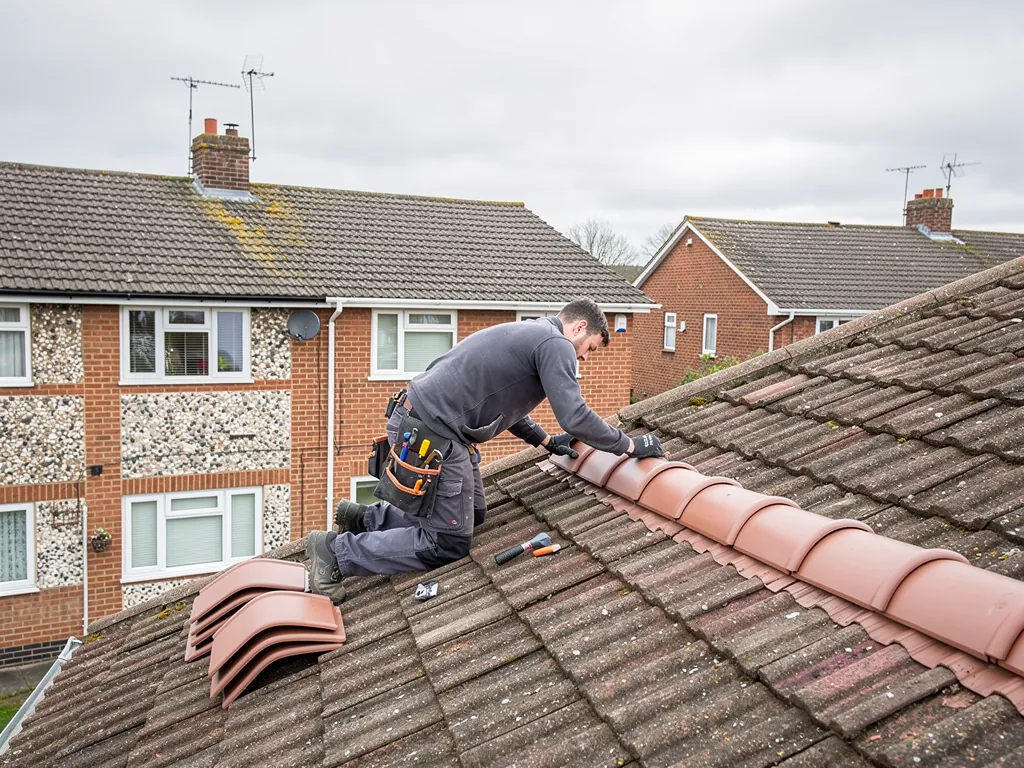
Roofer fixing new red ridge tiles along a concrete tile roof
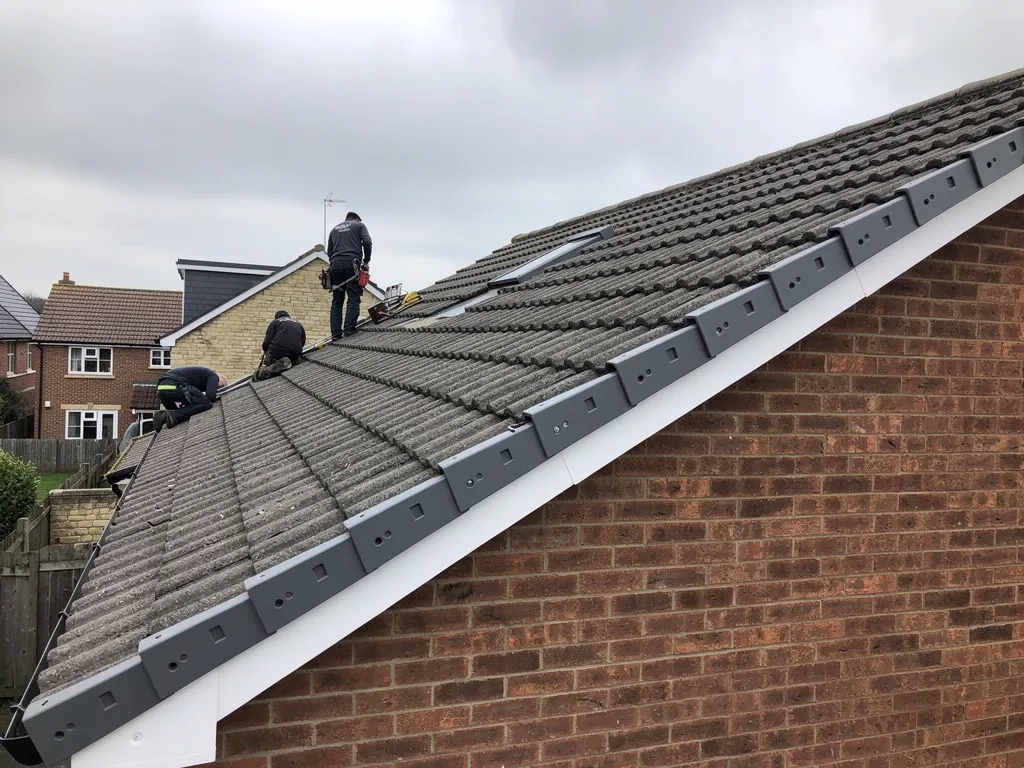
Grey dry verge units along the gable of a concrete tile roof

The short answer

Often, yes. Lambourn sits in a chalk valley on the Berkshire Downs, inside the North Wessex Downs National Landscape, and roofs with long ridges and open gable ends take the wind more than most. Since BS 5534 was revised in 2014, ridge and verge tiles also need mechanical fixings, so repairs add them.

The valley of the River Lambourn runs through open chalk uplands, and the village has plenty of roofs with long ridges, exposed gable ends and eaves that face the downs. Those are the places where wind lifts tiles first.

Why is mortar alone not enough?

Ridge and hip tiles have long been bedded on mortar. Since BS 5534 was revised in 2014, mortar alone no longer holds ridges and hips, with each tile also clipped or screwed down. That is why a re-bed on an old roof usually includes stainless fixings or a tested dry-fix system under BS 8612. Mortar is not banned. It is just no longer asked to do the whole job alone, and it still finishes the joint once the fixings are in. Our ridge, verge and dry-fix page explains the options.

What happens at verges and gable ends?

The verge, in trade language, is the sloping edge where a roof stops at a gable wall. On older houses it is often pointed in mortar that cracks and lets wind get under the tiles. A dry verge system or a properly bedded and fixed undercloak keeps the edge down and stops birds nesting under it.

What should be inspected before buying materials?

A quick look from the ground along the ridge line shows gaps, dropped tiles and a wavering ridge line. From the loft, daylight at the ridge or the verge confirms the problem. We use those two views, and then a close look from a ladder or a roof access system, before we recommend a repair.

The National Landscape designation does not alter these Building Regulations or standards. It matters mainly for dormers and similar additions, which stop being permitted development, and the council makes the planning decisions.

Our view

On an exposed ridge, a fixed tile outlasts a bedded one every time.

Questions from the Lambourn valley

Why do some Lambourn stable roofs leak at the gutter line?

Long ranges have long gutters, and a single blocked or sagging section sends water down the wall. Condensation under the eaves adds to it. We look at falls, outlets and brackets together, and repair the gutter run before suggesting any new covering.

Can you work around race days and early morning exercise?

Yes. We agree working hours with the yard in advance, keep noisy tasks away from the busy parts of the morning, and phase the job so that occupied boxes are the last to be opened. Tell us your timetable when you ask for a survey.

Do you cover Upper Lambourn, Eastbury and the villages along the valley?

Yes. Upper Lambourn, Eastbury and the other valley villages around Lambourn are within our area. The areas page lists every place we reach if your lane is not named here.

Is it worth repairing an old tiled roof near the market place?

Usually, while the tiles are sound. The weak points are mostly the ridge, flashings, battens and underlay, and all of them can be renewed while sound tiles are kept and re-laid. If tiles are crumbling across a whole slope, the photographs in your quote will show it.

Ask us about your roof

Tell us what’s happening and we’ll call you back.

  • Photos of what we find
  • A written quote
  • 10-year workmanship guarantee

Or call 01793 626096

Call Get a quote