New-build brick and render estate houses with grey tile roofs

Roofers in Chaddleworth

Roofwork in Chaddleworth for houses, cottages and outbuildings beneath the downs, from slipped tiles and leaking chimneys to full re-covers, planned around the village's conservation area and its exposed setting.

Chaddleworth's roofs, from church lane to downland edge

Old village roofs near a church tower
Around St Andrew's and the manor house

The parish church of St Andrew stands in the west of the village beside the manor house, Chaddleworth House. Older buildings tend to have been repaired and altered many times, so a roof can be a patchwork of different tiles, flashings and repairs from different decades. Our first task is to read that history from the ridge down, find which repairs are holding and which are hiding a fault, and plan the work so that nothing sound is removed for the sake of tidiness.

Cottage roof with a brick chimney stack
Cottages and houses on the village lanes

Beyond the church, Chaddleworth is a village of houses and cottages of several ages along its lanes, set below the southern slopes of the Berkshire Downs. Whatever the covering, the faults follow a pattern in homes like these: ridge tiles that rely on ageing mortar, lead flashings that have split at chimney stacks, valleys that fill with leaf litter, and gutters that spill because nobody has cleared them since autumn. A cottage roof can also carry more junctions than a modern one, since dormers, porches, rear wings and lean-tos each add a seam that must stay sealed, and every seam is a place where we look twice.

Outbuilding roofs on a rural plot
Outbuildings and parish ground

The parish reaches well beyond the village. Woolley is the site of a deserted medieval village, and Poughley has the remains of a medieval priory, which gives some idea of how far back the settlement goes. Today the parish includes farmhouses, converted buildings, stables, garages and sheds that all need a roof. Their coverings vary widely, from clay and concrete tile to profile sheeting and felt, and a survey that treats each roof on its own terms gives a clearer picture than assuming they all age at the same rate.

From Swindon out to the A338

Map showing Chaddleworth and central Swindon. 22 road miles east-south-east of central Swindon.

Distance
22 road miles east-south-east of central Swindon
Council
West Berkshire Council
Council
West Berkshire Council
Conservation area
Chaddleworth Conservation Area
Landscape
North Wessex Downs National Landscape

Chaddleworth roof questions

Is Chaddleworth's conservation area a barrier to a new roof?

Not for repairs. Renewing a covering like for like seldom calls for an application, though the boundary, and any plan to change material, are worth confirming with West Berkshire Council first.

How does a downland setting affect a roof?

Wind crossing open ground reaches the ridge, the gable edges and the eaves before anything else. We check how those are bedded and fixed first, since they carry the most strain.

Can one survey cover the house and the outbuildings?

Yes. We photograph every roof on the plot in one visit, and the written quote covers whichever buildings you want dealt with, so you can set priorities.

Q1

Why does a downland village like Chaddleworth wear its roofs hard?

Chimney stack taken down below roof level during removal
Blocked gutter full of leaves overflowing down a brick wall

The short answer

Chaddleworth lies below the southern slopes of the Berkshire Downs, where little stands between the wind and the roof edges. Those edges take the strain, so loosened tiles, failed bedding and lifted flashings tend to start there.

Chaddleworth sits just east of the A338, under the southern slopes of the Berkshire Downs, within the North Wessex Downs National Landscape. It is a quiet place, and an open one. Wind arriving across downland meets the roof edges first.

Why do ridges and verges lift under the downs?

The ridge is the top line where two slopes meet, and the verge is the roof's rafter-line edge at a gable wall. Both are normally bedded in mortar. With age the mortar cracks and crumbles, and a tile with no bedding left under it can lift in a single gust. Under BS 5534:2014, ridge and hip tiles also receive mechanical fixings, so mortar is no longer the only thing holding them. On an exposed roof, that second fixing is worth having, and we describe the choices on our ridge, verge and dry-fix page.

What do wind-driven rain and gutters do to eaves?

Eaves are where wind-driven rain is pushed under the lowest tiles. Gutters overloaded with leaves then spill down the wall and the fascia behind them softens. Chimneys stand out in the wind more than any other part of the building, so their pointing, flaunching (the mortar cap that seats the pots) and lead flashings receive a hard time. Our chimney repairs page explains the work in detail.

After a storm, a glance at the roof from the lane, binoculars in hand if you own a pair, can show a slipped tile or a gap in the ridge. Send a photograph our way and we will talk through the next step. If water is coming in, a leak gets our attention ahead of routine jobs, and the first aim is a dry, safe roof.

Wear in an exposed place is no mystery, and it is manageable. Keep the edges fixed, keep water moving off the roof, and keep an eye on the chimney. Between them, those three habits account for a great many of the repairs we are asked to do. A short annual look, or a survey every few years on an older roof, is the sensible way to catch the next problem while it is still small.


Q2

Should the old tiles on a Chaddleworth cottage be kept?

The answer

If they are sound, usually yes. Tiles can outlast the battens, nails and underlay beneath them, so the better route is often to strip a slope, renew what is tired underneath and relay the good tiles, topping up with matching ones. A fresh covering is for when the tiles themselves have failed.

A roof that leaks is not always a roof that needs replacing. A cottage in a village like Chaddleworth may be carrying tiles that have given long service and have more to give, resting on a structure that has aged faster than they have.

What gives way before the tiles do?

Timber battens soften where moisture sits. Old nails rust. Underlay, the waterproof sheet beneath the tiles, becomes brittle and tears. Lead around chimneys and in valleys splits at folds. The tiles themselves, clay especially, can last far longer than a rule of thumb suggests: the Building Conservation Directory points to clay-tiled roofs that are several hundred years old as proof that a life of around 60 years is not a reliable guide. Concrete tiles are often put at 30 to 60 years, with sources disagreeing.

How does stripping and relaying a slope work?

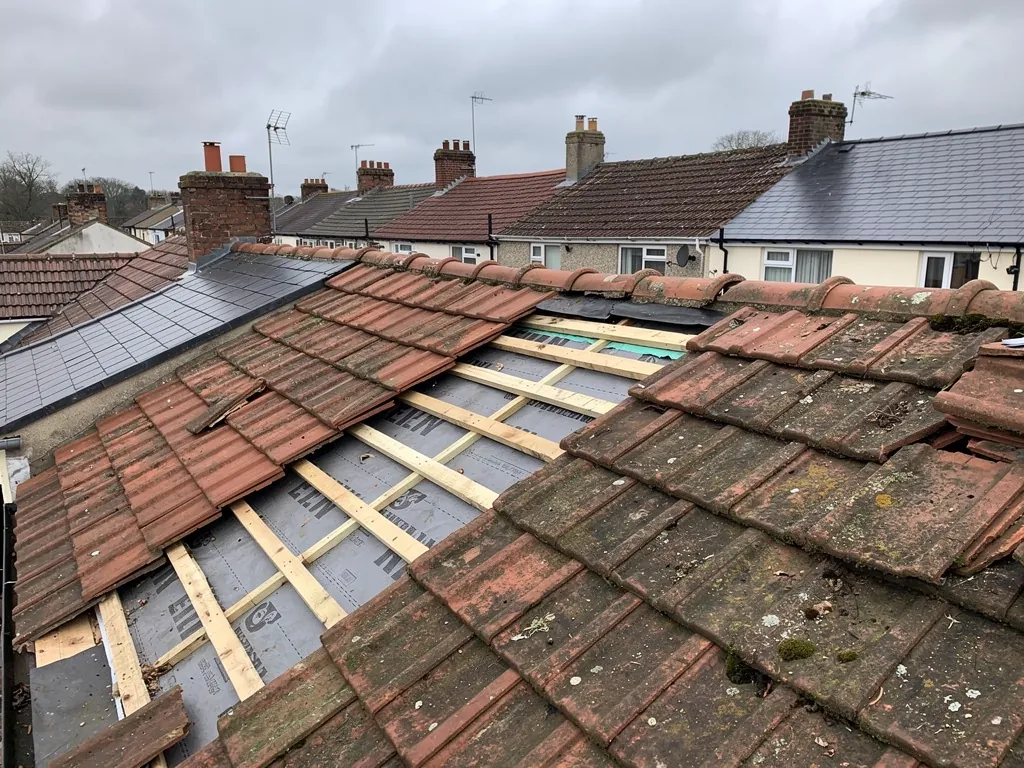
Where the tiles are good, we strip a slope, renew battens and underlay, and put the sound tiles back, adding matching ones where a few have cracked. The roof looks as it did and keeps working for years. When tiles are crazed, delaminating or cracked across a whole slope, fresh tiles are the right call, and our roof replacement page explains how that is planned.

Does a heavier tile change the roof structure?

Changing from clay to a heavier tile adds load. The Planning Portal says a covering 15 per cent or more heavier needs building control approval, so the roof structure should be checked before the choice is made.

You get the options alongside survey photographs and a written quote. We would rather fix the fault with the least work that does it properly, so a repair that is enough will be quoted as a repair.

Our view

Relay the sound tiles on fresh battens and underlay before paying for a whole new covering.

Q3

What permissions apply in Chaddleworth Conservation Area?

Clay tile roof opened to battens and membrane for repair
Rolled lead roof covering over a bay above white windows

The short answer

Chaddleworth is one of West Berkshire's conservation areas, with West Berkshire Council as the planning authority. Repairs in the existing material seldom need an application. A new material, or work on any listed building, should be checked with the council, and its boundary confirmed, before you order.

Chaddleworth Conservation Area appears on West Berkshire Council's own list of conservation areas, and the council's online map shows exactly where its boundary runs, so it is sensible to check whether your address falls inside the line before you plan anything beyond a matching repair.

What changes if you are inside the boundary?

Mending a roof, or renewing it in the covering it already has, counts as upkeep, and planning permission is not usually required. The council takes notice when the material differs, or when an alteration changes the roof's appearance from the lane. A listed house is a separate case, since listed building consent covers works that touch its character. The council can tell you whether a given house is listed, and we can help you put that question before pricing begins.

Does the National Landscape add rules?

The whole parish lies in the North Wessex Downs National Landscape. The partnership that looks after it advises on planning, but the council makes the decision. The status does not change the ordinary rules for repairing a roof.

When do Building Regulations apply in Chaddleworth?

A larger re-cover can trigger Building Regulations. The Planning Portal puts the dividing line at less than 25 per cent of the total building envelope along with less than 50 per cent of the roof, and a covering 15 per cent or more heavier also counts. Building Control Solutions serves West Berkshire Council, and a registered building control approver is the private option. We explain the consent and manage the notification where work is notifiable.

Protected species such as bats, and nesting birds, can use a rural roof space, so work stops while we take advice if we come across them. Farmhouses, stables and old barns are the likeliest places.

See our pitched roofing page for the larger re-covering jobs where these checks matter.

MythBeing in a National Landscape means the planners must approve every roof repair.

FactThe council decides, repairs that match the roof seldom need an application, and the landscape body gives advice only.

Questions from under the downs

Do roofs in Chaddleworth need ridge tiles fixed as well as bedded?

Yes, it is now the standard approach. Mortar alone is not relied on under BS 5534:2014, so tiles on ridges and hips are held with mechanical fixings too. In open country below the downs that second hold counts for more than it would in a sheltered lane, and we can fit a tested dry-fix system where a roof suits one.

What can you do with an outbuilding roof that has never been touched?

Look first. An outbuilding that has gone years unchecked may only need slipped sections refixed, or it may have rotten timbers under the covering. We photograph the roof, report what is there and quote for the work that the findings call for, whether the answer is patching or recovering.

Is there a church or manor house roof near the village centre you cannot touch?

We do not take on work uninvited, and anything affecting a historic building is first discussed with its owner and, where needed, the council. St Andrew's and Chaddleworth House stand beside each other in the west of the village, and both are for their owners to decide.

Can you reach Chaddleworth quickly after a storm?

A leak or storm damage gets attention ahead of routine work, and the first job is a dry, safe roof. Call 01793 626096 or send a photograph on WhatsApp, and we will advise on the safest next step for the roof and for the rooms beneath it.

Ask us about your roof

Tell us what’s happening and we’ll call you back.

  • Photos of what we find
  • A written quote
  • 10-year workmanship guarantee

Or call 01793 626096

Call Get a quote