Concrete tiled estate rooftops towards green hills

Roofers in Welford, Berkshire

Repairs, re-roofing, tall chimney stacks and low-slung extension roofs in Welford, from the older brick houses near St Gregory's to the newer homes spread along the River Lambourn.

Welford's roofs, from round tower to river meadow

Brick cottage roofs beside a village church
St Gregory's and the old village

St Gregory's is one of only two round-tower churches in Berkshire and has been Grade II* listed since 6 March 1985. Berkshire had no natural stone suitable for quoins, the corner stones of a building, and that shortage shaped how the tower was rebuilt. It is a useful reminder that this is brick and flint country rather than freestone country. Houses around the church are best approached with that in mind: their roofs sit on walls where lime, brick and old timber all move a little, and a repair must allow for it. Rigid, over-strong mortar on a ridge or chimney can crack the soft brick beneath it, so we choose materials gently and test a small area first where the brick is old.

Brick manor roof with tall chimney stacks
Welford Park and brick houses of its age

The brick manor house at Welford Park was built in the 1650s, with alterations in the 1690s and again in the 1830s, and it has decorative pilasters. A building altered in three periods is a roof with three histories: pitches that change, valleys where the phases meet, and chimney stacks added or rebuilt along the way. Brick houses built a generation or two either side of it, in this stretch of Berkshire, share some of that variety. Their roofs often combine plain clay tile, hips, parapet gutters and tall stacks. Each of those features is a place where water collects, so they are where our survey spends the most time.

Modern tiled homes in a river valley village
Along the Lambourn valley

Welford lies on both sides of the River Lambourn valley, northwest of Newbury, as a strip parish that narrows towards the south. Houses sit along the valley floor and the roads that climb out of it, from older terraces and farm buildings to later infill and newer estate-style homes. On the valley floor, where trees and neighbouring buildings shade the ground, shaded and sheltered plots hold damp, so moss and algae creep across north-facing slopes and gutters clog with leaves. On the rising ground the roofs are more exposed. Porches, garages and kitchen extensions with shallow or flat roofs have been added to many houses, and these little roofs often give up years ahead of the main slopes beside them.

Up the Lambourn valley from Newbury

Map showing Welford and central Swindon. 20 road miles east-south-east of central Swindon.

Distance
20 road miles east-south-east of central Swindon
Council
West Berkshire Council
Council
West Berkshire Council
National Landscape
North Wessex Downs
Setting
A strip parish astride the River Lambourn, northwest of Newbury

Welford roof questions

Is a Welford thatched or old-tiled cottage harder to repair?

Older roofs take more care, not more mystery. We read the earlier repairs, test the timbers and fix the specific fault before offering a larger job.

Will river-valley damp affect my gutters in Welford?

Often. Leaves, moss and wet ground load gutters and downpipes, so they are cleared and checked on a survey and replaced only where they fail.

Does West Berkshire need to approve a like-for-like re-roof?

Not normally. Matching repairs count as upkeep, whereas a listed house or a large re-covering follows other rules, and we tell you which one applies to yours.

Q1

What do roofs on Welford's older brick houses need?

Lead-lined valley gutter between two slate roof slopes
Weathered brick chimney stack with eroded joints and cracked pot

The short answer

Gentle materials and careful junctions. Brick houses of the 1600s and 1700s often have tiled hips, valleys, parapet gutters and tall stacks, and most leaks start where those features meet. Lime-based mortar, matching tiles and renewed lead usually serve these roofs better than strong, modern repairs.

Brick is a forgiving wall but an unforgiving place to put the wrong mortar. Welford Park, built in brick in the 1650s and altered in the 1690s and 1830s, is the village's grandest example, but the same lessons apply to ordinary houses of the period nearby.

Why do brick houses leak at the joints?

A brick house roof is simple in outline and complicated at its edges. The ridge is the horizontal crest. A hip is the angled edge between two faces of a hipped roof. A valley is the inside corner where two slopes meet and drain. A parapet gutter is a trough lined with lead that runs behind a low wall at the roof edge. Each depends on lead or mortar, and each wears. Cracks in a parapet or a split in a valley lining can let water into the wall head for months before anything shows indoors, and by then the timber beneath has been damp for a whole season.

Which mortar and tile suit old brick?

Hard cement mortar on soft old brick can force damp into the brickwork and spall its face. A lime-based mix flexes with the building. Replacement tiles are chosen to match the originals in size, colour and texture, and reclaimed tiles are sometimes the best fit.

Is a repair enough or does the roof need stripping?

Most repairs on these roofs are targeted ones: new tiles where they have cracked, lead renewed at a stack, valley liners replaced. Our pitched roofing page sets out where a repair stops being sensible. For a Welford house the survey photographs decide it: if the timber battens hold firm and most tiles are whole, a repair is the right answer, and a full strip is recommended only when the structure underneath has had its day. Either way you see the evidence before you decide.

Q2

Does the North Wessex Downs setting restrict roof work?

The answer

Not for ordinary repairs. The North Wessex Downs is a National Landscape that advises, while West Berkshire Council takes the planning decisions. Putting back matching material is not normally something that needs an application. Listed buildings, and any change to the appearance of a roof, are where a conversation with the council helps.

Welford falls within the North Wessex Downs National Landscape, and many owners wonder whether that label puts roof work under extra rules. The short answer is that it changes less than people expect.

What does National Landscape status mean?

Since November 2023 these designated areas have been called National Landscapes, although the legal protections are unchanged. The partnership for the North Wessex Downs describes its own part in planning as non-statutory and advisory, and says the main role belongs to the local planning authority. In Welford that authority is West Berkshire Council, and it is the body that grants or refuses an application.

Does it change repairs and re-roofing?

Re-laying the same covering is rarely a planning matter, and the designation leaves that alone. What it does mean is that the council will look more closely at any proposal that changes how a building sits in the landscape. Nothing about National Landscape status affects Building Regulations either, which apply to all roofs in the same way. Our skylights section covers the planning question that comes up most when new roof openings are proposed in protected places.

How do I check my own address?

Whether part of Welford is a conservation area is a question for West Berkshire Council's planning team, so put your address to them. They can also say whether your house is listed. Alterations affecting the special interest of a listed house need listed building consent, and a parish church such as St Gregory's, still in Church of England use, goes through the faculty system instead. For notifiable work, West Berkshire is covered by Building Control Solutions, with a registered building control approver as the private choice. We say which route your roof needs and deal with the notification.

In practice

Matching repairs go ahead as maintenance; changes to a roof's look go to West Berkshire Council.

Q3

How are old Welford chimney stacks kept sound?

Roofer repointing a stone chimney stack above lead flashing
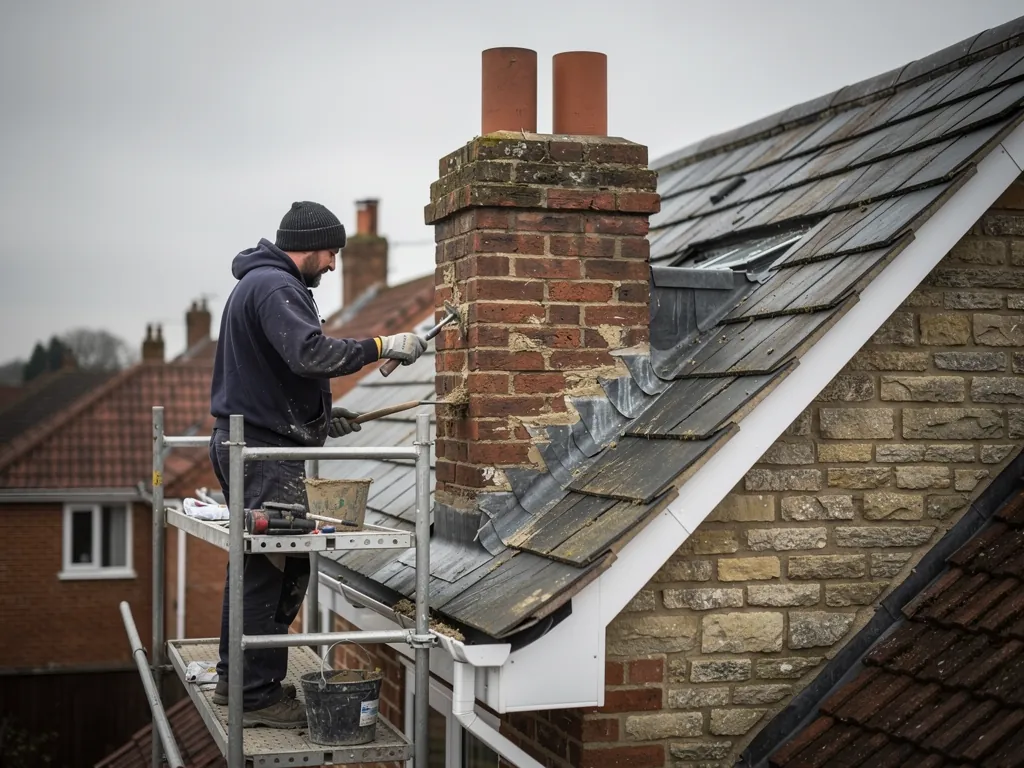
Roofer repointing a brick chimney stack from scaffolding

The short answer

By checking the pointing, flashings and pots together and repairing only what has failed. A tall brick stack takes rain on every face, so cracked pointing and worn lead usually explain a damp wall beneath it. Rebuilding comes last, and only when the brick itself has gone. In most cases the stack can be saved, which keeps both the cost and the look of the house intact, and the written quote after the survey says which applies.

Tall brick stacks are among the finest features of a house like Welford Park, and also among its main leak points. A stack stands in the weather on all four sides, and rain finds any gap in the pointing or the lead around it. Wind drives the water sideways into joints that look sound from the ground.

What does failed pointing do to a stack?

Pointing means the mortar joints between bricks. Once they wash out, water enters the stack and the brick faces start to flake, frost lifting them in cold snaps. Left alone, a stack can lean as its joints lose strength. Repointing in lime mortar, raking out only the loose joint and matching the finish, usually stops the problem. The brick itself is the part worth keeping wherever possible, because old handmade bricks cannot easily be matched.

Why does the lead at a stack let go?

The lead flashing where a stack meets the roof is the commonest source of a ceiling stain beside a chimney. Lead should be dressed into the mortar joints, not simply stuck to the brick with sealant, which fails within a few seasons. At the top, the flaunching, which is the mortar bed that grips the pots, cracks and lets water into the flues. We renew it with a proper fall so water runs off.

What do repairs cost and when is consent needed?

The prices below are national typical figures from MyBuilder, updated August 2026, with a lead patch figure from MyJobQuote. Removing a chimney breast always needs Building Regulations approval, and a shared wall brings a party wall notice into play too, so we explain those steps before pricing the work. Our chimney repairs page sets out the options in full.


What it typically costs

  • Chimney flashing repair£250 to £1,200
  • Chimney repointing£500 to £2,000
  • Lead patch repair£150 to £250 MyJobQuote
Typical national figures only. Access, stack height and condition fix the price for your own chimney. MyBuilder chimney repair guide, updated 21 August 2026; MyJobQuote leadwork guide, September 2026.

Questions from the river meadows

Why do Welford's older roofs have so many chimney stacks and hips?

Because brick houses of that era were built with several fireplaces and often with hipped roofs, and later alterations added more. Welford Park shows the pattern: a house altered in three periods collects stacks, valleys and junctions. Each is something we photograph, so you can see the condition of every one.

Do you mend the flat roofs on Welford extensions and garages?

Yes. Garage, porch and kitchen roofs with flat or shallow pitches are common in a valley village. A local fault is mended with a patch where that will last, and we recommend a full replacement in EPDM (a synthetic rubber membrane) or another system only when the deck or covering has finished its life.

Do you cover Newbury and the villages near Welford?

Yes. Newbury, Great Shefford, Boxford and the villages down the valley all lie within 30 road miles of Swindon. Our areas page names them, and a quick call or an enquiry form with your address will confirm yours.

What guarantee do you give on roof work here?

Our workmanship carries a written ten-year guarantee. That is a commitment from us about the job itself, separate from any manufacturer warranty, and not backed by insurance. At the end of the job we sweep up, remove all the waste and leave the garden and drive tidy.

Ask us about your roof

Tell us what’s happening and we’ll call you back.

  • Photos of what we find
  • A written quote
  • 10-year workmanship guarantee

Or call 01793 626096

Call Get a quote