Brick end-of-terrace gable beside a limestone house, slate roofs

Roofers in Newbury

Cloth Hall timbers, terraces beside the towpath, estate houses and the flat roofs behind the shops: we repair and replace roofs of every sort across Newbury.

Newbury's roofs, from Cloth Hall to canal bank

Timber-framed building with old tiled roof
The old market core

Newbury was founded as a borough in the late eleventh century, and cloth made its fortune. The town centre still keeps the Cloth Hall, built in 1626 and 1627 and now Grade I listed, with an adjoining half-timbered granary, and St Nicolas Church, a fifteenth-century Perpendicular building completed in 1532, stands close by. Roofs in a core like this sit on old frames, with timber that has moved over centuries, so ridges are rarely straight and valleys rarely meet where a modern drawing would put them. Repairs here need patience: finding where water is getting into an old timber structure, and fixing it in a way that does not stress the frame or hide a problem behind new work.

Terrace roofs with chimney stacks
Canal and railway streets

The Kennet and Avon Canal was completed in 1810 and the railway arrived in 1847, and between them they pulled new building into Newbury. Terraces and villas from this period typically have pitched roofs, chimney stacks shared between neighbours, valleys lined with lead and gutters tucked behind parapets or built into the eaves. Those details age in predictable ways. Lead flashings crease and split, shared stacks lose their pointing, and concealed gutters block and overflow into the wall rather than away from it. Because the Kennet and Avon Canal runs through the town centre, some of these buildings stand low and near water, which makes sound drainage from the roof more important.

Flat commercial roofs above a town centre
Modern estates and commercial roofs

With a population of over 33,000, Newbury is a large town, and much of its roof stock is far newer than the centre. Houses on later estates carry concrete or clay tiles on lighter timbers, and their faults tend to be ridges and verges, worn felt underlay and flashings at dormers and extensions. Newbury is also a working town, with shops, offices and units whose roofs are flat or low-pitched. These depend on drainage, membrane condition and clear outlets, and a failed membrane over an occupied floor needs to be dealt with promptly and tidily, with as little disruption to the business below as possible. Where a leak is active, the first visit makes it safe.

Out along the Kennet to Newbury

Map showing Newbury and central Swindon. 25 road miles east-south-east of central Swindon.

Distance
25 road miles east-south-east of central Swindon
Council
West Berkshire Council
Conservation areas
Town Centre, Shaw Road and Crescent, Shaw House and Church, Stroud Green and Donnington Square
Setting
Market town in the River Kennet valley, on the edge of the Berkshire Downs

Newbury roof questions

Is a house near the Kennet and Avon Canal in a conservation area?

It may be. West Berkshire Council's records list several in Newbury, the town centre among them. Ask the council where the line runs before you change what a roof looks like.

Do you repair roofs on shops in Newbury town centre?

Yes. Shop and office roofs are surveyed for drainage and membrane condition first, and the plan is made around access so that trading can carry on below.

Do half-timbered buildings need a different kind of roof repair?

They need a gentler one. The frame moves, so repairs avoid rigid fixings or heavy materials that would load it, and the survey checks the timbers as well as the covering.

Q1

What lies under the roofs near Newbury's Cloth Hall?

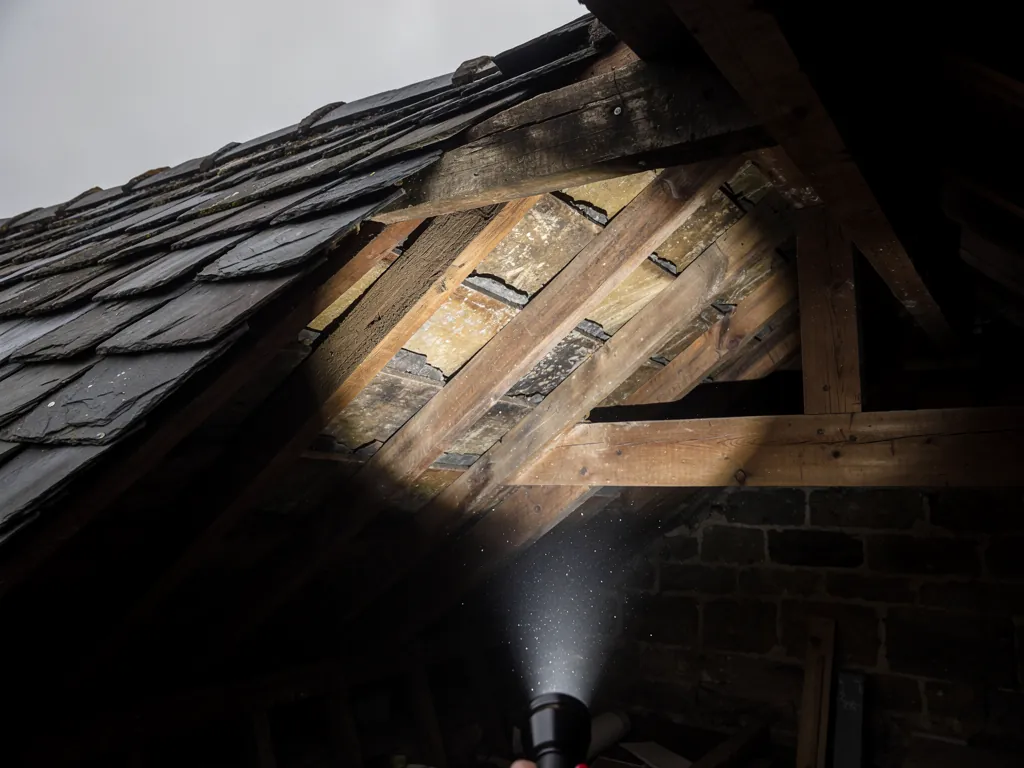
Torch showing a water-stained rafter beneath slates in a loft
Torch beam lighting slate undersides and timbers in a loft

The short answer

Old timber frames, in most cases adapted many times. Around the Cloth Hall and its half-timbered granary, a roof is often only as sound as the frame beneath it, so checking timbers, joints and earlier repairs matters as much as replacing a missing tile.

A medieval market town leaves its mark in the roofs. The Cloth Hall and granary are rare survivors, and the buildings around them, even where later, tend to share the same habits: irregular timbers, uneven lines and a history of alteration. Anyone repairing them is working with that history, not against it.

Why do old timber-framed roofs leak in odd places?

Water follows the structure. A frame that has twisted a little over generations opens gaps where roof meets wall, and rain that gets in can run along a beam a long way before showing up as a stain somewhere surprising. We therefore trace a leak from the inside as well, looking along rafters and wall plates, before deciding where to repair. The loft, where there is access, tells us more than the outside alone.

Can a new covering be laid on an old frame?

Sometimes, but weight and fixing both matter. A new covering far heavier than the old one loads timbers never meant to carry it, and Approved Document A treats anything more than 15 per cent heavier as a point to check. Where a frame is tired, we may recommend strengthening or replacing particular timbers rather than a full new roof. That is a smaller and kinder job, and the survey photographs show exactly which timbers we mean.

What happens around the church?

Take St Nicolas: while Anglican services continue, the ecclesiastical exemption covers the building, and any change is settled through a faculty rather than listed building consent. Houses and shops near the church do not share that exemption, and the work on them follows the ordinary rules, which is why a survey comes before any promise about consent. For those, roof repairs that keep to the existing materials and method are usually the simplest route.

Wherever we work in the centre, we keep the site tidy and take the waste away when the job is done. Narrow streets and busy pavements mean we plan deliveries and scaffold positions with the neighbours in mind, so that shopfronts and doorways stay clear.


Q2

How are Newbury's flat and shop roofs looked after?

The answer

By drainage first, membrane second. Newbury's town-centre flat roofs tend to fail where water cannot leave: blocked outlets, ponding and split upstands. Clear outlets, sound edges and a membrane suited to the roof's use are the main points, and a survey shows which of them is the problem.

Behind the shop fronts and above the offices, a good deal of Newbury's roofing is flat or low-pitched. These roofs have little margin for error, because water that sits on them finds every small weakness in the covering.

Why does water pond on a flat roof?

Flat roofs need a fall, a slight slope, so water runs towards an outlet. Over time structures settle, insulation compresses and boards sag, and the fall flattens or reverses. Water then pools in the low spots. A shallow pool is not always a fault by itself, but standing water speeds up ageing in a membrane, and a pool that stays for days is worth acting on. Our page on flat roofing explains the materials and how a lasting repair is made.

Is a repair or a full replacement right?

A repair is the right call where the membrane is healthy and the trouble is a split seam, a lifted upstand or a choked outlet. Where the covering has aged all over, patching only moves the leak from one spot to the next. We tell you which applies and why, using photographs of the roof itself.

Does the building have to close while the roof is done?

Usually, with planning. Our commercial roofing work is arranged around how the building is used, with access routes, noise, hours and safety discussed beforehand. A written quote follows the survey and spells out the job. If you are weighing more than one quote, find out whether each includes VAT and scaffolding, since both move the total.

On roofs above occupied rooms, protecting the interior comes first, and a leak is made safe before the permanent repair is started.

Common flat-roof faults on town-centre buildings
SymptomUsual causeTypical response
Standing waterLost fall or a blocked outletClear the outlet, check the fall
Stain below a parapetFailed upstand or flashingRe-form the edge and replace the flashing
Blistered surfaceMoisture trapped in the layersOpen, dry and patch if the rest is sound
Overflowing gutterBlocked or undersized outletClear it, then review capacity
Q3

Who approves a roof job in Newbury?

Brick and limestone cottages around a small village green
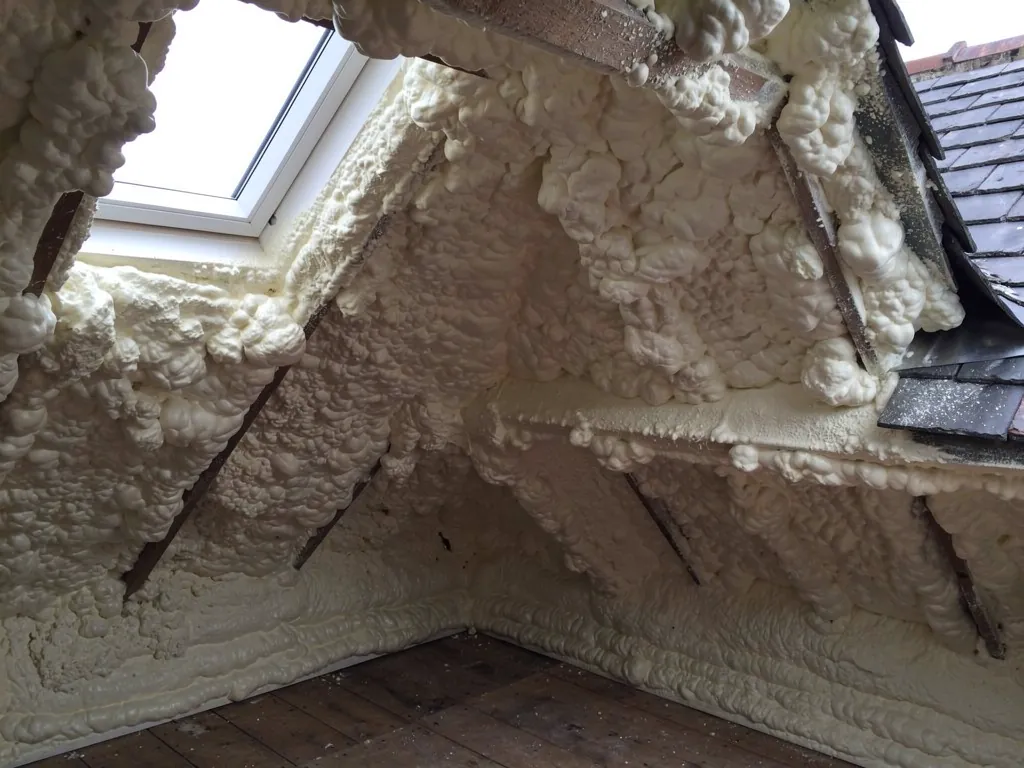
Loft thickly coated in white spray foam around a roof window

The short answer

Newbury is in West Berkshire, so planning questions go to West Berkshire Council, which records conservation areas in the town centre and around Shaw. Notifiable work needs a building control body: Building Control Solutions serves West Berkshire Council, or you can use a registered approver.

Most roofing work in Newbury needs no formal application. Swapping a few damaged tiles, renewing a flashing or bedding a ridge afresh is plain repair. Three things can turn it into a regulatory matter.

When does Newbury work need building control?

The Planning Portal draws the line at 25 per cent of the total building envelope and 50 per cent of the roof. Work that remains inside both limits does not normally need an application. Exceed either and approval applies, which can mean upgrading the thermal performance of the roof as well. Building Control Solutions serves West Berkshire Council, and you can also appoint a registered building control approver. Whichever applies, we explain what the job needs and send in the notice for you.

Do Newbury's conservation areas restrict roofs?

West Berkshire Council's records show conservation areas at Newbury Town Centre, Shaw Road and Crescent, Shaw House and Church, Stroud Green and Donnington Square. Repairing a roof to match what is there rarely calls for an application, but a different covering material, roof windows facing the street or alterations to a chimney need a conversation with the council first. Our roof window planning page explains how those rules work.

What about the Cloth Hall and other listed buildings?

The Cloth Hall is Grade I listed, and other historic buildings in the centre may carry statutory protection too. On any listed building, alterations to its character need consent before work starts, and a different roofing material is an obvious case. The council can confirm a building's status, and it is sensible to ask before accepting a quote.

If you manage a building with several occupants, the survey and the written quote give you a clear record to share with them. The quote is a total price, and it follows the survey photographs.

Our view

In Newbury, check the council's conservation areas first, and the rest of the process falls into place.

Questions from the Kennet valley

Why do roofs near the Kennet and Avon Canal need good drainage?

The canal runs through the town centre, and buildings near water and low ground cannot afford to hold rain on the roof or at the wall. Clear gutters, working outlets and downpipes that discharge away from the foundations matter more here than the colour of the tile, and they cost far less to keep right than to repair after the damage is done.

Are Newbury's Victorian roofs usually slate?

Many streets built after the railway arrived in 1847 have slate, clay tile or a mixture, so we identify the covering on your own house rather than assume it. Slate faults tend to be rusted nails and tired lead. Clay tile faults tend to be cracked or spalled tiles and failing ridge bedding.

What is a concealed gutter and why does it leak?

It is a gutter built into the roof or behind a parapet wall, so it cannot be seen from the street. Leaves and silt block it, the lining ages, and water overflows into the wall. Cleaning and relining it is much smaller than re-roofing, which is why it is the first thing we check.

Do you cover Newbury, Speen, Donnington and the villages around?

Yes. The town is inside the 30-road-mile area we cover from Swindon. Speen, Donnington, Shaw, Greenham and Thatcham are all close by. Our 10-year workmanship guarantee is in writing on every job, and the areas page lists every place.

Ask us about your roof

Tell us what’s happening and we’ll call you back.

  • Photos of what we find
  • A written quote
  • 10-year workmanship guarantee

Or call 01793 626096

Call Get a quote